
VIS-110 · Lesson 2 of 12 · 24 min
How light behaves: reflection, refraction, absorption and scattering
Almost nothing we photograph emits its own light. We see and record objects because light from the sun, a lamp or the sky strikes them and some of it reaches the lens. What happens at each surface, whether light bounces off, passes through, bends, is absorbed or is scattered, determines the color, texture, shine and transparency of everything in an image. Understanding these interactions lets an image maker predict how a subject will look under a given light, control reflections and glare, choose modifiers, and use filters intelligently. This lesson covers specular and diffuse reflection, absorption and the color of objects, transmission and translucency, refraction and its consequences in lenses and nature, scattering in the atmosphere, diffraction, polarization and polarizing filters, and the ideas of subsurface scattering and the Fresnel effect that shape how skin, liquids and glossy surfaces appear.
Reflection
When light meets a surface, part of it reflects. The kind of reflection depends on the surface texture compared with the wavelength of light:
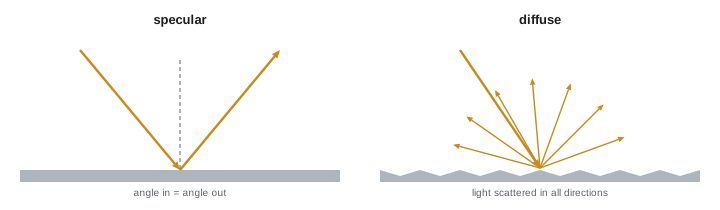
- Specular reflection occurs on smooth surfaces such as mirrors, still water, polished metal and glossy paint. Light reflects at an angle equal to the angle at which it arrived (the law of reflection: angle of incidence equals angle of reflection), producing a mirror image of the source called a specular highlight. Because the reflection follows a fixed angle, the highlight moves as the camera or light moves.
- Diffuse reflection occurs on rough or matte surfaces such as paper, unpolished wood, fabric and skin. Microscopic roughness scatters light in many directions, so the surface looks similar in brightness from different viewpoints and shows no mirror image of the source.
Most real surfaces mix both: a glossy apple shows a diffuse red body and a small white specular highlight; skin shows a diffuse base with specular shine on the forehead and nose. Controlling the balance, for example softening shine with powder or polarizers, or emphasizing gloss for product shots, is a constant task in lighting.
The law of reflection gives a practical tool: to avoid a reflection of a light in glass, a picture frame or eyeglasses, move the light so the reflected angle does not reach the lens, or move the camera. For product photography of reflective objects, photographers deliberately place large light sources where their reflections will define the shape of the object, a technique called lighting the reflection.
Absorption and the color of objects
The light a surface does not reflect or transmit is absorbed, usually becoming heat. Objects have color because they absorb some wavelengths more than others. A red apple absorbs most blue and green light and reflects mostly red; a white sheet reflects most wavelengths about equally; black velvet absorbs nearly everything. Dark surfaces heat up in sunlight because they absorb more energy, which matters for equipment and for black flags and cloth used near hot lights.
An object's color therefore depends on the light illuminating it. Under a light lacking red wavelengths, such as a sodium street lamp emitting mainly yellow-orange or some cheap LEDs with weak red output, a red object can look dull brown or gray, because there is little red light for it to reflect. This is why color rendering of light sources matters (Lesson 7).
Reflectance describes the fraction of light a surface reflects. Fresh snow reflects about 80 % to 90 %, a typical middle gray card is designed to reflect about 18 % (Lesson 11), average skin roughly 25 % to 40 % depending on tone, green grass perhaps 10 % to 20 %, and black velvet a few percent or less. These differences explain why metering a scene full of snow or black fabric can mislead an automatic exposure system.
Transmission and translucency
Some materials let light pass through. Transparent materials such as clear glass, water and acrylic transmit light with little scattering, so objects can be seen clearly through them. Translucent materials such as frosted glass, tracing paper, diffusion fabric, leaves and thin skin transmit light but scatter it, so shapes behind them are blurred. Translucency is the principle behind diffusion materials used to soften light (Lesson 4): a sheet of diffusion fabric in front of a hard light becomes a larger, softer source. Colored transparent materials, such as stained glass, theatrical gels and colored liquids, transmit some wavelengths and absorb others. Backlit translucent subjects such as leaves, petals, ears and drinks glow attractively, a look image makers use deliberately.
Refraction
Light slows down when it enters a denser medium such as glass or water, and if it enters at an angle, it changes direction: refraction. The amount of bending depends on the refractive index of each medium (about 1.0 for air, 1.33 for water and roughly 1.5 to 1.9 for optical glasses) and is described by Snell's law, n₁ sin θ₁ = n₂ sin θ₂. Refraction is how lenses work: curved glass surfaces bend light rays so they converge to form an image.
Refraction also explains everyday effects: a straw appears bent in a glass of water, swimming pools look shallower than they are, and heat shimmer over hot roads distorts distant objects because layers of air with different temperatures have slightly different refractive indices. Underwater photographers must account for refraction at the camera housing port: a flat port makes objects appear larger and narrows the field of view, while a dome port corrects for this.
Because the refractive index varies slightly with wavelength, different colors bend by different amounts: dispersion. A prism separates white light into a spectrum, and rainbows form when sunlight refracts and reflects inside raindrops. In lenses, dispersion causes chromatic aberration, color fringes at high-contrast edges, which lens designers reduce with combinations of glasses, including low-dispersion elements, and which can also be corrected in software.
Worked problem
Apparent depth of water
A rock lies 1.33 m below the surface of a clear pond. Viewed from directly above, how deep does it appear? (For near-vertical viewing, apparent depth ≈ real depth ÷ refractive index.)
Show solution
- Refractive index of water: about 1.33.
- Apparent depth ≈ 1.33 ÷ 1.33 = 1.0 m.
- The rock appears about a third closer to the surface than it really is.
Answer: About 1.0 m. This is why underwater subjects look closer and larger, and why focusing through water requires care.
Scattering in the atmosphere
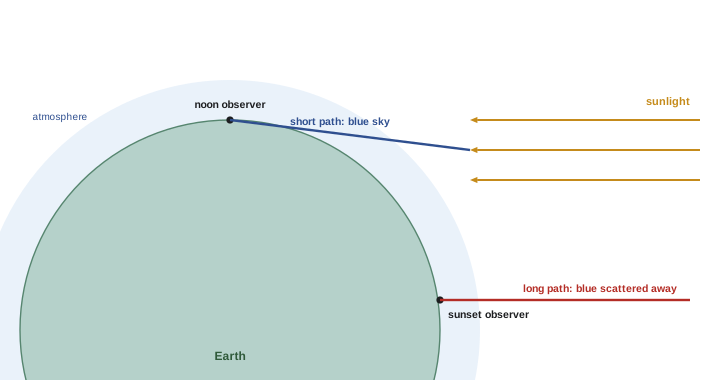
Small particles scatter light. Air molecules, much smaller than the wavelength of light, scatter short wavelengths far more strongly than long ones (Rayleigh scattering, proportional roughly to 1/λ⁴). This is why the clear sky is blue: blue sunlight is scattered across the sky toward us from all directions. At sunrise and sunset, sunlight travels through much more atmosphere, so most blue is scattered away before reaching us, and the direct sun and the light it casts become warm orange and red.
Larger particles such as water droplets in clouds, fog and haze scatter all wavelengths about equally (Mie scattering), so clouds and fog look white or gray and soften contrast. Haze reduces contrast and saturation with distance, creating aerial perspective: distant hills look lighter and bluer, which painters and photographers use to convey depth. Smoke and haze machines on film sets exploit scattering to make light beams visible and to add atmosphere.
Diffraction
When light passes through a small opening or past an edge, it spreads slightly: diffraction. In photography, diffraction limits sharpness at small apertures. Stopping a lens down from f/8 to f/22 increases depth of field but spreads each point of light into a larger blur (the Airy disk), softening fine detail, especially on high-resolution sensors with small photosites. Each lens and sensor has a range of apertures where sharpness is best, often around f/5.6 to f/8 on full-frame cameras. Diffraction at the blades of the aperture also creates the starburst effect around bright points of light at small apertures.
Polarization
Light waves oscillate in directions perpendicular to their travel. Ordinary sunlight and lamplight are unpolarized, oscillating in all such directions. Reflection from non-metallic surfaces such as water, glass, leaves and paint partially polarizes light, strongly so at a particular angle (Brewster's angle, about 53° from perpendicular for water and 56° for glass). Light from the blue sky is also polarized, most strongly at 90° from the sun.
A polarizing filter passes light oscillating in one direction and blocks light oscillating at right angles. Rotating a circular polarizer on a lens can remove reflections from water and glass (revealing what lies beneath or behind), cut glare from foliage to increase color saturation, and darken a blue sky at 90° from the sun. Cinematographers and product photographers use polarizers on both lights and lenses (cross-polarization) to eliminate specular reflections entirely, for example when photographing artwork or reducing shine on skin. Polarizers cost one to two stops of light, can make wide-angle skies look uneven, and do not remove reflections from bare metal, which does not polarize light.
Subsurface scattering and the Fresnel effect
Two further effects strongly influence how real materials look. In subsurface scattering, light enters a translucent material, scatters inside, and exits at a different point, giving skin, wax, marble, milk and leaves their soft glow; it is why skin lit from behind glows red at the edges and why harsh light on skin looks less harsh than on plaster. In the Fresnel effect, surfaces reflect more light at grazing angles than when viewed straight on: a lake reflects the sky strongly near the horizon but lets you see into the water at your feet, and the edges of a glossy object show stronger reflections. Computer graphics and modern visual effects simulate both effects to make digital materials look real, and image makers who notice them can light real materials more convincingly.
Using material properties in practice
Knowing how materials interact with light helps solve everyday problems. Glossy magazine pages and framed artwork reflect lights into the lens, so lights are placed at angles where their reflections miss the camera. Glassware is often lit from behind through diffusion, so its edges appear as dark or bright outlines. Water in a glass glows when backlit. Metal objects reflect their surroundings rather than showing their own color, so photographers surround them with white and black cards to create clean reflections that describe their shape.
When something in an image looks wrong, a strange color cast, an unwanted reflection, a soft or fringed edge, a washed-out distant landscape, the cause can usually be traced to one of the interactions in this lesson. Identifying which one is the first step to fixing it, whether by moving a light, changing the angle, adding a filter, choosing a different aperture or waiting for different atmospheric conditions.
Common mistakes
MistakePlacing lights where their reflections hit the lens in glass or glasses.
InsteadUse the law of reflection to move lights or camera.
MistakeExpecting colored objects to look right under any light.
InsteadCheck the light source spectrum and color rendering.
MistakeStopping down to f/22 for maximum sharpness.
InsteadRemember diffraction softens detail at small apertures.
MistakeUsing a polarizer to remove reflections from bare metal.
InsteadPolarizers work on non-metallic reflections.
MistakeIgnoring haze when shooting distant landscapes.
InsteadUse haze for depth or reduce it with timing and filters.
Summary and key terms
- Specular reflection follows the law of reflection; diffuse reflection scatters light in all directions.
- Objects have color by absorbing some wavelengths and reflecting others; reflectance varies widely.
- Transparent materials transmit clearly; translucent ones scatter and soften light.
- Refraction bends light, enabling lenses; dispersion causes rainbows and chromatic aberration.
- Rayleigh scattering makes skies blue and sunsets warm; larger particles cause white haze and fog.
- Diffraction softens images at small apertures.
- Polarization lets filters cut reflections and glare; subsurface scattering and the Fresnel effect shape materials.
- Specular reflection
- Mirror-like reflection from smooth surfaces.
- Diffuse reflection
- Scattered reflection from rough surfaces.
- Reflectance
- The fraction of light a surface reflects.
- Translucency
- Transmission of light with scattering.
- Refraction
- Bending of light as it changes medium.
- Refractive index
- A measure of how much a material slows and bends light.
- Dispersion
- Variation of refraction with wavelength.
- Rayleigh scattering
- Scattering by small particles, stronger for short wavelengths.
- Diffraction
- Spreading of light at edges and small openings.
- Polarizing filter
- A filter passing light oscillating in one direction.
Practice problems
Work each problem on paper first, then reveal the answer to check.
State the law of reflection.
Show answer
The angle of incidence equals the angle of reflection.
Why does a matte surface show no mirror image of a light?
Show answer
Its roughness scatters light in many directions.
Why might a red car look brown under a street lamp?
Show answer
The lamp emits little red light for it to reflect.
What reflectance is a standard gray card?
Show answer
About 18 %.
What makes diffusion fabric soften light?
Show answer
It transmits and scatters light, enlarging the source.
What is the refractive index of water?
Show answer
About 1.33.
What causes chromatic aberration?
Show answer
Dispersion: different wavelengths focus at different points.
Why is the sky blue?
Show answer
Air molecules scatter blue light more strongly (Rayleigh scattering).
Why are images softer at f/22?
Show answer
Diffraction spreads points of light.
Name three uses of a polarizing filter.
Show answer
Remove water and glass reflections, cut foliage glare, darken blue sky.
Lesson quiz · 5 questions
Score 60% or more to complete this lesson.
Create a free account to save your progress, take quizzes and earn a certificate.