
VIS-101 · Lesson 7 of 12 · 35 min
Depth and perspective
A photograph or film frame is flat, but the world it shows is not. Much of the craft of composition lies in creating a convincing sense of depth, drawing the viewer into the scene rather than presenting a flat arrangement of shapes. This lesson covers the visual cues the brain uses to perceive depth, linear perspective and vanishing points, how camera position and focal length shape perspective, depth of field as a tool for separating planes, and layering foreground, middle ground and background.
Depth cues
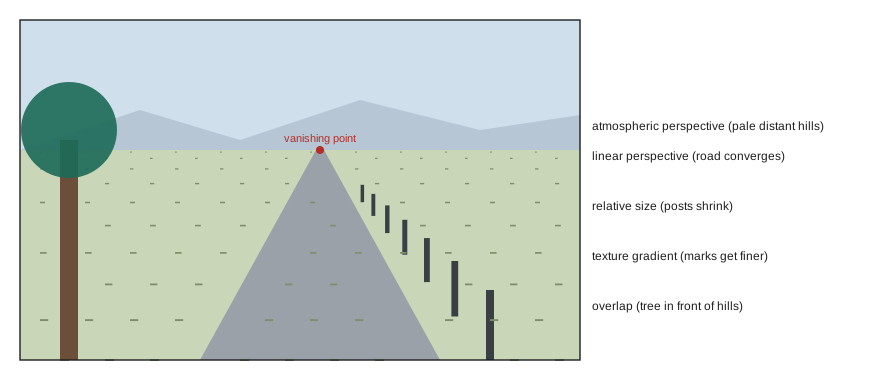
With two eyes, people judge depth partly from the slightly different view each eye receives (binocular disparity). Flat images cannot use this cue, so they rely on monocular cues that work with one eye, which painters discovered over centuries:
- Overlap (occlusion): an object that covers part of another is in front of it. The strongest single depth cue.
- Relative size: identical objects look smaller when farther away, so a row of trees or people shrinking into the distance creates depth.
- Linear perspective: parallel lines in the world, such as rails, roads or building edges, converge toward a vanishing point.
- Height in the frame: objects on the ground that are farther away appear higher in the frame, closer to the horizon.
- Atmospheric (aerial) perspective: distant objects look paler, lower in contrast and bluer because of haze. Fog and smoke exaggerate it.
- Texture gradient: surfaces such as grass, cobblestones or waves show finer texture with distance.
- Light and shadow: shading reveals form, and cast shadows place objects on surfaces.
- Focus: limited depth of field blurs planes in front of and behind the subject, separating them.
- Motion parallax (in moving images): nearer objects move across the frame faster than distant ones as the camera moves.
Size and distance
The size of an object in an image is inversely proportional to its distance from the camera. For an object of height \(h\) at distance \(d\), photographed with a lens of focal length \(f\), the height of its image on the sensor is approximately:
This simple relation explains why foreground objects can dominate a frame: a person 2 m from the camera appears five times as tall as an identical person 10 m away.
Worked problem
Relative size
Two people of the same height stand 3 m and 12 m from the camera. How do their image heights compare? With a 50 mm lens, how tall is the image of a 1.75 m person at 3 m, on a 24 mm tall sensor?
Show solution
- Ratio: \(12/3 = 4\), so the nearer person appears four times as tall.
- Image height: \(50 \times 1750/3000 = 29.2\) mm.
Answer: The near person appears four times as tall. At 3 m with a 50 mm lens, their image is 29 mm tall, more than the 24 mm sensor height, so they would not fit fully in a horizontal frame; the photographer would step back to at least \(50 \times 1750/24 = 3650\) mm, about 3.7 m, or use a wider lens.
Linear perspective
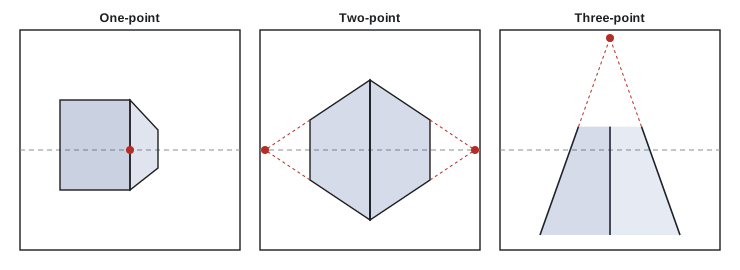
Linear perspective, formalized by Renaissance artists such as Filippo Brunelleschi and Leon Battista Alberti in the fifteenth century, describes how parallel lines in the world appear to converge. All lines parallel to each other (and not parallel to the image plane) meet at a vanishing point. Lines parallel to the ground meet at vanishing points on the horizon line, which is always at the height of the camera (the viewer's eye level).
- One-point perspective: when the camera faces a set of parallel lines head-on, such as looking straight down a corridor, road or railway, they converge to a single vanishing point, often near the center. It creates strong, symmetrical depth.
- Two-point perspective: when the camera faces the corner of a building, its horizontal edges converge to two vanishing points on the horizon, left and right, while vertical edges stay vertical (if the camera is level).
- Three-point perspective: when the camera tilts up or down, vertical lines also converge, to a third vanishing point above or below. Looking up at a tall building makes it taper upward ("converging verticals"), which can look dramatic or simply wrong depending on intent.
Worked problem
Camera height and the horizon
A photographer stands on flat ground with the camera 1.6 m high, level. A child 1.2 m tall and an adult 1.8 m tall stand at various distances. Where does the horizon cross each of them in the image?
Show solution
- The horizon is at camera height, 1.6 m above the ground, at every distance.
- It crosses the adult at 1.6 m, around the eyes, and passes above the child's head.
Answer: The horizon passes through every adult's eyes (at 1.6 m) regardless of distance, and above every child. Lowering the camera to 1.2 m would put the horizon at the children's head height, showing their world from their eye level. Camera height therefore determines how subjects relate to the horizon and to each other.
Camera position, focal length and perspective
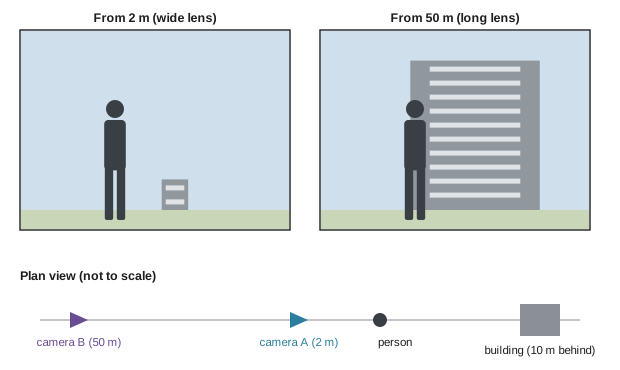
A common misconception is that wide-angle lenses "distort" perspective and telephoto lenses "compress" it. Perspective, the relative sizes and positions of objects, depends only on where the camera is. Focal length determines only how much of the scene is included (the field of view). What changes in practice is that photographers move closer with wide lenses and farther away with long ones, and that change of distance changes perspective.
- Close with a wide lens: nearby objects become very large relative to distant ones, exaggerating depth and distances. Faces photographed close up look distorted, with large noses, which is why portraits are usually taken from farther away with longer lenses.
- Far with a long lens: the ratio of distances between near and far objects becomes small, so they look similar in size and close together, "compressing" the scene. Long lenses make background mountains loom behind a subject and crowds look packed.
Worked problem
Why telephoto appears to compress
A person stands 10 m in front of a building. Compare the apparent size ratio of building to person when photographed from 2 m in front of the person (wide lens) and from 50 m in front of the person (long lens).
Show solution
- From 2 m: person at 2 m, building at 12 m. Building appears scaled by \(2/12 = 0.17\) relative to its size at the person's distance.
- From 50 m: person at 50 m, building at 60 m; scale \(50/60 = 0.83\).
Answer: From 2 m, the building is shrunk to 17% of the size it would have beside the person; from 50 m, to 83%. Shot from far away with a long lens, the building looms behind the person; shot close with a wide lens, it recedes. Choose distance to set perspective, then focal length to frame the shot.
Field of view is set by focal length and sensor size. For a sensor of width \(w\) and focal length \(f\):
A 50 mm lens on a full-frame sensor (36 mm wide) has a horizontal field of view of about 40°, similar to the central attention area of human vision, which is why it is called a "normal" lens. Smaller sensors give a narrower view with the same lens; their "crop factor" (1.5 or 1.6 for APS-C, 2 for Micro Four Thirds) multiplies the focal length to give the full-frame equivalent field of view.
Worked problem
Field of view
Compute the horizontal field of view of 24 mm, 50 mm and 200 mm lenses on a full-frame (36 mm wide) sensor.
Show solution
- 24 mm: \(2\arctan(18/24) = 2 \times 36.9° = 73.7°\).
- 50 mm: \(2\arctan(18/50) = 2 \times 19.8° = 39.6°\).
- 200 mm: \(2\arctan(18/200) = 2 \times 5.1° = 10.3°\).
Answer: About 74°, 40° and 10°. Wide lenses take in a broad sweep of the scene and encourage close working distances; long lenses isolate a narrow slice and usually mean working from far away.
Depth of field
Only one distance is in perfect focus, but a range in front of and behind it, the depth of field (DOF), appears acceptably sharp. Depth of field increases with smaller apertures (higher f-numbers), shorter focal lengths and greater subject distance, and is roughly:
where \(N\) is the f-number, \(c\) the acceptable blur (circle of confusion, about 0.03 mm for full frame), \(d\) the subject distance and \(f\) the focal length. Shallow depth of field isolates a subject from a busy background, creating a clear figure-ground relationship (Lesson 1) and directing attention; deep depth of field keeps everything sharp, suiting landscapes, architecture and scenes where the environment matters. The hyperfocal distance \(H \approx f^2/(Nc)\) is the focus distance that keeps everything from \(H/2\) to infinity acceptably sharp, a technique used in landscape photography.
Worked problem
Depth of field for a portrait
A portrait is taken with an 85 mm lens at f/1.8, focused 2 m away, on full frame (c = 0.03 mm). Estimate the depth of field. What is it at f/8?
Show solution
- At f/1.8: \(\text{DOF} \approx 2 \times 1.8 \times 0.03 \times 2000^2/85^2 = 432{,}000/7225 = 59.8\) mm, about 6 cm.
- At f/8: \(2 \times 8 \times 0.03 \times 4{,}000{,}000/7225 = 266\) mm, about 27 cm.
Answer: About 6 cm at f/1.8, enough for the eyes but not the ears; at f/8, about 27 cm. Shallow depth of field gives the soft background typical of portraits but requires precise focus on the nearer eye.
Worked problem
Hyperfocal distance
A landscape photographer uses a 24 mm lens at f/11 on full frame. What is the hyperfocal distance, and what range is sharp when focused there?
Show solution
- \(H = 24^2/(11 \times 0.03) = 576/0.33 = 1745\) mm \(\approx 1.75\) m.
- Sharp from \(H/2 \approx 0.87\) m to infinity.
Answer: Focusing at about 1.75 m keeps everything from under a meter away to the horizon acceptably sharp, allowing a close foreground element and distant mountains to be sharp in the same frame.
Layering: foreground, middle ground and background
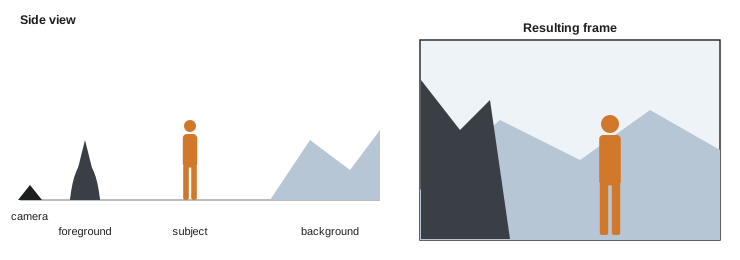
The most reliable way to create depth is to arrange the scene in layers. A foreground element (rocks, flowers, a doorframe, a person's shoulder), a subject in the middle ground and a background behind it give the eye a path from near to far. Each layer should be distinct in tone, focus or size so the planes separate. In landscapes, a strong foreground anchors the composition and gives scale; in interiors and film scenes, staging action in depth, with characters at different distances, adds richness and allows a single shot to show relationships that would otherwise need several cuts. Cinematographers call this deep staging, and directors such as Orson Welles and Gregg Toland in Citizen Kane (1941) famously used deep focus to keep near and far planes sharp at once.
Lighting reinforces depth: alternating light and dark planes (a dark foreground, a lit subject, a darker background) separate layers even when they are similar in color. A rim or back light outlines a subject against the background, and haze or smoke makes distant layers recede.
Lesson 8 shows how light and shadow model form and create depth, and Lesson 11 how camera movement reveals space.
Common mistakes
MistakeBelieving wide lenses distort and telephoto lenses compress by themselves.
InsteadPerspective comes from camera position; focal length only sets the field of view.
MistakePhotographing faces close up with a wide lens.
InsteadStep back and use a longer focal length to avoid exaggerated features.
MistakeTilting the camera up at buildings without intent.
InsteadKeep the camera level, use a shift lens or correct verticals, or tilt strongly on purpose.
MistakeUsing very shallow depth of field with sloppy focus.
InsteadFocus precisely on the eye or key detail; check sharpness.
MistakeIgnoring the foreground in landscapes.
InsteadInclude a foreground element and use hyperfocal focusing to give depth.
Summary and key terms
- Flat images use monocular depth cues: overlap, relative size, linear perspective, height, atmospheric perspective, texture, shading, focus and parallax.
- Image size is proportional to focal length times object size over distance.
- Parallel lines converge to vanishing points; ground-level lines converge on the horizon at camera height.
- One-, two- and three-point perspective depend on how the camera faces the scene.
- Perspective depends on camera distance; focal length sets field of view.
- Depth of field grows with f-number and distance and shrinks with focal length; hyperfocal focusing maximizes it.
- Layering foreground, middle ground and background, reinforced by light, creates depth.
- Monocular depth cue
- A depth cue available to a single eye or camera.
- Atmospheric perspective
- The paler, bluer, lower-contrast look of distant objects.
- Vanishing point
- The point where parallel lines appear to converge.
- Horizon line
- The line at the camera's eye level where ground-parallel lines converge.
- Converging verticals
- Vertical lines that taper when the camera tilts up or down.
- Field of view
- The angle of the scene captured by a lens and sensor.
- Crop factor
- The ratio of full-frame to sensor size, used to compare fields of view.
- Depth of field
- The range of distances that appear acceptably sharp.
- Hyperfocal distance
- The focus distance giving sharpness from half that distance to infinity.
- Deep staging
- Arranging action at several distances within one shot.
Practice problems
Work each problem on paper first, then reveal the answer to check.
Which depth cue is strongest?
Show answer
Overlap (occlusion).
Two equal objects are at 4 m and 20 m. Size ratio in the image?
Show answer
The near one appears 5 times as large.
Image height of a 2 m object at 10 m with a 100 mm lens?
Show answer
100 × 2000/10,000 = 20 mm.
Where is the horizon line in a photograph taken from 1.0 m above flat ground?
Show answer
At 1.0 m height in the scene; it passes through objects at that height at all distances.
What causes converging verticals?
Show answer
Tilting the camera up or down, creating a third vanishing point.
Horizontal field of view of a 35 mm lens on full frame?
Show answer
2 arctan(18/35) = 54.4°.
A 50 mm lens on an APS-C camera with crop factor 1.5 gives the field of view of what full-frame focal length?
Show answer
75 mm.
DOF of a 50 mm lens at f/4 focused at 3 m, c = 0.03 mm?
Show answer
2 × 4 × 0.03 × 9,000,000/2500 = 864 mm, about 0.86 m.
Hyperfocal distance of a 16 mm lens at f/8, c = 0.03 mm?
Show answer
256/0.24 = 1067 mm ≈ 1.07 m.
Give two ways lighting can separate layers.
Show answer
Alternate light and dark planes; rim or back light; haze to fade distant layers.
Lesson quiz · 5 questions
Score 60% or more to complete this lesson.
Create a free account to save your progress, take quizzes and earn a certificate.