
SMW-420 · Lesson 9 of 12 · 19 min
Coil lines and automation
Plasma tables cut the odd shapes, but most of the straight duct on a project like Eastgate never sees a plasma torch. It is made on a coil line, an automated machine that takes galvanized steel straight from a coil, flattens it, notches it, cuts it to length and often forms the seams and connectors, all from a cutting list sent by the fabrication software. A spiral machine does the same for round duct, forming a continuous helical lock seam from a narrow strip. This lesson follows a piece of rectangular duct through Keelson's coil line, explains how spiral duct is made, and looks at how automation, robotics and lean methods change the work of a sheet metal shop. Walt Szymanski runs the coil line; Kai Ferreira spent part of the Eastgate job learning it.
Why coil instead of sheets
Steel mills sell galvanized sheet in two forms: cut sheets of standard sizes and coils, long continuous strips wound into rolls weighing several tons. Coil steel usually costs less per unit of weight than cut sheets, because the mill does less handling, and a coil line can cut any length the job needs rather than the fixed lengths of a sheet, so there is less waste. A coil line also runs with little handling: the operator loads a coil with a forklift or crane, the line feeds itself, and finished blanks or formed sections come out the end. The trade-off is the cost of the line, the space it needs and the skill to set it up and keep it running.
Coils are specified by gauge, width, coating and weight. Keelson stocks coils of the common gauges in widths of 48 and 60 in, with a zinc coating designation such as G90 for general duct work. A coil of 24 gauge might weigh three to five tons and contain a strip more than a thousand feet long.
Inside the coil line
A typical rectangular duct coil line has a series of stations in a row. The figure shows Keelson's line in order, and the paragraphs below describe what happens at each station.
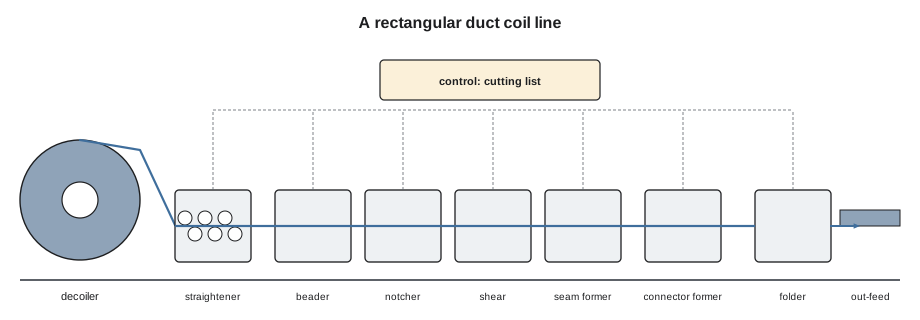
The decoiler holds one or more coils on a mandrel and pays out the strip as the line pulls it. Many lines have a multi-coil decoiler that holds several gauges at once, so the line can switch gauges between pieces without a coil change. A loop or dancer between the decoiler and the rest of the line keeps the strip from snapping tight when the line starts and stops.
The straightener, sometimes called a flattener, passes the strip through a series of offset rolls that bend it back and forth to remove coil set, the curve the strip keeps from being wound. Without straightening, the duct panels would curl and the seams would not line up. Bead rollers or cross-breaking stations follow, putting stiffening beads or cross breaks into the flat panel so the finished duct wall does not drum or flex, as SMW-130 explained.
The notcher punches the corner notches and any other cut-outs needed for the seams and connectors at each end of the panel, at the positions calculated by the software for the duct size. The shear then cuts the strip to the length of one panel. Next, roll formers form the edges: one forms the Pittsburgh lock seam pocket, another forms the transverse duct connector profile such as a TDC or TDF flange on the panel ends, as SMW-140 described. Finally, a brake or folder folds the panel into an L-shaped half or a full wrap, ready for seaming. Some lines also insert the corners, apply sealant and close the seam automatically.
All of this is driven by the cutting list. The software takes the straight duct sections from the shop drawings, works out the panel sizes, gauges, beads, notches and connectors for each, and sends them to the line in an order that reduces gauge changes. The operator watches the line, checks the first pieces of each run with a tape and square, and labels the finished pieces with the tags printed by the line.
Coil yield and throughput
Halima's estimate and Walt's schedule both depend on how much duct a coil makes and how fast the line runs. The code below works through both for a run of straight duct.
# Coil yield and line throughput for a run of straight duct (illustrative)
coil_mass = 9000             # coil mass, lb
mass_per_area = 1.19         # sheet mass for the gauge, lb per ft2
coil_width = 48            # in
panel_area = 19.0            # area of one duct panel cut from the coil, ft2
scrap = 0.03                 # notches and end trim
strip_area = coil_mass / mass_per_area
panels = int(strip_area * (1 - scrap) / panel_area)
print(f"strip area {strip_area:,.0f} ft2; panels per coil {panels}")
cycle_s = 22               # seconds per panel at the line's steady rate
setup_min = 12               # gauge change and first-piece check per run
run_panels = 240
hours = (run_panels * cycle_s / 3600) + setup_min / 60
print(f"{run_panels} panels take about {hours:.1f} h including setup")strip area 7,563 ft2; panels per coil 386 240 panels take about 1.7 h including setup
The rate in the example is illustrative; actual cycle times depend on the line, the panel length and the options fitted. What the calculation shows is that a coil line turns out hundreds of panels a shift once it is set up, which is why gauge changes and first-piece checks matter: on short runs, setup can take as long as the cutting.
Spiral duct
Round duct for exposed ceilings, exhaust and many supply mains is made on a spiral machine. A narrow strip, often about 5 ½ in wide, is fed from a coil into a forming head that rolls the edges into a lock profile and winds the strip around a forming tube at an angle, so each turn locks into the one before to form a continuous helical seam. The machine closes the lock as it forms, and a flying cut-off saw or knife cuts the tube to length while it is still turning. Changing diameter means changing the forming tube, which takes time, so spiral runs are scheduled by diameter.
Spiral duct is stiff for its weight because the helical seam acts like a reinforcing rib, and it often uses a lighter gauge than rectangular duct of the same area. Its smooth interior and sealed seam give low leakage and low friction, which is why designers like it for long mains. Fittings for spiral, such as elbows, tees and reducers, are made separately, either from gored sections on a plasma table and a seamer or bought from a fitting manufacturer.
Robotics and other automation
Automation in sheet metal shops goes well beyond the coil line. Many shops have automatic seam closers that close Pittsburgh seams, automatic duct liner machines that cut insulation, apply adhesive and pin it in place, and machines that install corners in TDC flanges. Larger shops add robotic welding cells for stainless and heavy-gauge work, CNC press brakes with automatic back gauges for repeatable bends, and elbow or gore machines that form round fittings. Each machine needs the same inputs: accurate data from the model, consistent material and trained people to set up, run and maintain it.
Automation changes the work of the trade rather than removing it. Walt's line operators need to read the cutting list, understand why a panel needs a particular notch, spot a mis-formed seam and know how to clear a jam safely. Kai's training, in layout, seams, gauges and connectors, is exactly what lets an operator tell when the machine is wrong. The shop's journeyworkers also do the work that machines still cannot do well: odd fittings, field changes, architectural work like the copper at St. Brendan's, and installation.
Safety on automated equipment
Coil lines and other automated machines have powerful moving parts that start automatically, sharp strip edges, and heavy coils. They are guarded with fixed guards, interlocked doors and light curtains that stop the machine when someone reaches in. Clearing a jam or changing tooling requires lockout of all energy sources, including stored energy such as air pressure and the tension in the strip, under the shop's lockout procedure and OSHA's control of hazardous energy rules. Coils are moved only with rated lifting equipment and slings or a coil hook, and coil ends are secured before the bands are cut, because a released coil end can spring out with great force.
Operators wear cut-resistant gloves and sleeves when handling strip and blanks, safety footwear, eye protection and hearing protection where noise requires it. Loose clothing, jewelry and long hair are kept away from rolls. Walt's daily start-up check includes testing the emergency stops and light curtains before the first piece runs.
Lean fabrication
Lean methods, adapted from manufacturing, aim to remove waste from a process: overproduction, waiting, unnecessary movement and transport, excess inventory, over-processing, defects and unused skill. In a sheet metal shop, lean shows up in practical ways. Keelson arranges machines so material flows in one direction, from coil storage through the line to staging. It keeps tools and consumables at the point of use with marked locations, a method often called 5S. It fabricates to the installation sequence rather than in large batches that sit in the yard, and it tracks first-pass yield so defects are fixed at the source.
A lean shop also pulls work from the field rather than pushing it. Aggie MacLeod, the Eastgate foreman, tells the shop which areas will be ready next, and the shop releases those packages, so duct arrives shortly before it is hung. That reduces damage and lost pieces on site, frees yard space and keeps the shop's cash from being tied up in fabricated duct that cannot be billed yet. Lesson 10 develops these ideas into a shop schedule.
Keeping the line running
A coil line earns its keep only when it runs, so Keelson treats maintenance as part of production. Walt keeps a log for each machine with daily, weekly and monthly tasks. Daily, operators clean zinc flakes and scrap from the notcher and shear, check lubrication points and air pressure, and test the safety devices. Weekly, the maintenance technician checks roll alignment, shear blade clearance and the condition of notching punches and dies, because a dull punch leaves burrs that cut hands and spoil seams. Monthly and yearly tasks include checking drive belts, encoder accuracy and the calibration of the length measurement, which is done by cutting test panels and measuring them against a steel tape.
Tooling wear shows up first in the product. A Pittsburgh pocket that is slightly too tight makes seams hard to close; a TDC flange formed out of square makes joints leak; a shear blade with too much clearance leaves a ragged edge. Operators who know what a good seam looks like catch these signs early, and the fix is usually a small adjustment rather than a breakdown. Walt also keeps critical spare parts, such as punches, shear blades, sensors and a spare drive belt, on the shelf, because waiting days for a part can stall a whole floor of Eastgate fabrication.
Software needs care too. The cutting list depends on the shop's fabrication standards stored in the software: which seams and connectors to use for each size and pressure class, the gauge table, bead spacing and allowances. When Keelson changes a standard, for example adopting a new connector for higher pressure duct, Lin Zhao updates the software library and Walt runs test pieces before any job uses it, so the model, the shop drawings and the line all agree.
Worked problem
Panels per coil
A 24 gauge coil weighs 9,000 lb. The gauge mass is 1.19 lb/sq ft. Each panel is 19.0 sq ft and scrap is 3 percent. How many panels does the coil make?
Show solution
- Strip area: 9,000 / 1.19 = 7,563 sq ft.
- Usable area after scrap: 7,563 × 0.97 = 7,336 sq ft.
- Panels: 7,336 / 19.0 = 386, rounded down.
Answer: About 386 panels, matching the code output.
Common mistakes
MistakeSkipping the first-piece check after a gauge change.
InsteadMeasure and square the first pieces of every run before letting the line run on.
MistakeReaching into a running line to clear a jam.
InsteadStop the line and lock out all energy, including air and strip tension, first.
MistakeCutting coil bands without securing the end.
InsteadSecure the coil end before cutting the bands.
MistakeRunning spiral diameters in random order.
InsteadGroup spiral runs by diameter to reduce tube changes.
MistakeFabricating far ahead of installation.
InsteadRelease packages to match the field sequence so duct does not wait in the yard.
Summary and key terms
- Coil lines decoil, straighten, bead, notch, shear, form seams and connectors and fold duct from a cutting list.
- Coil steel usually costs less and wastes less than cut sheets, at the cost of a large machine.
- Panels per coil follow from coil mass, gauge mass and panel area; setup matters on short runs.
- Spiral machines form round duct from a narrow strip with a helical lock seam and cut it to length.
- Automation needs good data and skilled operators; guarding, lockout and coil handling keep it safe.
- Lean fabrication reduces waste by flowing material in one direction and fabricating to the field sequence.
- Coil line
- An automated line that makes duct panels from coil steel.
- Decoiler
- The station that holds the coil and pays out the strip.
- Coil set
- The curve a strip keeps from being wound on a coil.
- Spiral duct
- Round duct with a continuous helical lock seam.
- Light curtain
- A safety device that stops a machine when a beam is broken.
- Lean
- Methods for removing waste from a process.
Practice problems
Work each problem on paper first, then reveal the answer to check.
Why does a coil line need a straightener?
Show answer
To remove coil set so panels lie flat and seams line up.
Name two kinds of stored energy to lock out on a coil line.
Show answer
Air pressure in pneumatic systems and tension in the strip; also gravity on raised parts and electrical capacitors.
Why is spiral duct stiff for its weight?
Show answer
The helical seam acts as a continuous reinforcing rib.
How does pull scheduling help the field?
Show answer
Duct arrives shortly before it is hung, so less is damaged, lost or stored in the yard.
Lesson quiz · 5 questions
Score 60% or more to complete this lesson.
Create a free account to save your progress, take quizzes and earn a certificate.