
SMW-410 · Lesson 9 of 12 · 20 min
Fume and process exhaust
Kitchen and dust systems are the largest part of Keelson's exhaust work, but not the only part. Welding shops need fume extraction. Finishing rooms need spray booths. Hospitals and schools have laboratories with fume hoods, and hospitals have isolation rooms whose exhaust must never come back into the building. Each of these has its own hood type, its own airflow rules and, often, its own duct materials, because the exhaust may be corrosive or hazardous. This lesson covers the process exhausts Keelson builds most often, using the Eastgate Hospital addition and Keelson's own welding bay as the examples.
Welding fume
Welding fume is a cloud of very fine metal oxide particles formed when vaporized metal condenses in the air above the arc, together with gases such as ozone and nitrogen oxides. Its composition depends on the base metal, filler and coatings. Galvanized steel gives zinc oxide fume, which causes metal fume fever. Stainless steel gives fume containing chromium, some of it in the hexavalent form, which is a recognized carcinogen with a very low exposure limit, as SMW-230 explained. Mild steel fume contains iron and manganese, and manganese exposure is linked to neurological effects. Because the particles are so fine, welding fume behaves almost like a gas: it rises with the hot plume and then spreads through the shop.
Local exhaust is the preferred control. Fume extraction arms, articulated arms with a small hood on the end, are positioned close to the arc, within about one hood diameter, and connected to a fan and filter unit. Downdraft and backdraft tables pull fume away from the welder through a perforated tabletop or a slotted back panel. Fume extraction guns draw fume through a shroud around the welding gun nozzle itself. For each, the airflow is set by the hood size and the capture distance, using the principles of Lesson 6, and the shielding gas must not be disturbed: too much air at the arc pulls the shielding gas away and causes porosity in the weld.
Keelson's own welding bay, where Kai welded the Brine & Ember grease duct, now has three fume arms and a backdraft table on a cartridge collector, installed after a hygienist measured chromium exposure during stainless welding. The cartridge collector suits welding fume because the particles are fine, dry and not fibrous, and it returns no air to the shop: the cleaned air is exhausted outdoors because cartridge filters do not remove the gases.
# Fume arm airflow by distance (flanged hood, Dalla Valle with 0.75 factor)
V = 100          # capture velocity at the arc, fpm
A = 0.33          # hood face area, ft2
for x in (0.5, 0.8, 1.3):   # distance from hood to arc, ft
    q = 0.75 * V * (10 * x**2 + A)
print(f"hood {x} ft from the arc: {q:.0f} cfm")hood 0.5 ft from the arc: 212 cfm hood 0.8 ft from the arc: 505 cfm hood 1.3 ft from the arc: 1292 cfm
The arms are sized for the hood about 10 in from the arc. Aggie's rule in the bay is to move the arm every time the welding position moves, because a hood left 16 in away captures only a fraction of the fume at the same airflow.
Spray booths
Spraying paint, lacquer or stain releases solvent vapor and overspray mist, both flammable and both harmful to breathe. Spray finishing must be done in a spray booth or spray room built to NFPA 33, Spray Application Using Flammable or Combustible Materials, as referenced by the fire codes. A spray booth is an enclosing hood: a three-sided or fully enclosed steel box with filters that catch the overspray and an exhaust fan that draws air through the open face or the doors at an average velocity high enough to keep vapor and mist inside. The exhaust system must run whenever spraying is done, the spray gun must be interlocked so it cannot operate without the exhaust, and the electrical equipment inside and near the booth must be suitable for the hazardous location.
For the Ironbark finishing room, the hygienist and Tomasz recommended a listed open-face spray booth for the occasional sprayed finishes, separate from the slot-hooded wiping bench. OSHA's spray finishing rules in 29 CFR 1910.107 and 1910.94 set airflow and construction requirements alongside NFPA 33. Its exhaust duct is steel, runs directly to the outdoors with no connection to the dust system, and discharges above the roof away from intakes. Booth ducts collect overspray residue and must have access for cleaning, much like grease ducts, and the booth filters are changed on a schedule and stored as a fire hazard until removal.
Spray booth exhaust must never share a duct with dust collection or kitchen exhaust. Mixing solvent residue with wood dust or grease creates a fuel that is easier to ignite than either alone, and the protection systems for each are different.
Laboratory fume hoods
A laboratory fume hood is a ventilated enclosure in which people handle chemicals. It has a work surface, a movable front sash of safety glass, and an exhaust connection at the top, usually with internal baffles that spread the airflow across the opening. Air is drawn in through the open sash face at a controlled face velocity, sweeps across the work and leaves through the exhaust. The main guidance for laboratory ventilation in North America is ANSI/ASSP Z9.5, Laboratory Ventilation, together with ASHRAE Standard 110, which describes a containment test using a tracer gas and a mannequin. Face velocities commonly used in practice fall around 80 to 100 fpm, but the standard puts more weight on proven containment than on any single face velocity, because a hood can have a good face velocity and still spill if it is badly placed or disturbed by supply air.
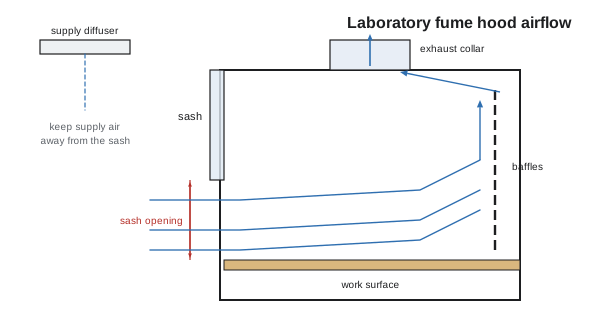
The hood's exhaust airflow is the face velocity times the open sash area. A hood with the sash fully open needs much more air than one with the sash lowered to a working height. Constant-volume hoods exhaust the same airflow whatever the sash position, using a bypass opening that opens as the sash closes. Variable-air-volume hoods measure the sash position or the face velocity and vary the exhaust to hold the face velocity constant, which saves a great deal of energy in a building with many hoods. Either way the lab's supply air is controlled to keep the lab negative to the corridor.
# Fume hood exhaust from sash opening and face velocity
width = 5           # sash opening width, ft
v_face = 100          # face velocity, fpm
for h in (1.5, 2.3):        # sash opening heights, ft
    q = width * h * v_face
    print(f"sash at {h} ft: exhaust {q:.0f} cfm")
hoods = 6
print(f"six hoods with sashes at working height instead of full open save about {hoods * (width * (2.3 - 1.5) * v_face ):.0f} cfm")sash at 1.5 ft: exhaust 750 cfm sash at 2.3 ft: exhaust 1150 cfm six hoods with sashes at working height instead of full open save about 2400 cfm
The Eastgate addition has a small clinical laboratory with six VAV fume hoods. Keelson installs the exhaust ducts to each hood, the hood exhaust valves supplied by the controls contractor, and the exhaust risers to two high-plume roof fans. The commissioning authority will test each hood with the ASHRAE 110 method before the lab is occupied, and the TAB group from SMW-330 will verify the airflows and the lab's negative pressure.
Laboratory exhaust stacks
Laboratory exhaust must leave the building fast and high enough to clear the roof and avoid being drawn back in through air intakes, windows or neighboring buildings. Common practice uses fans that discharge vertically at high velocity through a stack well above the roof; high-plume induced-flow fans mix in extra outdoor air at the fan to raise the plume further without a tall stack. The stack height, exit velocity and location are set by the engineer, sometimes with wind studies for large labs. Rain caps that deflect the plume downward are not used. Keelson builds and supports the stacks to resist wind and installs the fans so they can be serviced from the roof.
Corrosive exhaust and duct materials
Some exhaust streams attack ordinary galvanized steel: acid fumes from labs and plating, chlorine and moisture from pools, chemical vapors from some processes. The engineer chooses the duct material to suit. Type 316 stainless resists many lab chemicals and chlorides better than type 304. Fiberglass-reinforced plastic resists acids and chlorides well and is common for lab and scrubber exhaust, though it has fire limitations that the code and the listing address. PVC-coated galvanized steel, with a plastic coating inside and out, suits many corrosive fumes at moderate temperatures. Some specialty exhausts have their own rules: perchloric acid fume hoods, for example, need dedicated stainless ducts with washdown systems, because perchloric acid residues can become explosive.
| Exhaust | Common duct material | Notes |
|---|---|---|
| General lab fume | 316 stainless or coated steel | Welded or sealed joints; no fibrous lining |
| Acid and chloride fume | Fiberglass-reinforced plastic, PVC-coated steel | Check fire rating and listing |
| Pool and change-room exhaust | Aluminum or 316 stainless | As at Ashgrove in SMW-220 |
| Perchloric acid | Dedicated stainless with washdown | Never combined with other exhaust |
| Welding fume | Galvanized or black steel | Spark-resistant where dusts are present |
Isolation room exhaust at Eastgate
Airborne infection isolation rooms keep patients with airborne infections, such as tuberculosis, in negative pressure so air flows into the room from the corridor and out through a dedicated exhaust. ASHRAE/ASHE Standard 170, Ventilation of Health Care Facilities, the FGI Guidelines and the hospital's infection prevention team set the requirements. The exhaust from these rooms runs in its own duct, is discharged above the roof away from intakes and people, and in some designs passes through high-efficiency particulate filters before discharge. The TAB group balanced these rooms in SMW-330; Keelson's installation job is to keep the duct tight, because a leak in a positive-pressure section after the fan would push potentially infectious air into a shaft or a ceiling.
The design puts the exhaust fans on the roof at the end of each duct so every meter inside the building stays under suction. Kai's crew seals the exhaust risers to the same standard as supply duct, and the roof stacks are located where the hospital's mechanical engineer placed them, well away from the air handler intakes.
Worked problem
Choosing a fume hood exhaust rate
An Eastgate fume hood has a sash opening 5 ft wide that opens to 2.3 ft fully and is used at a working height of 1.5 ft. The design face velocity is 100 fpm. What are the exhaust rates fully open and at working height?
Show solution
- Full open area: 5 × 2.3 = 11.5 ft².
- Full open exhaust: 11.5 × 100 = 1,150 cfm.
- Working height area: 5 × 1.5 = 7.5 ft².
- Working height exhaust: 7.5 × 100 = 750 cfm.
Answer: A VAV hood that tracks the sash saves about 400 cfm per hood whenever users keep the sash at working height.
Commissioning fume exhaust
Fume systems are judged by how well they protect people, so they are tested that way. Laboratory fume hoods are checked when installed and at regular intervals afterwards, usually yearly: the face velocity is measured across a grid on the open sash, smoke is released at the face to show that it flows smoothly into the hood with no spillage, and the hood's flow monitor is calibrated so it alarms when airflow falls. For a full performance test, ASHRAE 110 releases a tracer gas inside the hood and measures how much reaches a mannequin standing in front of it. Eastgate's lab manager keeps the test results on a label on each hood, and a hood that fails is tagged out of service until it is fixed.
Spray booths and welding systems are checked by measuring airflow at the booth face or the hood and comparing it with the design, and by watching for overspray or fume escaping into the room. Fume arms lose capture quickly as they are moved away from the work, so an airflow reading at the arm hood tells only part of the story; watching where the plume goes during real welding tells the rest.
The isolation rooms at Eastgate have their own checks. Their negative pressure relative to the corridor is shown on a room pressure monitor at the door and verified by the hospital's engineering staff on a regular schedule, and the exhaust fans serving them are on emergency power so the rooms stay negative during a utility failure. Keelson's part at commissioning was to show that the ducts were sealed, the fans ran in the right direction and the dampers moved as the controls commanded.
Common mistakes
MistakePositioning a fume arm far from the arc and relying on more airflow.
InsteadKeep the hood close and move it with the work; too much air at the arc also disturbs the shielding gas.
MistakeConnecting a spray booth to the dust collection system.
InsteadGive each process exhaust its own duct to the outdoors.
MistakePlacing a ceiling supply diffuser in front of a fume hood.
InsteadKeep supply air away from the sash so it does not disturb containment.
MistakeUsing galvanized duct for acid or chloride exhaust.
InsteadUse the corrosion-resistant material the engineer specifies.
MistakeFitting a downward rain cap on a lab exhaust stack.
InsteadUse a vertical high-velocity discharge so the plume clears the roof.
Summary and key terms
- Welding fume is fine and hazardous; capture it close to the arc with arms, tables or extraction guns.
- Spray finishing needs a booth to NFPA 33, interlocked with its exhaust and ducted separately.
- Fume hood exhaust is face velocity times sash area; VAV hoods save energy by tracking the sash.
- Lab hoods are judged by containment testing, not face velocity alone.
- Lab exhaust leaves through high-velocity vertical stacks or high-plume fans.
- Corrosive exhaust needs stainless, fiberglass-reinforced plastic or coated duct as specified.
- Welding fume
- Fine metal oxide particles and gases formed above a welding arc.
- Fume extraction arm
- An articulated arm with a small hood positioned close to the work.
- Spray booth
- A ventilated enclosure for spray finishing built to NFPA 33.
- Fume hood
- A ventilated laboratory enclosure with a movable sash.
- Face velocity
- Average air velocity through a hood opening.
- High-plume fan
- A fan that mixes in outdoor air to raise the exhaust plume.
Practice problems
Work each problem on paper first, then reveal the answer to check.
Why is a cartridge collector suitable for welding fume?
Show answer
The particles are fine, dry and not fibrous, which suits pleated cartridges.
A hood sash opening is 4 ft × 1.6 ft at 100 fpm. What is the exhaust?
Show answer
4 × 1.6 × 100 = 640 cfm.
Why must spray booth exhaust not share a duct with a dust system?
Show answer
Mixed residues are a greater fire hazard and the protection systems differ.
Why are isolation room exhaust fans placed at the end of the duct, on the roof?
Show answer
So the duct inside the building is under suction and leaks draw air in rather than pushing infectious air out.
Lesson quiz · 5 questions
Score 60% or more to complete this lesson.
Create a free account to save your progress, take quizzes and earn a certificate.