
SMW-410 · Lesson 2 of 12 · 20 min
Commercial kitchen exhaust hoods
A commercial kitchen is one of the hardest places in a building to ventilate. Cooking appliances release heat, water vapor, smoke and grease aerosol in large and changing amounts, often right beside a dining room where customers expect clean, quiet air. The hood above the line is the first and most important part of the kitchen exhaust system: if it does not capture and contain the plume, no amount of duct, fan or make-up air will make the kitchen work. This lesson covers the kinds of hoods, how they work, how their exhaust rates are set, and how Keelson builds and installs them, using the Brine & Ember cook line as the example.
Brine & Ember is a seafood restaurant in an old warehouse building on the Cleveland waterfront. Its cook line runs along one wall: two fryers, a six-burner range with an oven below, a charbroiler and a flat-top griddle, with a pizza-style deck oven at the end. Over the dishwasher on the opposite wall is a separate small hood for steam. Kai welded the stainless grease duct for the main hood in SMW-230; the restaurant's chef-owner, Rania Haddad, and the mechanical engineer, Dev Bhatt of a local consulting firm, now want the whole package finished, inspected and running before the summer season.
Grease hoods and heat hoods
Hoods fall into two families. The International Mechanical Code, on which the Ohio Mechanical Code is based, calls them Type I and Type II. A Type I hood is installed over appliances that produce grease or smoke, such as fryers, ranges, griddles and charbroilers. It has grease filters or extractors, connects to a welded grease duct, is protected by a fire suppression system, and is built and installed to the code and to NFPA 96, Ventilation Control and Fire Protection of Commercial Cooking Operations. A Type II hood is installed over appliances that produce heat, steam and moisture but no grease, such as dishwashers and some ovens. It does not need a grease duct or fire suppression, though it needs corrosion-resistant construction and condensate control. Factory-built hoods are tested and listed to UL 710.
The difference matters for the shop because the two families are built differently. A grease hood is a liquid-tight welded or listed assembly of steel or stainless steel with grease filters, a grease gutter and a drain cup, a fire suppression nozzle network and a connection to a grease duct. A heat and moisture hood is usually a simpler sheet metal canopy, often stainless or aluminum, with a condensate gutter and a connection to an ordinary exhaust duct of corrosion-resistant material.
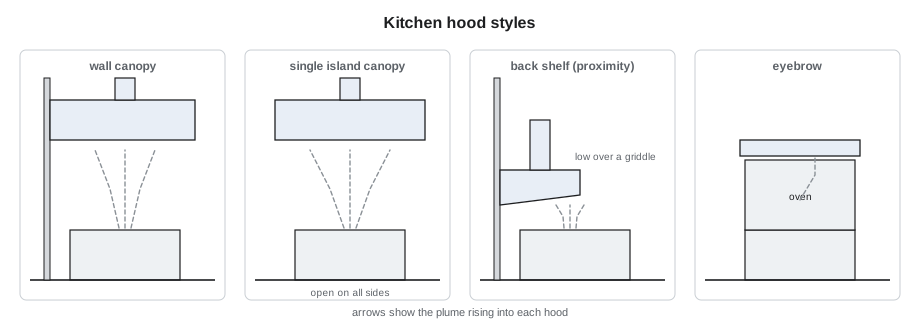
Capture and containment
A hood works in two stages. Capture means drawing the plume into the hood's reservoir as it rises. Containment means keeping it there until the exhaust removes it, without letting it spill out of the edges. The cooking plume rises because it is hot, and it grows and wobbles as it rises, so the hood must be big enough to sit over the whole plume and deep enough to hold its surges. Spillage happens when the plume surges past the front edge, when cross-drafts push the plume sideways, or when the exhaust rate is too low for the appliance.
Cross-drafts are the most common reason a well-sized hood fails. Make-up air delivered too fast near the hood, a nearby ceiling diffuser blowing across the line, an open back door, or a pedestal fan used by a cook on a hot day can all push the plume out of the hood. Research behind the ASHRAE kitchen ventilation standard has shown that hoods need much more exhaust to contain the plume when the air around them is disturbed. That is why Lesson 4 spends as much time on how make-up air is delivered as on how much is delivered.
Hood geometry helps too. A wall-mounted canopy with its back sealed against a wall captures far better than an island canopy, because the plume can only escape from three sides. End panels on a wall canopy improve capture again. The hood should overhang the cooking surfaces at the front and ends; a common minimum for canopies is 6 in on the open sides, and the engineer or the hood listing may require more. The lower edge must be at a height the listing or design allows, low enough to capture but high enough for the cook to work.
Appliance duty and exhaust rates
Appliances do not all make the same plume. The ASHRAE standard for kitchen ventilation, Standard 154, sorts cooking appliances into duty classes. Light-duty appliances, such as ovens, steamers and small kettles, produce mostly heat and moisture. Medium-duty appliances, such as ranges, griddles and fryers, produce more heat and some grease. Heavy-duty appliances, such as charbroilers and woks, produce a large, fast-moving plume with heavy grease and smoke. Extra-heavy-duty appliances burn solid fuel such as wood or charcoal and need the most exhaust and their own duct system. The hood's exhaust rate is set by the heaviest-duty appliance under it, unless the hood is split into sections.
There are two ways to set a hood's exhaust rate. A listed hood has been tested by the manufacturer under the standard for its listing, and its label and installation instructions give the minimum exhaust rate for each duty class, usually as airflow per unit length of hood. A hood that is not listed, often called an engineered or field-fabricated hood, must meet the exhaust rates set out in the code, which are higher, because the hood has not been tested. Keelson builds both kinds: listed hoods arrive from the manufacturer for Keelson to install and connect, and on some jobs the shop builds an engineered hood to the code rates and the engineer's design.
| Appliance duty | Examples | Typical exhaust per foot of wall canopy (illustrative) |
|---|---|---|
| Light | Ovens, steamers, kettles | about 200 cfm |
| Medium | Ranges, griddles, fryers | about 300 cfm |
| Heavy | Charbroilers, woks | about 400 cfm |
| Extra heavy | Wood or charcoal fired | about 550 cfm |
The table shows the order of magnitude, not a design value. A listed hood with good geometry and well-delivered make-up air may need far less, which is the main reason restaurants buy listed hoods: every liter per second of exhaust is a liter per second of make-up air that has to be heated in winter and cooled in summer. Island canopies need more exhaust than wall canopies, and proximity hoods close over the appliance need less.
# Hood exhaust from length and the heaviest duty under the hood
rates = {"light": 200, "medium": 300, "heavy": 400}          # exhaust per unit length by duty, cfm per ft
sections = [("fryers and range", 8, "medium"),
            ("charbroiler and griddle", 6, "heavy")]
total = 0
for name, length, duty in sections:
    q = length * rates[duty]
    total += q
    print(f"{name}: {length} ft x {rates[duty]} = {q:.0f} cfm ({duty} duty)")
print(f"hood total {total:.0f} cfm")
one_rate = (8 + 6) * rates["heavy"]
print(f"if the whole hood were rated for the heavy duty: {one_rate:.0f} cfm")fryers and range: 8 ft x 300 = 2400 cfm (medium duty) charbroiler and griddle: 6 ft x 400 = 2400 cfm (heavy duty) hood total 4800 cfm if the whole hood were rated for the heavy duty: 5600 cfm
Splitting the Brine & Ember hood into a medium-duty section over the fryers and range and a heavy-duty section over the charbroiler and griddle saves exhaust compared with rating the whole hood for the charbroiler. The engineer's design actually goes further: Dev has specified a listed hood whose tested rates are lower than these illustrative figures, and he has moved the charbroiler to the end of the line next to the wall, where the end panel helps contain its plume.
Grease filters and extractors
Grease hoods must have listed grease filters, baffles or extractors that remove part of the grease from the exhaust before it reaches the duct, and that act as a flame barrier. The common type is a stainless or aluminum baffle filter: a row of interlocking vertical channels that forces the air to change direction several times, so grease droplets hit the metal and drain down into a gutter. Mesh filters of the kind found in household range hoods are not acceptable on commercial grease hoods. Filters are installed at an angle, typically 45 to 60 degrees from horizontal, so grease drains to the gutter, and they must be removable by kitchen staff for washing, often daily on a busy line.
Filters have a rated airflow range. Too little air per filter and the baffles do not separate grease well; too much and the pressure drop rises and grease can be carried through. The hood designer selects the number and size of filters to suit the exhaust rate. The filter bank should also be far enough above the cooking surface that flames from a flare-up do not reach it; NFPA 96 sets minimum distances that depend on the appliance and the type of filter.
# Number of baffle filters for the hood exhaust
q_hood = 4800         # hood exhaust, cfm
per_filter = 700     # rated maximum per filter, cfm (illustrative)
import math
n = math.ceil(q_hood / per_filter)
print(f"filters needed: {n} (at {q_hood / n:.0f} cfm each)")filters needed: 7 (at 686 cfm each)
Hood construction and installation
An engineered grease hood is built of steel or stainless steel of the minimum thickness set by NFPA 96, with all external seams and joints welded or otherwise made liquid-tight so that grease cannot leak into the hood body or the ceiling space. The hood has a grease gutter below the filters draining to a removable cup or container, and it is supported from the building structure with noncombustible hangers. It also needs clearance from combustible construction, or a listed clearance-reduction system, just as the duct does; Lesson 3 covers the clearance rules. Listed hoods are installed exactly to their instructions, including hanging, clearance, filter and suppression details, because the listing depends on it.
The fire suppression system is installed by a separate licensed contractor, but the hood must be built to receive it: nozzle penetrations sealed liquid-tight, detection links located over the appliances, and access left for the piping. Keelson coordinates with the suppression contractor before the hood is hung, and Lin draws the hood with the nozzle locations and the duct collar shown, so nothing is drilled through a welded panel after it is installed.
Lighting inside a hood must be listed for the purpose, sealed against grease and installed so it does not interfere with filters. Wiring and conduit must not pass through the hood or the grease duct. The hood's exhaust collar, where the grease duct connects, is welded liquid-tight or joined with a listed connection, and the duct then runs as directly as possible to the outdoors, as the next lesson describes.
The dishwasher hood
The small hood over Brine & Ember's dishwasher handles steam, not grease. In the US it is a Type II hood; in any case, it does not need grease filters or suppression. Its main problems are condensation and corrosion. Warm, wet air hits the cooler hood and duct, condenses, and drips back onto the dish table or runs out of joints. Keelson builds it from stainless steel with sealed seams, a perimeter condensate gutter and a drain, and connects it to a duct sloped back toward the hood so condensate drains rather than pooling. Dishwasher manufacturers often specify an exhaust rate at the machine's vent collars; Dev's design uses that rate plus enough to capture the steam that escapes when the doors open.
Worked problem
Sizing the Brine & Ember main hood
The main hood is a wall canopy 14 ft long. The fryers and range take 8 ft, and the charbroiler and griddle take 6 ft. Using the illustrative unlisted rates, what is the exhaust, and what would a single heavy-duty rating give?
Show solution
- Medium section: 8 × 300 = 2,400 cfm.
- Heavy section: 6 × 400 = 2,400 cfm.
- Total: 4,800 cfm.
- Single heavy-duty rating: 14 × 400 = 5,600 cfm.
Answer: Rating each section for its own duty saves about 800 cfm, which is make-up air the restaurant does not have to heat; the listed hood Dev specified saves more.
Common mistakes
MistakeTreating a dishwasher hood like a grease hood, or a grease hood like a dishwasher hood.
InsteadGrease hoods need listed filters, a welded grease duct and suppression; steam hoods need corrosion and condensate control.
MistakeUsing the rate for the lightest appliance on a mixed line.
InsteadSize each section for the heaviest-duty appliance under it.
MistakeChanging a listed hood's hanging or filter arrangement in the field.
InsteadInstall listed hoods exactly as the listing instructions require.
MistakeDrilling a welded hood for suppression piping after it is hung.
InsteadCoordinate nozzle and detector locations with the suppression contractor before fabrication.
MistakePutting a ceiling diffuser beside the hood.
InsteadKeep high-velocity supply air away from the hood edges; cross-drafts cause spillage.
Summary and key terms
- Grease hoods over grease-producing appliances need listed filters, a grease duct and fire suppression; heat and moisture hoods do not.
- A hood must capture the rising plume and contain its surges; cross-drafts are the main cause of spillage.
- Appliances are grouped as light, medium, heavy and extra-heavy duty, and the hood rate follows the heaviest under it.
- Listed hoods use their tested rates; unlisted hoods use the higher code rates.
- Baffle filters remove grease and act as a flame barrier; they are cleaned often and set at an angle to drain.
- Suppression, lighting and the duct collar are coordinated before the hood is built.
- Grease hood
- A hood over grease- or smoke-producing appliances, with grease filters, a grease duct and fire suppression.
- Capture
- Drawing the cooking plume into the hood.
- Containment
- Keeping the plume in the hood until it is exhausted, without spillage.
- Appliance duty
- A class (light to extra heavy) describing how much heat, grease and smoke an appliance makes.
- Listed hood
- A factory hood tested and listed to a hood standard, installed to its instructions.
- Baffle filter
- A grease filter that forces the airflow to change direction so grease drains away.
Practice problems
Work each problem on paper first, then reveal the answer to check.
Why does a wall canopy need less exhaust than an island canopy of the same length?
Show answer
The wall blocks one side, so the plume can only escape from three sides.
A hood section over a griddle is 7 ft long. Using the illustrative medium rate, what is its exhaust?
Show answer
7 × 300 = 2,100 cfm.
Why are household mesh filters not used on commercial grease hoods?
Show answer
They are not listed for the purpose; baffle filters drain grease and act as a flame barrier.
Name two causes of hood spillage.
Show answer
Any two of: cross-drafts from make-up air or diffusers, too little exhaust for the appliance, open doors, portable fans, plume surges past the front edge.
Lesson quiz · 5 questions
Score 60% or more to complete this lesson.
Create a free account to save your progress, take quizzes and earn a certificate.