
SMW-410 · Lesson 4 of 12 · 20 min
Make-up air and kitchen balance
Every liter of air the kitchen hood sends up the grease duct has to be replaced. If it is not, the kitchen goes negative: the hood loses airflow, the back door is hard to open, cold air whistles in under every door and through every crack, smoke and odors spill, and gas appliances and water heaters may backdraft combustion gases into the building. Make-up air is the outdoor air supplied to replace the exhaust. Getting the amount right is a balancing problem, which Kai met in SMW-330. Getting the delivery right is an air distribution problem that decides whether the hood captures at all. This lesson covers both, for the Brine & Ember package.
How much make-up air
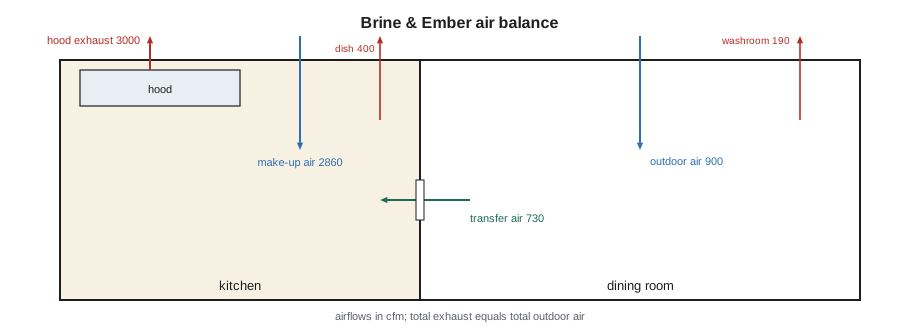
The mechanical codes require that make-up air be provided in about the same amount as the air exhausted, so that the building is not driven strongly negative. In practice, a kitchen is designed to run slightly negative relative to the dining room around it, so that odors, heat and smoke flow into the kitchen and out through the hood rather than out into the dining room. The engineer gets that slight negative pressure by supplying a little less make-up air directly to the kitchen than the hood exhausts, and letting the difference come from the dining room as transfer air. The dining room's own heating and ventilating unit supplies that transfer air as part of its outdoor air.
A common design approach supplies about 80 to 90 percent of the hood exhaust as dedicated make-up air into the kitchen, with the rest arriving as transfer air from the dining room. The exact split depends on the building, how much outdoor air the dining room unit brings in, and any other exhausts such as washrooms. What matters is that the totals balance: all the exhaust in the building equals all the outdoor air brought in, give or take a small positive margin for the building as a whole, which keeps it from pulling in unfiltered air through the walls.
# Kitchen air balance: make-up air, transfer air and the building total
hood = 3000             # main hood exhaust, cfm
dish = 400             # dishwasher hood exhaust, cfm
washroom = 190         # washroom exhaust, cfm
mua_share = 0.85       # share of kitchen exhaust supplied as dedicated make-up air
kitchen_ex = hood + dish
mua = mua_share * kitchen_ex
transfer = kitchen_ex - mua
dining_oa = 900       # outdoor air brought in by the dining room unit, cfm
total_in = mua + dining_oa
total_out = kitchen_ex + washroom
print(f"kitchen exhaust {kitchen_ex:.0f} cfm, make-up air {mua:.0f} cfm, transfer air {transfer:.0f} cfm")
print(f"building: in {total_in:.0f} cfm, out {total_out:.0f} cfm, net {total_in - total_out:+.0f} cfm")
print("building slightly positive" if total_in >= total_out else "building negative: raise outdoor air")kitchen exhaust 3400 cfm, make-up air 2890 cfm, transfer air 510 cfm building: in 3790 cfm, out 3590 cfm, net +200 cfm building slightly positive
The code output shows a kitchen that is slightly negative, through about 510 cfm of transfer air, and a building that is slightly positive overall. If the dining room unit brought in less outdoor air, the building would be negative and the kitchen would pull air from wherever it could: the front door, the back door, the apartments upstairs. The apartments make that unacceptable at Brine & Ember, where cooking odor drawn up a stairwell would be a complaint on the first busy night.
Interlocks
Make-up air must run when the exhaust runs. The codes require the make-up air system to be interlocked with the hood exhaust, so starting the hood starts the make-up air and stopping the hood stops it. Many restaurants also use demand-controlled kitchen ventilation, in which sensors for temperature or smoke over the cook line slow the exhaust and the make-up air together when the line is idle and speed them up when cooking starts. That saves a great deal of heating and fan energy, but it only works if the two fans stay matched through the whole range, which is a controls and balancing task.
The fire suppression system adds another interlock. When the suppression system discharges, it shuts off the fuel and power to the appliances under the hood. NFPA 96 and the manufacturer's instructions say whether the exhaust fan keeps running during a fire, which it normally does to carry smoke out, and what the make-up air does; many designs shut down make-up air delivered at the hood so it does not feed the fire. Keelson does not wire these interlocks, but it installs the dampers and the duct connections they control and must know how the sequence is meant to work.
Tempering the make-up air
In a Cleveland winter, outdoor air at design conditions is well below freezing. Delivering it untempered into a kitchen chills the cooks, freezes pipes near the inlets and pushes staff to switch off the hood. Make-up air is therefore usually tempered, which means heated to somewhere around room temperature, by a gas-fired heater, a heat pump or a hot-water coil in the make-up air unit. The heating load is large because the airflow is large.
# Heating load to temper make-up air
mua = 2860           # make-up air, cfm
t_out = 1        # winter design outdoor temperature (illustrative), degF
t_supply = 60     # tempered supply temperature, degF
q = 1.08 * mua * (t_supply - t_out)
print(f"heating load {q / 1:.0f} Btu/h")
hours = 2200        # operating hours per heating season (illustrative)
avg_dt = 25       # average temperature rise over the season, degF
season = 1.08 * mua * avg_dt * hours / 1e6
print(f"seasonal heat about {season:.0f} million Btu")heating load 182239 Btu/h seasonal heat about 170 million Btu
At about 182,000 Btu/h, the make-up air heater is one of the largest energy users in the restaurant. That is why Dev specified a listed hood with lower tested rates and demand control, and why Rania's operating costs depend on the hood being installed so it captures at those rates. Every liter per second saved at the hood is saved again at the heater.
Delivering make-up air without spoiling the hood
How make-up air enters the kitchen matters as much as how much enters. Air delivered fast near the hood creates cross-drafts that pull the plume out of the hood. Air delivered too cold at head height makes the cooks uncomfortable. Air delivered through the hood itself, the so-called short-circuit or internal make-up air design, was once popular because it seemed to save energy, but it usually makes capture worse and is discouraged or limited by many designers and some codes.
| Delivery method | How it works | Effect on capture |
|---|---|---|
| Displacement diffusers | Low-velocity air from wall or floor diffusers away from the line | Good: gentle air does not disturb the plume |
| Perforated perimeter or front face | Air released at low velocity from a plenum along the hood front | Good if the velocity is low; poor if too fast |
| Back-wall supply | Air released behind and below the appliances | Can work; needs careful design and clearance |
| Ceiling diffusers | Ordinary diffusers in the kitchen ceiling | Poor near the hood; acceptable well away from it |
| Internal (short-circuit) | Air released inside the hood | Usually poor; discouraged |
Dev's design for Brine & Ember uses a perforated plenum along the front of the hood with a low discharge velocity, plus two low-velocity displacement diffusers at the far end of the kitchen. The rule Kai is given is simple: no ceiling diffuser within a few meters of the hood, and the perforated plenum face velocity checked on start-up. If the plenum discharges too fast, the cooks will feel a draft on their faces and the plume will be pushed out of the hood front.
# Face velocity of a perforated make-up air plenum along the hood front
q_plenum = 1480        # air through the plenum, cfm
length = 14          # plenum length, ft
height = 1.33         # perforated face height, ft
free_area = 0.25      # open fraction of the perforated face
v = q_plenum / (length * height * free_area)
print(f"velocity through the holes {v:.2f} fpm")
v_face = v * free_area
print(f"average face velocity {v_face:.2f} fpm (keep low near the hood)")velocity through the holes 317.94 fpm average face velocity 79.48 fpm (keep low near the hood)
Balancing and checking the kitchen
The kitchen is balanced the way any system is, with the methods from SMW-330, but with a few special checks. The hood exhaust is measured by a traverse in the grease duct where access allows, or by the hood manufacturer's method, which often uses a pressure reading at a test port on the hood compared with the listing's chart. The make-up air is measured at the unit or by traverse. Transfer air is checked by the pressure difference between the kitchen and the dining room, and by the simplest test of all, a smoke puffer at the pass-through window and the kitchen door, which should show air moving gently into the kitchen.
The final check is a capture and containment test with the appliances hot. The appliances are turned on to cooking temperature with nothing on them, and a smoke source is used along the hood edges to see whether the plume is captured and held. With the make-up air running at design and the dining room unit running, the hood should contain the plume with no spillage at the front or ends. If it spills, the fix is usually in the air around the hood, not in the hood itself: lower plenum velocity, a moved diffuser, or a closed door.
Worked problem
Matching the dishwasher hood to the balance
The dishwasher hood exhausts 400 cfm. When the dishwasher hood runs alone, for washing up after closing, the main hood and its make-up air are off. Dev asks Kai what the building balance does then.
Show solution
- Exhaust: 400 cfm from the dishwasher hood plus 190 cfm from the washrooms.
- Outdoor air: the dining room unit's 900 cfm, if it runs after closing.
- Net: 900 − 590 = +310 cfm, still positive.
- If the dining room unit is set back to recirculation only after closing, the building goes negative by 590 cfm.
Answer: The dishwasher hood must be interlocked with some source of outdoor air, either the dining room unit or a small make-up air damper, or the after-hours wash-up will pull air from the apartments' stairwell.
Make-up air in cold climates and quiet seasons
Cleveland and Cleveland winters are hard on make-up air. Untempered air at 1 °F dumped into a kitchen chills the cooks, freezes water lines near the diffusers and drives staff to switch the hood off, which is the worst result of all. That is why most jurisdictions require make-up air to be tempered when it is discharged into an occupied space, and why Dev specified a direct-fired gas make-up air unit with a discharge temperature control. Direct-fired units burn gas in the airstream and are very efficient, but their combustion products enter the kitchen, so they are listed for that use and must run only with the exhaust fan. Indirect-fired units keep the flame inside a heat exchanger and are used where the code or the owner does not accept direct firing.
Summer brings the opposite problem. Hot, humid make-up air raises the kitchen temperature and can condense on cold surfaces such as walk-in cooler doors. Some kitchens supply part of the make-up air through the dining room's air conditioning so that the transfer air is cooled and dried, and some add cooling to the make-up air unit. Either way, the balance does not change: the air that leaves through the hood must come back in somewhere, and the designer only chooses where and in what condition.
Demand-controlled kitchen ventilation adds another layer. Temperature and optical sensors in the hood detect when cooking is light and slow the exhaust fan, and the make-up air unit follows it down so the balance holds at every speed. The savings can be large in a restaurant that cooks hard for two meal periods and idles in between. For Keelson, demand control means more sensors to mount in the hood and the duct, a controller to coordinate with the electrician, and a balance that must be checked at both minimum and maximum speed during commissioning.
Kai noted one more practical point from the start-up. With the make-up air unit off, the kitchen door to the dining room whistled and the back door took real effort to open; with it on, the doors behaved normally and smoke from a test candle drifted gently into the hood. A simple door test and a smoke check are often the quickest sign that the balance is right or wrong.
Common mistakes
MistakeSupplying no make-up air because the building leaks anyway.
InsteadProvide make-up air interlocked with the exhaust; leakage is not a reliable supply.
MistakeSupplying more make-up air than exhaust to the kitchen.
InsteadKeep the kitchen slightly negative to the dining room so odors flow into the hood.
MistakeDelivering make-up air through a high-velocity diffuser beside the hood.
InsteadDeliver it at low velocity, away from the hood edges.
MistakeLeaving make-up air untempered in a cold climate.
InsteadTemper it, or staff will switch off the hood.
MistakeAssuming the hood is fine because its fan reads the right airflow.
InsteadTest capture and containment with the appliances hot and the make-up air running.
Summary and key terms
- All exhaust must be replaced by make-up air; the building as a whole should be slightly positive.
- Kitchens run slightly negative to dining rooms, using transfer air from the dining room.
- Make-up air is interlocked with the hood exhaust and coordinated with the fire suppression sequence.
- Tempering make-up air is a large heating load; reducing hood exhaust reduces it.
- Low-velocity delivery away from the hood protects capture; short-circuit designs are discouraged.
- Final acceptance includes a capture and containment test with appliances hot.
- Make-up air
- Outdoor air supplied to replace exhaust.
- Transfer air
- Air that moves from one room to another, such as from a dining room into a kitchen.
- Tempering
- Heating or cooling make-up air to near room temperature.
- Interlock
- A control link that starts and stops one system with another.
- Demand-controlled kitchen ventilation
- Controls that vary hood exhaust and make-up air with cooking activity.
- Short-circuit make-up air
- Make-up air released inside the hood; usually harms capture.
Practice problems
Work each problem on paper first, then reveal the answer to check.
Why is the kitchen kept slightly negative to the dining room?
Show answer
So odor, heat and smoke flow into the kitchen and out through the hood, not into the dining room.
Make-up air of 2,100 cfm is heated from 5 to 62 degrees. What is the load?
Show answer
1.08 × 2,100 × 57 = 129,276 Btu/h.
What simple test shows transfer air moving into the kitchen?
Show answer
A smoke puffer at the door or pass-through, showing smoke drifting into the kitchen.
What usually fixes a hood that spills when the make-up air is running?
Show answer
Changing how the make-up air is delivered: lower velocity, moved diffusers, closed doors.
Lesson quiz · 5 questions
Score 60% or more to complete this lesson.
Create a free account to save your progress, take quizzes and earn a certificate.