
SLS-299 · Lesson 4 of 12 · 18 min
First outreach
▶ Video coming soon A video version of this lesson is on the way.
The cadence started on Tuesday, November 24, 2026, in the scenario. For this stage, Owen Pelletier's inside team played Wheatland's front desk and voicemail, and Farida, playing Simone Bélanger, decided from her private brief how Simone would react to each touch. Simone's brief said she was busy, interested in the move timeline, wary of salespeople who "talk about themselves", and had already been called by two furniture dealers.
The deliverable is a set of outreach materials and a results log: the first email, the call opener and voicemail, the network note, the video script, and a record of what happened at each touch.
The first email
Maya's first email had one job: to earn twenty minutes on Simone's calendar. Ridgeline's guidance from SLS-210 is to write about the prospect's situation in the first line, offer one useful thing, make one small request, and keep the whole message short enough to read on a phone.
| Part | Maya's first email |
|---|---|
| Subject | Your move at the end of June |
| Opening | "Congratulations on the new head office. Most organizations we help with a move find that the hardest dates are the ones they set in January, not June." |
| Relevance | "You downloaded our move checklist earlier this month, so you may already be building a timeline. I have a one-page version we use with clients that shows when furniture, technology and printing decisions need to be made for a late-June move." |
| Request | "Would 20 minutes next week be useful to walk through it? I can do Tuesday or Thursday morning." |
| Sign-off | Name, title, Ridgeline Workplace Solutions, phone number |
| Required footer | Ridgeline's postal address and an unsubscribe link, honored within 10 business days |
Darnell checked one phrase in particular: "You downloaded our move checklist." Mentioning a download can feel intrusive if it reads as surveillance. Maya had written it plainly and offered something more useful in return, and Ridgeline's download form tells people that a member of the team may follow up. Darnell let it stand but noted that he would cut it if the form had not said so.
Under CAN-SPAM, a business-to-business commercial email must not use a misleading header or subject line, must identify itself as an advertisement where that applies, must give Ridgeline's postal address and must offer an opt-out honored within 10 business days. CAN-SPAM does not require consent before the first message, but Ridgeline also records that Simone ticked a box on the download form agreeing to be contacted.
The call opener and voicemail
Calling a busy operations manager without warning means asking for attention she did not plan to give. Ridgeline's opener, from SLS-210 and SLS-221, gives the reason for the call in the first sentence, asks permission to continue, and offers an easy way out.
| Moment | What Maya says | Why |
|---|---|---|
| Identify | "Hi Simone, it's Maya Chen from Ridgeline Workplace Solutions." | Honest identification at once |
| Reason | "I'm calling about your move at the end of June; I sent you a timeline last week." | Ties the call to her situation |
| Permission | "Have I caught you at a bad time, or do you have two minutes?" | Respects her time and lowers resistance |
| Question | "When you think about the move, which decision feels most urgent right now?" | Gets her talking about her priorities |
| Request | "Would 20 minutes next Thursday help to go through the timeline together?" | One small next step |
Her voicemail was 22 seconds: her name and company, the reason (the move timeline), one line of value ("the dates that usually matter most are in January"), her number said twice, and a note that she would also send an email. She did not try to make the voicemail persuasive; its purpose was to make the next email or call familiar.
Network note and video
On day 3, Maya sent Simone a connection request on a professional network with a 200-character note: "Hi Simone, I work with organizations planning office moves in Sioux Falls. Congratulations on Wheatland's new space. Happy to share a move timeline if useful." She did not pitch in the note, and she did not send a message immediately after Simone accepted, which Owen's team had found often reads as a trap.
The video on day 10 was 58 seconds, recorded at Maya's desk with a printed copy of the move timeline held up to the camera. Following Owen's coaching from SLS-221, it covered one idea: three decisions that need to be made by the end of February for a late-June move. It ended with the same request for 20 minutes.
What happened
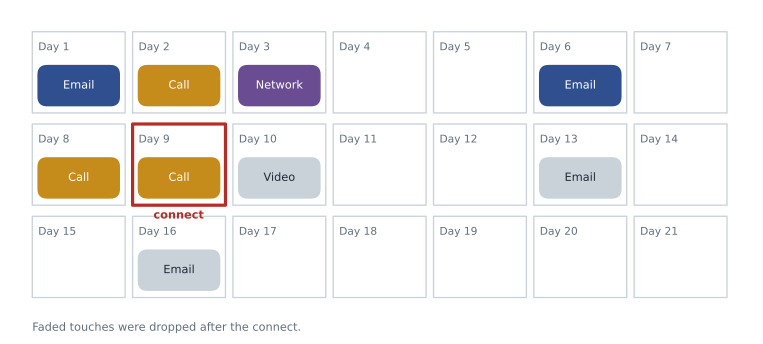
The scenario played out over eight working days. Every touch and outcome went into Ridgeline's CRM the same day, as SLS-140 taught.
| Day | Touch | Outcome |
|---|---|---|
| 1 (Nov 24) | Email 1 | Delivered; no reply |
| 2 (Nov 25) | Call 1 | Voicemail left |
| 3 (Nov 26) | Network request | Accepted on November 28 |
| 6 (Nov 30) | Email 2 with move timeline | No reply; Simone forwarded the timeline to Gareth (learned later) |
| 8 (Dec 2) | Call 2 | No answer; no voicemail left |
| 9 (Dec 3) | Call 3, late afternoon | Connected; 6-minute conversation; meeting booked for Thursday, December 10 |
| Canceled | Video, emails 3 and 4 | Not sent once the meeting was booked |
In the six-minute call, Simone said that two furniture dealers had already called her, that the move was "mostly a furniture job" in her view, and that she was not sure who would decide what. She also said, almost in passing, that Rachel had mentioned hearing good things about Ridgeline at a health committee meeting. Dr. Anand had kept his promise.
Worked problem
How many calls does it take?
Owen's team finds that a call to a business line at the right time of day reaches the person about 15 times in 100. If each call attempt is independent, what is the chance that four call attempts reach Simone at least once?
Show solution
- The chance that one call does not connect is 1 − 0.15 = 0.85.
- \[P(\text{no connect in 4}) = 0.85^4 = 0.522\]
- \[P(\text{at least one connect}) = 1 - 0.522 = 0.478\]
Answer: About 48 in 100. Even four well-timed calls fail more often than not, which is why a cadence mixes channels and why one unanswered call says nothing about the prospect's interest.
The calculation also explains why Maya moved her third call to late afternoon. Owen's team logs connect rates by hour, and operations managers in Ridgeline's data answer more often after 3:30 p.m., once the day's urgent problems are settled. Assuming independence is a simplification; a person who is never at her desk on Wednesday mornings will miss every Wednesday-morning call. Varying the time is the practical fix.
Reading the results
A results log is more than a record. It tells the seller what worked, which matters for the next account. In Maya's log, the email that mattered was the second one, which carried something useful, even though Simone never replied to it: she forwarded it to Gareth, and Gareth would later mention that the timeline was the reason he agreed to meet. The connect came on the third call, at a different time of day. The network request built familiarity but produced no conversation.
Maya's summary also flagged a risk. Simone saw the project as "mostly a furniture job", and two dealers had already called. If discovery did not widen the conversation to training, branches and printing, Ridgeline would be competing on furniture price alone, where national dealers are strong.
| Criterion | Points | Full points when | Maya |
|---|---|---|---|
| 5 | Prospect-first opening, one useful offer, one small request, compliant footer | 5 | |
| Call opener and voicemail | 4 | Honest identification, permission, one question, short voicemail | 4 |
| Network note and video | 3 | No pitch, one idea, clear request | 3 |
| Compliance | 4 | Consent and identification rules on the site applied and recorded | 4 |
| Results log and lessons | 4 | Every touch logged the same day, with what it taught | 3 |
| Total | 20 | 19 |
Maya lost a point because her log recorded outcomes but not the time of day of each call, which was the very thing that had made the difference.
Reflection
- Which of your touches carried something useful to the prospect, rather than only a request?
- What would you have done if Simone had replied, "We've already picked a furniture dealer"?
- How did you check that your messages complied with the rules on your site?
Handling the brush-off
Outreach often produces a quick refusal. In the scenario, Farida's brief for Simone allowed her to answer the first connected call in one of three ways, chosen by a dice roll so that learners could not prepare a single response: "We're fine, thanks," "Send me something," or "We've already got furniture quotes." Maya prepared for all three, using the pattern from SLS-210: acknowledge, ask one honest question, and accept the answer.
| Brush-off | Maya's prepared response | What she wants to learn |
|---|---|---|
| "We're fine, thanks." | "That's fair. Most people I call about a move are already well organized. Can I ask which part of it you're least sure about?" | Whether there is any open decision |
| "Send me something." | "Happy to. So it's actually useful, what would help most: the timeline, or examples of training rooms we've set up for agencies?" | Which topic matters to her |
| "We've already got furniture quotes." | "Good, it sounds like you're ahead. Are the quotes covering the training room and meeting-room technology as well, or just the furniture?" | Whether the scope is open |
| Any firm no | "Understood. I won't keep calling. If anything changes before the move, my number is in the email." | Nothing; respect the answer |
The last row matters most. A seller who will not accept a no turns a polite prospect into an annoyed one. Ridgeline's sales code, from SLS-150, says that a clear request to stop contact is recorded in the CRM at once and honored across every channel. In the scenario, Simone's dice roll gave "We've already got furniture quotes", which led directly to the comment that the move was "mostly a furniture job".
Warm introductions
Dr. Anand's mention of Ridgeline to Rachel was a warm introduction: a trusted person telling a prospect that a seller is worth hearing. Introductions are often the most effective way into an account, but they spend the introducer's reputation, not the seller's. Maya had asked Dr. Anand only whether he would be comfortable mentioning Ridgeline, not to recommend a product, and she thanked him afterward with a short note rather than a gift. Ridgeline's sales code limits gifts to 100 dollars a person a year in any case, and a gift to a referrer from a health committee could look like payment for the referral.
She also did not mention the introduction to Simone first. When Simone raised it, Maya said only that she had been glad to work with Northfield, without passing on anything Dr. Anand had said about Wheatland. Keeping each customer's information private is part of why customers are willing to make introductions at all.
What the log taught the team
After the stage, Owen added Maya's log to his team's library of cadences. Two patterns from it matched what his team saw across many accounts. Useful content, such as the timeline, is more likely to be forwarded than replied to, so a lack of replies is a poor measure of an email's value. And connects cluster at certain times of day for certain roles, so a cadence that varies call times does better than one that calls at the same time each day.
Owen also asked Maya to record one more number for future accounts: the elapsed time from the first touch to a booked meeting. For Wheatland it was nine calendar days, or eight working days. Across Owen's team, the median for accounts with a strong trigger was eleven working days, so this account had moved faster than usual. A seller who knows the normal speed can tell when an account is unusually warm, or unusually cold, and adjust.
Common mistakes
MistakeA strong first email makes the case for your company.
InsteadA strong first email is about the prospect and asks for one small step.
MistakeA voicemail should persuade.
InsteadA voicemail makes your next contact familiar; keep it short and clear.
MistakeNo reply means no interest.
InsteadMost connects come after several touches; a forwarded email can matter more than a reply.
MistakeOnce the meeting is booked, the cadence continues.
InsteadStop the remaining touches; continuing would feel automated.
Summary and key terms
- First outreach turns the plan into messages: a prospect-first email with one useful offer, a call opener that asks permission, a short voicemail, a network note without a pitch and a one-idea video.
- Each message follows CAN-SPAM: identification, a postal address and an opt-out, with calls dialed manually.
- Maya connected on the third call, at a different time of day, and booked discovery for December 10.
- Four well-timed calls reach a person only about 48 times in 100, which is why cadences mix channels.
- The results log records each touch and what it taught.
- Commercial email (CAN-SPAM)
- An email whose primary purpose is to advertise or promote a product or service.
- Express consent
- Consent a person gives clearly, such as ticking a box agreeing to be contacted.
- Call opener
- The first few sentences of a call, which identify the caller, give the reason and ask permission.
- Connect rate
- The share of call attempts that reach the intended person.
- Results log
- A record of each outreach touch, its outcome and what it taught.
Practice problems
Work each problem on paper first, then reveal the answer to check.
Why did Maya cancel the remaining touches after the day 9 call?
Show answer
The meeting was booked; continuing would feel automated and disrespectful of the conversation.
If each call has a 20 in 100 chance of connecting, what is the chance that three calls connect at least once?
Show answer
1 − 0.8³ = 1 − 0.512 = 0.488, about 49 in 100.
What risk did Maya flag after the call, and why does it matter?
Show answer
Simone saw the move as a furniture job; if the conversation stayed there, Ridgeline would compete on furniture price alone.
Lesson quiz · 5 questions
Score 60% or more to complete this lesson.
Create a free account to save your progress, take quizzes and earn a certificate.