
SLS-254 · Lesson 9 of 12 · 24 min
Chat and messaging sales
▶ Video coming soon A video version of this lesson is on the way.
On Wednesday, November 4, 2026, before the packing tables, Tessa had Aiden spend the first hour of the session at the chat console. A customer named Priya wanted to know whether the Halden sofa came in a deeper seat; another asked whether a fridge would fit an opening of 36 inches; a third wrote at length about a delivery that had arrived with a scratched leg. Some chats were answered first by the website's AI assistant, which the store had begun trialling in October; others came straight to a person. By the end of the hour Aiden had handled nine conversations and turned two of them into appointments. "Chat is the closest thing online to talking to someone on the floor," Tessa said. "Done well, it sells. Done badly, it loses the sale faster than a slow website."
This lesson covers conversational commerce, selling through live chat on the website, text messages, social media direct messages and video calls. It looks at what customers use each channel for, how to answer quickly and well, how to turn a chat into a sale or an appointment, how to use AI assistants responsibly, and the consent rules for following up. SLS-130 covered chat as a service channel; this lesson treats it as a selling channel. Marketing messages to many customers at once, such as text promotions, belong to SLS-257.
Why customers chat
Customers use chat when they have a question that the product page did not answer and they want the answer now, without phoning or visiting. In October 2026 Juniper & Pine's website chat handled 420 conversations. Tessa sorted them by purpose and found that most were not complaints but questions before a purchase.
| Purpose | Chats | Share |
|---|---|---|
| Questions about a product before buying (fit, fabric, features, stock) | 96 | about 23 in 100 |
| Delivery and pick-up questions on existing orders | 148 | about 35 in 100 |
| Store hours, location, financing and policies | 83 | about 20 in 100 |
| Problems and complaints (damage, delays, billing) | 61 | about 15 in 100 |
| Other | 32 | about 8 in 100 |
The 96 pre-purchase chats were the selling opportunity. Each came from a shopper who was interested enough to ask. Tessa traced what happened afterward using the order system and the clienteling app: 22 of those 96 shoppers bought the product they asked about, or a close alternative, within seven days, either online or in the store, spending an average of 820 dollars.
Worked problem
What were pre-purchase chats worth?
Of 96 pre-purchase chats in October, 22 led to a purchase within seven days, averaging 820 dollars. What was the chat-to-sale rate and the revenue traced to those chats? If the store's gross margin on those products averages 42 in 100, what gross margin was traced?
Show solution
- Chat-to-sale rate:
- \[22 \div 96 \approx 0.229\]
- Revenue traced:
- \[22 \times 820 = 18{,}040\]
- Gross margin traced:
- \[18{,}040 \times 0.42 \approx 7{,}576.80\]
Answer: About 23 in 100 pre-purchase chats led to a sale, worth about 18,040 dollars of revenue and about 7,577 dollars of gross margin in one month. That is a far higher conversion rate than any other online channel the store measures, because chatting customers are already close to a decision.
Speed matters
Chat customers expect a quick reply, and the value of a chat falls fast with waiting. A shopper who asks whether a sofa comes in a deeper seat and waits ten minutes may have moved on to another retailer's website. Juniper & Pine set a standard of a first human or AI response within one minute during store hours and a complete answer, or a clear time for one, within five minutes. Outside store hours, the chat window says when a person will reply, and messages left overnight are answered first thing the next morning.
The store's email and contact-form replies had been much slower. SLS-250 described how the average reply time to website enquiries was 31 hours in October; by mid-November, after Tessa moved enquiries into the same queue as chat and set a morning and afternoon check, it was down to about 9 hours. Tessa compared the purchase rate of enquiries answered within an hour with those answered the next day.
Worked problem
Does response time change the result?
Of 64 pre-purchase chats answered within one minute, 18 led to a purchase within seven days. Of 32 pre-purchase questions that waited more than ten minutes, or were left as messages and answered later, 4 led to a purchase. Compare the two rates.
Show solution
- Fast replies:
- \[18 \div 64 \approx 0.281\]
- Slow replies:
- \[4 \div 32 = 0.125\]
Answer: Fast replies converted at about 28 in 100 and slow replies at about 12.5 in 100, a little more than twice as high. This is not a controlled test; the slow ones were often evening questions from customers who were less ready to buy. But it points the same way as published research on speed of response to leads, and it was enough for Bev to add a second person to the chat queue on Saturday afternoons.
Selling in a chat
Chat selling uses the same steps as floor selling: greet, discover, present, handle objections and close. Writing changes how each step works. Messages must be short, because long blocks of text are hard to read on a phone. Questions should come one at a time. Links and photos can do some of the presenting. And the close is often not "buy now" but a next step: a link to the right product page, a reservation, an appointment or a fabric sample.
| Message | What it does |
|---|---|
| Customer: Does the Halden come in a deeper seat? Mine is 18 inches and my husband says it is too shallow for him. | States the need and a measurement |
| Aiden: Hi Priya, thanks for asking! The Halden only comes in one depth. Can I ask how tall your husband is and whether he likes to sit back or lounge? | Greets by name, answers directly, then asks one discovery question |
| Customer: He is 6 foot 3 and likes to put his feet up. | Gives the detail that decides the recommendation |
| Aiden: Then a deep-seat sofa will suit him better. The Arden has a 23-inch seat and a matching ottoman. Here is the page with photos and dimensions: [link] | Recommends one product with a reason and a link |
| Customer: It looks great but I want him to try it. | Raises the real objection |
| Aiden: Of course. I can hold one in the store for 48 hours, or book you a time with me on Saturday so it is set up when you arrive. Which works better? | Offers two clear next steps |
| Customer: Saturday at 11, please. | Commits to the next step |
The chat did not end in an order, but it ended in an appointment with a qualified buyer, which is often the right close for furniture. Aiden logged the appointment and the conversation in the clienteling app so that whoever met Priya on Saturday knew her husband's height and the reason for the visit.
Video appointments
Some customers cannot easily visit: they live far from the store, have mobility limits or simply prefer to shop from home. A video appointment is a scheduled video call in which an associate walks the customer through the store with a phone or tablet, shows products up close, measures them and answers questions. Juniper & Pine began offering 20-minute video appointments in November 2026, bookable from product pages. In the first two weeks Aiden ran four, two of which ended in orders. The rules are the same as for any customer visit, plus two: never show other shoppers' faces on camera, and confirm in writing afterward what was discussed, with links.
AI assistants
In October 2026 Juniper & Pine began a trial of an AI assistant on its website chat. The assistant answers routine questions, such as store hours, delivery areas, return policies and product dimensions, using only the store's approved content: product pages, policies and a knowledge base that Tessa's team maintains. It hands the conversation to a person whenever the customer asks, whenever it cannot find an answer in the approved content, and always for damage, complaints, refunds over 100 dollars, financing applications and anything involving personal health or safety.
Worked problem
How much work did the assistant take on?
In the last two weeks of October the assistant handled the first reply in 210 chats. It fully answered 80 of them; 112 were handed to a person; and in 18 the customer left before a reply. What share did it fully answer, and what share needed a person?
Show solution
- Fully answered:
- \[80 \div 210 \approx 0.381\]
- Handed to a person:
- \[112 \div 210 \approx 0.533\]
Answer: The assistant fully answered about 38 in 100 chats and handed off about 53 in 100, while about 9 in 100 customers left. That freed staff for the harder conversations without pretending the assistant could handle everything. Tessa reviews a sample of its answers each week for accuracy.
AI assistants raise two kinds of risk. The first is accuracy: an assistant can produce a confident answer that is wrong, such as a delivery time or a refund rule that does not exist. The store is responsible for what its assistant says. In Moffatt v. Air Canada, 2024 BCCRT 149, British Columbia's Civil Resolution Tribunal held Air Canada liable for a refund policy its website chatbot had described incorrectly and rejected the argument that the chatbot was responsible for its own words. The second risk is privacy: chats often contain names, addresses, phone numbers and sometimes health details, and the assistant's provider must handle them under the store's privacy commitments. Juniper & Pine tells customers when they are chatting with an AI assistant and offers a person at any point.
Following up: consent rules
A chat often ends with the customer agreeing to hear back: "Can you text me when the Arden is back in stock?" Following up by text or email is effective, and both countries regulate it.
Text messages are governed by the Telephone Consumer Protection Act and FCC rules, which require consent before sending marketing texts, require stores to honor opt-out requests made by any reasonable method, and limit the hours for marketing texts. The rules changed several times in 2025 and 2026, including an FCC order adopted on September 30, 2026 on how opt-outs apply across types of messages, so associates send texts only through the store's texting tool, which records consent and opt-outs. A text the customer specifically asked for, such as a back-in-stock alert, is the safest kind. Marketing emails must follow CAN-SPAM: accurate sender information, no misleading subject lines, a physical address and a working unsubscribe honored within 10 business days.
Personal phones are the main risk. An associate who texts customers from a personal number creates messages the store cannot see, consent it cannot prove and customer data that leaves with the associate. Juniper & Pine's rule, set when the clienteling app's texting tool was introduced, is that all customer texts go through the store's tool.
A hand-off done well
The moment when an AI assistant passes a chat to a person is where many conversations are lost. The customer has already explained the problem once and does not want to do it again. Juniper & Pine's chat tool passes the full conversation to the associate, along with the product page the customer was viewing, and the associate is expected to read it before typing anything.
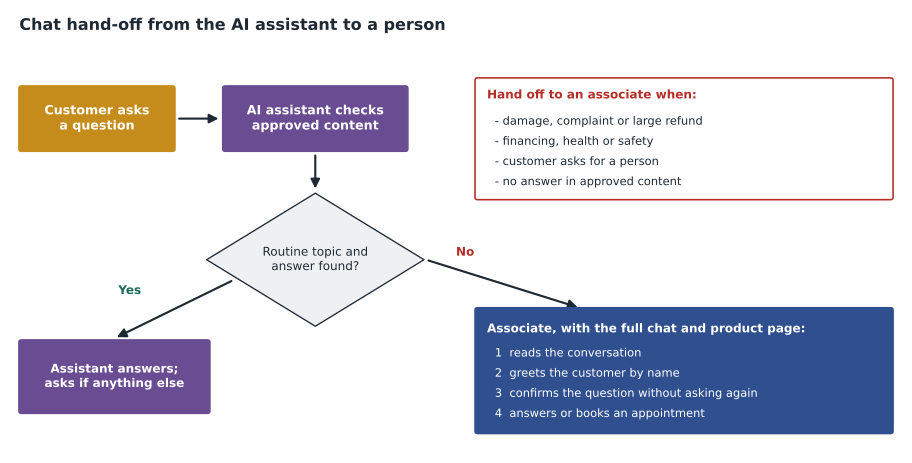
Aiden practiced the opening line until it felt natural. In one of his nine chats on November 4, the assistant had handed over a customer asking whether a sectional's chaise could be switched from the left side to the right. Instead of "How can I help you?", he wrote: "Hi Marie, this is Aiden at Juniper & Pine. I see you're looking at the Brandt sectional and want the chaise on the right. Good news: the chaise on that model can be moved to either side, and I can show you how in a quick video call or in the store. Which would suit you better?" The customer booked a store visit for that Saturday. A good hand-off greets the customer by name, shows that the associate has read what was said, answers or moves the question forward, and offers a clear next step.
Common mistakes
MistakeChat is mainly for complaints.
InsteadAt Juniper & Pine about a quarter of chats were pre-purchase questions, and they converted to sales better than any other online channel.
MistakeReply when you have time; customers will wait.
InsteadChat customers expect a reply within a minute or two, and slow replies convert at a much lower rate.
MistakeSend the whole product description in one message.
InsteadKeep messages short, ask one question at a time and use a link for the details.
MistakeThe AI assistant is responsible for its own answers.
InsteadThe store is responsible for what its assistant tells customers, so limit it to approved content and hand off hard cases.
MistakeText customers from your own phone to be quick.
InsteadUse the store's tool so consent, opt-outs and records are handled properly.
Summary and key terms
- Chat, text, social messaging and video calls let shoppers ask questions in the moment, and pre-purchase chats convert to sales at high rates.
- Response speed strongly affects results; set and staff a clear response standard.
- Chat selling follows the floor steps in short messages, and the close is often an appointment, reservation or link.
- Video appointments extend the store to customers who cannot easily visit.
- AI assistants can handle routine questions from approved content, but the store is responsible for their answers and must hand off hard cases.
- Follow-up texts and emails must follow the TCPA and CAN-SPAM, and should be sent only through the store's tools.
- Conversational commerce
- Selling through chat, text, social messaging and video conversations.
- Chat-to-sale rate
- The share of chats that lead to a purchase within a set period.
- First response time
- How long a customer waits for the first reply in a chat.
- Video appointment
- A scheduled video call in which an associate shows products to a customer remotely.
- Hand-off
- Passing a conversation from an AI assistant to a person.
- Commercial message
- Under CAN-SPAM, an email whose primary purpose is to advertise or promote a commercial product or service.
Practice problems
Work each problem on paper first, then reveal the answer to check.
Of 80 pre-purchase chats, 20 led to a purchase. What was the chat-to-sale rate?
Show answer
20 divided by 80 is 0.25, or 25 in 100.
What is often the right close in a chat about a 2,000-dollar sofa?
Show answer
A next step such as an appointment, a reservation or a fabric sample.
Name three situations in which Juniper & Pine's AI assistant must hand off to a person.
Show answer
Damage, complaints, refunds over 100 dollars, financing, and anything involving health or safety.
Why shouldn't associates text customers from personal phones?
Show answer
The store cannot record consent or opt-outs, see the messages or protect the customer data.
Lesson quiz · 5 questions
Score 60% or more to complete this lesson.
Create a free account to save your progress, take quizzes and earn a certificate.