
SLS-254 · Lesson 7 of 12 · 21 min
Social commerce
▶ Video coming soon A video version of this lesson is on the way.
On Wednesday, October 14, 2026, after the product page session, Tessa showed Aiden a short video she had posted the week before. It was 22 seconds long: a hand pulling a rust-colored throw off the back of the Halden sofa, a cushion being fluffed, a mug set down on a side table, and the words "Fall, but make it cozy" across the screen. It had been viewed about 18,000 times, far more than anything else the store had posted that month. "Views are nice," Tessa said. "But what I need to know is whether anyone bought a throw because of it, and whether the time it took was worth it." That question, how social media turns attention into sales, is the subject of this lesson.
Social commerce means selling through social media: shoppers discover products in posts, short videos, creator content and ads on platforms such as Instagram, Facebook, TikTok, Pinterest and YouTube, and either buy inside the app or follow a link to the store's website. It overlaps with social media marketing, but its focus is the sale, not just awareness. This lesson covers how shoppers buy through social media, what the main platforms offer for retailers in Canada and the United States in late 2026, how to work with creators, the disclosure rules that apply, and how to measure results.
How social media sells
Social media changes the order of the decision process from SLS-110. In a search, the shopper starts with a need and looks for a product. On social media, the product often comes first: a shopper scrolling through videos sees a throw blanket she was not looking for, and the need appears with it. Marketers call this discovery commerce. It suits products that are visual, affordable enough to buy on impulse, and easy to understand in a few seconds, such as décor, small furniture, kitchen tools and anything with a satisfying demonstration.
Social media also supplies social proof, one of the influences SLS-110 described. Seeing a product in a real home, used by someone the viewer follows and trusts, does some of the work of a review. That is why creators, also called influencers, matter in social commerce: people who post regularly to an audience that follows them for their taste or expertise. For a regional store, a local creator with 20,000 followers who mostly live within an hour's drive can be worth more than a national celebrity whose audience will never visit.
The platforms in late 2026
Social platforms change their shopping features often, and several big features have been launched and withdrawn within a few years. Facebook shut down its live shopping feature in October 2022, Instagram stopped letting creators tag products in live videos in March 2023, and in 2025 Meta phased out checkout inside Facebook and Instagram Shops, so shoppers who tap a product are now sent to the seller's own website to buy. Anyone planning social commerce should check each platform's current features before building a plan around them.
The United States has the widest range of in-app shopping. TikTok Shop has operated in the US since its full launch in September 2023, letting sellers list products that viewers buy without leaving the app. The long dispute over TikTok's ownership ended when a new US joint venture took control of TikTok's American operations on January 22, 2026, which removed much of the risk sellers had worried about.
| Platform | Shopping features | Where the sale happens |
|---|---|---|
| Instagram and Facebook | Shops, product tags in posts and short videos, ads with product catalogs | On the store's website since checkout inside the apps was phased out in 2025 |
| TikTok | TikTok Shop with in-app checkout, shoppable videos and live shopping, affiliate creators | Inside the app for TikTok Shop sellers; otherwise the website |
| Product pins from a catalog, shopping ads | On the store's website | |
| YouTube | Product tagging in videos for eligible channels, shopping ads | Usually on the store's website |
Juniper & Pine had decided not to sell inside any app. Its products, apart from décor, need advice, delivery booking and sometimes financing, and its client book depends on knowing its customers. Every social post therefore points to a product page on the store's own website, or invites viewers to visit the store. Tessa uses link tracking, adding a tag to each link so the website analytics can tell which post brought a visitor, and offers a few posts with a code to use in the store.
From views to sales
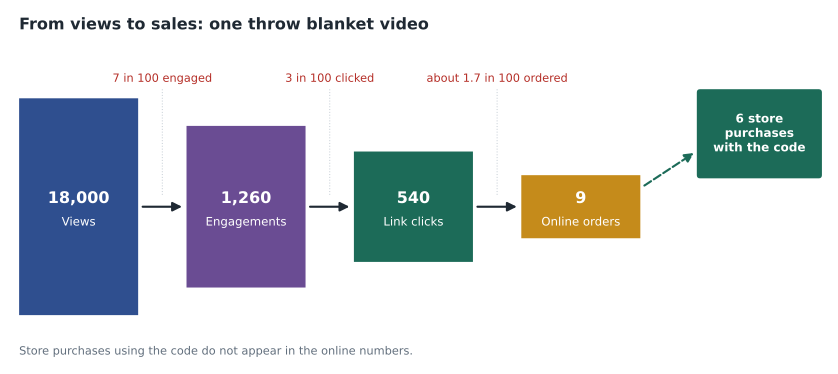
Social media produces many numbers, and most of them are about attention, not sales. Views or impressions count how many times content was shown. Engagement counts likes, comments, shares and saves. Click-through counts how many viewers followed a link. Conversions count purchases that can be traced to the post. Each step is much smaller than the one before, and the same funnel thinking from lesson 2 applies.
Worked problem
Did the throw video pay off?
The video had 18,000 views, 540 link clicks and 9 online orders averaging 180 dollars. Six more customers bought in the store using the code shown at the end of the video, spending an average of 140 dollars. The gross margin on the products sold averages 55 in 100. Making the video took Tessa about 3 hours at 32 dollars an hour, plus 60 dollars to boost it to local viewers. What was the click-through rate, the online conversion rate from clicks, and the gross margin earned compared with the cost?
Show solution
- Click-through rate:
- \[540 \div 18{,}000 = 0.03\]
- Online conversion from clicks:
- \[9 \div 540 \approx 0.0167\]
- Revenue traced to the video:
- \[9 \times 180 + 6 \times 140 = 1{,}620 + 840 = 2{,}460\]
- Gross margin earned:
- \[2{,}460 \times 0.55 = 1{,}353\]
- Cost of the video:
- \[3 \times 32 + 60 = 156\]
Answer: About 3 in 100 viewers clicked and about 1.7 in 100 clickers bought online. The traced sales produced about 1,353 dollars of gross margin against a cost of 156 dollars. This undercounts the effect, because some viewers bought later without the link or the code, and it says nothing about whether those customers would have bought anyway. It is still a clear sign that this kind of video is worth making.
Working with creators
Creators can reach audiences a store cannot reach by itself, and their recommendations often feel more trustworthy than ads. Juniper & Pine's first creator partnership, in October 2026, was with a local home-décor creator who posts room makeovers to about 24,000 followers, most of them in the city and surrounding area. She styled a reading corner with the store's products and posted a video and three photos. The store paid her 400 dollars plus 150 dollars of products she kept, and gave her a discount code for her followers.
A good creator partnership starts with fit: does the creator's audience match the store's customers, and does the creator genuinely like the products? It continues with a clear written agreement covering what will be posted, by when, payment, who owns the photos, how the partnership will be disclosed, and what the creator must not say, such as claims the store cannot support. And it ends with measurement through the creator's link and code. Tessa avoids paying for follower numbers alone, because followers can be bought and engagement can be faked; she asks creators for their audience location and engagement data, and looks at whether comments come from real people.
Worked problem
Comparing a creator post with a store post
The creator's reading-corner video had 31,000 views, 1,150 link clicks and 21 online orders averaging 165 dollars, plus 11 store purchases with her code averaging 210 dollars. It cost 550 dollars in fee and products. Gross margin averages 55 in 100. What was the gross margin per dollar spent?
Show solution
- Revenue:
- \[21 \times 165 + 11 \times 210 = 3{,}465 + 2{,}310 = 5{,}775\]
- Gross margin:
- \[5{,}775 \times 0.55 = 3{,}176.25\]
- Gross margin per dollar spent:
- \[3{,}176.25 \div 550 \approx 5.8\]
Answer: Each dollar spent returned about 5.8 dollars of gross margin from traced sales. The store's own throw video returned about 8.7 dollars per dollar (1,353 divided by 156) but reached fewer people. Both are worth repeating; one good result is not proof, so Tessa planned three more creator partnerships before deciding on a regular budget.
Disclosure rules
When a business pays or gives free products to someone who posts about it, the audience has a right to know. Both countries require clear disclosure of these material connections, and both hold the business, not just the creator, responsible.
The FTC's Guides Concerning the Use of Endorsements and Testimonials in Advertising, updated in 2023, require clear and conspicuous disclosure of any material connection between an endorser and a brand, including payment and free products. The disclosure must be hard to miss, in the post itself, using plain words such as "ad", "sponsored" or "Paid partnership with Juniper & Pine". In videos, it should be said or shown on screen, not just written in the description. The FTC's 2024 rule on consumer reviews and testimonials also allows civil penalties for fake endorsements, which lesson 10 covers.
Juniper & Pine's agreement with creators requires the platform's built-in "paid partnership" label plus a spoken or on-screen mention in videos, and gives the store the right to ask for a post to be corrected or removed if the disclosure is missing. Staff who post about the store on their personal accounts are also asked to say that they work there.
Social selling by associates
Social commerce is not only for marketing teams. Associates who build a following among their customers can share new arrivals, styling ideas and photos of rooms they helped design. Carl Jensen, the store's top commission salesperson, had for years sent photos of new arrivals to regular customers by text. In 2026 the store gave associates simple guidelines for doing this on social media: post only store-approved photos or their own; never share a customer's home or name without written permission; disclose that they work for the store; follow the store's advertising rules on prices and claims; and move any conversation about an order to the store's official channels. SLS-257 covers the marketing side of customer messaging.
Planning content that sells
Posting whenever someone has a spare moment produces uneven results. Tessa and Noura set out a simple monthly plan for the store's social accounts, built around a few repeating kinds of posts, each with its own purpose.
| Kind of post | Purpose | How often |
|---|---|---|
| Room styling video | Show products together in a real room; inspire | Weekly |
| New arrival | Announce new stock with price and a link | Twice a week |
| How-to tip | Teach something useful, such as measuring for a sectional | Weekly |
| Behind the scenes | Show the people and the store; build trust | Twice a month |
| Customer room | Share a customer's photo, with permission | Twice a month |
Every post that features a product includes its name and price in the caption, and a link where the platform allows one, because a shopper who has to search for a product is likely to give up. The how-to and behind-the-scenes posts rarely sell anything directly, but they earn followers and trust, and the store's best-selling posts were often seen first by people who had followed for the tips. Tessa reviews the plan at the end of each month, keeping the kinds of posts that brought visits and store conversations and dropping those that did not. She also keeps a list of customer questions from the sales floor, because a question asked three times in a week is a good subject for the next how-to video.
Common mistakes
MistakeA post with many views was a success.
InsteadViews measure attention; track clicks, orders and in-store purchases traced to the post.
MistakePlan around a platform feature because it exists today.
InsteadSocial platforms launch and withdraw shopping features often; check current features in each country.
MistakePay creators by follower count.
InsteadCheck audience location, real engagement and fit with the store's customers.
MistakeThe creator is responsible for disclosure, not the store.
InsteadBoth countries hold the business responsible for clear disclosure of paid or gifted posts.
MistakeSelling inside the app is always best.
InsteadIn-app checkout can mean losing the customer relationship; many stores send shoppers to their own website.
Summary and key terms
- Social commerce sells through social media, often by putting the product in front of shoppers before they knew they needed it.
- Platform shopping features differ by country and change often; in 2026 TikTok Shop operated in the US but not Canada, and Meta's shops send buyers to the seller's website.
- Social media numbers run from views to engagement, clicks and conversions, and each step is much smaller than the last.
- Link tracking and store codes let a retailer trace some sales to posts, though they always undercount.
- Creator partnerships work when audience, taste and agreement fit, and should be measured by traced sales and margin.
- Paid and gifted posts must be clearly disclosed in both countries, and the business shares responsibility.
- Social commerce
- Selling through social media platforms, in the app or by linking to the store's website.
- Discovery commerce
- Selling to shoppers who come across a product before they were looking for it.
- Creator
- A person who posts regularly to an audience that follows them for their taste or expertise; also called an influencer.
- Engagement
- Likes, comments, shares and saves on social content.
- Click-through rate
- The share of viewers who follow a link.
- Material connection
- A relationship, such as payment or free products, that might affect how an audience judges an endorsement.
Practice problems
Work each problem on paper first, then reveal the answer to check.
A post has 12,000 views and 300 link clicks. What is the click-through rate?
Show answer
300 divided by 12,000 is 0.025, or 2.5 in 100.
Why do link tracking and store codes undercount the sales a post produces?
Show answer
Some viewers buy later without using the link or code, in the store or on another device.
Name two things a creator agreement should cover.
Show answer
What will be posted and when, payment, photo ownership, disclosure and claims the creator must not make.
How should a paid partnership be disclosed in a video?
Show answer
Clearly in the video itself, said or shown on screen, as well as with the platform's label.
Lesson quiz · 5 questions
Score 60% or more to complete this lesson.
Create a free account to save your progress, take quizzes and earn a certificate.