
SLS-110 · Lesson 3 of 12 · 20 min
The consumer decision process
▶ Video coming soon A video version of this lesson is on the way.
Bev Halvorsen keeps a habit she learned from her first manager twenty years ago. In the first two minutes with any customer, she tries to answer one question silently: how far along is this person? Some customers are browsing for ideas months before a move. Some have narrowed their choice to two sofas and want to sit on both. Some have already decided and only want to check the color in daylight before paying. 'If you treat the third customer like the first,' she tells new associates, 'you'll bore them out the door. If you treat the first like the third, you'll scare them out the door.'
This lesson looks at the process consumers go through when they buy, and at how a salesperson can tell where a customer is in it. BUS-220 introduced the classic five-stage model. Here the model becomes a practical tool for the sales floor, the phone and the online chat window.
The five stages, from the seller's side
The classic model, which goes back to John Dewey's description of problem solving in 1910 and was set out for consumers by James Engel, David Kollat and Roger Blackwell in 1968, has five stages: need recognition, information search, evaluation of alternatives, the purchase decision and post-purchase behavior. Each stage asks something different of the seller.
| Stage | What the buyer is doing | Signals a seller can notice | What helps the buyer |
|---|---|---|---|
| Need recognition | Noticing a gap between how things are and how they should be | "We're just starting to think about it", talk of a move, a baby, a breakdown | Questions about the situation; ideas, not pressure |
| Information search | Learning what options exist and what matters | Broad questions, photos on a phone, comparisons with other stores | Clear explanations, honest guidance on what to look for |
| Evaluation | Comparing a short list against criteria | Going back to two or three items, asking about differences | Side-by-side comparison, trial, answers to specific doubts |
| Purchase decision | Choosing what, where, when and how to pay | Questions about delivery dates, financing, stock | Clear terms, easy checkout, confirming the choice |
| Post-purchase | Using the product and judging the decision | Calls about delivery, questions after setup, reviews | Follow-up, help with problems, reassurance |
The stages are a model, not a rule. Real buyers skip stages, loop back and move at very different speeds. A customer whose fridge died on Tuesday morning may move from need recognition to purchase in a single afternoon. A couple furnishing a new house may spend months in information search, return to need recognition when they realize the dining room is smaller than they thought, and evaluate three times before buying. The value of the model is that it gives the seller a vocabulary for the question Bev asks: where is this person right now?
Need recognition: the trigger
Every purchase starts with something that makes the gap between the current state and the desired state big enough to act on. Researchers call this a trigger, and it may be internal, such as discomfort or boredom, or external, such as an advertisement, a friend's new kitchen or a broken appliance. In retail, the most common triggers are life events: moving, marriage, a baby, children leaving home, a parent moving in, retirement. Juniper & Pine's own sales data shows that customers who mention a move or a renovation spend far more, on average, than customers who come in to replace a single item, because one change usually exposes several gaps at once.
A seller cannot create a real need, but can help a customer see a gap they had not noticed. When a customer replacing a sofa mentions that guests stay often, a question about where guests sleep may reveal a need for a sleeper sofa or a guest bed. The line between helping and pushing is the same as in lesson 1: the suggestion must be something the customer would be glad to have heard.
Information search: internal and external
Once a need is recognized, buyers search memory first. Internal search uses past experience: the brand of washer that lasted fifteen years, the store that delivered late. If memory is enough, the search stops there, which is why routine purchases are quick. If not, buyers search externally: friends and family, online reviews, retailer websites, social media and visits to stores. Most shoppers now do much of this search on their phones, often while standing in the store. Google's researchers described the online research that happens before a shopper ever contacts a seller as the zero moment of truth in 2011, and the term is still widely used.
For a salesperson, the important consequence is that customers arrive with information, some accurate and some not. A customer who has read that 'memory foam sleeps hot' or that 'induction cooktops need special pots' is partly right and partly wrong. The seller's job is not to argue with the research but to fill gaps and correct errors gently: 'You're right that some memory foam holds heat. These two models have cooling layers, and this one is a hybrid with coils, which most hot sleepers prefer. Would you like to try both?'
Evaluation: the consideration set
Buyers do not evaluate every product available. They narrow the market to a small group of options they will seriously consider, called the consideration set. Research on consumer choice going back to the 1970s has found that consideration sets are usually small, often three to five brands, even when dozens are available. A product that is not in the consideration set is unlikely to be bought, however good it is.
BUS-220 showed how buyers weigh attributes with a multi-attribute model. Salespeople see the same process in a simpler form. The customer has a handful of criteria, often unstated, and is checking each option against them. The seller's job is to discover the criteria, help the buyer apply them and, where appropriate, suggest a criterion the buyer has not thought about. For the couple with the new baby, a criterion they had not considered was whether the cushion covers zip off for washing.
Herbert Simon, the economist who won the 1978 Nobel Prize for his work on decision making, observed that people rarely search for the best possible option. They satisfice: they set a standard of 'good enough' and choose the first option that meets it. The psychologist Barry Schwartz later contrasted satisficers with maximizers, people who feel they must find the best option, and found that maximizers often end up less satisfied with their choices. Salespeople meet both. A satisficer wants to be told when an option meets the need. A maximizer wants evidence that the alternatives have been checked, and often needs reassurance after the purchase.
The purchase decision
Between choosing a product and paying for it, several things can still go wrong. Philip Kotler's textbooks describe two factors that intervene between purchase intention and the purchase itself: the attitudes of others, such as a spouse who dislikes the color, and unexpected situational factors, such as a delivery date that is too late or a financing application that is declined. In stores, the purchase stage also includes many smaller decisions: which size, which finish, which delivery window, whether to add a protection plan, how to pay.
Sellers often lose sales at this stage through friction rather than disagreement. A customer who has decided is lost if the checkout line is long, the delivery date is three weeks away and nobody mentions the floor model available tomorrow, or the financing terms are confusing. Making the decision easy is part of selling. Lesson 5 explains why too many choices at this stage can stall a customer, and why a clear default often helps.
Post-purchase: the decision is not over
After buying, people continue to judge their decision. If the product performs as expected, they feel satisfied. If it falls short, they feel disappointed, and if it exceeds expectations, they may become enthusiastic advocates. Leon Festinger's theory of cognitive dissonance, published in 1957, explains a further effect: after an important choice, people often feel uneasy about the alternatives they gave up, and they look for information that confirms their decision was right. Buyers of expensive items are particularly prone to this discomfort, which salespeople sometimes call buyer's remorse.
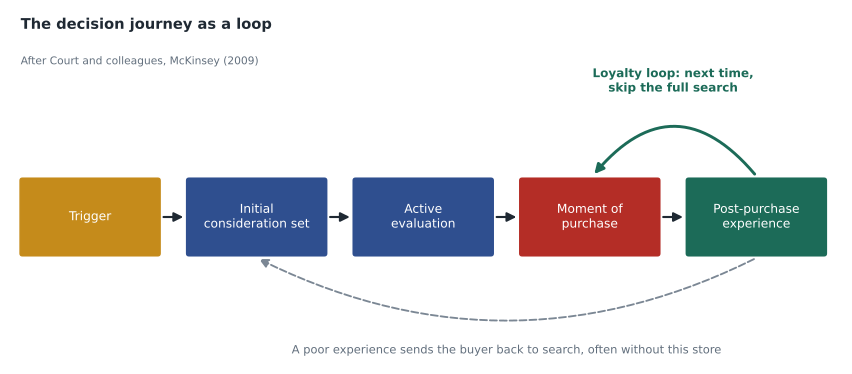
In 2009 David Court and his colleagues at McKinsey argued that the purchase journey is better pictured as a loop than as a funnel. After buying, a customer who has a good experience may skip the search next time and go straight back to the same brand or store, which the authors called the loyalty loop. A customer who has a poor experience goes back to the beginning, often with the store removed from the consideration set. For Juniper & Pine, this is why the delivery crew matters as much as the sales floor, and why Bev insists that associates call every customer who bought a mattress three weeks after delivery to ask how they are sleeping.
Worked problem
Where customers drop out on a Saturday
On a busy Saturday in October 2026, Juniper & Pine's door counter recorded 520 visitors to the furniture gallery. Associates greeted 390 of them, had a conversation of more than five minutes with 210, wrote a quote or hold for 95 and completed 62 sales. What share of visitors reached each step, and where was the biggest drop?
Show solution
- Greeted: 390 of 520 is 75 in 100 visitors.
- Conversation: 210 of 390 greeted is about 54 in 100.
- Quote or hold: 95 of 210 conversations is about 45 in 100.
- Sale: 62 of 95 quotes is about 65 in 100.
- Overall: 62 of 520 visitors is about 12 in 100.
Answer: The largest drop came between being greeted and having a real conversation: almost half of greeted visitors left without one. Bev's response was coaching on the first two minutes, in particular asking an opening question about the customer's situation rather than 'Can I help you find anything?'
Numbers like these do not show which stage each customer was at, but they help a manager see where the process is losing people. Many visitors in the early stages of a decision leave without a long conversation, and that is fine; they may return. The goal is to make sure that the customers who are ready to evaluate get the help they need, and that early-stage customers leave with a good impression and a reason to come back.
Types of decision and involvement
BUS-220 described routine, limited and extensive decision making, and how involvement, meaning the personal importance of a purchase, drives the effort a buyer puts in. On a sales floor these types show up in obvious ways. A customer buying a replacement filter for a fridge makes a routine decision and wants speed. A customer buying a dishwasher makes a limited decision and wants a few clear differences explained. A couple furnishing a whole home makes an extensive decision, may visit several times and values a salesperson who remembers them.
High involvement is not the same as high price. A modest purchase can matter enormously, such as a crib for a first child or a lift chair for a parent, and a costly one can be routine for a buyer who has done it before. Asking about the situation, rather than assuming from the price tag, tells the seller how much care the customer wants.
Reading the stage in practice
Bev's training sheet for new associates lists simple ways to read the stage. Listen to the verbs: 'thinking about', 'looking at' and 'deciding between' each place the customer differently. Watch what the customer does: wandering broadly suggests search, returning to the same two pieces suggests evaluation. Ask a light question: 'Is this the start of your search, or are you narrowing it down?' Most customers answer happily, because the question shows the seller is not going to rush them. Online and by phone, the same signals appear in the words customers use and the questions they ask.
Once the stage is clear, the seller adjusts. Early-stage customers get ideas, education and an easy way to come back. Evaluating customers get comparisons and trials. Deciding customers get clear terms and a smooth purchase. After the sale, every customer gets a follow-up. Aiden found that this approach changed how customers treated him. When he stopped trying to sell everyone on the first visit, more of them asked for him by name on the second.
Common mistakes
MistakeEvery customer should be moved toward a purchase on the first visit.
InsteadCustomers early in their decision need ideas and a reason to return, not pressure.
MistakeThe decision process is a fixed sequence of five steps.
InsteadBuyers skip, repeat and loop through the stages at very different speeds.
MistakeOnce the customer has paid, the sale is finished.
InsteadPost-purchase experience decides whether the customer comes back and what they tell others.
MistakeExpensive items are always high-involvement purchases.
InsteadInvolvement depends on personal importance, so ask about the situation rather than assume from price.
Summary and key terms
- The five stages are need recognition, information search, evaluation, purchase and post-purchase behavior.
- Each stage calls for different help from the seller, and real buyers move through them unevenly.
- Triggers, often life events, start the process; consideration sets are usually small.
- Many buyers satisfice, while maximizers need evidence and reassurance.
- Friction and the attitudes of others can stop a purchase after the choice is made.
- Post-purchase dissonance and experience shape loyalty; good experiences create a loyalty loop.
- Trigger
- An event that makes a buyer recognize a need and start the decision process.
- Consideration set
- The small group of options a buyer seriously evaluates.
- Satisficing
- Choosing the first option that meets a standard of good enough.
- Cognitive dissonance
- Discomfort after a decision, often about the alternatives not chosen.
- Loyalty loop
- A return to the same brand or store at the next purchase without a full search.
Practice problems
Work each problem on paper first, then reveal the answer to check.
A customer keeps returning to the same two recliners and asks how they differ. Which stage is this?
Show answer
Evaluation of alternatives.
What is a satisficer, and how should a seller help one?
Show answer
A buyer who chooses the first good-enough option; help by confirming when an option meets the need.
Of 300 visitors, 60 received a quote and 24 bought. What share of quotes became sales?
Show answer
24 of 60 is 40 in 100.
Why does Bev have associates call mattress buyers three weeks after delivery?
Show answer
To support the post-purchase stage, ease any doubts and build the loyalty loop.
Lesson quiz · 5 questions
Score 60% or more to complete this lesson.
Create a free account to save your progress, take quizzes and earn a certificate.