
SLS-110 · Lesson 2 of 12 · 20 min
Needs, wants and motives
▶ Video coming soon A video version of this lesson is on the way.
On a Tuesday evening in September 2026, a man in his sixties came into Juniper & Pine and asked Aiden for 'the firmest mattress you've got'. Aiden, eager to help, led him straight to the firmest model in the store, a dense hybrid that most customers find hard as a board. The man lay on it for ten seconds and got up wincing. Carl Jensen, passing by, asked a different question: 'What's making you want a firmer one?' The answer was that the man had been waking up with a sore lower back, and a friend had told him firm mattresses fix that. Carl explained that what usually helps is support that keeps the spine straight, which for a side sleeper often means a medium mattress with good support underneath and some give at the shoulder and hip. The man tried a medium-firm model, stayed on it for five minutes, and bought it with an adjustable base.
The man had asked for a product. What he needed was a night without back pain. This lesson separates those two things and adds a third, the motive: the deeper reason a person acts at all. Understanding all three is the foundation of every sales technique in later courses, from discovery questions in SLS-211 to value selling in SLS-222.
Needs, wants and requests
BUS-220 defined a need as a state of felt deprivation, a want as the form a need takes when shaped by culture and personality, and demand as a want backed by the ability to pay. Salespeople add one more layer, because buyers rarely state needs directly. They make requests. A request is the specific thing a buyer asks for: the firmest mattress, a printer that does 60 pages a minute, a quote for twenty desks. A request is the buyer's own solution to a need, and the buyer may have chosen the wrong solution.
This matters because a seller who simply fills requests is easy to replace. Any website can take an order for the firmest mattress. A seller who understands the need behind the request can suggest a better solution, catch mistakes and earn the buyer's trust. The skill is to accept the request respectfully, then ask about the need behind it, as Carl did, without making the buyer feel foolish for asking.
| Buyer | Request | Want | Need |
|---|---|---|---|
| Shopper at Juniper & Pine | The firmest mattress | A mattress like the one a friend recommended | Sleep without back pain |
| Couple expecting a baby | A light gray sofa | A sofa that looks good in a new living room | Seating that survives spills and can be cleaned easily |
| Prairie Valley school business office | Quotes for 30 new printers | Newer, faster machines | Fewer lost teaching minutes and predictable printing costs |
| Halverson Law office manager | A larger boardroom table | A boardroom that impresses clients | Room for video calls with clients who are not in the room |
Explicit and latent needs
Some needs the buyer can describe clearly: the old fridge has died, the clinic needs a printer for the new examination room. These are explicit needs. Others the buyer has not yet put into words, or has accepted as normal: the teachers who print at home because the school's machines are always broken, the family that never uses the dining room because the chairs are uncomfortable. These are latent needs. A buyer with only latent needs is not yet looking to buy, and will often say, quite honestly, that everything is fine.
Neil Rackham's research for his book SPIN Selling, based on observing more than 35,000 sales calls in the 1970s and 1980s, distinguished implied needs, which are statements of problems or dissatisfaction, from explicit needs, which are clear statements of a want or desire. In larger sales, he found that successful calls turned implied needs into explicit ones before presenting a solution. SLS-211 teaches the questioning method he developed. For now, the key idea is that a latent or implied need does not become a buying decision until the buyer recognizes it, puts a cost on it and decides that solving it is worth the trouble.
Motives: why people act
A motive is the inner drive that pushes a person to act on a need. Psychologists have proposed many lists of human motives, and salespeople have borrowed from most of them. The best known is Abraham Maslow's hierarchy, first published in 1943, which arranged needs from physiological and safety needs at the bottom through belonging and esteem to self-actualization at the top. The idea that people want different things once basic needs are met is intuitive and useful. The strict ordering is not well supported: a 1976 review of the research by Mahmoud Wahba and Lawrence Bridwell found little evidence that people satisfy needs in a fixed sequence. People buy a status watch while worrying about rent. Treat Maslow's list as a reminder of the range of human motives, not as a ladder buyers climb.
A more practical tool for salespeople is the idea of the job a customer hires a product to do. Clayton Christensen and his colleagues popularized this approach in the 2000s, arguing that customers do not buy products so much as hire them to make progress in a particular situation. Each job has three dimensions. The functional job is the practical task: keep milk cold, print report cards. The emotional job is how the buyer wants to feel: confident, relieved, proud. The social job is how the buyer wants to be seen by others: as a responsible parent, as a capable manager, as someone with good taste.
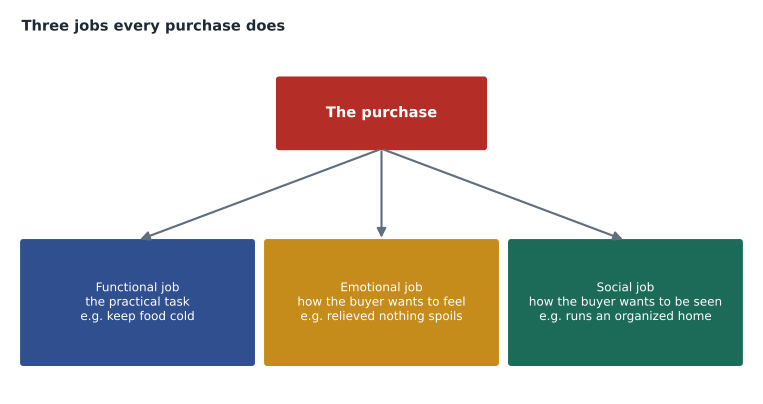
The three dimensions explain behavior that features alone cannot. Two refrigerators may keep food equally cold, yet one customer pays more for a counter-depth model in a stainless finish because the kitchen will be shown to friends, and another chooses a basic white model because the purchase is for a rental unit and nobody will see it. In business, the functional job of a managed print contract is reliable printing at a known cost. The emotional job for the business manager may be relief from monthly arguments about invoices. The social job may be appearing to the school board as someone who controls costs.
Rational and emotional motives
Older sales textbooks divided buying motives into rational ones, such as price, durability and efficiency, and emotional ones, such as pride, fear and the desire for comfort. The division is still a useful checklist, but modern research shows that the two are not separate. Antonio Damasio's studies in the 1990s of patients with damage to the brain areas that process emotion found that they struggled to make even simple decisions, even though their reasoning ability was intact. Emotion is part of how people weigh options, not an interference with it. Lesson 7 returns to this.
For a salesperson, the practical lesson is that buyers usually need both: a feeling that the purchase is right and a set of reasons they can give themselves and others. A couple may fall in love with a sofa and then look for evidence that the fabric will last. A clinic manager may feel strongly that Ridgeline's account team is more trustworthy and then build a cost comparison to justify the choice to the owners. A seller who offers only reasons misses the feeling; a seller who offers only feelings leaves the buyer without the justification they need.
Organizational and personal motives
Business buyers have the organization's motives and their own. The organization wants lower cost, better performance, less risk and compliance with its rules. The individuals involved also want things for themselves: to be seen as competent, to get credit for a successful project, to avoid blame for a failed one, to keep their workload manageable and to protect their relationships with colleagues. Sales trainers often call the individual motive the personal win.
Personal motives are not a sign of dishonesty. They are normal, and they often decide close contests. When Maya met the IT coordinator at Keystone Grain Equipment, the organizational motive for a new meeting-room system was better video calls with dealers. His personal motive turned out to be simpler: he was tired of being called away from other work every time a sales manager could not get a call started. A system that the managers could start with one button would solve the company's problem and his. Maya made sure her demonstration showed exactly that.
Worked problem
Laddering from a feature to a value
Means-end chain theory, developed by Jonathan Gutman and Thomas Reynolds in the late 1970s and 1980s, links product attributes to consequences for the buyer and then to personal values, by repeatedly asking why something matters. The couple expecting a baby say they want 'performance fabric'. Build the ladder from attribute to value.
Show solution
- Attribute: the fabric resists stains and can be cleaned with water.
- Ask why that matters. Consequence: spills from bottles and food will not ruin the sofa.
- Ask why that matters. Consequence: the couple will not have to keep the baby away from the sofa or worry about every spill.
- Ask why that matters. Value: they want a relaxed family home where everyone can be together.
Answer: The ladder runs from stain resistance to not worrying about spills to a relaxed family home. Aiden should talk about the last two steps, not only the first. 'You won't have to keep her off the couch' speaks to what the couple actually cares about.
Laddering is a research method, but its everyday form is simply asking 'why does that matter to you?' with genuine curiosity. Asked too many times, the question becomes irritating, so good salespeople vary it: 'What would that let you do?', 'What happens if it doesn't?', 'Tell me more about that.' Each answer moves the conversation from the product toward the person.
Patronage motives: why buy from you
So far the lesson has looked at why people buy a product. Patronage motives explain why they buy from a particular seller. In retail, common patronage motives include location, selection, price, delivery options, financing, the store's reputation and the salesperson. In business buying, they include the supplier's reliability, service coverage, ease of ordering, existing contracts and, very often, the relationship with the account team.
Juniper & Pine cannot win every price comparison with online retailers. It wins customers who value seeing and testing furniture, next-day delivery within the city, removal of the old mattress and a person to call if something goes wrong. Ridgeline competes against national office suppliers on price and wins when buyers value a local technician who arrives within four hours and a single invoice for printers, furniture and room technology. Knowing which patronage motives a buyer holds tells the seller which strengths to emphasize, and which customers the business is unlikely to win.
Why motives are hard to see
Buyers do not always know their motives, and they do not always share them. Some motives feel too personal to mention, such as wanting to impress a new boss or worrying about looking old. Some are socially awkward, such as preferring a supplier because a friend works there. And people are often poor at explaining their own choices: a famous 1977 review by Richard Nisbett and Timothy Wilson showed that people readily give reasons for their behavior that do not match what actually influenced them. A buyer may say that price decided the matter when the real reason was that one salesperson listened.
The practical response is humility. Treat a buyer's stated reasons as important information, but not the whole story. Ask open questions, listen to how the buyer describes the situation, notice what they return to and watch which options they linger over. When you think you have found a motive, test it gently: 'It sounds like making this easy for the managers matters as much as the picture quality. Is that right?' A buyer who hears their real concern reflected back accurately tends to trust the person who heard it.
Common mistakes
MistakeGive buyers exactly what they ask for.
InsteadRespect the request, then ask about the need behind it; the buyer may have chosen the wrong solution.
MistakeMaslow showed that people satisfy needs in a fixed order.
InsteadResearch does not support a strict order; use the list as a reminder of the range of motives.
MistakeBusiness buyers are purely rational.
InsteadOrganizational buyers also have emotional and personal motives, such as avoiding blame or saving time.
MistakeIf you ask, buyers will tell you why they buy.
InsteadPeople often cannot or will not state their real motives; listen, observe and test your understanding.
Summary and key terms
- A request is the buyer's chosen solution; the need behind it may be better met another way.
- Explicit needs are stated clearly; latent or implied needs must be recognized before the buyer acts.
- Maslow's hierarchy lists human motives, but the strict order is not supported by research.
- Products do functional, emotional and social jobs for buyers.
- Emotion and reason work together in decisions; buyers need both a feeling and reasons.
- Business buyers have organizational motives and personal wins, and patronage motives explain why they choose a seller.
- Request
- The specific product or solution a buyer asks for.
- Latent need
- A need the buyer has not yet recognized or put into words.
- Jobs to be done
- The functional, emotional and social progress a customer hires a product to make.
- Personal win
- What an individual in a buying organization hopes to gain personally from a purchase.
- Patronage motive
- A reason for buying from a particular seller or store.
- Means-end chain
- A ladder linking product attributes to consequences and personal values.
Practice problems
Work each problem on paper first, then reveal the answer to check.
What is the difference between a request and a need?
Show answer
A request is the specific thing the buyer asks for; the need is the problem or goal behind it.
Name the three dimensions of a customer job and give an example of each for a new refrigerator.
Show answer
Functional: keep food cold. Emotional: feel relieved nothing will spoil. Social: be seen as running an organized, modern kitchen.
What did Wahba and Bridwell conclude about Maslow's hierarchy?
Show answer
They found little evidence that people satisfy needs in a fixed order.
What was the IT coordinator's personal win at Keystone Grain Equipment?
Show answer
Not being called away every time a manager could not start a video call.
Lesson quiz · 5 questions
Score 60% or more to complete this lesson.
Create a free account to save your progress, take quizzes and earn a certificate.