
ROB-499 · Lesson 2 of 12 · 29 min
Problem definition, stakeholders and requirements
Most failed capstones do not fail in the lab. They fail in the first three weeks, when a team rushes from a vague idea to building hardware without agreeing what problem it is solving, for whom, and how success will be measured. This lesson covers the front end of a project: framing the problem, identifying and engaging stakeholders, turning needs into measurable requirements, prioritizing them, and tracing each requirement from need to test. ROB-360 lesson 2 covered requirements for robot software; here the scope is the whole system, including mechanical, electrical, operational and safety requirements, and the emphasis is on getting a term-sized project right.
From an idea to a problem statement
Partners usually arrive with a solution in mind rather than a problem. Port Willow Parks first asked Team Tern for "a beach-cleaning robot like the big tractors, but small". The team's first job was to understand the underlying problem. Through interviews and two site visits, they learned that the large sand-sifting tractor already cleans the lower beach weekly, but staff spend roughly 12 hours a week on foot collecting small litter near the boardwalk, picnic tables and dune fences, where the tractor cannot go. Staff also wanted data on where litter accumulates, to target bins and signage.
A good problem statement describes the need without prescribing the solution, names who has the need, and states why it matters. A common template is: who needs what, because why, under which constraints. Team Tern wrote: "Parks staff at Port Willow need a way to reduce the time spent collecting small litter on the upper beach and boardwalk edges, and to record where litter is found, because manual collection consumes about 12 staff hours a week in summer and gives no data for prevention; any solution must operate safely around beach users and wildlife and must be maintainable by parks staff." Note that this statement does not say "robot". A robot is the team's proposed solution, and the trade study in lesson 3 should compare it honestly against alternatives such as better bins or a hand-pushed sifting tool.
Problem statements also need boundaries. A term-long capstone cannot solve the full problem, so the team defines what is in scope and what is not. Tern will patrol only the upper beach and boardwalk edge, in daylight, in dry weather, at quiet times, and will collect items between about 2 cm and 15 cm that weigh under 200 g. It will not collect glass, needles or hazardous waste, which it will photograph and report instead. These boundaries become the operational design domain, a term borrowed from automated vehicles in ROB-420 lesson 1, and they protect the team from scope creep later.
Stakeholders
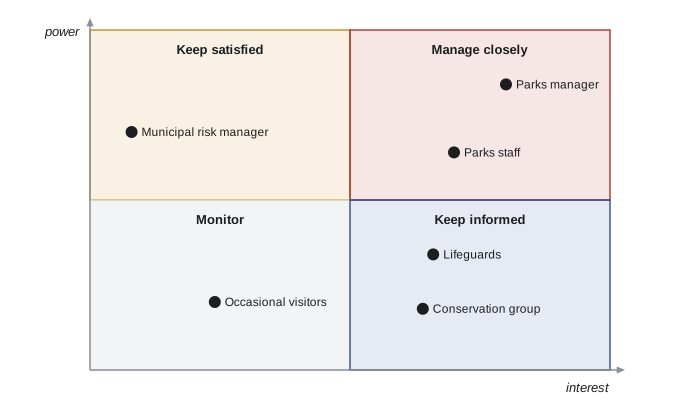
A stakeholder is anyone who affects or is affected by the project. Capstone teams tend to think only of the client, but robots in public spaces have many stakeholders. Team Tern listed parks staff who would operate the robot, the parks manager who controls the budget, beach visitors, families with small children, dog walkers, lifeguards, the municipality's risk manager and insurer, the local conservation group concerned about nesting shorebirds, the faculty advisor, the course instructor and the team itself.
Stakeholders differ in how much influence they have and how much they are affected. A power-interest grid sorts them into four groups: manage closely (high power, high interest, such as the parks manager); keep satisfied (high power, lower interest, such as the risk manager); keep informed (lower power, high interest, such as the conservation group and lifeguards); and monitor (lower power, lower interest, such as occasional visitors). The grid tells the team where to spend its limited time. It does not mean low-power stakeholders do not matter: beach visitors have little formal power over the project but their safety is a non-negotiable requirement.
To understand needs, teams use interviews, site observation, surveys and reviews of existing documents such as incident logs and maintenance schedules. Interviews work best with open questions about current practice, such as "Walk me through a typical litter round" or "What happens when you find something hazardous?", rather than leading questions such as "Would a robot help?". Observation often reveals needs people do not mention: Team Tern noticed that staff carry litter in a bag clipped to a belt and empty it every 20 minutes, which suggested the robot needed a removable bin of similar size. If you survey or interview members of the public and plan to publish or analyze the results as research, check with your institution whether research ethics review is needed; lesson 9 covers this.
Needs, requirements and specifications
Needs are statements in the stakeholder's language, such as "the robot must not scare the birds". Requirements translate needs into statements the engineering team can design to and verify, such as "the robot shall not enter the posted dune fence zone" and "the robot shall travel at no more than 0.5 m/s within 10 m of a detected bird". Specifications go further and describe how the design meets a requirement, for example the geofence implementation. Keeping these levels separate helps when requirements must change: a need is stable, while requirements may be revised as the team learns.
Requirements fall into several categories. Functional requirements say what the system must do: detect litter, navigate to it, pick it up, log its location. Performance requirements say how well: detection recall of at least 80 percent for target items, pick-up success of at least 70 percent. Interface requirements cover connections between subsystems and with the outside world: the bin must fit the parks department's standard bag, the robot must export a CSV report. Environmental requirements cover the conditions the robot must survive: sand, salt air, sun, temperatures from 5 to 35 \( ^\circ \)C, light rain. Safety requirements protect people, animals and property. Constraints limit the design space: budget, mass for one-person lifting, schedule and regulations.
| Category | Example requirement for Tern | Verification method |
|---|---|---|
| Functional | Tern shall log the GNSS position and photo of every item collected or reported. | Demonstration |
| Performance | Tern shall detect at least 80 % of target litter items within 3 m in daylight. | Test (statistical) |
| Interface | The collection bin shall accept the parks department's standard 30 L bag. | Inspection |
| Environmental | Tern shall operate on dry sand slopes of up to 10 degrees. | Test |
| Safety | Tern shall stop within 0.5 m when a person enters its protective field. | Test |
| Constraint | Tern shall have a total mass of no more than 25 kg without the bin. | Inspection (weighing) |
| Operational | A parks staff member shall be able to start a patrol in under 5 minutes after 30 minutes of training. | Test with users |
Writing good requirements
A good requirement is necessary, unambiguous, measurable, achievable within the project, and verifiable by a stated method. The SMART acronym, specific, measurable, achievable, relevant and time-bound, is widely used, although for system requirements "testable" is often more useful than "time-bound". Requirements use "shall" for mandatory statements and avoid vague words such as "fast", "robust", "user-friendly" or "as much as possible". Each requirement should state one thing; compound requirements joined by "and" are hard to verify because they can half pass.
| Weak requirement | Problem | Improved requirement |
|---|---|---|
| The robot should be fast. | Vague, not measurable, "should" is ambiguous | Tern shall cover a 100 m transect of upper beach in no more than 10 min while searching. |
| The robot shall be safe around people. | Not testable as written | Tern shall stop within 0.5 m of entering a person's protective field in 19 of 20 trials at 0.5 m/s. |
| The gripper shall pick up all litter. | Unachievable; "all" undefined | The gripper shall grasp target items (cans, caps, wrappers, 2 to 15 cm, under 200 g) with at least 70 % success on dry sand. |
| The battery shall last long enough and be easy to change. | Two requirements, both vague | Tern shall patrol for at least 90 min on one battery. A battery swap shall take under 2 min without tools. |
Numbers in requirements should come from evidence, not guesswork. The 90-minute patrol came from the parks department's morning quiet period; the 70 percent grasp target came from a quick feasibility test with a borrowed gripper and from literature on low-cost grasping on deformable surfaces; the 0.5 m stopping distance came from the safety analysis in lesson 9. When a number is a guess, label it as a target to be confirmed, and revisit it at the next design review.
Prioritizing with MoSCoW
A capstone always has more possible requirements than time. MoSCoW prioritization sorts them into must have, should have, could have and won't have this time. Must-haves define the minimum viable system that meets the core need; if any must-have is missed, the project has failed its main objective. Should-haves are important but the system is still useful without them. Could-haves are desirable extras. Won't-haves are explicitly out of scope for this term, which is as valuable as the other categories because it prevents arguments later.
A common guideline is to keep must-haves to roughly 60 percent of the planned effort, so that the remaining effort provides contingency and room for should-haves. Team Tern's must-haves were autonomous navigation along a pre-taught route, detection of cans and bottle caps, pick-up of cans, a protective stop for people, and a litter log. Wrappers, which are soft and blow around, became a should-have. Automatic docking and charging was a could-have. Night operation, rain operation and glass handling were won't-haves.
Traceability
Traceability links each requirement backwards to the stakeholder need that justifies it and forwards to the design elements that satisfy it and the tests that verify it. A requirements traceability matrix records these links. It answers three questions examiners and partners ask: why is this requirement here, which part of the design meets it, and how do we know it is met? It also exposes problems. A requirement with no linked need may be gold-plating; a need with no requirement has been forgotten; a requirement with no test cannot be verified; a design element with no requirement may be unnecessary work.
# A small requirements traceability matrix: find gaps automatically
needs = {"N1": "Reduce staff collection time", "N2": "Record where litter is found",
         "N3": "Safe around visitors", "N4": "Protect nesting birds", "N5": "Maintainable by staff"}
reqs = {  # requirement: (need, priority, design element, test)
    "R1 navigate route":        ("N1", "Must",   "nav stack",     "T1"),
    "R2 detect cans/caps 80%":  ("N1", "Must",   "detector",      "T2"),
    "R3 grasp cans 70%":        ("N1", "Must",   "gripper",       "T3"),
    "R4 log GNSS + photo":      ("N2", "Must",   "logger",        "T4"),
    "R5 protective stop 0.5 m": ("N3", "Must",   "safety lidar",  "T5"),
    "R6 dune geofence":         ("N4", "Must",   "geofence",      None),
    "R7 grasp wrappers 50%":    ("N1", "Should", "gripper",       "T7"),
    "R8 LED status light":      (None, "Could",  "status LED",    "T8"),
}
covered = {v[0] for v in reqs.values() if v[0]}
print("needs without requirements:", sorted(set(needs) - covered))
print("requirements without a need:", [r for r, v in reqs.items() if v[0] is None])
print("requirements without a test:", [r for r, v in reqs.items() if v[3] is None])
must = [r for r, v in reqs.items() if v[1] == "Must"]
tested = [r for r in must if reqs[r][3]]
print(f"must-have test coverage: {len(tested)}/{len(must)} = {len(tested)/len(must):.0%}")needs without requirements: ['N5'] requirements without a need: ['R8 LED status light'] requirements without a test: ['R6 dune geofence'] must-have test coverage: 5/6 = 83%
The script finds three problems in a few lines. Need N5, maintainability, has no requirement at all, so the team added "a parks technician shall replace the gripper fingers in under 10 minutes with standard tools". The status LED has no linked need; after discussion the team traced it to N3, because visitors and lifeguards should be able to see whether Tern is moving autonomously, which ROB-430 lesson 3 discussed. The dune geofence has no test, so the team planned a test in which Tern is commanded to a goal beyond the fence and must refuse. Real projects keep traceability in a spreadsheet, a requirements tool or the issue tracker, but the logic is the same.
Worked problem
Turning a need into verifiable requirements
The conservation group says: "The robot must not disturb the plovers." How should Team Tern turn this into requirements?
Show solution
- Clarify the need: piping plovers nest above the high-tide line from spring to midsummer; disturbance means flushing birds off nests or chicks off feeding areas.
- Derive a geographic requirement: Tern shall not enter zones marked as nesting areas in its map, verified by commanding goals inside the zone.
- Derive a behavioral requirement: if a bird is detected within 10 m, Tern shall slow to 0.3 m/s and shall not approach closer than 5 m.
- Derive an operational requirement: patrols in nesting season shall be scheduled only with the parks department's approval of the current nest map.
- Record the need as the parent of all three in the traceability matrix, and review the requirements with the conservation group.
Answer: One stakeholder need becomes three verifiable requirements, geofence, detection-and-slowing behavior and operational approval, each with a test or inspection method and traced back to the need.
Managing requirement changes
Requirements will change. Partners learn what is possible, tests reveal that a target is unrealistic, or a part arrives late. Uncontrolled change is scope creep; controlled change is good engineering. After the system requirements review in week 3, the team freezes a baseline and handles changes through a simple change log: what changed, why, who approved it, and what it affects in the schedule, budget and tests. Small capstone teams do not need a formal change control board, but they do need the discipline to record changes and to tell the partner and instructor. A requirement that quietly disappears before the final demonstration looks very different to an examiner from one that was formally descoped in week 8 with a recorded reason.
If the project involves an industry sponsor, check whether a nondisclosure or sponsored project agreement governs what the sponsor's requirements documents can be shared and published. US universities typically route such agreements through an office of sponsored programs or technology transfer, and students should not sign agreements on the institution's behalf.
Common mistakes
MistakeAccepting the partner's proposed solution as the problem statement.
InsteadInvestigate the underlying need first and write a problem statement that does not prescribe the solution.
MistakeListing only the client as a stakeholder.
InsteadIdentify everyone affected, including users, the public, regulators and maintainers, and map them by power and interest.
MistakeWriting requirements with words like fast, robust or user-friendly.
InsteadState measurable values with a verification method for each requirement.
MistakeJoining several conditions in one requirement.
InsteadWrite one requirement per statement so each can pass or fail on its own.
MistakeMaking everything a must-have.
InsteadUse MoSCoW and keep must-haves to roughly 60 % of planned effort, with explicit won't-haves.
MistakeLetting requirements change silently.
InsteadBaseline requirements at SRR and log every change with its reason, approval and impact.
Summary and key terms
- A problem statement names who needs what and why, without prescribing a solution, and is bounded by an operational design domain.
- Stakeholders include users, the public, regulators, maintainers and partners; a power-interest grid guides engagement effort.
- Needs are in stakeholder language; requirements are measurable, verifiable statements; specifications describe the design.
- Requirement categories include functional, performance, interface, environmental, safety, operational and constraints.
- Good requirements are specific, measurable, achievable, relevant and testable, use shall, and state one thing each.
- MoSCoW prioritization defines a minimum viable system and explicit exclusions.
- A traceability matrix links needs, requirements, design and tests, revealing gaps; changes after baseline are logged.
- Problem statement
- A concise description of who has a need, what the need is and why it matters, without prescribing a solution.
- Operational design domain
- The conditions, such as location, weather and time, under which a system is designed to operate.
- Power-interest grid
- A two-by-two chart classifying stakeholders by their influence and interest to guide engagement.
- Functional requirement
- A statement of what the system must do.
- Performance requirement
- A statement of how well the system must perform a function, with a measurable value.
- MoSCoW
- A prioritization method sorting requirements into must, should, could and won't have this time.
- Requirements traceability matrix
- A table linking each requirement to its source need, design elements and verification.
- Baseline
- An approved version of requirements or design against which later changes are controlled.
- Scope creep
- Uncontrolled growth of project scope without corresponding changes to time, budget or resources.
- Verification method
- The way a requirement will be shown to be met: inspection, analysis, demonstration or test.
Practice problems
Work each problem on paper first, then reveal the answer to check.
Rewrite "Build a robot that cleans the beach" as a problem statement.
Show answer
For example: parks staff need to reduce time spent collecting small litter in areas the sifting tractor cannot reach and to record where litter accumulates, within safety and maintainability constraints.
Place a lifeguard on the power-interest grid and justify it.
Show answer
Keep informed: high interest because Tern operates near swimmers and visitors, but limited formal power over the project; their input on safety is still valuable.
Classify: "Tern shall operate at temperatures from 5 to 35 degrees C."
Show answer
Environmental requirement, verified by test or by analysis of component ratings.
What is wrong with "The arm shall be precise and fast"?
Show answer
It is vague and compound; split into measurable requirements such as positioning repeatability and cycle time with values.
Give one requirement that should be a won't-have for Tern this term and explain why.
Show answer
Night operation: lighting, perception and safety would add large effort outside the core need and the term's capacity.
Why should must-haves be limited to about 60 % of planned effort?
Show answer
To leave contingency for problems and room for should-haves; if must-haves take all the effort, any slip causes failure.
In a traceability matrix, what does a requirement with no linked need suggest?
Show answer
Possible gold-plating; either find the real need it serves or remove the requirement.
Name the four standard verification methods.
Show answer
Inspection, analysis, demonstration and test.
A partner asks in week 9 for Tern to also empty bins. How should the team respond?
Show answer
Assess impact on schedule, budget and existing requirements, discuss trade-offs, record the decision in the change log and usually defer it as a won't-have this term.
Why is it useful to keep needs, requirements and specifications separate?
Show answer
Needs stay stable while requirements and designs change; separation makes changes traceable and justified.
Lesson quiz · 5 questions
Score 60% or more to complete this lesson.
Create a free account to save your progress, take quizzes and earn a certificate.