
ROB-430 · Lesson 12 of 12 · 32 min
Capstone: designing and evaluating a cobot workstation or a social robot interaction
The capstone brings the course together. You will choose one of two projects, a collaborative robot workstation or a social robot interaction, and carry it from stakeholder analysis through design and safety analysis to a complete, preregistration-ready evaluation plan and an analysis of pilot data. The deliverable is a design and evaluation report of the kind an HRI team would hand to a client, an ethics board or a journal. This lesson describes the process, works through key calculations for both project options, and gives a marking rubric so you know what a strong submission looks like.
The two project options
Option A is a collaborative workstation. A small manufacturer of electrical enclosures wants to add a collaborative robot to a manual assembly station where a worker currently drives 12 screws into each enclosure lid, a repetitive task linked to wrist strain. The robot would drive the screws while the worker positions parts, inspects and handles exceptions. You must design the station layout and task split, choose and justify the collaborative method, show that the safety numbers work, address ergonomics and accessibility, and plan a study comparing the new station with the current manual one.
Option B is a social robot interaction. A public library wants a small social robot in its lobby to greet visitors, answer common questions, guide people to sections and remind registered older adults in a weekly program about upcoming sessions. You must design the robot's interaction, including its communication channels, approach behavior and dialogue, address accessibility for visitors with disabilities and multiple languages, deal with privacy for a public space and a program serving older adults, and plan a field study of its effects on visitors and staff.
Step 1: stakeholders and context
List everyone affected, not only the primary users. For option A: assembly workers, including those on other shifts and any with disabilities; supervisors; maintenance technicians; the health and safety committee; the integrator; and the company's owners. For option B: library visitors of all ages, abilities and languages; older adults in the program and their families; front-desk staff; library management; the municipality or library board; and people who pass through the lobby without wanting to interact. For each stakeholder, note their goals, concerns and the values at stake, as in value sensitive design (lesson 11). Interviews and observation of the current situation are the best sources; in a course project, structured role-play and published studies can substitute.
Step 2: task analysis
A hierarchical task analysis breaks the overall goal into tasks and subtasks, with plans describing their order and conditions. For option A, the top goal, assemble an enclosure lid, divides into fetching a lid, placing it in the fixture, placing screws, driving screws, inspecting and unloading. Each step is then assigned to the worker, the robot or both, using the strengths of each: the robot for repetitive, precise, forceful steps; the worker for handling variable parts, judgment and exceptions. For option B, the goal, help a visitor, divides into noticing the visitor, approaching or waiting, greeting, understanding the request, answering or guiding, handing over to staff when needed and ending the interaction politely.
| Step (option A) | Assigned to | Reason |
|---|---|---|
| Fetch lid from bin | Worker | Variable part orientation; quick for a person |
| Place lid in fixture | Worker | Dexterity; checks for damage at the same time |
| Feed screws | Automatic feeder | Removes fine repetitive handling |
| Drive 12 screws | Robot | Repetitive, wrist-straining; torque must be consistent |
| Inspect screw heads | Robot vision, worker confirms exceptions | Robot flags; worker judges unclear cases |
| Unload and stack | Worker | Simple; keeps worker engaged with flow |
Step 3: requirements and risks
Turn needs into requirements that can be checked. Functional requirements say what the system must do: the station must produce at least 60 lids per hour. Safety requirements come from risk assessment. Human factors requirements address workload, reach, posture and communication: the worker must not need to reach above shoulder height, and the robot must signal before each move into the shared zone. Accessibility requirements follow lesson 10, and privacy requirements follow lesson 11. Each requirement should name how it will be verified: by calculation, inspection, test or user study.
Risk assessment follows the general method of ISO 12100: identify hazards for every task and phase of the machine's life, including setup, normal operation, cleaning, maintenance and faults; estimate risk from the severity of possible harm and the probability of its occurrence, which depends on exposure, the probability of the hazardous event and the possibility of avoiding harm; and reduce risk in the order of inherently safe design, safeguarding and complementary protective measures, then information for use. A simple risk matrix ranks hazards for attention, though formal work uses the methods in the applicable standards and in ROB-450.
Worked problem
Ranking hazards with a risk matrix
For the screwdriving station, a team scores severity S from 1 (minor) to 4 (serious, irreversible) and probability P from 1 (very unlikely) to 4 (likely). Hazards: hand clamped between screwdriver and lid (S 3, P 3); screwdriver bit ejected toward face (S 3, P 1); worker strains wrist placing lids (S 2, P 3); trip over robot cable (S 2, P 2). Rank by \( R = S \times P \) and propose a measure for the top hazard.
Show solution
- Clamping: \( 3 \times 3 = 9 \). Wrist strain: \( 2 \times 3 = 6 \). Trip: \( 2 \times 2 = 4 \). Bit ejection: \( 3 \times 1 = 3 \).
- Ranking: clamping, wrist strain, trip, bit ejection.
- For clamping, first redesign: keep the worker's hands out of the screw zone during driving with a two-position fixture or a monitored standstill while hands are present, and limit force under PFL if contact remains possible.
Answer: Clamping ranks highest at 9; the measures should follow the hierarchy, starting with a layout or fixture change, then safety functions, then training and signage.
Step 4: design concepts and safety numbers
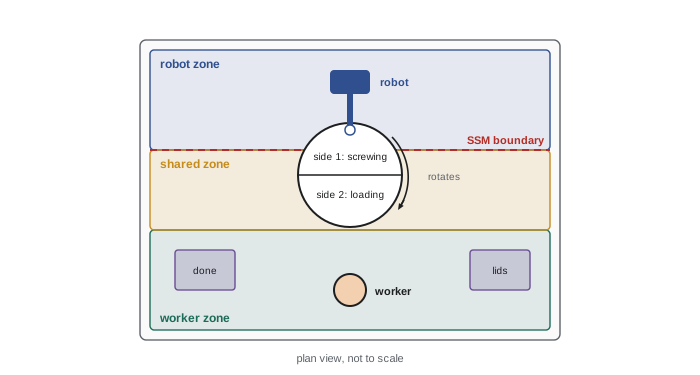
Generate at least two design concepts and compare them against the requirements. For option A, one concept might use power and force limiting with the worker and robot sharing the fixture; another might use a rotating two-position fixture so the worker loads one side while the robot screws the other, with speed and separation monitoring at the boundary. Use the formulas from lesson 4 to check that each concept is feasible, and the cycle-time reasoning to check productivity.
Worked problem
Takt time and robot cycle
The station must produce 60 lids per hour. The robot drives each screw in 3.0 s including the move between screws, and spends 4 s on approach and retract per lid. With the rotating fixture, the worker loads, inspects and unloads in 45 s per lid in parallel with the robot. Does the station meet the takt time?
Show solution
- Takt time: \( 3600/60 = 60 \) s per lid.
- Robot time per lid: \( 12 \times 3.0 + 4 = 40 \) s.
- Fixture rotation adds about 3 s, so the cycle is set by the slower of the two parallel tasks plus rotation: \( \max(40, 45) + 3 = 48 \) s.
- Margin: \( 60 - 48 = 12 \) s per lid, or 20 percent.
Answer: Yes: a 48 s cycle against a 60 s takt time, with the worker's 45 s task the bottleneck; the 20 percent margin absorbs exceptions and slowdowns.
# Concept A2 feasibility: SSM distance at the shared boundary and throughput with slowdowns
import numpy as np
rng = np.random.default_rng(430)
v_h, T_r, C, Z = 1.6, 0.08, 0.20, 0.12          # m/s, s, m (C for a sensor that detects hands), m
a_stop = 4.0
def Sp(v_r):
    T_s = v_r / a_stop
    return v_h * (T_r + T_s) + v_r * T_r + v_r**2 / (2 * a_stop) + C + Z
print(f"S_p at 0.5 m/s: {Sp(0.5):.2f} m, at 1.0 m/s: {Sp(1.0):.2f} m")
# throughput over a shift: worker time varies; occasional intrusions slow the robot to 30 %
lids, t, shift = 0, 0.0, 7.5 * 3600
while t < shift:
    worker = rng.normal(45, 6)
    robot = 40.0
    if rng.random() < 0.08:                     # 8 % of cycles: worker reaches into the shared zone
        robot += 10 / 0.3 - 10                  # 10 s of robot work at 30 % speed
    t += max(worker, robot) + 3.0; lids += 1
print(f"lids per shift: {lids}, per hour: {lids / 7.5:.1f} (target 60)")S_p at 0.5 m/s: 0.72 m, at 1.0 m/s: 1.05 m lids per shift: 541, per hour: 72.1 (target 60)
For option B, the equivalent calculations concern the interaction rather than machinery: approach distances and speeds (lesson 5), alert levels relative to lobby noise (lesson 3), screen contrast and reach ranges (lesson 10), data retention and the privacy settings for identification features (lesson 11), and the robot's capacity: how many visitors per hour it can serve if each interaction lasts two minutes and when it must hand off to staff. Physical safety still matters: a small lobby robot must meet the safety requirements for its type, avoid tipping, and keep away from stairs and children's areas.
Step 5: the evaluation plan
The evaluation plan states hypotheses, design, participants, measures, procedure, analysis and ethics, in enough detail to preregister. For option A, a strong plan compares the current manual station with the collaborative station in a within-subjects field trial with experienced workers, counterbalancing order across workers and allowing a practice period with each station to reduce novelty and learning effects. Measures could include throughput and defect rates from logs, NASA-TLX workload, the System Usability Scale, a validated trust scale, a body-part discomfort rating and video of postures coded by two raters with Cohen's kappa. For option B, a strong plan combines a field deployment of several weeks, measuring interactions from logs and coded video, with short surveys of visitors (Godspeed or RoSAS, SUS for the touch interface), interviews with staff and program participants, and attention to the novelty effect.
| Plan element | Option A (workstation) | Option B (library robot) |
|---|---|---|
| Primary outcome | NASA-TLX workload, or wrist discomfort rating | Share of visitor questions resolved without staff |
| Design | Within subjects, counterbalanced, field trial | Interrupted time series over several weeks, plus surveys |
| Participants | Assembly workers on all shifts, with consent | Visitors who choose to interact; program participants; staff |
| Other measures | Throughput, defects, SUS, trust, posture coding | Godspeed or RoSAS, SUS, interaction logs, interviews |
| Reliability | Kappa for posture coding | Kappa for coded visitor reactions |
| Ethics | REB or IRB review; voluntary participation separate from employment evaluation | REB or IRB review; signage; consent for surveys; privacy safeguards |
Both options need research ethics review under the Common Rule, 45 CFR 46, by your institution's Institutional Review Board, which also decides whether any part qualifies as exempt. In option A, participation must be genuinely voluntary: workers should not feel their job depends on taking part, and study data must not be used for performance evaluation. In option B, recording in a public library lobby raises privacy questions under state law and library confidentiality rules, which many states apply to library records; signage, minimal recording and face blurring are expected, and identification features such as face recognition would need explicit consent and, in states such as Illinois, written consent under biometric privacy law.
Worked problem
Sample size for option A
From a pilot, the team expects the collaborative station to lower NASA-TLX by 8 points, with a standard deviation of 14 points in each condition and a correlation of 0.5 between a worker's scores in the two conditions. How many workers are needed for 80 percent power at a two-sided 0.05 level? The plant has 22 assembly workers. What should the team do?
Show solution
- \( d = 8/14 \approx 0.57 \); \( d_z = 0.57/\sqrt{2(1 - 0.5)} = 0.57 \).
- \( n \approx (2.80/0.57)^2 + 1.92 \approx 24.1 + 1.9 \approx 26 \) workers.
- Only 22 are available, so power is somewhat below 80 percent; options include repeated measurement days per worker to reduce noise, recruiting from a sister plant, or reporting the study honestly as having limited power with emphasis on the confidence interval.
Answer: About 26 workers; with 22 available, the team should increase measurement reliability or sample size, or present the result as an estimate with its interval rather than a pass or fail test.
Step 6: analyzing pilot data
Before the main study, run a pilot to check procedures, measures and timing. Analyze pilot data with the planned methods, but remember that pilots are too small to estimate effect sizes precisely; use them to find problems, not to decide whether the effect exists.
# Pilot analysis for option A: paired TLX difference, SUS and coder agreement (synthetic data)
import numpy as np
rng = np.random.default_rng(430)
n = 8
worker = rng.normal(55, 10, n)
manual = np.clip(worker + 4 + rng.normal(0, 7, n), 0, 100)
cobot = np.clip(worker - 4 + rng.normal(0, 7, n), 0, 100)
d = manual - cobot
t = d.mean() / (d.std(ddof=1) / np.sqrt(n))
print(f"TLX manual {manual.mean():.1f}, cobot {cobot.mean():.1f}, mean diff {d.mean():.1f}, t({n-1}) = {t:.2f}, d_z = {d.mean()/d.std(ddof=1):.2f}")
sus = np.clip(np.round(rng.normal(74, 9, n) / 2.5) * 2.5, 0, 100)
print(f"cobot SUS scores {sus}, mean {sus.mean():.1f}")
a = rng.choice(2, 60, p=[0.7, 0.3]); b = a.copy(); flip = rng.random(60) < 0.12; b[flip] = 1 - b[flip]
po = np.mean(a == b); pe = np.mean(a) * np.mean(b) + (1 - np.mean(a)) * (1 - np.mean(b))
print(f"awkward-posture coding: agreement {po:.2f}, kappa {(po - pe) / (1 - pe):.2f}")TLX manual 63.3, cobot 55.6, mean diff 7.7, t(7) = 3.97, d_z = 1.40 cobot SUS scores [72.5 70. 62.5 75. 90. 80. 62.5 47.5], mean 70.0 awkward-posture coding: agreement 0.92, kappa 0.73
The report and rubric
The final report should run to about 4000 to 6000 words plus figures and appendices, and include: an executive summary; stakeholders and context; task analysis and allocation; requirements with verification methods; risk assessment with the main calculations (for option A, protective separation distance, PFL check where relevant and cycle time; for option B, approach parameters, capacity, accessibility checks and data flows); two design concepts and the chosen design; communication design (signals, legibility, dialogue); accessibility and privacy analyses with the applicable Canadian or US laws; the evaluation plan in preregistration form; the pilot analysis; limitations; and an ethics section. Code and data for calculations go in an appendix or repository.
| Criterion | Weight | A strong submission |
|---|---|---|
| Stakeholders and task analysis | 15 percent | Includes bystanders, maintenance and staff; justified task allocation |
| Requirements and risk | 20 percent | Checkable requirements; hazards across the life cycle; correct safety calculations |
| Interaction design | 15 percent | Redundant, tested signals; legible motion; appropriate autonomy and trust support |
| Accessibility, privacy and ethics | 15 percent | Specific barriers addressed; data minimized; laws correctly mapped for the chosen country |
| Evaluation plan | 20 percent | Specific hypotheses, appropriate design, validated measures, justified sample size, ethics review |
| Analysis and reporting | 15 percent | Correct methods, effect sizes with intervals, honest limitations, reproducible code |
Common weaknesses in past capstone projects include treating the robot as the whole system and ignoring the people around it, quoting standards without doing the calculations, using homemade questionnaires, choosing sample sizes without justification, and promising results before any evaluation. Strong projects show their reasoning, state uncertainty honestly and connect each design decision to evidence from the course.
Common mistakes
MistakeStarting the capstone by choosing a robot model.
InsteadStart with stakeholders and tasks; choose the robot to fit the allocation and requirements.
MistakeTreating risk assessment as a form to fill in at the end.
InsteadUse it from the start to shape layout, task allocation and safety functions.
MistakeClaiming a design meets throughput without modeling slowdowns.
InsteadInclude SSM slowdowns, exceptions and worker variability in cycle-time estimates.
MistakeUsing the pilot to decide whether the effect is real.
InsteadUse pilots to test procedures and measures; base conclusions on the planned main study.
MistakeIgnoring the power limits of a small workforce.
InsteadState power honestly, improve measurement reliability and emphasize confidence intervals.
Summary and key terms
- The capstone designs and evaluates either a collaborative workstation or a social robot interaction.
- Stakeholder analysis includes bystanders, staff, maintenance and decision-makers as well as primary users.
- Hierarchical task analysis supports allocating steps between people and robots by their strengths.
- Requirements must be checkable; risk assessment follows identify, estimate and reduce, in a hierarchy of measures.
- Safety and productivity calculations, such as protective distance and takt time, test design concepts.
- The evaluation plan specifies hypotheses, design, measures, sample size, analysis and ethics review.
- Pilots test procedures; the report connects every decision to evidence and states limitations honestly.
- Stakeholder
- Anyone affected by or able to affect a system.
- Hierarchical task analysis
- A breakdown of a goal into tasks, subtasks and plans.
- Task allocation
- Assigning task steps to people, robots or both.
- Takt time
- Available production time divided by required output.
- Risk matrix
- A table combining severity and probability to rank hazards.
- Hierarchy of measures
- Reducing risk by inherent design first, then safeguards, then information.
- Pilot study
- A small preliminary study to test procedures and measures.
- Interrupted time series
- A design comparing measurements before and after an intervention over time.
- Preregistration
- A public, time-stamped record of hypotheses and analysis plans.
- Verification method
- The calculation, inspection, test or study used to show a requirement is met.
Practice problems
Work each problem on paper first, then reveal the answer to check.
Required output 90 per hour: takt time?
Show answer
40 s.
Robot: 10 screws at 2.5 s plus 5 s; worker 32 s; rotation 2 s. Cycle?
Show answer
\( \max(30, 32) + 2 = 34 \) s.
Severity 4, probability 2: risk score in a 4 by 4 matrix?
Show answer
8.
Order the hierarchy of risk reduction.
Show answer
Inherently safe design, safeguarding and complementary measures, information for use.
Name three stakeholders for the library robot besides visitors.
Show answer
Staff, program participants and families, management, the library board, passers-by.
Why should workers' study data not be used for performance evaluation?
Show answer
Participation must be voluntary and free of pressure, as ethics review requires.
\( d_z = 0.6 \): approximate n for 80 percent power?
Show answer
\( (2.8/0.6)^2 + 1.9 \approx 24 \).
Give two measures suitable for option A.
Show answer
NASA-TLX, SUS, trust scale, throughput, defects, discomfort, posture coding.
What is a pilot study for?
Show answer
Testing procedures, measures and timing, not estimating effects precisely.
Name a verification method for "the worker must not reach above shoulder height".
Show answer
Inspection of the layout with anthropometric data, or observation in a trial.
Lesson quiz · 5 questions
Score 60% or more to complete this lesson.
Create a free account to save your progress, take quizzes and earn a certificate.