
RAC-330 · Lesson 6 of 12 · 18 min
Cooling loads
Irene Novak's second question, a week after the first, was about summer. "The heat pump was sized for heating, which I understand now," she wrote. "But it also cools. How do you know it isn't too big for cooling? My neighbor's air conditioner makes his house feel like a cave: cold and damp." Theo brought the cooling side of the calculation to the next visit. It was, he discovered, a different kind of problem from the heating load, with more parts and more judgment.
This lesson explains the parts of a cooling load: heat through the envelope, which the sun makes larger and later than a simple temperature difference suggests; solar gain through windows; heat from people, lighting and appliances; and outdoor air, which brings moisture as well as heat. It shows why sensible and latent loads are calculated separately, and works through the Novak house's summer load.
Why cooling loads are different
A heating load is close to a steady-state problem: on a cold night the outdoor temperature changes slowly, the sun is down and internal gains are ignored. A cooling load changes through the day. The sun moves across the sky, heating the east walls and windows in the morning and the west in the afternoon; heat absorbed by walls and roofs reaches the inside hours after the sun has struck them; and people, cooking and appliances add heat at particular times. The cooling equipment must handle the peak of all these together, which usually comes in the late afternoon in houses with a lot of west glass.
Cooling loads also have two parts. The sensible load raises the indoor temperature; the latent load raises the indoor humidity. The equipment must remove both, and lesson 3 showed that a coil's sensible heat ratio sets how it divides its capacity. Equipment selected for the total load but with too high an SHR for the house leaves the air damp.
Design conditions
The summer design conditions for Louisville in Manual J's tables are about 92 °F dry bulb with a coincident wet bulb of about 75 °F, the 1 % values, and a daily temperature range classed as medium. Manual J uses an indoor design of 75 °F and about 50 % relative humidity. As with heating, the design conditions are not the hottest day on record but a hot day that is exceeded only occasionally.
Envelope gains and the sun
Heat flows in through walls and roofs by conduction, like heat loss in winter, but the outdoor surface is much hotter than the outdoor air when the sun is on it. A dark roof in summer sun can reach 140 to 160 °F. And because walls and roofs store heat, the peak gain reaches the room hours after the peak sun. Load methods account for both effects by using an equivalent temperature difference, also called a cooling load temperature difference, CLTD: a larger temperature difference than the air alone would give, taken from tables for each construction type, orientation and time of day. A vented attic above an insulated ceiling has a large equivalent temperature difference, because the attic air gets very hot.
Windows gain heat in two ways: conduction, from the outdoor-indoor temperature difference, which uses the window's U-value and the air temperature difference; and solar gain, sunlight passing through the glass. Solar gain is usually the largest single part of a house's cooling load. It depends on the window's orientation, its solar heat gain coefficient, SHGC, which is the fraction of incident solar heat that gets through, and on shading by overhangs, trees, blinds and drapes. The standards give peak solar factors for each orientation and glazing type, already combined with typical interior shading, so the solar gain is simply the glass area times the factor.
West windows are the worst in a house, because the afternoon sun is low and strikes them nearly straight on at the same time as the outdoor air is hottest. East windows get a similar sun in the morning when the air is cooler. South windows in summer get a high sun that overhangs easily shade. North windows get mostly diffuse light.
Internal gains
People give off sensible heat, which warms the air, and latent heat, the moisture from breathing and perspiration. A seated adult gives off about 230 Btu/h sensible and 200 Btu/h latent, more when active. Houses are normally calculated for the number of bedrooms plus one occupants. Lighting and appliances add sensible heat, and cooking adds both heat and moisture; the standards give allowances for a typical kitchen and household equipment rather than counting every appliance.
In commercial buildings internal gains are often the largest part of the cooling load: lighting, computers, servers, kitchen equipment and, at the clinic, sterilizers, compressors and dental equipment. The clinic's original design had counted them room by room, which is why the operatories had been given a larger share of the airflow than the waiting room.
Outdoor air: sensible and latent
Air that leaks in, or is brought in for ventilation, must be cooled from outdoor to indoor temperature, a sensible load, and dried from outdoor to indoor humidity ratio, a latent load. In a humid climate the latent part is often larger than the sensible part, because outdoor air carries much more moisture than indoor air. The latent load is the airflow times the difference in humidity ratio times the heat of condensation of water.
Q_{\text{latent}} = 0.68 \times \dot{V} \times (W_{\text{out}} - W_{\text{in}}) \quad \text{Btu/h } (\dot{V}\ \text{in cfm},\ W\ \text{in grains/lb})
Summer air leakage is lower than winter leakage, because the stack effect is weaker when indoor and outdoor temperatures are close, so load methods use a smaller natural air change rate in summer. A house with mechanical ventilation adds the ventilation air, reduced by an ERV's recovery of heat and moisture.
The Novak cooling load
Theo had done the cooling calculation with the heating one, in the same software, and now reproduced it line by line for Irene. The equivalent temperature differences and solar factors came from the standard's tables for the Novaks' construction, orientation and blinds; the summer air leakage was a smaller fraction of the blower door result than in winter; and the occupants were the standard four for a three-bedroom house.
import math
def p_atm(z_m):
    """Standard atmospheric pressure, kPa, at an elevation in meters (feet x 0.3048)."""
    return 101.325 * (1 - 2.25577e-5 * z_m) ** 5.2559
def pws(t):
    """Saturation pressure of water vapor over water, kPa, t in deg C (Magnus form)."""
    return 0.61094 * math.exp(17.625 * t / (t + 243.04))
def w_from_rh(t, rh, p):
    """Humidity ratio, kg of water per kg of dry air."""
    pv = rh * pws(t)
    return 0.622 * pv / (p - pv)
def pv_from_w(w, p):
    return w * p / (0.622 + w)
def dew_point(pv):
    a = math.log(pv / 0.61094)
    return 243.04 * a / (17.625 - a)
def enthalpy(t, w):
    """kJ per kg of dry air."""
    return 1.006 * t + w * (2501 + 1.86 * t)
def spec_volume(t, w, p):
    """Cubic meters per kg of dry air."""
    return 0.287042 * (t + 273.15) * (1 + 1.607858 * w) / p
def wet_bulb(t, w, p):
    """Thermodynamic wet-bulb temperature found by bisection."""
    lo, hi = -40.0, t
    for _ in range(60):
        m = (lo + hi) / 2
        ws = w_from_rh(m, 1.0, p)
        wc = ((2501 - 2.326 * m) * ws - 1.006 * (t - m)) / (2501 + 1.86 * t - 4.186 * m)
        lo, hi = (lo, m) if wc > w else (m, hi)
    return (lo + hi) / 2
def rel_humidity(t, w, p):
    return pv_from_w(w, p) / pws(t)
def c(f): return (f - 32) / 1.8
def f(c_): return c_ * 1.8 + 32
def h_ip(t_c, w):
    """Enthalpy in Btu per lb of dry air (0 deg F datum)."""
    return enthalpy(t_c, w) * 0.4299 + 7.686
GR = 7000   # grains per lb

P = p_atm(460 * 0.3048)
out_db, out_wb = 92.0, 75.0        # Louisville summer design, dry bulb and coincident wet bulb
in_db, in_rh = 75.0, 0.50          # Manual J indoor cooling design
ws = w_from_rh(c(out_wb), 1.0, P)
w_out = ((2501 - 2.326 * c(out_wb)) * ws - 1.006 * (c(out_db) - c(out_wb))) / (2501 + 1.86 * c(out_db) - 4.186 * c(out_wb))
w_in = w_from_rh(c(in_db), in_rh, P)
dT = out_db - in_db
sens = {}
sens["walls (UA 135, equivalent difference 20 F)"] = 135 * 20
sens["attic ceiling (UA 65, equivalent difference 45 F)"] = 65 * 45
sens["window conduction (UA 104)"] = 104 * dT
glass = {"north": (43, 14), "east": (32, 45), "south": (54, 30), "west": (43, 58)}   # ft2, Btu/h per ft2 of glass
sens["window solar"] = sum(a * f for a, f in glass.values())
leak = 0.22 * 20800 / 60                    # cfm: 0.22 air changes per hour in summer
sens["air leakage, sensible"] = 1.08 * leak * dT
sens["people (4 x 230 Btu/h)"] = 4 * 230
sens["appliances and lighting"] = 3000
lat = {"air leakage, latent": 0.68 * leak * (w_out - w_in) * GR, "people (4 x 200 Btu/h)": 4 * 200}
for k, v in list(sens.items()) + list(lat.items()):
    print(f"{k:52s} {v:7,.0f} Btu/h")
S, L = sum(sens.values()), sum(lat.values())
print(f"outdoor {w_out * GR:.0f} gr/lb, indoor {w_in * GR:.0f} gr/lb, leakage {leak:.0f} cfm")
print(f"sensible {S:,.0f} Btu/h, latent {L:,.0f} Btu/h, total {S + L:,.0f} Btu/h, SHR {S / (S + L):.2f}")
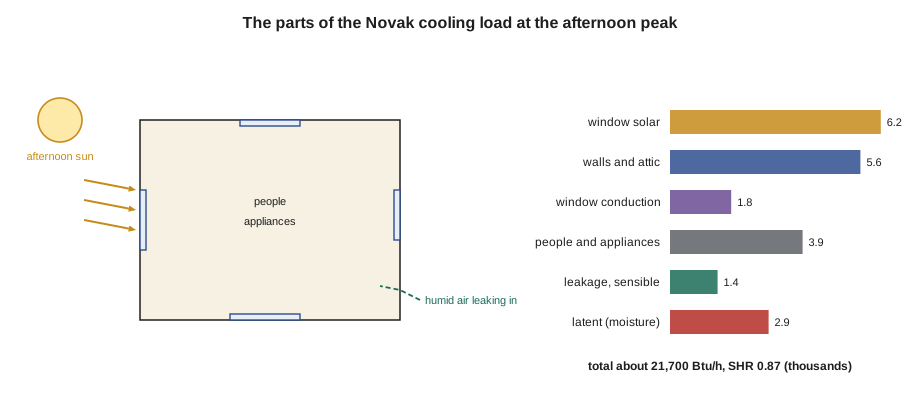
print(f"west glass alone is {glass['west'][0] * glass['west'][1] / (S + L):.0%} of the total")walls (UA 135, equivalent difference 20 F) 2,700 Btu/h attic ceiling (UA 65, equivalent difference 45 F) 2,925 Btu/h window conduction (UA 104) 1,768 Btu/h window solar 6,156 Btu/h air leakage, sensible 1,400 Btu/h people (4 x 230 Btu/h) 920 Btu/h appliances and lighting 3,000 Btu/h air leakage, latent 2,057 Btu/h people (4 x 200 Btu/h) 800 Btu/h outdoor 105 gr/lb, indoor 66 gr/lb, leakage 76 cfm sensible 18,869 Btu/h, latent 2,857 Btu/h, total 21,726 Btu/h, SHR 0.87 west glass alone is 11% of the total
The cooling load came to about 21,700 Btu/h, which the design summary had rounded to 22,000: about 18,900 Btu/h sensible and 2,900 Btu/h latent, an SHR of 0.87. The window solar gain, at 5,800 Btu/h, was more than a quarter of the total, and the 43 square feet of west glass alone were 11 %. The cooling load was about three-quarters of the heating load, which is typical of houses in Kentucky.
That answered Irene's question. The heat pump's nominal cooling capacity was three tons, 36,000 Btu/h, about two-thirds more than the cooling load. A single-speed system that size would have run in short cycles, satisfying the thermostat before the coil had time to remove much moisture. The variable-speed system ran at low capacity for long periods in summer, which kept the coil cold and wet and let it dehumidify. RAC-320 lesson 7 had chosen the equipment with this in mind; this lesson showed where the cooling numbers came from.
Cooling load and equipment selection
Equipment for cooling is selected from the manufacturer's extended data at the design outdoor temperature and the indoor wet bulb, so that both its sensible and its total capacity meet the calculated loads. Manual S sets limits on how much the cooling capacity may exceed the total load, typically about 115 % for air conditioners and somewhat more for heat pumps where the heating load governs, and requires the latent capacity to meet the latent load. Where a heat pump must be oversized for cooling to meet a cold-climate heating load, variable-speed equipment and a thermostat with a dehumidification feature are the usual answers.
Oversized cooling is a common source of humidity complaints in houses and small commercial buildings. The neighbor's cold, damp house was a textbook case: a large single-speed air conditioner, short cycles, little dehumidification. A smaller unit, or a variable-speed one, would have run longer and dried the air better while using less energy.
Commercial cooling loads
Commercial cooling loads use the same physics but more elaborate methods. The radiant time series method in the ASHRAE Handbook, and the heat balance method on which it is based, account for heat stored in the building and released hours later, and are done hour by hour for a design day in each month to find the peak. Software does the work. The inputs are the same as for a house, only more of them: lighting and equipment power densities, occupancy schedules, ventilation rates from ASHRAE 62.1, and the building's construction and glazing. The clinic's original load calculation, which Marcus found in the drawings, had been done this way; its operatory loads included about 5,000 Btu/h of equipment each, which helped explain their humidity problem in lesson 3.
Common mistakes
MistakeCalculating cooling loads with the outdoor air temperature difference alone.
InsteadUse equivalent temperature differences and solar factors that include the sun and heat storage.
MistakeIgnoring the latent load.
InsteadCalculate sensible and latent loads separately and check the equipment meets both.
MistakeTreating all windows alike.
InsteadUse orientation and shading; west glass usually dominates the peak.
MistakeOversizing cooling equipment for safety.
InsteadSelect from extended data close to the load; oversizing leaves rooms damp.
MistakeUsing winter air leakage for summer loads.
InsteadSummer leakage is lower; use the standard's summer method.
Summary and key terms
- Cooling loads change through the day; the peak usually comes in the late afternoon.
- Walls and roofs use equivalent temperature differences that include sun and heat storage.
- Window solar gain depends on orientation, SHGC and shading and is often the largest single load.
- People, lighting and appliances add sensible heat; people and cooking also add moisture.
- Outdoor air brings sensible and latent loads; in humid climates the latent part can dominate.
- Equipment must meet both sensible and latent loads; oversizing leaves spaces cold and damp.
- Cooling load
- The rate at which heat and moisture must be removed to hold indoor design conditions.
- Sensible load
- The part of the cooling load that raises indoor temperature.
- Latent load
- The part of the cooling load that raises indoor humidity.
- Solar heat gain coefficient (SHGC)
- The fraction of incident solar heat that passes through a window.
- Equivalent temperature difference (CLTD)
- A temperature difference that includes solar heating and heat storage, used for wall and roof gains.
- Internal gains
- Heat and moisture from people, lighting and equipment inside a building.
- Coincident wet bulb
- The wet-bulb temperature that typically occurs with the design dry-bulb temperature.
Practice problems
Work each problem on paper first, then reveal the answer to check.
West glass of 43 ft² has a solar factor of 58 Btu/h·ft². What is its solar gain?
Show answer
About 2,500 Btu/h.
80 cfm of outdoor air at 105 gr/lb enters a house kept at 66 gr/lb. What is the latent load?
Show answer
0.68 × 80 × 39 ≈ 2,100 Btu/h.
Why do roofs use a larger equivalent temperature difference than the outdoor air would suggest?
Show answer
Sun heats the roof surface well above air temperature, and stored heat arrives later.
Why can an oversized air conditioner leave a house damp?
Show answer
It satisfies the thermostat in short cycles before the coil removes much moisture.
Lesson quiz · 5 questions
Score 60% or more to complete this lesson.
Create a free account to save your progress, take quizzes and earn a certificate.