
RAC-220 · Lesson 8 of 12 · 17 min
Evacuation and dehydration
The clinic's rooftop unit needed a new indoor coil after a slow leak in its tubes, and Raj sent Theo to do the evacuation while he finished the brazing on another job. Theo hooked up the vacuum pump, ran it for forty minutes, closed the valve and watched the micron gauge climb from 500 microns to 3,000 microns in under five minutes. His first thought was a leak. His second, after he remembered the coil had been open to rain for a day before the replacement arrived, was water. "Good," Raj said when Theo called. "Now prove which one it is. The decay test will tell you if you read it right."
Evacuation removes air, nitrogen and moisture from a refrigeration system before it is charged. Air and nitrogen are non-condensables that raise head pressure and reduce capacity; moisture reacts with refrigerants and oils to form acids, freezes at metering devices and attacks motor insulation. A good evacuation is the foundation of every charge in this course. This lesson covers the physics of evacuation and dehydration, the tools, the procedure, the standing decay test and how to read it, and the care of vacuum pumps.
Why vacuum removes moisture
Water boils when its vapor pressure equals the pressure around it. At sea level that happens at 212 °F. Lower the pressure and water boils at a lower temperature. At about 17 mm Hg, water boils at room temperature, near 68 °F, and at about 1,000 microns it boils at roughly 1 °F. A vacuum pump lowers the system's pressure enough that liquid water in it boils away at the ambient temperature, and the vapor is drawn out by the pump. That is dehydration. Pulling the air out is called degassing. Evacuation does both.
Pressure in deep vacuum is measured in microns of mercury, a thousandth of a millimeter of mercury, or in pascals. One micron is about 0.133 pascal, so 500 microns is about 67 Pa, and atmospheric pressure is about 760,000 microns. Compound gauges on a manifold cannot read anywhere near these levels; an electronic micron gauge, connected as close to the system as possible, is required.
| Pressure | Microns of mercury | Water boils at about |
|---|---|---|
| Atmosphere, 14.7 psia | 760,000 | 212 °F |
| 0.33 psia | 17,500 | 68 °F |
| 0.089 psia | 4,600 | 32 °F |
| 0.019 psia | 1,000 | 1 °F |
| 0.0097 psia | 500 | −12 °F |
The tools
- A two-stage rotary vane vacuum pump, sized for the system. Larger systems need larger pumps; a small pump on a large system takes a very long time.
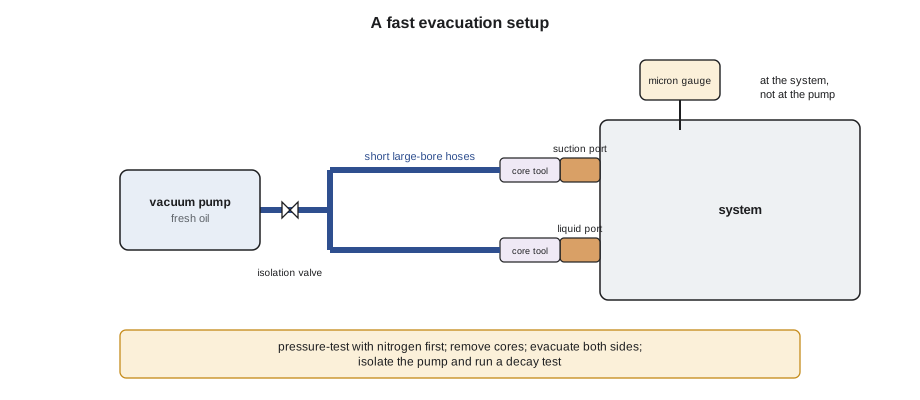
- An electronic micron gauge, connected directly to the system through a valve core tool or isolation valve, not at the pump.
- Valve core removal tools, which let the hoses connect to the system without the restriction of the Schrader cores. Cores are the biggest restriction in most evacuation setups.
- Short, large-diameter vacuum-rated hoses. Standard charging hoses with their small bores and low-loss fittings restrict flow and can leak at deep vacuum. Flow through a hose at low pressure falls sharply with smaller diameter and longer length.
- A vacuum-rated manifold or, better, no manifold: many technicians connect the pump through core tools and short hoses directly, with the micron gauge on a separate core tool.
A good evacuation procedure
- Start with a nitrogen pressure test, as RAC-210 described, so you know the system is tight before you evacuate. A vacuum is not a leak test; it can pull water and air in through a small leak while hiding it.
- Remove the valve cores, connect short, large hoses to both the high and low side, and connect the micron gauge at the system side.
- Check that the pump's oil is clean and filled to the mark, and start the pump with its gas ballast open if it has one, closing it once the pressure falls, as the pump's instructions describe. Gas ballast helps prevent moisture from condensing in the pump's oil.
- Pull down until the micron gauge reaches the target. Many equipment manufacturers and industry guidance call for 500 microns or lower; some specify different values, and the manufacturer's value takes priority.
- Isolate the pump from the system with a valve and watch the micron gauge for a decay test, typically for at least ten to fifteen minutes, longer on large systems.
- If the system holds within the acceptable rise, break the vacuum with refrigerant, reinstall the cores and charge as described in lesson 9.
Warming the system helps. Moisture boils off faster when the system is warm, so on a cold day a heat gun or work light on cold parts, or running the indoor fan with heat in a heat pump's indoor section, can speed dehydration. Evacuating from both sides speeds the process and ensures parts isolated by closed valves, such as a stepper EEV or a solenoid, are reached; lesson 5 described the special steps for EEV systems.
Triple evacuation
Triple evacuation is a method used when a system is known to be wet or when a deep vacuum is hard to reach. The system is evacuated to a moderate vacuum, then the vacuum is broken with dry nitrogen to slightly above atmospheric pressure, and the process is repeated, with the final evacuation going to the full target. The dry nitrogen absorbs moisture and sweeps it out, and each cycle dilutes whatever air and water vapor remain. It is also a common choice for systems that have been open for a long time, flooded, or recovered from a burnout.
The decay test: leak or moisture?
After the pump is isolated, the pressure in the system rises. How it rises tells you what is inside.
- A tight, dry system rises a little and levels off at a low value, typically within a few hundred microns of where it started, and stays there. Many guides accept a rise that settles below about 1,000 microns or the manufacturer's value.
- A tight but wet system rises quickly at first as remaining water boils, then levels off at the vapor pressure of water at the system's temperature, often several thousand microns. The curve flattens: moisture is still in the system, so continue evacuating, warm the system or use triple evacuation.
- A leaking system rises steadily and keeps rising in a straight line toward atmospheric pressure, because air keeps entering at a steady rate. Find and repair the leak, and pressure-test with nitrogen before evacuating again.
# Read a decay test: microns recorded every minute after isolating the pump
tests = {
    "tight and dry": [480, 560, 610, 640, 655, 665, 670, 672, 674, 675, 676],
    "wet":           [500, 1500, 2300, 2800, 3100, 3250, 3330, 3370, 3390, 3400, 3405],
    "leak":          [500, 900, 1310, 1700, 2120, 2510, 2930, 3320, 3740, 4130, 4550],
}
for name, r in tests.items():
    first_half = r[5] - r[0]
    second_half = r[10] - r[5]
    ratio = second_half / first_half if first_half else 0
    if r[-1] < 1000 and second_half < 50:
        verdict = "passes: low and level"
    elif ratio < 0.3:
        verdict = "leveling off high: moisture remains, keep evacuating or warm the system"
    else:
        verdict = "steady rise: leak, pressure-test and repair"
print(f"{name:14s}: start {r[0]:5d}, after 5 min {r[5]:5d}, after 10 min {r[10]:5d} microns -> {verdict}")tight and dry : start 480, after 5 min 665, after 10 min 676 microns -> passes: low and level wet : start 500, after 5 min 3250, after 10 min 3405 microns -> leveling off high: moisture remains, keep evacuating or warm the system leak : start 500, after 5 min 2510, after 10 min 4550 microns -> steady rise: leak, pressure-test and repair
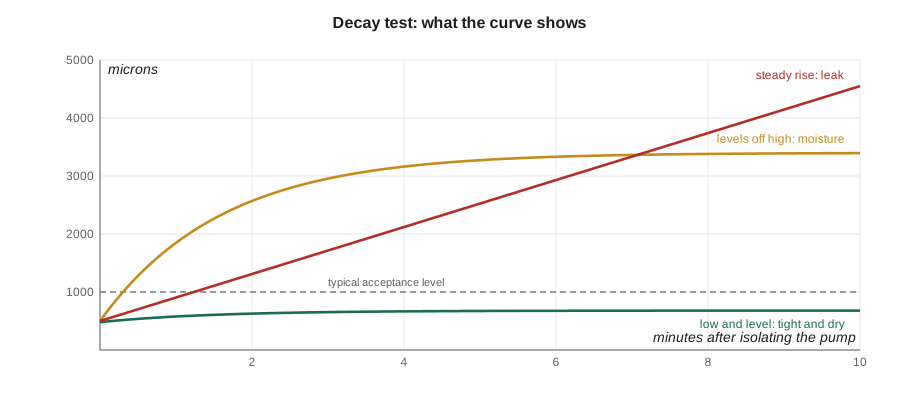
The difference between the second half and the first half of the test is the key. Moisture produces a curve that bends over; a leak produces a straight line. A combination, wet and leaking, rises fast and then keeps rising, which is why a nitrogen pressure test before evacuation saves so much time: it removes the leak question before the moisture question is asked.
Caring for the vacuum pump
- Change the pump oil often, ideally after every wet or contaminated evacuation and before deep vacuum work. Moisture and acids dissolved in the oil ruin the pump's ultimate vacuum; fresh oil can make a slow pump fast again.
- Use the vacuum pump oil the pump's maker specifies, and drain it while warm.
- Never run a vacuum pump on a system that still contains refrigerant; recover first, as RAC-120 required.
- Check the pump against the micron gauge alone, with the gauge connected directly to the pump's inlet, to know what the pump can reach. A pump that cannot reach a low value on its own will not reach it on a system.
- Close the pump's isolation valve before shutting it off, so oil is not drawn back into the hoses.
Proving it at the clinic
Theo's first decay test had risen fast and then started to flatten near 3,200 microns, which looked like moisture rather than a leak, especially as the nitrogen standing test that morning had held. He checked his pump oil: it was milky. He changed it, broke the vacuum with dry nitrogen to just above atmospheric pressure, evacuated again, and repeated the cycle once more. He set a work light on the new indoor coil, which sat in a cool mechanical room. After the third evacuation, the system reached 400 microns, and the decay test settled at about 600 microns and stayed there for fifteen minutes. He broke the vacuum with R-410A, reinstalled the cores and moved on to the charge. In the record, he noted the triple evacuation, the oil change and the final vacuum and decay values.
Evacuating larger systems
Small residential systems with clean, dry piping often reach a deep vacuum in under an hour with a good setup. Large commercial systems, long line sets and systems that have been open for days take much longer, and the time is set mostly by the restrictions in the hoses and fittings and by how much moisture has to boil off, not by the pump's rated capacity. A pump rated at several cubic meters per hour cannot pull more through a small hose and a Schrader core than the hose will pass at low pressure, which is why large-bore hoses and core removal matter more as the system grows.
- Use the largest practical hose diameter and the shortest length, and connect to as many access points as the system offers, including the liquid line, the suction line and any receiver or isolated section.
- Open every valve inside the system that could trap a section: solenoid valves, service valves, ball valves, check valves that might seal against the vacuum. Some solenoids have manual opening stems or need to be energized during evacuation.
- Use a micron gauge at the far end of the system from the pump, so the reading reflects the hardest part to evacuate.
- On very wet systems, change the pump oil during the evacuation as well as after, and consider triple evacuation with dry nitrogen.
A large system that reaches a good vacuum only at the pump end, while the micron gauge at the far end lags well behind, is still evacuating; isolating the pump at that point and watching the far gauge gives a decay curve that looks like moisture, even if the system is dry. Patience and a good setup are cheaper than a call-back for a wet system.
Common mistakes
MistakeUsing the vacuum to find leaks.
InsteadPressure-test with nitrogen first; a vacuum hides leaks and pulls in moisture.
MistakeReading vacuum on the manifold's compound gauge.
InsteadUse an electronic micron gauge at the system.
MistakeEvacuating through Schrader cores and long, thin hoses.
InsteadRemove the cores and use short, large-bore hoses.
MistakeUsing old, wet pump oil.
InsteadChange the oil often, especially after wet evacuations.
MistakeStopping as soon as the gauge reaches the target.
InsteadIsolate the pump and run a decay test to confirm the system is tight and dry.
Summary and key terms
- Evacuation removes air, nitrogen and moisture; low pressure makes water boil at ambient temperature.
- Deep vacuum is measured in microns with an electronic gauge at the system.
- Core removal tools and short, large hoses make evacuation faster and more accurate.
- Pressure-test with nitrogen before evacuating; follow the manufacturer's target vacuum, often 500 microns or lower.
- In a decay test, a low level curve passes, a curve leveling off high shows moisture and a steady rise shows a leak.
- Triple evacuation and warming help dry wet systems; fresh pump oil keeps the pump effective.
- Evacuation
- Removing gases and moisture from a system with a vacuum pump.
- Dehydration
- Removing moisture from a system by boiling it off under vacuum.
- Micron
- One thousandth of a millimeter of mercury, a unit for deep vacuum.
- Decay test
- Watching the pressure rise after the pump is isolated to judge whether a system is tight and dry.
- Triple evacuation
- Evacuating, breaking with dry nitrogen and repeating, to sweep out moisture and gases.
- Gas ballast
- A vacuum pump feature that admits a little air to keep moisture from condensing in the pump oil.
- Valve core tool
- A tool that removes Schrader cores under pressure or vacuum without opening the system.
Practice problems
Work each problem on paper first, then reveal the answer to check.
A decay test rises from 500 to 3,400 microns and then stops rising. What does it mean?
Show answer
Moisture remains; keep evacuating, warm the system or use triple evacuation.
A decay test rises steadily at about 400 microns a minute. What does it mean?
Show answer
A leak; repair it and pressure-test before evacuating again.
Why remove Schrader cores before evacuating?
Show answer
They are the main restriction; removing them speeds evacuation greatly.
Your pump alone, with the gauge at its inlet, cannot get below 2,000 microns. What should you do?
Show answer
Change the pump oil and service the pump before using it.
Lesson quiz · 5 questions
Score 60% or more to complete this lesson.
Create a free account to save your progress, take quizzes and earn a certificate.