
RAC-220 · Lesson 1 of 12 · 18 min
The metering device's job
Theo's second year at Northfield Mechanical started with a box on his bench. Dana Okafor had collected one of every metering device the shop had pulled out of service in the past year: a coil of capillary tube from the restaurant's reach-in, a brass piston from a residential condenser, two thermostatic expansion valves with their bulbs still clamped to a stub of suction pipe, an electronic expansion valve with its stepper motor and cable, and a float valve from an old flooded chiller. "Last year you learned what each component does," she said. "This year you learn to set the system up so it works the way it was designed. That starts here, with the smallest part in the system and the one that decides how much refrigerant the evaporator gets."
This course is about the metering device and the refrigerant charge, the two things that together decide whether an evaporator is fed correctly. It covers each family of metering device, how to read superheat and subcooling in depth, how to evacuate a system properly, how to charge it by weight, by superheat, by subcooling and by the manufacturer's chart, how to handle blends, low ambient conditions and inverter-driven equipment, and how to work safely with the mildly flammable A2L refrigerants now used in new equipment. This first lesson sets out what every metering device has to do and why getting the feed right matters so much.
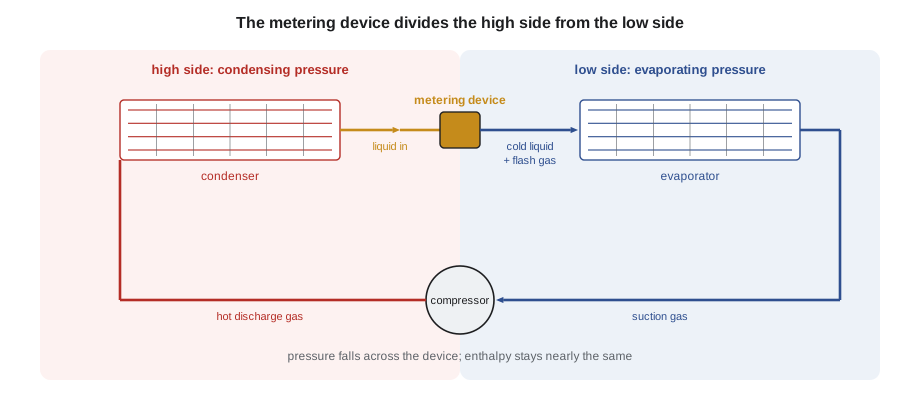
Two jobs at once
Every metering device does two jobs. First, it is a restriction that holds back the high-pressure liquid, so the condenser side stays at the condensing pressure and the evaporator side stays at the much lower evaporating pressure. Without that restriction, the pressures would equalize and the refrigerant could neither condense nor boil at useful temperatures. Second, it controls the flow of refrigerant into the evaporator, and through it the amount of the evaporator's surface that is filled with boiling liquid. The first job is the same for every device; the second is where the families differ.
- Fixed restrictions, such as capillary tubes and fixed orifices or pistons, have a constant opening. Their flow depends only on the pressures and the state of the liquid reaching them, so they do not respond directly to the evaporator's load.
- Thermostatic expansion valves (TXVs) adjust their opening to hold a roughly constant superheat at the evaporator outlet, sensed by a bulb on the suction line.
- Electronic expansion valves (EEVs) are driven by a controller that reads pressure and temperature sensors and positions the valve to hold a target superheat or another control point.
- Automatic expansion valves hold a constant evaporator pressure rather than a superheat, and float valves hold a liquid level in a flooded evaporator or receiver.
Each family has a place. Fixed devices are cheap, have no moving parts and suit systems with a fairly steady load and a critical charge. Valves cost more but keep the evaporator well fed over a wide range of loads and condensing pressures, so they are used where conditions vary, as in commercial refrigeration, rooftop units and modern high-efficiency equipment.
What happens inside the device
Liquid arrives at the metering device at nearly the condensing pressure, usually a few degrees subcooled. As it is forced through the restriction, its pressure falls quickly. Once the pressure falls below the saturation pressure for the liquid's temperature, the liquid begins to boil. The energy for that boiling comes from the liquid itself, so a small part of the liquid flashes to vapor and cools the rest down to the saturation temperature at the evaporator pressure. What leaves the device is a cold mixture, mostly liquid by mass but mostly vapor by volume. This process happens with almost no heat exchange with the surroundings, so the enthalpy of the refrigerant is nearly the same before and after the device; on a pressure-enthalpy diagram, the expansion is a vertical line.
The vapor formed in the device is called flash gas. It has already boiled, so it can no longer absorb heat in the evaporator; it simply travels through the coil and back to the compressor, taking up capacity. The more flash gas, the less useful cooling each kilogram of refrigerant delivers. Subcooling the liquid before the device reduces flash gas, which is one reason subcooling matters, and one reason a restriction in the liquid line, which lets liquid flash before it reaches the device, cuts capacity so sharply.
# Flash gas and refrigerating effect for R-410A (approximate property values)
# liquid enthalpy h_f and vapor enthalpy h_g at the evaporator, Btu/lb
t_evap = 41.0                       # F evaporating temperature
h_f_evap, h_g_evap = 22.4, 116.1    # Btu/lb at 41 F (approximate, ASHRAE reference)
cp_liquid = 0.42                    # Btu/(lb F), approximate for R-410A liquid near 104 F
h_liquid_sat_cond = 55.5            # Btu/lb saturated liquid at 104 F condensing (approximate)

for subcool in [0, 5, 10, 15, 20]:   # F of subcooling at the metering device
    h_in = h_liquid_sat_cond - cp_liquid * subcool
    quality = (h_in - h_f_evap) / (h_g_evap - h_f_evap)   # fraction already vapor
    effect = h_g_evap - h_in                              # useful heat per lb
print(f"subcooling {subcool:2d} F: flash gas {quality*100:4.1f} % of the mass, refrigerating effect {effect:5.1f} Btu/lb")subcooling 0 F: flash gas 35.3 % of the mass, refrigerating effect 60.6 Btu/lb subcooling 5 F: flash gas 33.1 % of the mass, refrigerating effect 62.7 Btu/lb subcooling 10 F: flash gas 30.8 % of the mass, refrigerating effect 64.8 Btu/lb subcooling 15 F: flash gas 28.6 % of the mass, refrigerating effect 66.9 Btu/lb subcooling 20 F: flash gas 26.4 % of the mass, refrigerating effect 69.0 Btu/lb
With no subcooling, roughly a third of the refrigerant's mass is already vapor as it enters the evaporator. Every few degrees of subcooling lowers that fraction and raises the heat each kilogram can absorb. The program uses approximate properties, but the trend is real and holds for every refrigerant: more subcooling at the device means less flash gas and more capacity per unit of refrigerant pumped.
Feeding the evaporator: starving, flooding and the right feed
Inside the evaporator, the refrigerant boils as it moves along the tubes. Near the outlet, ideally a short length of tube carries only vapor, which picks up a few degrees of superheat before it leaves. The metering device decides where along the coil the last drop of liquid boils away.
- A starved evaporator gets too little refrigerant. The liquid boils away early, a long section of the coil carries only vapor and adds a lot of superheat, the useful surface shrinks, and the suction pressure and capacity fall. Starving also lets the compressor run hot, because it relies on cool suction gas for motor cooling.
- A flooded evaporator gets too much. Liquid reaches the outlet and is carried into the suction line, the superheat falls to near zero, and liquid can reach the compressor, diluting the oil and damaging valves or scrolls.
- A correctly fed evaporator uses most of its surface for boiling and finishes with a small, steady superheat, typically a few degrees for air conditioning and commercial refrigeration with expansion valves.
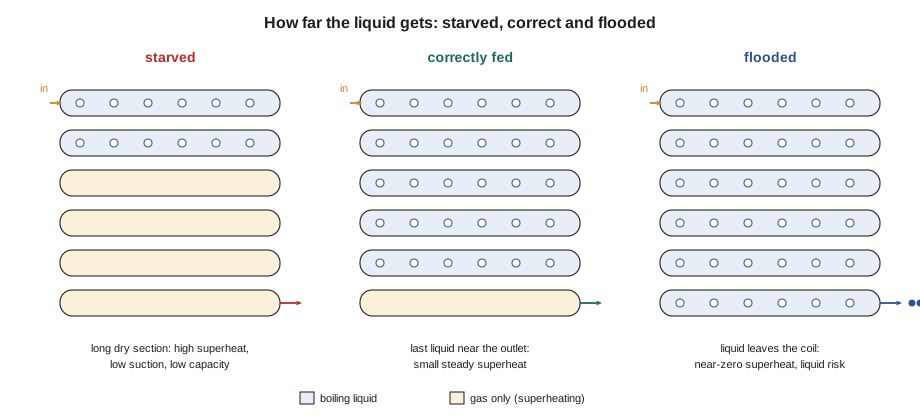
Superheat is therefore the main window into the metering device's work. High superheat with low suction pressure says the evaporator is starved. Very low or zero superheat says it is flooding or close to it. But superheat on its own does not say why: a starved coil can be caused by a low charge, a restriction, a weak valve or very low load; a flooded coil by an overcharge, a valve stuck open or poor airflow. Lesson 7 builds the diagnostic method that uses superheat together with subcooling and pressures to separate these causes.
What controls the flow through a fixed device
Through a fixed restriction, the flow depends on three things: the pressure difference across it, the density of the liquid reaching it and whether that liquid is fully liquid or already partly vapor. A higher head pressure pushes more refrigerant through; a lower head pressure, as on a cold day, pushes less. Liquid with good subcooling is dense and flows well; liquid that has flashed is a mixture that flows poorly. That is why fixed-device systems are very sensitive to the charge and the condensing pressure, and why a manufacturer charges them by superheat, which reflects how well the evaporator is being fed under the current conditions.
A valve, by contrast, opens wider when the evaporator needs more refrigerant and closes when it needs less, so it can hold a steady superheat across a range of head pressures and loads. It cannot work miracles, though: if the liquid reaching it is not solid liquid, or if the pressure difference across it is too small, even a wide-open valve cannot feed the coil. This is why systems with valves need good subcooling at the valve inlet and head pressure control in cold weather.
Where the metering device sits
The metering device is usually at the evaporator inlet, so the cold mixture enters the coil immediately and the liquid line can stay warm and fully liquid. In split air conditioners and heat pumps, the device may be in the indoor coil, in the outdoor unit or both, depending on the design: a heat pump needs a metering device for each direction of flow, either two devices with check valves or bypasses, or a bi-flow valve or EEV that works in both directions. Ductless systems usually have their EEV in the outdoor unit, so the line set between the units carries the two-phase mixture in cooling. Large evaporators have a distributor right after the device, a manifold of small, equal-length tubes that divides the flow evenly among the coil's circuits.
- A distributor has its own pressure drop and must suit the device and coil. A blocked or kinked distributor tube starves one circuit, which shows as a cold, frosted or sweating section of coil next to a warm one.
- The external equalizer line of a TXV, covered in lesson 3, is connected to the suction line after the coil because the distributor and coil together cause a large pressure drop.
Reading the evidence on Dana's bench
Dana had Theo match each device on the bench to the system it came from and the reason it was removed. The capillary tube had a kink near its inlet that had starved the reach-in's evaporator. The piston had the wrong size stamped on it: a previous installer had left the factory piston for a different outdoor unit in the indoor coil, and the system had flooded and cooled poorly for two summers. One TXV had lost its bulb charge, so it closed completely; the other had been mounted with its bulb on top of the suction pipe where it sensed the line correctly but its clamp had worked loose, so it overfed. The EEV had a failed coil on its stepper motor and had been stuck at one position. "Every one of these looked like a refrigerant problem to the person who found it," Dana said. "Two of them had refrigerant added before anyone looked at the metering device. By the end of this course, you'll be able to tell the difference."
| Device family | What it controls | Responds to load? | Typical use |
|---|---|---|---|
| Capillary tube | Fixed restriction | Only indirectly, through pressures | Small refrigerators, freezers, ice machines, room units |
| Fixed orifice or piston | Fixed restriction | Only indirectly | Residential split air conditioners and some heat pumps |
| Thermostatic expansion valve | Evaporator outlet superheat | Yes, mechanically | Commercial refrigeration, rooftop units, many split systems |
| Electronic expansion valve | Superheat or another set point, by controller | Yes, electronically | Inverter systems, ductless, supermarkets, chillers |
| Automatic expansion valve | Evaporator pressure | Opposite to load | Small, steady-load units, some specialty equipment |
| Float valve | Liquid level | Yes, by level | Flooded evaporators, chillers, industrial systems |
Common mistakes
MistakeTreating the metering device as a simple hole that never needs checking.
InsteadCheck the device type, size and condition as part of every charge-related service call.
MistakeIgnoring flash gas in the liquid line.
InsteadConfirm subcooling at the device inlet; liquid that flashes before the device starves the evaporator.
MistakeReading low superheat as proof of an overcharge.
InsteadLow superheat can come from low airflow, a stuck valve or a wrong piston as well; use the full diagnostic method.
MistakeLeaving a factory piston in place without checking it matches the outdoor unit.
InsteadConfirm the piston size or valve required by the matched system's documentation.
Summary and key terms
- The metering device holds back the high-pressure liquid and controls how much refrigerant reaches the evaporator.
- Expansion through the device is nearly constant enthalpy; some liquid flashes to vapor and cools the rest.
- Subcooling reduces flash gas and raises the refrigerating effect per kilogram.
- A starved evaporator has high superheat and low suction; a flooded one has near-zero superheat and risks liquid return.
- Flow through a fixed device depends on pressure difference and liquid quality; valves adjust their opening to the load.
- Distributors, equalizers and heat pump bi-flow arrangements are part of the metering system.
- Metering device
- The restriction that drops the pressure from the high side to the low side and controls the feed to the evaporator.
- Flash gas
- Vapor formed as liquid passes through a restriction; it cannot absorb further heat in the evaporator.
- Refrigerating effect
- The heat absorbed per unit mass of refrigerant in the evaporator.
- Starved evaporator
- An evaporator receiving too little refrigerant, with high superheat and low suction pressure.
- Flooded evaporator
- An evaporator receiving too much refrigerant, with liquid reaching its outlet.
- Distributor
- A manifold of small tubes dividing the flow from the metering device among the coil circuits.
- Fixed restriction
- A metering device with a constant opening, such as a capillary tube or piston.
Practice problems
Work each problem on paper first, then reveal the answer to check.
Why does more subcooling increase the refrigerating effect?
Show answer
Liquid entering the device has a lower enthalpy, so less of it flashes and each kilogram absorbs more heat in the evaporator.
A coil has frost on half its circuits and warm tubes on the rest. What should you check first?
Show answer
The distributor and its tubes for a blockage or kink.
Why does a fixed-orifice system lose capacity on a cold day?
Show answer
The lower head pressure pushes less refrigerant through the fixed opening, starving the evaporator.
What two jobs does every metering device do?
Show answer
It maintains the pressure difference between high and low sides, and it controls the refrigerant feed to the evaporator.
Lesson quiz · 5 questions
Score 60% or more to complete this lesson.
Create a free account to save your progress, take quizzes and earn a certificate.