
RAC-220 · Lesson 7 of 12 · 17 min
Superheat and subcooling diagnostics
Dana gave Theo a stack of six old service tickets from the shop's files, each with the readings a technician had written down and the final repair. She had covered the repair with a sticky note. "Read the numbers," she said, "and tell me what was wrong before you lift the note." The first ticket was the clinic's rooftop unit from two years earlier: low suction, high superheat, low subcooling, low amps. Theo guessed a low charge, lifted the note and found a cracked flare on the liquid line service valve. The second had low suction, high superheat and high subcooling, and he guessed a restriction; the note said a plugged filter-drier. By the fourth ticket he was getting faster, and by the sixth he had learned that the pattern only works when every reading is taken correctly.
RAC-110 introduced superheat and subcooling as the two numbers that show what is happening inside the evaporator and the condenser. This lesson builds them into a diagnostic method. It covers where and how to measure each value, the targets and what moves them, and how combining superheat, subcooling, pressures, temperature splits and compressor current separates the common charge and component faults from each other. Charging itself is covered in lessons 9 and 10.
Five measurements, taken properly
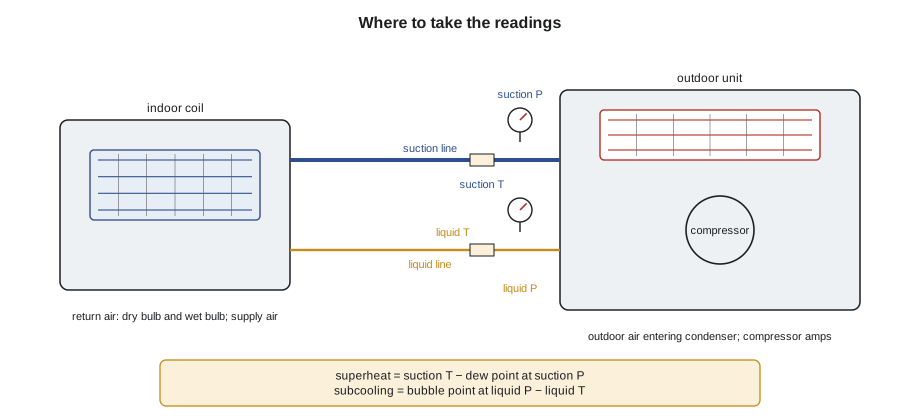
Every charge-related diagnosis starts with a consistent set of readings, taken after the system has run for at least ten to fifteen minutes at a steady condition, with the indoor and outdoor fans at their normal speeds, filters and coils clean, and the doors or panels closed:
- Suction pressure, converted to the evaporator saturation temperature (dew point for blends).
- Suction line temperature, measured on clean pipe within about 6 in of the suction service valve, or at the bulb location for TXV evaluation, with an insulated clamp.
- Liquid pressure, converted to the condenser saturation temperature (bubble point for blends).
- Liquid line temperature, measured near the liquid service valve, on clean pipe, out of the sun.
- Air or water temperatures across both coils, outdoor ambient and, for comfort cooling, the indoor wet bulb temperature entering the evaporator, plus the compressor current.
From these come superheat, which is the suction line temperature minus the evaporator saturation temperature, and subcooling, which is the condenser saturation temperature minus the liquid line temperature. Superheat measured at the condensing unit includes the heat picked up along the suction line; superheat at the evaporator outlet is what a TXV controls. For fixed-orifice systems, manufacturers usually specify superheat at the outdoor unit. Know which one the target refers to.
What moves superheat and what moves subcooling
Superheat responds to how well the evaporator is fed compared with its load. More refrigerant or less load lowers it; less refrigerant or more load raises it. Subcooling responds to how much liquid is backed up in the condenser. More refrigerant in the system or a restriction downstream that holds liquid back raises it; less refrigerant or a condenser that is flooded with vapor lowers it. On a system with a TXV or EEV, the valve tries to hold superheat steady, so the charge shows up mainly in the subcooling; on a fixed-orifice system, the charge shows up in both, and especially in the superheat.
- A TXV system with a correct charge typically runs a subcooling the manufacturer specifies, often a few kelvin in air conditioning, with superheat close to the valve's setting.
- A fixed-orifice system has a target superheat that depends on indoor wet bulb and outdoor dry bulb temperatures; on a hot, dry day with low indoor load, the target is low, and on a mild day with a high indoor load, it is higher. Lesson 9 shows how the target is found.
- Valve-fed refrigeration systems with receivers are different again: the liquid leaving the receiver is saturated, so subcooling at the condenser outlet tells you little; the sight glass, receiver level and liquid line temperature drop guide the charge.
The nine-symptom table
With superheat and subcooling in hand, add the suction and head pressures, the condenser split (the condensing temperature minus the outdoor air temperature) and the evaporator split (the return air temperature minus the evaporator saturation temperature, or the air temperature drop across the coil). Together they separate the common faults. The table below summarizes the patterns technicians use; real systems can show combinations, and every result must be confirmed by inspection.
| Fault | Suction | Head | Superheat | Subcooling | Other clues |
|---|---|---|---|---|---|
| Low charge | Low | Low | High | Low | Low amps; bubbles in sight glass; oil stains at a leak |
| Overcharge | High | High | Low | High | High amps; condenser split high |
| Liquid line or metering restriction | Low | Normal or low | High | High | Temperature drop at the restriction |
| Low evaporator airflow or load | Low | Low | Low (fixed) or normal (valve) | Normal or high | Large air temperature drop; iced coil |
| Dirty condenser or failed condenser fan | High | High | Normal or low | Normal | Condenser split high |
| Inefficient compressor | High | Low | High (valve) or normal | Low or normal | Low amps; small pressure difference |
| Overfeeding metering device | High | Normal | Low | Low | Cold suction line, frost to compressor |
| Non-condensables in the system | Normal or high | High | Normal | Low to normal | Standing pressure above the P-T value |
| High heat load | High | High | High | Normal | Return air hot or humid; large split |
Two pairs in the table are the most commonly confused. A low charge and a restriction both starve the evaporator, giving low suction and high superheat; they differ in the subcooling, which is low when there is not enough liquid and high when liquid backs up behind a restriction. An overcharge and a dirty condenser both raise the head pressure; they differ in the subcooling, which is high with an overcharge because extra liquid fills the condenser, and normal with a dirty condenser, where the condenser simply cannot reject heat.
# A first-pass diagnostic helper based on the nine-symptom table (readings in F)
def classify(suction_sat, head_sat, superheat, subcool, outdoor, design):
    s_low = suction_sat < design["suction_sat"] - 4
    s_high = suction_sat > design["suction_sat"] + 4
    split = head_sat - outdoor
    h_high = split > design["cond_split"] + 7
    h_low = split < design["cond_split"] - 7
    sh_high = superheat > design["superheat"] + 7
    sh_low = superheat < design["superheat"] - 5
    sc_high = subcool > design["subcool"] + 5
    sc_low = subcool < design["subcool"] - 5
    if s_low and sh_high and sc_low:
        return "low charge"
    if s_low and sh_high and sc_high:
        return "restriction in liquid line or metering device"
    if s_high and h_high and sh_low and sc_high:
        return "overcharge"
    if h_high and not sc_high:
        return "condenser problem: dirty coil, fan or airflow"
    if s_low and not sh_high and not h_high:
        return "low evaporator airflow or load"
    if s_high and h_low:
        return "inefficient compressor"
    return "no clear pattern: recheck readings and compare with manufacturer data"

design = {"suction_sat": 45, "cond_split": 20, "superheat": 11, "subcool": 11}   # illustrative TXV rooftop unit
tickets = {"A": (36, 109, 25, 2, 95), "B": (37, 115, 27, 22, 95), "C": (52, 136, 4, 23, 95),
           "D": (50, 138, 11, 11, 95), "E": (36, 108, 9, 11, 95), "F": (54, 102, 16, 7, 95)}
for name, r in tickets.items():
print(f"ticket {name}: suction sat {r[0]} F, head sat {r[1]} F, SH {r[2]} F, SC {r[3]} F -> {classify(*r, design)}")ticket A: suction sat 36 F, head sat 109 F, SH 25 F, SC 2 F -> low charge ticket B: suction sat 37 F, head sat 115 F, SH 27 F, SC 22 F -> restriction in liquid line or metering device ticket C: suction sat 52 F, head sat 136 F, SH 4 F, SC 23 F -> overcharge ticket D: suction sat 50 F, head sat 138 F, SH 11 F, SC 11 F -> condenser problem: dirty coil, fan or airflow ticket E: suction sat 36 F, head sat 108 F, SH 9 F, SC 11 F -> low evaporator airflow or load ticket F: suction sat 54 F, head sat 102 F, SH 16 F, SC 7 F -> inefficient compressor
A program like this is only a first pass, a way to practice reading patterns, because it cannot see the coil, feel the suction line or hear the compressor. Its thresholds are illustrative, and real systems have their own normal values that change with indoor and outdoor conditions. The habit it teaches is valuable: write down every reading, compare each one with what is expected for the conditions, and look for the pattern before reaching for the refrigerant cylinder.
Temperature splits and the evaporator
Superheat and subcooling describe the refrigerant; temperature splits describe the heat transfer. For comfort cooling, the air temperature drop across the evaporator is often around 18 to 22 °F at normal airflow and moderate humidity, smaller in very humid conditions because more of the coil's capacity goes into condensing moisture. A large drop with low suction pressure suggests low airflow, such as a dirty filter, a slipping belt or closed dampers. A small drop with normal or high suction pressure suggests a high load or an inefficient compressor. On refrigeration coils, the evaporator TD, the box air temperature minus the evaporator saturation temperature, should match the coil's selection, often about 10 to 15 °F for coolers, as RAC-210 described.
The condenser split works the same way. A condensing temperature far above the outdoor air temperature compared with the unit's design split means heat is not leaving the condenser, from dirt, a fan problem, recirculation of hot air or non-condensables; a high split with high subcooling points instead to an overcharge. Non-condensables, such as air left in a poorly evacuated system, collect in the condenser, raise the head pressure and are confirmed by a standing pressure that is higher than the pressure-temperature chart value for the refrigerant at the ambient temperature, after the system has been off long enough for all parts to reach the same temperature.
Common measurement errors
- Reading the wrong column of the P-T chart, or the wrong refrigerant. Check the nameplate and set your digital gauges to the right refrigerant.
- Measuring line temperatures on insulated or painted pipe, in the sun, or with a loose clamp.
- Taking readings before the system is stable, or with the panels off, which changes the airflow.
- Ignoring the pressure drop in long suction lines when calculating superheat at the evaporator from a pressure taken at the condensing unit.
- Using a pressure from a hose with a leaking Schrader core or a gauge that has not been zeroed.
Lifting the last sticky note
The sixth ticket was from the seniors' residence's small walk-in: suction high, head low, superheat high, subcooling low, amps low. Theo hesitated, then said an inefficient compressor, perhaps with broken valves, and lifted the note: the tech had found a leaking discharge reed, as on the restaurant's reach-in in RAC-210. "Six for six," Dana said. "Now the hard part. In the field, nobody hands you a clean ticket. Half the time the readings are mixed up because the filter's dirty and the charge is low. That's why you fix the airflow first, every time, and then read the refrigerant side again."
When the readings conflict
Sometimes the readings fit no pattern: superheat says one thing, subcooling another, and the pressures something else. That usually means two faults at once, such as a low charge on a system with a dirty condenser, or an error in the readings. Recheck the gauges and clamps, confirm the refrigerant setting, make sure the system has been stable for long enough, and correct any airflow problem. Then read the system again. If the pattern is still mixed, fix the fault you can confirm, take a new set of readings and see what remains.
Common mistakes
MistakeCharging on suction pressure alone.
InsteadUse superheat, subcooling and the manufacturer's charging method.
MistakeConfusing a restriction with a low charge.
InsteadLook at the subcooling: high with a restriction, low with a low charge.
MistakeDiagnosing the refrigerant side with a dirty filter or coil.
InsteadCorrect the airflow first, then take new readings.
MistakeUsing bubble point for superheat or dew point for subcooling.
InsteadSuperheat uses the dew point; subcooling uses the bubble point.
MistakeTreating a table pattern as proof.
InsteadConfirm the fault by inspection, such as a temperature drop at a restriction or a leak test.
Summary and key terms
- Diagnosis needs suction and liquid pressures, line temperatures, air or water temperatures and compressor current, taken at stable conditions.
- Superheat shows how well the evaporator is fed; subcooling shows how much liquid is in the condenser.
- On valve systems the charge shows mainly in subcooling; on fixed systems it shows in both, especially superheat.
- Low charge and restriction differ in subcooling; overcharge and dirty condenser also differ in subcooling.
- Temperature splits across the coils show airflow, load and heat transfer problems.
- Non-condensables raise head pressure and are confirmed by a standing pressure above the P-T value.
- Condenser split
- The condensing temperature minus the outdoor air temperature entering the condenser.
- Evaporator split
- The air temperature entering the coil minus the evaporator saturation temperature, or the drop in air temperature across the coil.
- Non-condensables
- Gases such as air that do not condense in the condenser and raise the head pressure.
- Dew point
- The temperature at which a refrigerant vapor begins to condense at a given pressure.
- Bubble point
- The temperature at which a refrigerant liquid begins to boil at a given pressure.
- Standing pressure
- The pressure in a system that has been off long enough for all parts to reach ambient temperature.
Practice problems
Work each problem on paper first, then reveal the answer to check.
A TXV system shows suction sat 37 °F, head sat 115 °F at 95 °F outdoors, superheat 27 °F and subcooling 22 °F. What is likely?
Show answer
A restriction: starved evaporator with liquid backed up.
Suction and head are high, superheat low and subcooling high. What is likely?
Show answer
An overcharge.
Head is high with normal subcooling and a condenser split of 40 °F against a design of 20 °F. What is likely?
Show answer
A dirty condenser or a condenser fan problem.
How do you confirm non-condensables?
Show answer
Compare a standing pressure at equalized ambient temperature with the P-T chart; a higher pressure indicates non-condensables.
Lesson quiz · 5 questions
Score 60% or more to complete this lesson.
Create a free account to save your progress, take quizzes and earn a certificate.