
RAC-220 · Lesson 3 of 12 · 17 min
Thermostatic expansion valves
Raj, the shop's senior technician, had a TXV in pieces on the bench when Theo came in. It came from the brewery's walk-in cooler, the R-448A system with the 9,000 Btu/h condensing unit that Theo had worked on twice before. The valve was not faulty; the shop had replaced the evaporator after the brewery's forklift had punctured it, and the new coil came with a new valve. Raj had kept the old one to show Theo the inside. "Most techs never see what's in here," he said, unscrewing the power head. "Once you see the diaphragm, the pin and the spring, you'll know what the valve is thinking every time you read your gauges."
The thermostatic expansion valve is the most common metering device in commercial refrigeration and in many air conditioning systems. It adjusts its opening to keep the superheat at the evaporator outlet roughly constant, so the evaporator stays well fed as the load and head pressure change. This lesson explains how a TXV's forces balance, what the bulb charge and the equalizer do, and what static and operating superheat mean. Lesson 4 covers setting up, adjusting and troubleshooting TXVs in the field.
The three forces
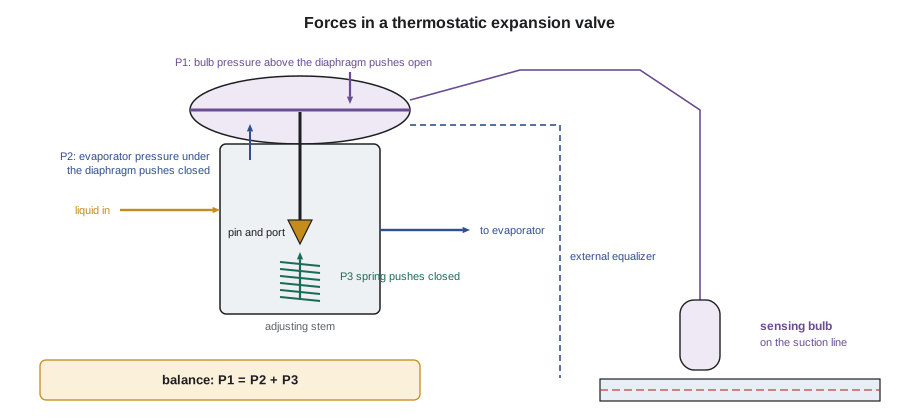
A TXV has a flexible diaphragm in its power head. Above the diaphragm is a sealed space connected through a thin capillary to the sensing bulb, which is clamped to the suction line at the evaporator outlet. The bulb contains a charge, usually a refrigerant, whose pressure rises and falls with the temperature of the suction line. Below the diaphragm is a push rod or a set of pins connected to the valve's needle or ball in the port. Three pressures act on the diaphragm and the pin:
- Bulb pressure (P1) acts on top of the diaphragm and pushes the valve open. It rises when the suction line warms, which happens when the evaporator is starved and the outlet vapor picks up superheat.
- Evaporator pressure (P2) acts under the diaphragm and pushes the valve closed. In a valve with an internal equalizer it is the pressure at the valve outlet; with an external equalizer it is the pressure at the evaporator outlet, piped from the suction line.
- Spring pressure (P3) also pushes the valve closed. The spring is adjustable on most valves and sets how much superheat is needed before the valve opens.
At balance, P1 = P2 + P3. Imagine the bulb contains the same refrigerant as the system. If the suction line at the bulb were at exactly the evaporating temperature, with no superheat, the bulb pressure would equal the evaporator pressure, and the spring would hold the valve closed. For the valve to open, the bulb must be warmer than the evaporating temperature, so that its pressure exceeds the evaporator pressure by the spring pressure. The superheat needed to do that is the valve's superheat setting.
When the load rises, the evaporator boils its liquid off sooner, the outlet superheat rises, the bulb warms, P1 rises, and the valve opens further to feed more refrigerant. When the load falls, the outlet superheat falls, the bulb cools and the valve throttles back. The valve does not hold a perfectly constant superheat: it needs a little more superheat to open further, so at high load the superheat is somewhat higher than at low load. This is normal and is described by the valve's opening superheat.
Static, opening and operating superheat
- Static superheat is the superheat at which the valve just begins to open. It is set by the spring, and it is what the adjusting stem changes.
- Opening superheat is the extra superheat needed to move the valve from just open to its rated capacity.
- Operating superheat is the superheat the technician actually measures when the system is running: the static superheat plus whatever opening superheat the current load requires.
Valve catalogs usually describe a factory static superheat and rate the valve at a stated opening superheat. In the field, technicians adjust and judge a TXV by operating superheat at the evaporator outlet under stable conditions, compared with the equipment manufacturer's target. Typical targets are a few kelvin for air conditioning and medium-temperature refrigeration, and a little lower for low-temperature systems, where every degree of superheat costs a larger share of the evaporator's capacity; always use the manufacturer's value where one is given.
# TXV force balance with a same-refrigerant bulb charge (R-448A dew-point values, approximate)
import math
# dew-point pressure table, F -> psia (approximate values for R-448A)
dew = [(-4, 28.6), (5, 35.0), (14, 42.4), (23, 50.9), (32, 60.6), (41, 71.8)]

def p_sat(t):
    for (t1, p1), (t2, p2) in zip(dew, dew[1:]):
        if t1 <= t <= t2:
            f = (t - t1) / (t2 - t1)
            return math.exp(math.log(p1) + f * (math.log(p2) - math.log(p1)))
    raise ValueError("outside table")

t_evap = 14.0                     # F evaporating (dew) temperature in the walk-in coil
P2 = p_sat(t_evap)
spring = 8.5                      # psi spring pressure set on the valve (illustrative)
for t_bulb in [14, 18, 21, 23, 25, 28, 32]:
    P1 = p_sat(t_bulb)
    margin = P1 - (P2 + spring)
    state = "opening further" if margin > 0.7 else ("just balancing" if margin > -0.7 else "closed / throttled")
print(f"bulb {t_bulb:3d} F superheat {t_bulb - t_evap:4.1f} F P1 {P1:5.1f} P2+P3 {P2 + spring:5.1f} psia -> {state}")bulb 14 F superheat 0.0 F P1 42.4 P2+P3 50.9 psia -> closed / throttled bulb 18 F superheat 4.0 F P1 46.0 P2+P3 50.9 psia -> closed / throttled bulb 21 F superheat 7.0 F P1 48.9 P2+P3 50.9 psia -> closed / throttled bulb 23 F superheat 9.0 F P1 50.9 P2+P3 50.9 psia -> just balancing bulb 25 F superheat 11.0 F P1 52.9 P2+P3 50.9 psia -> opening further bulb 28 F superheat 14.0 F P1 56.1 P2+P3 50.9 psia -> opening further bulb 32 F superheat 18.0 F P1 60.6 P2+P3 50.9 psia -> opening further
With these illustrative numbers, the spring needs the bulb to be about 9 °F warmer than the evaporating temperature before the valve balances. Below that superheat the valve throttles; above it, the valve opens further. Turning the adjusting stem to compress the spring raises the pressure the bulb must overcome, and so raises the superheat; backing it off lowers the superheat.
Bulb charges
The fluid in the bulb, called the charge, decides how the valve behaves over its temperature range. Valve manufacturers offer several types, chosen for the refrigerant and application:
- Liquid charge. The bulb holds enough of the system's refrigerant that some liquid always remains, so the bulb pressure always follows the coldest part of the bulb, capillary or power head. These charges respond quickly but can be confused if the power head becomes colder than the bulb.
- Gas charge. The bulb holds a limited amount of refrigerant that becomes all vapor above a certain temperature. Above that point, the bulb pressure rises only slowly, which limits how far the valve opens and gives a maximum operating pressure (MOP). MOP valves protect the compressor from overload during pull-down after an off cycle or defrost, when the evaporator is warm.
- Cross charge. The bulb holds a different fluid, or a blend, whose pressure-temperature curve is flatter than the system refrigerant's. Cross charges keep the superheat more even over a wide evaporating range and are typical in low-temperature refrigeration.
- Adsorption charge. The bulb holds a gas and a solid adsorbent; the pressure follows temperature through adsorption. These charges respond slowly, which damps hunting in some applications.
A TXV must have the right charge for the refrigerant and temperature range, so valves are selected from the manufacturer's tables by refrigerant, capacity and application and are labeled with a code. A valve for R-404A will not hold the right superheat on R-448A without the manufacturer confirming it, and it may need a different charge or body. When a system is converted to a different refrigerant, the valve, or at least its power head, is often replaced.
Internal and external equalizers
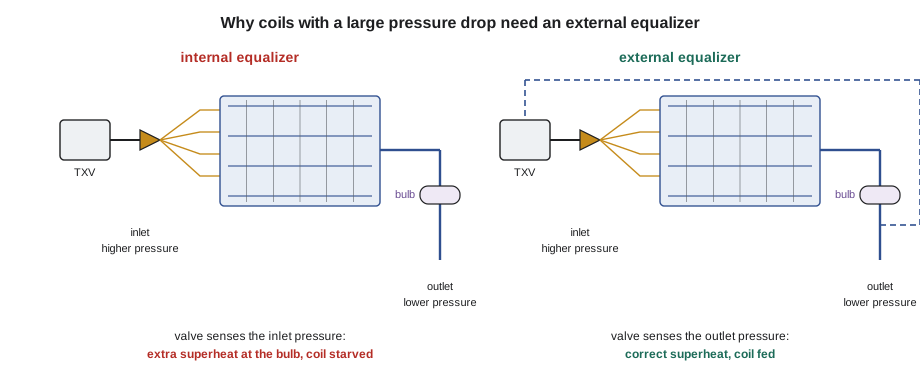
In a valve with an internal equalizer, the pressure under the diaphragm is the pressure at the valve outlet, at the inlet of the evaporator. That works only when the pressure drop through the evaporator is small. If the evaporator has a distributor and long circuits, the pressure at the outlet, where the bulb is, can be much lower than at the inlet. The saturation temperature at the outlet is then lower too, so the bulb sees extra superheat that the valve did not account for, and the valve throttles: the coil is starved and the measured superheat is high.
An external equalizer solves this by piping the pressure under the diaphragm from the suction line just downstream of the bulb, so the valve compares the bulb's temperature with the actual pressure at the same point. Valves on coils with distributors, or with a pressure drop more than a small amount, need external equalizers. The equalizer line must never be capped on a valve that has one, must be connected to the suction line after the bulb, and should be connected at the top of the pipe so oil does not fill it.
Balanced ports, bleed ports and other features
- Balanced-port valves cancel the effect of the liquid line pressure on the pin, so the valve's superheat stays steady when the head pressure varies, as with floating head pressure or on systems that run over a wide range of outdoor temperatures. Many modern valves are balanced-port.
- Bleed-port or bleed valves have a small permanent opening that lets pressures equalize during the off cycle, so a compressor with low starting torque, such as a PSC motor without a start kit, can start against equal pressures. Bleed valves are not used on pump-down systems, because the bleed lets the low side refill.
- Bi-flow TXVs meter in both directions and are used in some heat pumps.
- Hard-shutoff and replaceable-element valves suit particular applications; manufacturers describe each in their catalogs.
Reading the walk-in's new valve
Raj showed Theo the label on the new valve that came with the brewery's replacement coil: the refrigerant, the nominal capacity, the bulb charge code, external equalizer and balanced port. He had Theo confirm each item against the coil manufacturer's selection and the condensing unit's data. At start-up, the evaporating temperature settled around 14 °F. Theo measured the suction line temperature at the bulb, read the evaporator pressure at the access fitting near the bulb and converted it to the dew-point temperature, and found an operating superheat of about 9 °F, within the manufacturer's range. "Now leave it alone," Raj said. "A new valve set at the factory is usually right. When you think it needs adjusting, check everything else first. That's tomorrow's lesson."
Selecting a replacement TXV
When a valve has to be replaced, the replacement is chosen from the valve manufacturer's selection tables, not by matching the look of the old valve. The tables need five pieces of information: the refrigerant, the evaporator's capacity, the evaporating temperature, the condensing temperature or the pressure drop available across the valve, and the subcooling of the liquid reaching it. A valve's nominal rating is given at standard conditions; at a low evaporating temperature or a low pressure difference, the same valve passes much less refrigerant, so a low-temperature freezer or a system with floating head pressure may need a valve body one size larger than its nominal capacity suggests. Too small a valve starves the coil at full load; too large a valve tends to hunt at low load. The selection also fixes the bulb charge, the equalizer type, the connection sizes and the port design. When the evaporator manufacturer specifies a particular valve, as the brewery's coil did, that specification is the starting point.
Some valves have replaceable power heads and orifice cartridges, so a technician can change the capacity or the charge without brazing a new body. This is convenient, but it brings the same rule: the new parts must be the ones the selection tables call for.
Common mistakes
MistakeThinking the bulb measures pressure.
InsteadThe bulb senses temperature; its pressure is a stand-in for that temperature.
MistakeCapping or omitting the external equalizer on a valve that has one.
InsteadConnect it to the suction line downstream of the bulb.
MistakeUsing an internally equalized valve on a coil with a distributor.
InsteadCoils with significant pressure drop need an external equalizer.
MistakeAssuming any valve of the right size will work with a new refrigerant.
InsteadConfirm the valve body and bulb charge are rated for the refrigerant and application.
MistakeUsing a bleed valve on a pump-down system.
InsteadBleed valves let the low side refill; use them only where the system design calls for them.
Summary and key terms
- A TXV balances bulb pressure (opening) against evaporator pressure and spring pressure (closing).
- The spring sets the static superheat; operating superheat is what is measured at the coil outlet.
- Bulb charges include liquid, gas (MOP), cross and adsorption types, each suited to an application.
- External equalizers sense the evaporator outlet pressure and are needed on coils with distributors or large pressure drops.
- Balanced ports keep superheat steady as head pressure changes; bleed ports equalize pressures for starting.
- Valves are selected by refrigerant, capacity and application from the manufacturer's tables.
- Thermostatic expansion valve
- A valve that adjusts its opening to keep a roughly constant evaporator outlet superheat.
- Sensing bulb
- The bulb clamped to the suction line whose pressure follows the line temperature.
- Static superheat
- The superheat at which a TXV just begins to open, set by its spring.
- Operating superheat
- The superheat measured at the evaporator outlet while the system runs.
- External equalizer
- A line from the suction line to under the TXV diaphragm, sensing evaporator outlet pressure.
- MOP
- Maximum operating pressure, a limit on evaporator pressure provided by a gas-charged bulb.
- Balanced port
- A TXV design that cancels the effect of liquid line pressure on the valve.
Practice problems
Work each problem on paper first, then reveal the answer to check.
A TXV has a large pressure drop through its distributor and coil but only an internal equalizer. What will you see?
Show answer
A starved coil with high superheat; the valve senses too high a pressure.
What adjustment raises a TXV's superheat?
Show answer
Turning the stem to compress the spring.
Why might a low-temperature freezer use a cross-charged bulb?
Show answer
To keep the superheat more even across a wide evaporating range.
Why is a bleed-port valve unsuitable for a pump-down system?
Show answer
The bleed passage lets refrigerant flow into the low side during the off cycle.
Lesson quiz · 5 questions
Score 60% or more to complete this lesson.
Create a free account to save your progress, take quizzes and earn a certificate.