
RAC-220 · Lesson 11 of 12 · 18 min
A2L refrigerants: safe charging and service
The Lindqvist family's new ducted heat pump was the first R-454B installation Theo had worked on from start to finish. The outdoor unit had a red band around the refrigerant label and a notice about mildly flammable refrigerant; the indoor unit, in a small basement furnace room, came with a refrigerant detection sensor already wired to its board. Before they left the shop, Dana walked Theo through the van: an A2L-rated recovery machine, a vacuum pump listed for A2L use, a leak detector rated for the refrigerant, left-hand-thread cylinder adapters and a fire extinguisher. "Nothing about the vapor-compression cycle changes," she said. "What changes is that this refrigerant can burn if enough of it leaks into a small room and meets a spark. So everything we do today is about not letting that happen."
New air conditioners and heat pumps in Canada and the United States have been moving from R-410A to lower-GWP refrigerants, mainly R-454B and R-32, which are classed as A2L: lower toxicity and lower flammability. RAC-110 introduced the safety classes and RAC-120 the regulations that drive the transition. This lesson covers what A2L means in practice, the codes and standards that govern A2L equipment, how to handle, charge, evacuate and recover A2L systems safely, and how charge limits and refrigerant detection systems protect occupied spaces.
What A2L means
Safety classes, under ASHRAE Standard 34 and its equivalent ISO 817, use a letter for toxicity, A for lower and B for higher, and a number for flammability, 1 for no flame propagation, 2 for lower flammability, 3 for higher flammability. The subclass 2L covers refrigerants that are flammable but burn slowly, with a burning velocity of no more than about 4 in/s, and that need a fairly high concentration in air to ignite. Their lower flammability limit (LFL), the lowest concentration in air that can burn, is much higher than for a hydrocarbon like propane, and they are harder to ignite, typically needing an open flame or a strong spark rather than a small static discharge.
| Refrigerant | Class | Approximate LFL | Approximate GWP | Notes |
|---|---|---|---|---|
| R-410A | A1 | not flammable | about 2,100 | Being phased out of new comfort equipment |
| R-454B | A2L | 0.018 lb/ft³ | about 470 | Near-azeotrope blend of R-32 and R-1234yf; small glide |
| R-32 | A2L | 0.019 lb/ft³ | about 675 | Single component; higher discharge temperatures |
| R-290 (propane) | A3 | 0.0024 lb/ft³ | about 3 | Higher flammability; small charges only |
A2L does not mean safe to ignore. Burning A2L refrigerant produces hydrogen fluoride and other toxic decomposition products, the same hazard that any fluorinated refrigerant creates in a fire or at a torch flame. And although an A2L is hard to ignite, a large release into a small, closed space can reach its LFL. The codes for A2L equipment are written to keep concentrations well below that level.
Codes and standards
In the United States, A2L equipment is listed to UL 60335-2-40, and installations follow ASHRAE Standard 15 and, for residential systems, ASHRAE 15.2, as adopted through the mechanical code, such as the International Mechanical Code and the state's version of it in Kentucky. These set charge limits by room size, ventilation, refrigerant detection and equipment location requirements. Under EPA's Technology Transitions rule, new residential and light commercial air conditioning and heat pump systems manufactured from January 1, 2025 must use refrigerants with a GWP of 700 or less, and split systems built from components made before then could be installed only until January 1, 2026. EPA's SNAP program lists which refrigerants are acceptable in which equipment and the conditions of use. Section 608 certification still applies to A2L refrigerants, and many manufacturers and distributors require A2L-specific training as well.
Equipment manufacturers' installation instructions are written to these standards and often go further: they state the maximum charge for the unit, the minimum room area for the indoor unit, whether a refrigerant detection system is fitted and how to test it, which joints are allowed in occupied spaces, and how the unit must be labeled. Those instructions are part of the code compliance for the installation.
Charge limits and room size
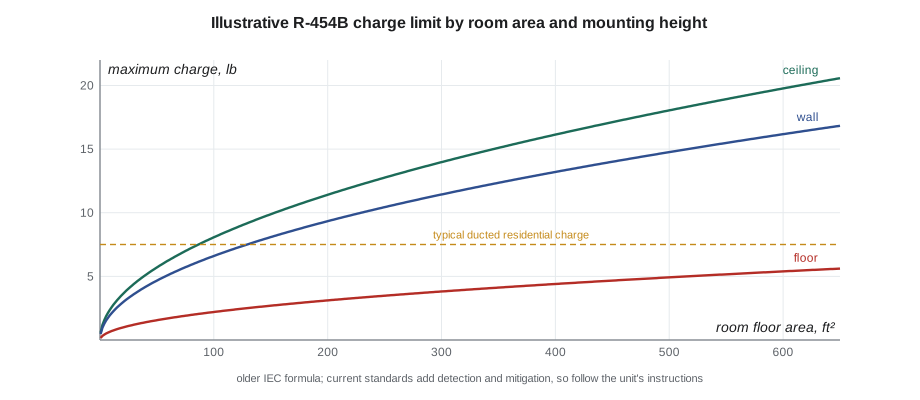
The basic idea behind A2L charge limits is that if the entire charge leaked into the room served by the indoor unit, the concentration should stay well below the LFL. A larger room, or a unit mounted high on a wall where leaked refrigerant mixes before reaching the floor, allows a larger charge. Earlier editions of the equipment standard expressed the maximum charge for a room with a well-known formula, which still shows the logic clearly even though current editions use more detailed methods and allow larger charges when refrigerant detection and mitigation are provided.
Here m_max is in kilograms, LFL in kilograms per cubic meter, h_0 is a height factor for the indoor unit's mounting (about 0.6 for floor-mounted, 1.0 for window, 1.8 for wall-mounted and 2.2 for ceiling-mounted units in that formula), and A is the room's floor area in square meters. Rearranged, the same formula gives the minimum floor area for a given charge.
# Illustrative A2L room charge limit using the older IEC 60335-2-40 formula, converted to US units
# (current editions use more detailed methods; always follow the manufacturer's instructions)
LFL = {"R-454B": 0.296, "R-32": 0.307}      # kg/m3, approximate
h0 = {"floor": 0.6, "wall": 1.8, "ceiling": 2.2}
KG_PER_LB, M2_PER_FT2 = 0.4536, 0.0929

def m_max_lb(ref, area_ft2, mount):
    return 2.5 * LFL[ref] ** 1.25 * h0[mount] * (area_ft2 * M2_PER_FT2) ** 0.5 / KG_PER_LB

def min_area_ft2(ref, charge_lb, mount):
    return (charge_lb * KG_PER_LB / (2.5 * LFL[ref] ** 1.25 * h0[mount])) ** 2 / M2_PER_FT2

for area in [86, 160, 320, 650]:
    print(f"room {area:3d} ft2: R-454B wall unit up to {m_max_lb('R-454B', area, 'wall'):4.1f} lb, floor unit up to {m_max_lb('R-454B', area, 'floor'):4.1f} lb")
charge = 7.5
print(f"\na {charge} lb R-454B charge would need about {min_area_ft2('R-454B', charge, 'floor'):.0f} ft2 for a floor-level unit")
print(f"and about {min_area_ft2('R-454B', charge, 'ceiling'):.0f} ft2 for a ceiling unit by this formula;")
print("ducted systems in small rooms rely instead on refrigerant detection, ventilation and the manufacturer's limits")room 86 ft2: R-454B wall unit up to 6.1 lb, floor unit up to 2.0 lb room 160 ft2: R-454B wall unit up to 8.4 lb, floor unit up to 2.8 lb room 320 ft2: R-454B wall unit up to 11.8 lb, floor unit up to 3.9 lb room 650 ft2: R-454B wall unit up to 16.8 lb, floor unit up to 5.6 lb a 7.5 lb R-454B charge would need about 1162 ft2 for a floor-level unit and about 86 ft2 for a ceiling unit by this formula; ducted systems in small rooms rely instead on refrigerant detection, ventilation and the manufacturer's limits
The numbers show why ducted A2L systems need extra protection. A typical residential charge is too large for a small furnace room by the simple formula, so ducted A2L equipment above a small charge threshold, about 4 lb in many cases, is supplied with a refrigerant detection system (RDS). The sensor sits in the indoor unit; if it detects refrigerant, the board turns on the indoor blower to mix and dilute the leak through the ductwork, shuts down the compressor and may disable ignition sources such as an electric heater. Ductless wall units, mounted high, can often carry their charge in smaller rooms.
Tools and handling
- Use recovery machines, vacuum pumps and leak detectors that the manufacturer lists as suitable for A2L refrigerants. Their motors, switches and relays are designed so they will not ignite a mildly flammable mixture.
- A2L cylinders have left-hand threads and a red band or marking, so A2L refrigerant cannot be connected to R-410A equipment by accident. Use the correct adapters and hoses, and store and transport cylinders upright, secured and away from heat, with the transport rules in RAC-120.
- Use recovery cylinders rated and labeled for the refrigerant, and do not mix A2L refrigerant with other refrigerants in a recovery cylinder.
- Remove ignition sources from the work area: no smoking, no open flames until the system has been recovered and purged, and caution with tools that spark. Ventilate enclosed work areas, and use a refrigerant detector to check the area before and during work.
- Never braze on a system that may still contain refrigerant. Recover, evacuate and purge with dry nitrogen first, then braze with nitrogen flowing, as RAC-210 described for all refrigerants.
- Keep a suitable fire extinguisher nearby, as for any hot work.
Charging and service steps for A2L systems
The methods from lessons 8 to 10 apply, with these additions from typical manufacturers' instructions:
- Pressure-test with dry nitrogen and leak-check every field joint before evacuating. Some manufacturers allow only brazed joints or listed mechanical connectors in occupied spaces; flare joints, where allowed, must be made with the specified flare type and torque.
- Evacuate to the manufacturer's target and run a decay test, as in lesson 8.
- Charge by weight, with the nameplate charge plus the line set adjustment, and never above the maximum charge stated for the room on the unit's label or instructions. R-454B and R-32 are charged as liquid or vapor as the manufacturer allows; R-454B is a blend with small glide and is normally charged as liquid.
- Mark the total charge on the unit's label, as the instructions require, and keep the A2L labeling and notices on the equipment.
- Test the refrigerant detection system as the manufacturer describes, typically with a test function on the board, and confirm that the blower starts and the compressor stops.
- When recovering, use A2L-rated equipment, ground the recovery machine and cylinder as instructed, and purge the system with nitrogen after recovery before opening it.
Commissioning the Lindqvist heat pump
Theo and Dana pressure-tested the brazed line set joints at the manufacturer's test pressure with dry nitrogen, held it for the specified time, and checked every joint with a bubble solution and the A2L detector. The furnace room was 75 ft², with a ducted indoor unit, so the charge was protected by the RDS rather than by room area. The outdoor unit's nameplate charge of 6.75 lb covered a line set of 25 ft; the actual line set was 35 ft, so the instructions called for about 0.4 lb more, bringing the total to 7.15 lb, under the unit's stated maximum. After evacuation to 300 microns and a decay test that settled at 450 microns, Theo weighed in the charge as liquid. He ran the board's RDS test, watched the blower start and the outdoor unit stop, cleared the test, and then checked the system in its cooling test mode against the manufacturer's chart. He wrote the total charge on the label with a permanent marker and left the homeowner the manual's section on what the unit does if it detects a leak.
Leak detection on A2L systems
Electronic leak detectors respond differently to different refrigerants, and some older heated-diode and infrared detectors were not designed or listed for use with flammable refrigerants. For A2L systems, use a detector that its manufacturer rates for the refrigerant, check it against a reference leak before use, and move it slowly around each joint, below it where possible, because R-454B and R-32 vapor is heavier than air. Confirm a suspected leak with bubble solution. Ultrasonic detectors and nitrogen with trace gas are other options for difficult systems. Never use an open-flame halide torch, an old method still mentioned in some books, on any modern system.
Common mistakes
MistakeTreating A2L refrigerants exactly like R-410A.
InsteadUse A2L-rated tools, control ignition sources and follow the charge limits and labeling rules.
MistakeExceeding the nameplate or room charge limit to cover a long line set.
InsteadCalculate the line set adjustment and confirm the total stays within the stated maximum.
MistakeBrazing on a system that has not been recovered and purged.
InsteadRecover, evacuate and purge with nitrogen before any hot work.
MistakeSkipping the refrigerant detection system test.
InsteadTest it as the manufacturer describes and confirm the mitigation actions.
MistakeForcing an R-410A fitting onto an A2L cylinder.
InsteadA2L cylinders have left-hand threads; use the correct adapter.
Summary and key terms
- A2L refrigerants have lower toxicity and lower flammability; they burn slowly and need high concentrations to ignite.
- Codes and standards set charge limits by room size, ventilation, detection and location.
- Charge limits keep a full leak below the LFL; higher mounting and larger rooms allow more charge.
- Ducted A2L systems above a small charge use refrigerant detection systems that run the blower and stop the compressor.
- Use A2L-rated tools and cylinders, control ignition sources, and recover and purge before brazing.
- Charge by weight within the stated maximum, label the charge and test the detection system.
- A2L
- A safety class for refrigerants with lower toxicity and lower flammability.
- Lower flammability limit
- The lowest concentration of a refrigerant in air that can burn.
- Burning velocity
- The speed at which a flame moves through a flammable mixture.
- Refrigerant detection system
- A sensor and controls that detect a leak and start mitigation actions.
- Mitigation
- Actions that reduce the risk of a leak, such as running the blower to dilute refrigerant.
- Ignition source
- Anything that can ignite a flammable mixture, such as a flame or a spark.
- Left-hand thread
- A thread used on flammable refrigerant cylinders that tightens counterclockwise.
Practice problems
Work each problem on paper first, then reveal the answer to check.
Using the illustrative formula, roughly how much R-454B can a wall unit hold in a 160 ft² room?
Show answer
About 8.4 lb; a floor unit in the same room would be limited to about 2.8 lb.
A ducted R-454B unit is in a 75 ft² room. How is the charge protected?
Show answer
By the refrigerant detection system and its mitigation actions, within the manufacturer's maximum charge.
Why must you recover and purge an A2L system before brazing?
Show answer
Refrigerant near a flame can ignite and decomposes into toxic products.
What is unusual about the cylinder valve thread on an A2L cylinder?
Show answer
It is left-hand, so it cannot be connected to non-flammable refrigerant equipment by mistake.
Lesson quiz · 5 questions
Score 60% or more to complete this lesson.
Create a free account to save your progress, take quizzes and earn a certificate.