
RAC-210 · Lesson 5 of 12 · 22 min
Compressor lubrication, oil return and failure modes
For the second time in eighteen months, the compressor on the restaurant's walk-in freezer had failed. The first replacement had been done by another contractor before the restaurant switched to Northfield. Raj and Theo recovered the refrigerant, cut out the failed compressor and drained a little of its oil into a clean glass jar. It was dark and thin and smelled of solvent. Raj cut the old compressor open on the bench: the connecting rods and the lower bearing were scored, but the motor windings were bright and undamaged. "Washed-out bearings, not a burnout," Raj said. "Something has been feeding it liquid." On the roof they found the evaporator fan motor in the freezer had been seizing intermittently, letting the coil starve of airflow and sending liquid back. They also found that the suction line had been rerouted during a renovation with a long horizontal run and a riser without a trap. "The compressor wasn't the problem," Raj said. "It was the victim."
Compressors depend on a thin film of oil between their moving parts, and the oil travels around the system with the refrigerant. This lesson covers refrigeration oils and their compatibility with refrigerants, why oil must return to the compressor and how piping design and velocity keep it moving, refrigerant migration and crankcase heaters, the main failure modes of compressors and how to tell them apart from the evidence a failed compressor leaves behind, and the acid test that guides cleanup decisions.
Refrigeration oils
Compressor oil lubricates bearings, pistons, scrolls and rotors, seals small clearances and carries some heat away. A refrigeration oil must stay fluid at low evaporator temperatures, resist breakdown at high discharge temperatures, and be compatible with the refrigerant it mixes with. Because some oil always leaves the compressor with the discharge gas, the refrigerant and oil must be miscible enough for the refrigerant to carry the oil back.
| Oil type | Typical refrigerants | Notes |
|---|---|---|
| Mineral oil (MO) | R-22 and other HCFCs and CFCs, ammonia | Not miscible enough with HFCs to return reliably |
| Alkylbenzene (AB) | R-22, some HCFC blends, retrofits | Better low-temperature miscibility than mineral oil |
| Polyolester (POE) | HFCs such as R-134a, R-410A, R-404A and many HFO blends | Very hygroscopic: absorbs moisture from air quickly |
| Polyvinyl ether (PVE) | HFCs and HFOs, notably in many ductless and variable refrigerant flow systems | Hygroscopic, but its absorbed water is less prone to forming acid |
| Polyalkylene glycol (PAG) | Vehicle air conditioning with R-134a or R-1234yf | Not used in most stationary systems |
POE oils absorb moisture from the air within minutes. Moisture in a POE system reacts with the oil at high temperatures to form acids, which attack motor insulation, copper and bearing surfaces. For this reason, POE oil is bought in small sealed metal containers, kept capped, and never left open; a compressor or system with POE oil is kept sealed until it is connected; and a filter-drier is replaced whenever the system is opened. Mixing oils or using the wrong viscosity can starve bearings or prevent oil from returning.
Why oil must return
Every compressor loses some oil with its discharge gas, often called oil circulation or oil carryover, typically a few percent of the refrigerant mass flow in systems without an oil separator. In a well-designed system, the oil travels through the condenser and liquid line dissolved in the liquid refrigerant and returns through the evaporator and suction line, where the refrigerant has boiled off and the oil moves as a film along the pipe walls, dragged along by the suction vapor.
Oil moves easily through liquid lines and down sloping horizontal lines, but in suction lines and vertical risers it relies on the velocity of the vapor. If the velocity is too low, oil collects in low spots, coats the evaporator's inner surface and builds up in long horizontal runs, and the compressor slowly loses its oil. Oil logging in the evaporator also insulates the tube walls and reduces capacity. When the load or the compressor speed rises later, a large slug of collected oil can return at once, which can damage a reciprocating compressor almost as badly as a liquid slug.
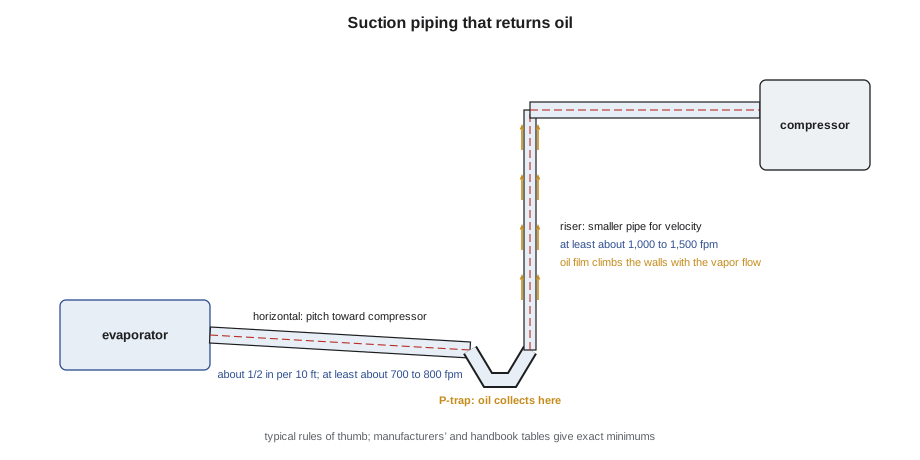
Common design practices for oil return include:
- Pitching horizontal suction lines toward the compressor, commonly about 1/2 in per 10 ft or as the manufacturer specifies, so oil drains with the flow.
- Sizing suction risers smaller than horizontal runs, so the vapor velocity in the riser is high enough to carry oil up. Commonly quoted minimum velocities are about 700 to 800 fpm in horizontal lines and about 1,000 to 1,500 fpm in risers, depending on the refrigerant, temperature and pipe size. Manufacturers' and handbook tables give exact minimums.
- Installing a P-trap at the bottom of each suction riser, so oil collects in a small volume where the vapor can lift it, and additional traps on very tall risers.
- Using double suction risers on systems with a wide capacity range: a small riser that carries oil at minimum load, and a larger riser that adds capacity at full load, with a trap arranged so the larger one fills with oil and closes off at low load.
- Keeping suction lines as short and direct as possible, with no unnecessary traps or dips.
Variable-speed and multi-compressor systems need special attention because the vapor velocity falls at low speed. Many inverter systems run an oil return cycle, briefly increasing the compressor speed, to sweep oil back. Supermarket racks and screw compressors use oil separators and oil management systems to return oil directly from the discharge to the compressors.
# Suction line velocity check for oil return (R-448A walk-in freezer)
import math

mass_flow = 83.0            # lb/h at design
density = 0.275             # lb/ft3, suction vapor near -18 F with superheat (approximate)
pipes = {  # name: inside diameter in inches (Type L copper, approximate)
    "1-1/8 in OD": 1.025,
    "7/8 in OD":   0.785,
    "5/8 in OD":   0.545,
}
minimum = {"horizontal": 750, "riser": 1000}    # fpm, typical rules of thumb

for name, d in pipes.items():
    area = math.pi * (d / 12)**2 / 4            # ft2
    v = mass_flow / 60 / (density * area)       # ft/min
    ok_h = "ok" if v >= minimum["horizontal"] else "too slow"
    ok_r = "ok" if v >= minimum["riser"] else "too slow"
print(f"{name:12s}: {v:5.0f} fpm horizontal {ok_h:8s} riser {ok_r}")1-1/8 in OD : 878 fpm horizontal ok riser too slow 7/8 in OD : 1497 fpm horizontal ok riser ok 5/8 in OD : 3105 fpm horizontal ok riser ok
During the renovation, the previous contractor had upsized the whole suction line, riser included, to 1-1/8-inch copper to cut pressure drop on the longer run. The program shows the result: at the freezer's design flow, the velocity in that size is acceptable for a horizontal line but below the usual minimum for a riser, so oil collects at the bottom of the riser and in the evaporator, especially at light load. Reducing the riser to 7/8-inch brings the velocity well above the riser minimum while the horizontal run stays large. Designers check both oil return and pressure drop; pipe sizing is covered in a later course. Here the point is that a correctly sized and trapped riser is part of protecting the compressor.
Refrigerant migration and crankcase heaters
During the off cycle, refrigerant vapor moves to the coldest part of the system and condenses there. In cold weather, the outdoor compressor is often the coldest part, and refrigerant is also strongly attracted to the oil, in which it dissolves. Over a long off period, a large amount of refrigerant can migrate into the compressor crankcase and dissolve in the oil. When the compressor starts, the sudden drop in crankcase pressure makes the dissolved refrigerant boil violently, foaming the oil. The foam is pumped out with the discharge gas, the bearings are starved of oil, and with reciprocating compressors liquid and foam can be drawn into the cylinders.
- Crankcase heaters, either belly-band heaters strapped around the shell or insert heaters in a well, keep the oil warmer than the rest of the system during the off cycle so refrigerant does not condense in it. Many manufacturers require the heater to be energized for a number of hours before a compressor is started after a long shutdown.
- Pump-down control, used on the brewery walk-in, closes a liquid line solenoid at the end of each cycle and lets the compressor pump the refrigerant into the condenser and receiver before stopping, so little refrigerant is left on the low side to migrate.
- Some systems use the compressor motor windings themselves as a heater, trickling current through them while stopped, or rely on accumulators and other components to hold liquid away from the compressor.
A crankcase heater that has failed open is a common, quietly destructive fault. It should be checked with an ammeter or by resistance on every maintenance visit, especially before winter.
How compressors fail
When a compressor fails, the evidence inside it, and in the system, usually points to the cause. Manufacturers and experienced technicians read that evidence before installing a replacement, because the same cause will kill the new compressor.
| Failure mode | Typical evidence | Common system causes |
|---|---|---|
| Floodback | Worn or scored rods, bearings and pistons; diluted oil; cold crankcase while running | Failed evaporator fan, iced or dirty coil, overfeeding metering device, overcharge |
| Liquid slugging | Broken reeds, valve plates or rods; often a knocking noise before failure | Liquid draining to the compressor off cycle, defrost or start-up flooding |
| Flooded start | Worn upper bearings, oil foaming, oil loss at starts | Refrigerant migration, failed crankcase heater, no pump-down |
| Overheating | Discolored valves, carbonized oil, worn or seized parts from oil breakdown | High compression ratio, low charge, high superheat, dirty condenser, restriction |
| Loss of oil | Uniform wear or seizure of all bearings; little oil in the crankcase | Poor oil return piping, short cycling, oil logging in evaporator, leaks |
| Electrical failure | Burnt windings, carbon and acid in oil, sometimes failed terminals | Voltage problems, failed contactors, overheating, moisture or acid contamination |
Raj's freezer is a textbook floodback failure: washed-out bearings, thin diluted oil, an undamaged motor, and a system fault, the failing evaporator fan, that sent liquid back. The badly sized riser added a loss-of-oil effect. Fixing only the compressor would have produced a third failure.
Overheating deserves special mention because it is easy to miss. Most compressor manufacturers set a limit on the discharge line temperature measured close to the compressor, commonly about 225 °F. At that line temperature, the gas at the discharge valve inside the compressor is much hotter, and oil begins to break down, forming acids and carbon. High discharge temperatures come from high compression ratios, such as low suction pressure and high head pressure, and from high return gas superheat, such as a low charge, a restriction or uninsulated suction lines in hot spaces.
Worked problem
Is the discharge temperature safe?
On the brewery walk-in, the discharge line temperature measured 6 in from the compressor is 244 °F. The suction superheat at the compressor is 54 °F, and the condenser is badly plugged with brewery dust. What should Theo conclude?
Show solution
- Discharge line 244 °F is above the typical limit of about 225 °F
- Both causes of high discharge temperature are present: high superheat and high head pressure
Answer: The compressor is overheating and its oil is at risk. The condenser must be cleaned, and the high superheat investigated as a possible low charge or restriction, before the compressor is damaged. Lesson 10 covers how to diagnose the cause of high superheat.
The acid test
When a hermetic compressor's motor burns out, the heat breaks down the oil and insulation, producing acids, sludge and carbon. Even without a burnout, moisture and high temperatures can make the oil acidic. Acid test kits measure the acidity of a small oil sample, usually by a color change compared with a chart for the oil type. The result guides the cleanup: mild contamination may need only new driers, while a severe burnout needs suction-line filter-driers with high acid capacity, repeated oil and drier changes, and follow-up testing, as lesson 11 explains.
The oil sample is taken from the failed compressor, from the oil sump of a semi-hermetic, or from the replacement compressor after it has run for a while, using a clean, dry container and the kit's instructions. Oil from a burnt compressor can be strongly acidic and should not touch the skin or eyes; wear gloves and safety glasses. A strong acrid smell when the system is opened is itself a warning sign that acid is present, and the released refrigerant can carry acid vapor, so the area must be ventilated.
# Acid test results over a burnout cleanup (illustrative readings)
# The kit reports a color that maps to an acid level; here as a fraction of the 'acid' threshold.
readings = [  # (hours after start-up, acid level relative to threshold, suction filter pressure drop psi)
    (0,   2.6, 1.0),
    (24,  1.8, 3.1),
    (48,  1.2, 2.0),
    (96,  0.7, 1.3),
    (240, 0.4, 0.9),
]
max_drop = 3.0   # psi, illustrative limit from a drier maker's instructions
for h, acid, dp in readings:
    acid_note = "acid - keep cleaning" if acid >= 1 else "below threshold"
    drop_note = "change suction filter core" if dp > max_drop else ""
print(f"{h:4d} h: acid {acid:3.1f} x threshold ({acid_note}); suction filter drop {dp:3.1f} psi {drop_note}")0 h: acid 2.6 x threshold (acid - keep cleaning); suction filter drop 1.0 psi 24 h: acid 1.8 x threshold (acid - keep cleaning); suction filter drop 3.1 psi change suction filter core 48 h: acid 1.2 x threshold (acid - keep cleaning); suction filter drop 2.0 psi 96 h: acid 0.7 x threshold (below threshold); suction filter drop 1.3 psi 240 h: acid 0.4 x threshold (below threshold); suction filter drop 0.9 psi
The readings show a typical cleanup. The suction filter-drier catches acid and debris fastest in the first day, so its pressure drop climbs and its core is changed. The acid level falls as the driers and fresh oil remove it, until a test some days later shows the system is clean. The actual pressure drop limits and test intervals come from the drier and compressor manufacturers' instructions.
Common mistakes
MistakeLeaving a can of POE oil open on the truck.
InsteadPOE absorbs moisture quickly; keep it sealed and use small containers.
MistakeReplacing a compressor that failed from floodback without checking fans, coils and metering.
InsteadFind the cause of the liquid return first, or the new compressor will fail the same way.
MistakeRunning a single large riser on a system with a wide capacity range.
InsteadSize risers for oil-return velocity at minimum load, or use double risers.
MistakeIgnoring a cold, failed crankcase heater before winter.
InsteadCheck heaters every visit; migration can foam the oil and wreck bearings at start-up.
MistakeSmelling the oil from a failed compressor closely without gloves or glasses.
InsteadBurnt oil can be strongly acidic; protect skin and eyes and ventilate the area.
Summary and key terms
- Oil must match the refrigerant: mineral or alkylbenzene for older HCFCs, POE or PVE for HFCs and HFOs.
- POE oil is very hygroscopic; moisture and heat turn it acidic.
- Oil leaves the compressor continuously and returns through the suction line if the vapor velocity is high enough.
- Pitch horizontal suction lines toward the compressor, trap and size risers for velocity, and use double risers where loads vary widely.
- Refrigerant migration during the off cycle causes flooded starts; crankcase heaters and pump-down prevent it.
- Failure modes leave evidence: floodback, slugging, flooded starts, overheating, oil loss and electrical burnout point to different system causes.
- Acid tests on the oil guide burnout cleanup.
- POE oil
- Polyolester oil, used with HFC and many HFO refrigerants; strongly hygroscopic.
- Hygroscopic
- Readily absorbing moisture from the air.
- Oil logging
- Oil building up in an evaporator or line because it is not being returned.
- Suction riser
- A vertical suction line carrying vapor and oil upward to the compressor.
- P-trap
- A U-shaped fitting at the bottom of a riser where oil collects and is lifted by the vapor.
- Double suction riser
- Two parallel risers that keep oil moving at both low and high loads.
- Refrigerant migration
- Movement of refrigerant to the coldest part of the system during the off cycle.
- Crankcase heater
- A heater that keeps compressor oil warm to prevent refrigerant dissolving in it.
- Flooded start
- A start with liquid refrigerant in the crankcase, causing oil foaming and bearing damage.
- Acid test
- A test of oil acidity used to judge contamination after a failure.
Practice problems
Work each problem on paper first, then reveal the answer to check.
Which oil would you expect in a new R-410A residential heat pump?
Show answer
POE oil (or PVE in some designs); check the nameplate.
Name two ways to prevent a flooded start after a long off period.
Show answer
A working crankcase heater energized beforehand, and pump-down control.
A compressor shows scored rods and bearings, thin diluted oil and clean motor windings. What failure mode is this?
Show answer
Floodback.
Why are suction risers often a smaller size than the horizontal suction line?
Show answer
To keep the vapor velocity high enough to carry oil upward.
Lesson quiz · 5 questions
Score 60% or more to complete this lesson.
Create a free account to save your progress, take quizzes and earn a certificate.