
RAC-210 · Lesson 2 of 12 · 20 min
Reciprocating compressors
The call came from the restaurant on the main street that Northfield had serviced for years: the reach-in cooler on the cook line was warm, and the small condensing unit on the roof was running but not cooling. Raj, Northfield's senior commercial technician, took Theo. With gauges connected, the suction pressure was high and the head pressure was low, and the compressor was drawing much less than its usual current. The suction line at the compressor was cool rather than cold. Raj blocked the condenser to raise the head pressure for a moment and watched the gauges barely move. "This compressor isn't pumping," he said. "Broken suction valve or worn rings. It's a sealed recip, so it's a replacement." On the bench later, Theo cut the old compressor open and found a suction reed valve snapped in half.
Reciprocating compressors were for most of the twentieth century the standard compressor of refrigeration and air conditioning, and they are still common in small refrigeration, walk-ins and serviceable semi-hermetic commercial systems. This lesson explains how a reciprocating compressor works, its valves and clearance volume, why volumetric efficiency falls as the compression ratio rises, how displacement and volumetric efficiency together set capacity, how reciprocating compressors control capacity, and how they fail.
Parts and the compression stroke
A reciprocating compressor works like a small engine running in reverse. An electric motor turns a crankshaft. Connecting rods convert the rotation into the up-and-down, or reciprocating, motion of pistons in cylinders. Each cylinder has a valve plate at its top end, with a suction valve and a discharge valve, usually thin spring-steel reeds or rings that open and close by the pressure difference across them.
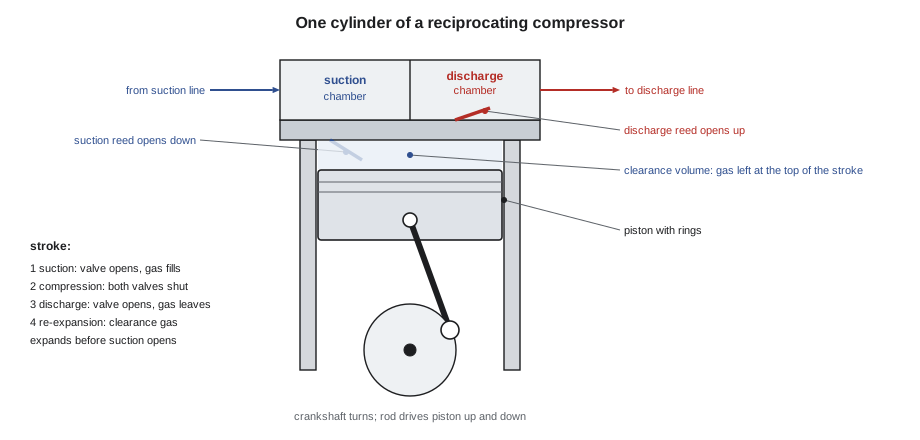
The cycle in one cylinder has four parts.
- Suction stroke. As the piston moves down, the pressure in the cylinder falls below suction pressure, the suction valve opens, and vapor from the suction line fills the cylinder.
- Compression. At the bottom of the stroke the piston reverses. The suction valve closes, and the trapped vapor is squeezed as the piston rises, raising its pressure and temperature.
- Discharge. When the cylinder pressure rises just above the pressure in the discharge chamber, the discharge valve opens and the hot vapor is pushed out into the head and the discharge line.
- Re-expansion. At the top of the stroke the piston cannot touch the valve plate, so a small volume of high-pressure gas remains. As the piston starts down again, this gas expands. The suction valve cannot open until the gas has expanded below suction pressure, so part of the down stroke is wasted.
Small reciprocating compressors are hermetic, with the motor cooled by suction gas flowing over its windings inside the shell. Larger ones are semi-hermetic, with bolted heads, valve plates and bottom plates, an oil pump driven by the crankshaft for pressure lubrication, an oil sight glass, and often a separate oil pressure safety control. Some are suction-cooled; others are air-cooled with fins on the body and a fan blowing over them, used in low-temperature work where suction gas is too scarce to cool the motor.
Displacement
A compressor's displacement is the volume its pistons sweep per unit time. For one cylinder, the swept volume per stroke is the area of the bore times the stroke length. Multiplying by the number of cylinders and the speed gives the theoretical displacement, the volume the compressor would pump if every stroke drew in a full cylinder of suction gas.
Most hermetic and semi-hermetic compressors on 60 Hz power run at about 1,750 or about 3,500 revolutions per minute, depending on whether the motor has four poles or two. Displacement is printed in the manufacturer's data, often in cubic feet per hour or cubic feet per minute.
Clearance volume and volumetric efficiency
Because of re-expansion, a real compressor never pumps its full displacement. Volumetric efficiency is the ratio of the volume of suction vapor actually pumped to the displacement. Clearance is expressed as a fraction c of the swept volume, typically a few percent. Assuming the trapped gas re-expands like an ideal gas with a polytropic exponent n, the clearance volumetric efficiency is:
As the compression ratio rises, the trapped gas has to expand further before the suction valve opens, so less of the stroke draws in fresh vapor. Real compressors lose a little more from heating of the suction gas by the hot cylinder walls, leakage past rings and valves and pressure drops through the valves, so actual volumetric efficiency is somewhat lower than this formula gives.
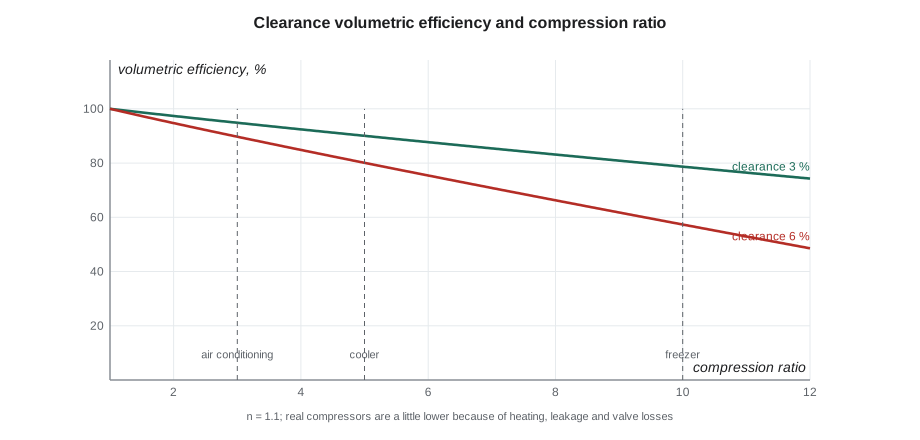
This is the main reason a reciprocating compressor loses capacity so quickly at low suction pressures. Two things happen together when the suction pressure falls: the suction vapor becomes less dense, so each cylinderful carries less mass, and the compression ratio rises, so the cylinder fills with less fresh vapor. Together they make the capacity of a reciprocating compressor drop sharply as the evaporating temperature falls, which is why a freezer compressor needs a much larger displacement than a cooler compressor of the same capacity.
From displacement to capacity
The mass flow the compressor pumps is the displacement times the volumetric efficiency times the density of the suction vapor. The capacity is the mass flow times the refrigerating effect, the enthalpy gain per kilogram or pound across the evaporator.
# Reciprocating compressor: displacement, volumetric efficiency, mass flow and capacity
import math

bore, stroke = 1.97, 1.57       # in
cyl, rpm = 2, 3450
c, n = 0.04, 1.10               # clearance fraction, re-expansion exponent

disp = math.pi / 4 * bore**2 * stroke * cyl * rpm / 1728    # ft3/min
print(f"displacement: {disp:.2f} cfm ({disp * 60:.0f} ft3/h)")

# R-134a glycol chiller conditions (approximate values from the course tables)
cases = [  # (name, Ps psia, Pd psia, suction density lb/ft3, refrigerating effect Btu/lb)
    ("design: 14 F evap, 104 F cond",  29.1, 147.4, 0.60, 63.7),
    ("dirty condenser: 122 F cond",    29.1, 191.2, 0.60, 57.2),
    ("low suction: -4 F evap",         19.3, 147.4, 0.39, 60.4),
]
for name, ps, pd, rho, re in cases:
    ratio = pd / ps
    ev = 1 - c * (ratio ** (1 / n) - 1)
    m = disp * ev * rho * 60             # lb/h
    q = m * re                           # Btu/h
print(f"{name:32s}: ratio {ratio:4.1f}, eta_v {ev:.2f}, mass flow {m:5.0f} lb/h, capacity {q:6.0f} Btu/h")displacement: 19.11 cfm (1147 ft3/h) design: 14 F evap, 104 F cond : ratio 5.1, eta_v 0.87, mass flow 595 lb/h, capacity 37912 Btu/h dirty condenser: 122 F cond : ratio 6.6, eta_v 0.82, mass flow 563 lb/h, capacity 32207 Btu/h low suction: -4 F evap : ratio 7.6, eta_v 0.79, mass flow 351 lb/h, capacity 21229 Btu/h
The small two-cylinder compressor in the program has about the capacity of the brewery's glycol chiller at design conditions. The other two lines show the effects explained above. A dirty condenser raises the ratio and lowers both volumetric efficiency and refrigerating effect, so capacity falls. A falling suction temperature cuts suction density by about a third and lowers volumetric efficiency, so capacity falls even further. In the field, the compressor manufacturer's published tables already include all these effects, and real figures should be taken from them.
Worked problem
Why a freezer compressor is bigger
A compressor has a clearance fraction of 0.04 and n = 1.10. Compare its clearance volumetric efficiency at a cooler's compression ratio of 5 and a freezer's ratio of 10.
Show solution
- \[\eta_{v,5} = 1 - 0.04\,(5^{1/1.1} - 1) = 1 - 0.04\,(4.32 - 1) \approx 0.87\]
- \[\eta_{v,10} = 1 - 0.04\,(10^{1/1.1} - 1) = 1 - 0.04\,(8.11 - 1) \approx 0.72\]
Answer: Volumetric efficiency falls from about 87 to about 72 percent. Combined with the much lower density of suction vapor at freezer temperatures, the same compressor delivers well under half its cooler capacity on a freezer. Low-temperature compressors have larger displacements, and sometimes smaller clearances, for this reason.
Capacity control
A compressor sized for the hottest day is oversized most of the time. Simple systems control capacity by cycling the compressor on and off with a thermostat or a pressure control. Larger reciprocating compressors also use other methods.
- Cylinder unloading. In semi-hermetic compressors with several cylinders, an unloader holds the suction valves of one or more cylinders open, or blocks the suction to a bank of cylinders, so they pump nothing. A six-cylinder compressor might run at 100, 67 or 33 percent. Unloading saves energy compared with a hot gas bypass.
- Multiple compressors. Supermarket racks and many chillers use several compressors in parallel, switching them on and off in steps. The grocery rack Northfield decommissioned had four semi-hermetic compressors on a common suction header.
- Variable speed. Some newer reciprocating compressors run on variable-frequency drives, though variable-speed operation is far more common with scroll and rotary compressors, as lesson 3 explains.
- Hot gas bypass. Discharge gas is routed to the evaporator inlet or the suction to keep the evaporator pressure up at low loads. It prevents coil freezing and short cycling but wastes energy, because the compressor still runs fully loaded.
How reciprocating compressors fail
Reciprocating compressors have more moving parts than scrolls or rotaries, and their valves are their most vulnerable parts.
- Liquid slugging. A slug of liquid refrigerant or oil entering a cylinder cannot be compressed. The piston tries to push it through the discharge valve, breaking reeds, cracking valve plates, bending connecting rods or snapping crankshafts. Slugging often makes a loud knocking noise. It is caused by liquid draining into the compressor during the off cycle, by flooding from an overfeeding metering device, or by a defrost or start-up that moves liquid back suddenly.
- Floodback. A steady return of a small amount of liquid with the suction gas, rather than a sudden slug. In a suction-cooled compressor the liquid lands in the crankcase, dilutes the oil and washes it from bearings and cylinder walls, causing wear of rods, bearings and pistons. It is harder to hear and more common than slugging.
- Valve damage from overheating. Running at a high compression ratio or high return gas superheat raises the discharge temperature. Valves can lose temper and break, and oil on the valves can carbonize.
- Worn rings and valves. Over years, leakage past rings and valves reduces pumping, giving the high suction, low head pattern Raj saw at the restaurant.
- Motor failures. Like any hermetic compressor, a reciprocating compressor's motor can burn out from overheating, voltage problems or contamination, as lesson 5 explains.
Raj's quick pumping test at the restaurant, blocking the condenser for a moment to see whether the head pressure would rise, is a field check rather than a precise measurement. Manufacturers and experienced technicians use various checks, including comparing current and pressures with published data and, for semi-hermetic compressors, front-seating the suction service valve to see whether the compressor can pull the crankcase down into a vacuum and hold it. Pumping a compressor into a vacuum must be brief and done only where the manufacturer permits it, and never with a scroll compressor, which can be damaged by running in a deep vacuum.
Service on semi-hermetic compressors
Semi-hermetic compressors can be repaired in place, which is one of their main attractions in commercial refrigeration. Common tasks include replacing a valve plate and gaskets after a valve failure, replacing unloaders, adjusting or replacing the oil pump and oil safety control, and checking and adding oil through the oil fill port. Before any internal work, the compressor is isolated with its service valves, the refrigerant in the compressor is recovered, and the power is locked out. Bolts are tightened to the manufacturer's torque in the specified sequence, gaskets are always new, and the compressor is leak-tested and evacuated before it is returned to service. Oil taken from a failed semi-hermetic is checked for color, smell and acid, because a burnt or acidic oil changes the repair from a valve job to a cleanup.
Common mistakes
MistakeExpecting a reciprocating compressor to keep its capacity at low suction pressures.
InsteadCapacity falls sharply because density and volumetric efficiency both fall.
MistakeIgnoring a knocking compressor after start-up.
InsteadKnocking suggests liquid slugging; find out how liquid is reaching the compressor before it breaks.
MistakeUsing hot gas bypass as the first choice for capacity control.
InsteadUnloading, multiple compressors or variable speed save energy; hot gas bypass wastes it.
MistakePulling a compressor into a deep vacuum to test its valves without checking the maker's instructions.
InsteadKeep any pump-down test brief, on compressors where it is permitted, and never on a scroll.
MistakeReusing a valve plate gasket.
InsteadAlways fit new gaskets and torque bolts in the specified sequence.
Summary and key terms
- A reciprocating compressor uses pistons, a crankshaft and reed or ring valves to draw in, compress and discharge vapor.
- Displacement is bore area times stroke times cylinders times speed.
- Gas trapped in the clearance volume re-expands each stroke, so volumetric efficiency falls as compression ratio rises.
- Mass flow = displacement × volumetric efficiency × suction density; capacity = mass flow × refrigerating effect.
- Capacity control includes cycling, cylinder unloading, multiple compressors, variable speed and hot gas bypass.
- Main failures: liquid slugging, floodback, overheated valves, worn rings and valves, and motor burnouts.
- Reciprocating compressor
- A positive displacement compressor using pistons in cylinders.
- Reed valve
- A thin spring-steel valve opened and closed by pressure difference.
- Clearance volume
- The space left between the piston at top dead center and the valve plate.
- Re-expansion
- The expansion of gas trapped in the clearance volume before new suction gas can enter.
- Volumetric efficiency
- The ratio of suction vapor actually pumped to the compressor displacement.
- Displacement
- The volume swept by the pistons per unit time.
- Cylinder unloading
- Disabling cylinders to reduce a reciprocating compressor's capacity.
- Liquid slugging
- A sudden slug of liquid entering a cylinder, causing mechanical damage.
- Floodback
- A continuous return of liquid with suction gas that dilutes and washes away the oil.
- Hot gas bypass
- Routing discharge gas to the low side to hold up evaporator pressure at low load.
Practice problems
Work each problem on paper first, then reveal the answer to check.
A four-cylinder compressor has a 2.36 in bore and 1.97 in stroke and runs at 1,750 rpm. What is its displacement in cubic feet per minute?
Show answer
π/4 × 2.36² × 1.97 × 4 × 1,750 ÷ 1,728 ≈ 35 cfm.
With c = 0.05 and n = 1.1, what is the clearance volumetric efficiency at a ratio of 8?
Show answer
1 − 0.05 × (8^0.909 − 1) ≈ 1 − 0.05 × 5.62 ≈ 0.72.
Name the difference between slugging and floodback.
Show answer
Slugging is a sudden slug of liquid causing breakage; floodback is a steady return that washes out the oil.
Why do multiple-compressor racks save energy compared with one large compressor with hot gas bypass?
Show answer
They match capacity by switching compressors off instead of pumping gas uselessly around the system.
Lesson quiz · 5 questions
Score 60% or more to complete this lesson.
Create a free account to save your progress, take quizzes and earn a certificate.