
PRIN-160 · Lesson 9 of 12 · 25 min
Practicing the processes I: starting up, directing and initiating
The seven processes describe the journey of a project from its first request to its closure, and the exams test them in two ways. Foundation asks about their purposes, objectives, triggers, activities and outputs. Practitioner asks which process is running in a scenario, who should be doing what, and what should happen next. This lesson covers the three processes that get a project off the ground: starting up a project, directing a project and initiating a project. Lesson 10 covers the four that run and end it. As always, check the exact activity names in your manual before the exam; this lesson uses descriptive wording.
How the processes fit together
A project begins when the business layer issues a project mandate. Starting up a project is a pre-project process that checks whether the project is viable and worthwhile and prepares for initiation. Directing a project runs from the end of starting up until closure and is where the project board makes its decisions. Initiating a project is the first management stage, which builds the foundation for the rest of the project: the project initiation documentation, the project plan and the detailed business case. Controlling a stage, managing product delivery and managing a stage boundary then repeat for each delivery stage, and closing a project ends it.
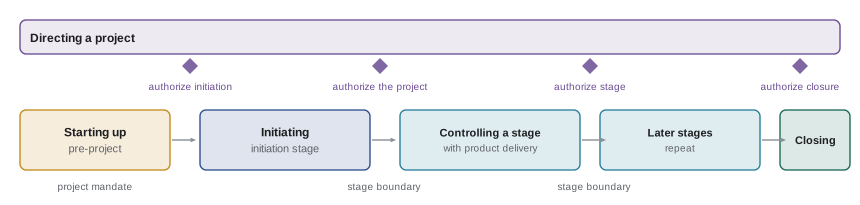
Starting up a project: revision points
| Point | What to remember |
|---|---|
| Trigger | The project mandate from the business layer |
| Purpose | Ensure the prerequisites for initiating are in place by answering whether the project is viable and worthwhile |
| Key activities | Appoint the executive and project manager; capture previous lessons; prepare the outline business case; design and appoint the project management team; select the delivery approach and assemble the project brief; plan the initiation stage |
| Main outputs | Project brief (including the outline business case and project product description); initiation stage plan; daily log; lessons log |
| Who does most of the work | The executive is appointed first; the project manager then prepares most products |
| Ends with | A request to the board to initiate the project |
Two points catch candidates. First, the executive is appointed before the project manager, because the executive is accountable and appoints the rest of the team. Second, starting up is deliberately short and light. Its purpose is to stop poorly conceived projects before money is committed to initiation, so a scenario where starting up takes months and produces a detailed plan has probably gone wrong.
Directing a project: revision points
| Point | What to remember |
|---|---|
| Trigger | The request to initiate a project, from starting up |
| Purpose | Enable the board to be accountable for success by making key decisions and exercising overall control while delegating day-to-day management |
| Key activities | Authorize initiation; authorize the project; authorize a stage or exception plan; give ad hoc direction; authorize project closure |
| How the board works | By exception: it sets tolerances and responds to exceptions, rather than managing day to day |
| Ad hoc direction | Responds to requests for advice, exception reports and external events; can be given at any time |
| Ends with | Closure authorized and the business layer notified |
The most frequent Practitioner question about directing asks whether the board is behaving as a board. Boards that approve individual work packages, hold weekly progress meetings to tell the project manager what to do next, or skip stage boundary decisions are not directing by exception. Equally, a board that never gives direction when the project manager asks for advice is failing in its role.
Initiating a project: revision points
| Point | What to remember |
|---|---|
| Trigger | Authority to initiate from the board |
| Purpose | Establish solid foundations so the organization understands the work needed before committing to a significant spend |
| Key activities | Agree the tailoring requirements; prepare the management approaches; set up project controls; create the project plan; refine the business case; assemble the project initiation documentation |
| Management approaches | Including risk, quality, change control, communication, commercial, sustainability, and digital and data management approaches |
| Main outputs | Project initiation documentation; detailed business case; project plan; benefits management approach; next stage plan (prepared in managing a stage boundary near the end of initiation) |
| Ends with | A request to the board to deliver the project |
Initiation is a management stage with its own stage plan and its own boundary. Near its end, managing a stage boundary prepares the plan for the first delivery stage, so the board can authorize the project and the next stage at the same time. Questions sometimes test this overlap by asking which process produces the first delivery stage plan.
Foundation-style practice
| Question | Options | Answer and reasoning |
|---|---|---|
| Which process is triggered by the project mandate? | A. Directing a project; B. Starting up a project; C. Initiating a project; D. Managing a stage boundary | B. |
| Which role is appointed first in starting up a project? | A. Project manager; B. Executive; C. Senior user; D. Team manager | B. |
| Which is NOT an activity in directing a project? | A. Authorize the project; B. Give ad hoc direction; C. Authorize a work package; D. Authorize project closure | C. Work packages are authorized by the project manager in controlling a stage. |
| Which product is assembled in initiating a project? | A. Project brief; B. Project initiation documentation; C. End project report; D. Checkpoint report | B. |
| What is a purpose of starting up a project? | A. Deliver specialist products; B. Ensure the prerequisites for initiating are in place; C. Authorize stages; D. Hand over products | B. |
Practitioner-style practice: a new branch project
Scenario extract. Harbor City Libraries' board of trustees has asked the library to open a small branch in a leased storefront in a growing neighborhood. The director of library services, who will be executive, appoints Dev Sharma as project manager. Dev starts by reviewing the lessons report from the makerspace refit and the accessibility upgrade. He drafts a project brief with an outline business case comparing a leased storefront with a mobile library van, and plans a three-week initiation stage. A trustee suggests skipping initiation because 'the lease is already signed and the design is simple'.
| Question | Analysis | Answer |
|---|---|---|
| Which process is Dev carrying out? | He is preparing the project brief and initiation plan before the board decides to initiate. | Starting up a project. |
| Is it appropriate for Dev to review the earlier lessons reports? | Capturing previous lessons is part of starting up and applies learn from experience. | Yes, because lessons are sought at the start of the project. |
| Is skipping initiation appropriate because the lease is signed? | Manage by stages requires at least two management stages, initiation being the first. Initiation can be short. | No. Initiation can be brief and light, but it is still needed to agree the plan, controls and business case. |
| The executive wants to approve the project brief and the project plan at the same meeting next week. Is this appropriate? | The project brief leads to authorizing initiation; the project plan is created during initiation, so it cannot be ready yet. | No. The board authorizes initiation on the brief; it authorizes the project later, on the project initiation documentation. |
The branch's lease must be approved under the library board's delegated authority policy and reported to the city, which funds most of the library's capital budget. In exam terms, the city and the library board are both parts of the business layer, which is why the executive checks the project mandate's constraints before starting up continues.
A matching question on outputs
| Item | Options: A Starting up a project; B Directing a project; C Initiating a project; D Managing a stage boundary; E Controlling a stage; F Closing a project | Answer |
|---|---|---|
| Produces the project brief | Pre-project preparation | A |
| Produces the plan for the first delivery stage near the end of initiation | Planning the next stage | D |
| Agrees the tailoring requirements for the branch project | Building the foundations of the project | C |
Timing the decisions
Questions about directing often turn on when a decision is made. The program below lays out Dev's branch project as a sequence of process steps and board decisions, which is a useful study aid: drawing the sequence for each running case makes 'what happens next' questions much easier.
steps = [
    ("project mandate", "business layer", None),
    ("starting up a project", "executive and project manager", None),
    ("authorize initiation", "project board", "decision"),
    ("initiating a project", "project manager", None),
    ("managing a stage boundary (plan stage 2)", "project manager", None),
    ("authorize the project and stage 2", "project board", "decision"),
    ("controlling a stage / managing product delivery", "project manager / team managers", None),
    ("managing a stage boundary (plan stage 3)", "project manager", None),
    ("authorize stage 3", "project board", "decision"),
    ("closing a project", "project manager", None),
    ("authorize project closure", "project board", "decision"),
]
for n, (step, who, kind) in enumerate(steps, 1):
    mark = "  <- board decision" if kind else ""
    print(f"{n:>2}. {step:<50} {who}{mark}")
print(f"board decisions: {sum(1 for s in steps if s[2])}")1. project mandate business layer 2. starting up a project executive and project manager 3. authorize initiation project board <- board decision 4. initiating a project project manager 5. managing a stage boundary (plan stage 2) project manager 6. authorize the project and stage 2 project board <- board decision 7. controlling a stage / managing product delivery project manager / team managers 8. managing a stage boundary (plan stage 3) project manager 9. authorize stage 3 project board <- board decision 10. closing a project project manager 11. authorize project closure project board <- board decision board decisions: 4
The sequence shows four board decisions for a project with an initiation stage and two delivery stages. Look at which steps belong to the project manager: preparing the next stage plan in managing a stage boundary always comes before the board's authorization of that stage.
Worked problem
What happens next?
Question: 'The branch project's executive has just authorized initiation. What should happen next?' Options: (a) Dev authorizes work packages for the storefront fit-out; (b) Dev begins initiating a project, starting by agreeing the tailoring requirements; (c) the board authorizes the project; (d) Dev prepares the project brief.
Show solution
- Locate: directly after authorize initiation in directing a project.
- Classify: process sequence.
- Rule: authority to initiate triggers initiating a project; the project brief was already prepared in starting up.
- Eliminate (a): no delivery work before the project is authorized. Eliminate (c): the project initiation documentation is not ready. Eliminate (d): already done.
- Choose (b).
Answer: (b). Initiation follows the authority to initiate.
The project brief and the PID
Questions often test the difference between the project brief and the project initiation documentation. The brief is a starting point: it describes the project's background, objectives, outline business case, project product description, delivery approach and the project management team, in enough detail for the board to decide whether to invest in initiation. The PID is the full basis for managing the project: it adds the management approaches, project controls, the project plan, the detailed business case and the tailoring decisions. If a question asks which product the board uses to authorize the project, it is the PID; if it asks which product supports the decision to authorize initiation, it is the brief.
Common mistakes
MistakeThinking the request to initiate triggers initiating a project.
InsteadIt triggers directing a project, where the board authorizes initiation.
MistakeAppointing the project manager before the executive.
InsteadThe executive is appointed first.
MistakeSkipping initiation on simple projects.
InsteadInitiation can be short but is always a management stage.
MistakeHaving the board authorize work packages.
InsteadWork packages are authorized by the project manager.
MistakeExpecting the project plan in starting up.
InsteadThe project plan is created during initiation.
Summary and key terms
- Starting up is triggered by the project mandate and asks whether the project is viable and worthwhile.
- The executive is appointed first; the project brief and initiation stage plan are the main outputs.
- Directing a project runs from the request to initiate until closure, with the board deciding by exception.
- Initiating a project is the first management stage and produces the project initiation documentation.
- The plan for the first delivery stage is prepared in managing a stage boundary near the end of initiation.
- Draw the decision sequence for each scenario to answer 'what happens next' questions.
- Project mandate
- The trigger for starting up a project, issued by the business layer.
- Project brief
- A statement describing the purpose, cost, time and performance requirements and constraints, used to start initiation.
- Project initiation documentation
- The collection of products that defines the project and forms the basis for its management.
- Authority to initiate
- The board's decision that starts initiating a project.
- Ad hoc direction
- Board guidance given at any time in response to requests or events.
- Initiation stage
- The first management stage, in which the project's foundations are built.
Practice problems
Work each problem on paper first, then reveal the answer to check.
What triggers starting up a project?
Show answer
The project mandate.
Which role is appointed first?
Show answer
The executive.
Name the five board activities in directing a project.
Show answer
Authorize initiation, authorize the project, authorize a stage or exception plan, give ad hoc direction, authorize project closure.
Who authorizes work packages?
Show answer
The project manager, in controlling a stage.
What does initiating a project assemble?
Show answer
The project initiation documentation.
Which process prepares the first delivery stage plan?
Show answer
Managing a stage boundary, near the end of initiation.
Can initiation be skipped on a simple project?
Show answer
No; it can be short, but it is always a management stage.
Why can't the board approve the project plan with the project brief?
Show answer
The project plan is created later, during initiation.
How many board decisions are in the three-stage example?
Show answer
Four.
What happens straight after authority to initiate?
Show answer
Initiating a project begins.
Lesson quiz · 5 questions
Score 60% or more to complete this lesson.
Create a free account to save your progress, take quizzes and earn a certificate.