
PRIN-160 · Lesson 6 of 12 · 25 min
Practicing people and the integrated elements
PRINCE2 7 describes the method as five integrated elements: the principles, the people element, the practices, the processes and the project context. Exams test the structure itself, because candidates need to know how the elements fit together, and they test the people element in depth, because PRINCE2 7 gave it a much bigger place than earlier editions. People questions cover leadership, teams, communication, organizational change and culture, and they connect closely to the organizing practice, which defines roles and responsibilities. This lesson revises the points that exams test most often and then works through original practice questions, including a matching question of the kind that costs Practitioner candidates the most marks.
The five integrated elements
| Element | What it is | Typical exam angle |
|---|---|---|
| Principles | Seven universal obligations | Which principle an action supports or breaks |
| People | Leadership, teams, communication, change and culture around the project | How the project manages relationships and the change it creates |
| Practices | Seven aspects managed continually: business case, organizing, plans, quality, risk, issues, progress | Which practice, product or role handles a situation |
| Processes | Seven step-wise processes from starting up to closing | Which process is running and what happens next |
| Project context | The environment that drives tailoring | Whether a tailoring decision suits the context |
The elements are integrated, so questions often cross them. A question about the board's response to a stakeholder complaint involves people (relationships and communication), organizing (who decides), issues (capturing the complaint) and directing a project (the board's process). When a question seems to fit several elements, ask which one the stem is really testing: who should act, what product should hold the information, or which behavior is appropriate.
The people element: what exams test
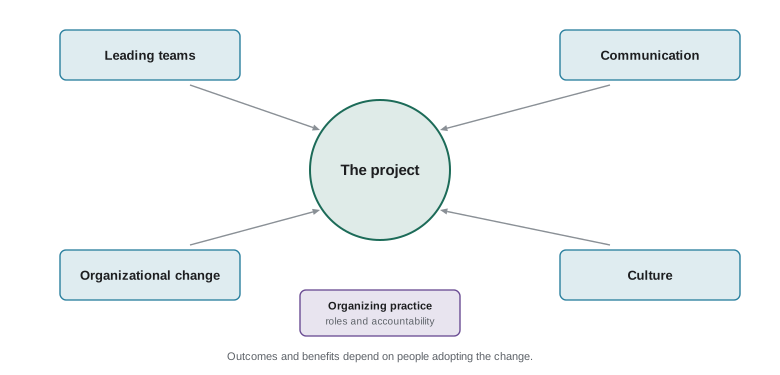
The people element recognizes that projects are delivered by people and create change for people. PRINCE2 7 discusses how project managers lead teams, often across organizations, how they communicate with stakeholders, how they handle the organizational change that projects cause, and how culture affects the way the method should be applied. Exam questions in this area tend to test four ideas.
First, projects create change, and change affects people. The project manager is responsible for delivering the project's outputs, but the outcomes and benefits depend on people adopting them. The project therefore needs to understand who is affected, plan how they will be supported and work with the business areas that will own the change after handover.
Second, leadership and teamwork matter at every level. The project manager leads a team that may include staff from different organizations with different cultures and loyalties. Building shared purpose, agreeing ways of working and dealing with conflict early are part of the job, not optional extras.
Third, communication is planned. PRINCE2 7 includes a communication management approach describing how and when the project will communicate with its stakeholders, including the format, frequency and channels. Exams test that stakeholder engagement is identified early, during starting up and initiating, and reviewed as the project changes.
Fourth, culture shapes tailoring. An organization with a formal, hierarchical culture may need more formal reporting; a team used to agile ways of working may need lighter controls and more frequent conversation. Tailoring that ignores culture tends to fail even if it looks correct on paper.
Organizing: roles that decide questions
Many people questions are really organizing questions. The organizing practice sets out four levels: the business layer, which commissions the project and sets project tolerances; directing, by the project board; managing, by the project manager; and delivering, by team managers and teams. The board represents three interests: business (the executive), user (one or more senior users) and supplier (one or more senior suppliers). Project assurance acts for board members, project support helps the project manager, and the board may delegate change authority within limits.
| Role | Key accountability | Common exam trap |
|---|---|---|
| Executive | Ultimate accountability for the project; owns the business case; single person | Splitting the executive role between two people |
| Senior user | Specifies needs and benefits; commits user resources; demonstrates benefits are realized | Giving benefit realization to the project manager |
| Senior supplier | Represents those designing and delivering; commits supplier resources; technical integrity | Assuming suppliers cannot sit on the board |
| Project assurance | Independent check on behalf of board members | Confusing it with quality assurance by the organization |
| Change authority | Decides on changes within delegated limits | Assuming it is always the project manager |
| Project manager | Day-to-day management within stage tolerances | Combining with the executive role |
| Team manager | Delivers work packages within agreed tolerances | Sending exception reports straight to the board |
| Project support | Administrative and configuration support | Combining with project assurance |
Combining roles is allowed with limits. The executive and project manager roles should not be combined, because directing and managing must stay separate. Project assurance should not be combined with project support or with the project manager, because assurance must be independent of the people it checks. Senior user and executive can be combined on small internal projects, and the project manager can act as team manager when there is no separate team.
Foundation-style practice
| Question | Options | Answer and reasoning |
|---|---|---|
| Which role is accountable for the project's success and owns the business case? | A. Senior user; B. Executive; C. Project manager; D. Senior supplier | B. The executive is the single point of accountability. |
| Which roles should NOT be combined? | A. Executive and senior user; B. Project manager and team manager; C. Project manager and project assurance; D. Senior user and project assurance for users | C. Assurance must be independent of the project manager. D is not a combination of roles but a delegation by the senior user. |
| Which is a purpose of the communication management approach? | A. Describe how and when the project will communicate with stakeholders; B. Record all issues; C. Define quality criteria; D. Record actual costs | A. |
| Who represents the interests of those who will use the project's outputs? | A. Senior user; B. Senior supplier; C. Executive; D. Business layer | A. |
| Statement 1: The business layer sets project tolerances. Statement 2: The project board sets stage tolerances. | A. Both true; B. 1 true, 2 false; C. 1 false, 2 true; D. Both false | A. |
Practitioner-style practice: the library accessibility upgrade
Scenario extract. Harbor City Libraries' accessibility upgrade (1.4 million, five stages) renovates entrances, washrooms and service desks at four branches. The executive is the director of library services. The senior user role is shared by the head of branch services and a representative of the library's accessibility advisory committee. The architect's firm and the general contractor each provide a senior supplier. Branch staff are anxious about working in partly closed buildings, and the advisory committee has complained that it learned about design changes from social media.
| Item | Options: A Communication management approach; B Issue register; C Risk register; D Stage plan; E Benefits management approach; F Lessons log | Answer |
|---|---|---|
| Where should the agreed method, frequency and channels for updating the advisory committee be defined? | How the project communicates with stakeholders | A |
| Where should the advisory committee's complaint be recorded for formal handling? | A concern raised during the project | B |
| Where should the project record that branch staff may resist temporary layouts, with an owner and response? | An uncertain future event with a response | C |
| Question | Analysis | Answer |
|---|---|---|
| Is it appropriate for the senior user role to be shared by branch services and the advisory committee representative? | The role can be held by more than one person if the users' interests need it; accessibility users are central to this project. | Yes, because the senior user role may be shared to represent different user groups. |
| The executive proposes that the project manager also becomes executive while the director is on leave for six weeks. Is this appropriate? | Directing and managing must stay separate. | No. Another person should act as executive, or decisions should wait, but the project manager should not hold both roles. |
| The project manager plans a staff session at each branch before work starts there. Which aspect of the people element does this apply? | It prepares people for the change and reduces resistance. | Managing organizational change and communication with affected people. |
Accessibility is also a compliance matter: the library's design must meet the ADA Standards for Accessible Design and any state and local requirements. In exam terms, those obligations shape quality criteria and stakeholder engagement, and an accessibility advisory committee is a natural source of user representation and assurance.
Tracking people questions
People questions are newer and less familiar to candidates who learned earlier editions, so Ana tracked them separately. The program below estimates how many people-related marks a candidate gains by moving from 55 % to 75 % accuracy on them, given an assumed share of the paper.
total_marks = 70
share_people = 0.15      # assumed share of marks touching people and organizing
people_marks = total_marks * share_people
for acc in (0.55, 0.65, 0.75, 0.85):
    print(f"accuracy {acc:.0%}: about {people_marks * acc:4.1f} of {people_marks:.1f} people marks")
gain = people_marks * (0.75 - 0.55)
print(f"moving from 55 % to 75 % adds about {gain:.1f} marks")accuracy 55%: about 5.8 of 10.5 people marks accuracy 65%: about 6.8 of 10.5 people marks accuracy 75%: about 7.9 of 10.5 people marks accuracy 85%: about 8.9 of 10.5 people marks moving from 55 % to 75 % adds about 2.1 marks
If about a seventh of the marks touch people and organizing, improving from 55 % to 75 % on them adds about two marks. Two marks sound small, but many failing candidates miss the pass mark by fewer than five.
Worked problem
Culture and tailoring
Question: 'The accessibility upgrade's contractor runs weekly site meetings and keeps a site diary. The project manager proposes that the contractor's site diary replaces team checkpoint reports, provided it records progress against the work package, issues and quality checks. Is this appropriate?'
Show solution
- Locate: delivery stages, managing product delivery and controlling a stage.
- Classify: tailoring of the progress practice to the supplier's culture and existing tools.
- Rule: checkpoint reports provide the project manager with progress information from team managers; their form can be tailored if the purpose is met.
- Apply: the site diary records the needed information at the needed frequency and avoids duplication for the contractor.
- Choose: yes, because the purpose of checkpoint reporting is met in a form that suits the supplier.
Answer: Yes. Using the contractor's existing site diary is legitimate tailoring because it delivers the checkpoint information the project manager needs.
Questions about the business layer
The business layer sits outside the project but appears in many questions. It commissions the project through the project mandate, sets project tolerances, appoints the executive, receives escalations when project tolerances are forecast to be exceeded and, after closure, owns the realization of many benefits. Questions often test whether a decision belongs to the board or to the business layer. A decision within project tolerance belongs to the board; a decision that would breach project tolerance, or change the project's purpose or funding beyond what the business layer authorized, belongs to the business layer. In the accessibility upgrade, for example, the city capital program acts as a funding partner and part of the business layer, so a request to add a fifth branch would go beyond the board's authority.
Remember too that the people element applies to the project management team itself. A board whose members rarely meet, or whose senior users do not have the authority to commit user resources, will struggle to direct the project, and Practitioner questions sometimes ask what the executive should do when a board member is not fulfilling the role.
Common mistakes
MistakeTreating the people element as optional soft skills.
InsteadIt is one of the five integrated elements and is examined.
MistakeCombining the executive and project manager roles.
InsteadKeep directing and managing separate.
MistakeCombining project assurance with project support or the project manager.
InsteadAssurance must be independent.
MistakeThinking the project manager realizes benefits.
InsteadThe senior user is accountable for demonstrating benefits.
MistakeIgnoring culture when judging tailoring.
InsteadTailoring should suit the organization and team culture.
Summary and key terms
- PRINCE2 7 has five integrated elements: principles, people, practices, processes and project context.
- The people element covers leading teams, communication, organizational change and culture.
- Organizing defines four levels and the board's business, user and supplier interests.
- Executive and project manager roles must not be combined; assurance must stay independent.
- Senior user and senior supplier roles may be shared by several people.
- Tailoring should reflect culture as well as size and complexity.
- Integrated elements
- The five parts of PRINCE2 7: principles, people, practices, processes and project context.
- People element
- The part of PRINCE2 7 dealing with leadership, teams, communication, change and culture.
- Business layer
- The organization that commissions the project and sets project tolerances.
- Communication management approach
- A product describing how and when the project communicates with stakeholders.
- Change authority
- A person or group delegated to decide on changes within limits.
- Project assurance
- Independent checking on behalf of board members.
Practice problems
Work each problem on paper first, then reveal the answer to check.
Name the five integrated elements.
Show answer
Principles, people, practices, processes and project context.
Name four topics within the people element.
Show answer
Leading teams, communication, organizational change and culture.
Which three interests does the board represent?
Show answer
Business, user and supplier.
Who sets project tolerances?
Show answer
The business layer.
Who sets stage tolerances?
Show answer
The project board.
Which roles should not be combined?
Show answer
Executive and project manager; project assurance with project manager or project support.
Can the senior user role be shared?
Show answer
Yes, when different user groups need representation.
Where are communication methods and frequency defined?
Show answer
In the communication management approach.
Where should the advisory committee's complaint be recorded?
Show answer
In the issue register, for formal handling.
Why was the contractor's site diary acceptable?
Show answer
It met the purpose of checkpoint reporting in a form suited to the supplier.
Lesson quiz · 5 questions
Score 60% or more to complete this lesson.
Create a free account to save your progress, take quizzes and earn a certificate.