
PRIN-130 · Lesson 6 of 12 · 25 min
The organizing practice II: role combinations, delegation and change authority
Lesson 5 described the roles in a PRINCE2 project management team. In practice, few projects have a different person for every role. Small projects combine roles; large projects split them among several people and delegate parts of them. Both are legitimate tailoring, provided the combinations do not create conflicts of interest and the accountability that each role carries remains clear. This lesson looks at which combinations work, how delegation operates within the structure, how authority for changes is handled through the change authority, and how the structure supports communication.
Roles are not jobs
A PRINCE2 role is a set of responsibilities, not a job title or a full-time position. One person can hold several roles, and one role can be shared among several people. The executive of a small project might spend an hour a fortnight in the role; the project manager of a large one might work full time on it with a team of assistants. Thinking of roles as bundles of responsibilities makes it easier to tailor the organization without losing anything essential.
| Situation | Typical tailoring of roles | What must stay clear |
|---|---|---|
| Very small internal project | Executive and senior user combined; project manager also does team management and support | Who decides whether the project continues; who accepts the products |
| Mid-sized project with one supplier | Separate board roles; project manager and project support separate; one or two team managers | Who commits user and supplier resources; who carries out assurance |
| Large multi-supplier project | Several senior users and suppliers; assurance delegated to specialists; project office provides support | Single executive; how board members coordinate; who is the change authority |
| Project within a program | Program roles may also hold project roles, such as the program's business change manager as senior user | Which decisions sit with the program and which with the project board |
Which roles can be combined
Some combinations are common and sensible; others create conflicts of interest that undermine the checks the structure provides. The principle is that a person should not be in a position to check, approve or accept their own work, and that the three board interests should each have a voice. The following summary reflects general PRINCE2 guidance; the official manual should be consulted for the authoritative wording.
| Combination | Generally acceptable? | Reason |
|---|---|---|
| Executive and senior user | Yes, often on internal projects | The person paying is also the main user; still check the user interest is properly represented |
| Executive and senior supplier | Sometimes, for internal suppliers | Possible where the same department funds and delivers, but watch for pressure to accept poor products |
| Project manager and team manager | Yes, on small projects | The project manager manages the team directly |
| Project manager and project support | Yes, on small projects | Administrative work done by the project manager |
| Project manager and any board role | No | The project manager would direct and check themselves |
| Project manager and project assurance | No | Assurance must be independent of the project manager |
| Project support and project assurance | No | Support works for the project manager, so it is not independent |
| Project assurance and the board role it serves | Yes | Board members may carry out their own assurance |
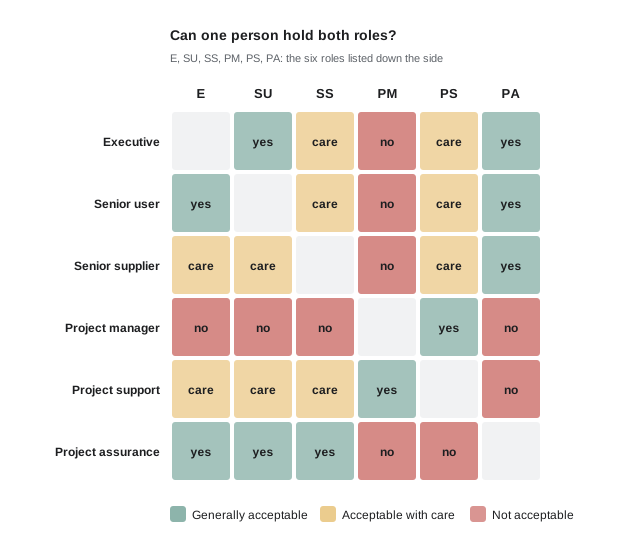
The code below encodes these rules and checks a proposed set of role assignments for a small project. Encoding rules like this is not part of PRINCE2, but it is a quick way for a project office to check many projects consistently.
forbidden = {
    frozenset({"PM", "Exec"}), frozenset({"PM", "SU"}), frozenset({"PM", "SS"}),
    frozenset({"PM", "Assurance"}), frozenset({"Support", "Assurance"}),
}
care = {frozenset({"Exec", "SS"})}

def check(assignments):
    by_person = {}
    for role, person in assignments.items():
        by_person.setdefault(person, []).append(role)
    ok = True
    for person, held in by_person.items():
        for i, a in enumerate(held):
            for b in held[i + 1:]:
                pair = frozenset({a, b})
                if pair in forbidden:
                    print(f"NOT ALLOWED: {person} holds {a} and {b}")
                    ok = False
                elif pair in care:
                    print(f"check carefully: {person} holds {a} and {b}")
    print("structure acceptable" if ok else "structure needs changes")

proposal = {"Exec": "Dana", "SU": "Dana", "SS": "Lee", "PM": "Sam",
            "Support": "Sam", "Assurance": "Sam"}
check(proposal)
print("--- revised")
proposal["Assurance"] = "Priya"
check(proposal)NOT ALLOWED: Sam holds PM and Assurance NOT ALLOWED: Sam holds Support and Assurance structure needs changes --- revised structure acceptable
The first proposal fails because Sam, the project manager, would also carry out assurance; the checker flags it twice, once against the project manager role and once against project support. Combining executive and senior user in Dana, and project manager and support in Sam, is fine for a small project. Moving assurance to Priya, who is independent of Sam, fixes the structure. In a real project, Priya might be a colleague from the finance or audit team who spends a few hours per stage on assurance reviews.
Delegation within the structure
PRINCE2 relies on delegation through tolerances. The business layer delegates to the board within project tolerances; the board delegates to the project manager within stage tolerances; the project manager delegates to team managers within work package tolerances. Each level can act freely within its tolerances and must escalate when they are forecast to be exceeded. This allows senior people to spend their time on genuine decisions rather than on detail.
| Delegating level | Delegates to | Through | Escalation when forecast to exceed |
|---|---|---|---|
| Business layer | Project board | Project tolerances in the project mandate or brief | Board refers to business layer |
| Project board | Project manager | Stage tolerances in the stage plan | Exception report to the board |
| Project manager | Team manager | Work package tolerances | Issue raised with the project manager |
Board members can also delegate their assurance responsibilities and, within limits, some of their authority. A senior user who cannot attend every quality review may appoint user representatives to review products on their behalf. What cannot be delegated is accountability: the senior user remains accountable for the user interest even if others do the work.
Change authority
Every project faces requests for change: to products, scope, requirements or approach. PRIN-131 covers how changes are assessed and controlled through the issues practice. The organizing practice establishes who has authority to approve them. By default, the project board approves changes. On projects with many changes, the board may delegate authority for approving changes within defined limits to a change authority, which might be the project manager, a board member, or a small group. The board sets the limits, usually expressed as a change budget and rules on the size of individual changes.
| Size of change | Who may approve (Ridgeline Water) | Limit |
|---|---|---|
| Minor: no effect on stage tolerances | Project manager as change authority | Up to 10,000 per change and 50,000 per stage from the change budget |
| Moderate: within stage tolerances but uses the change budget | Senior user and senior supplier as a joint change authority | Up to 60,000 per change |
| Major: would breach stage tolerances | Project board | Through an exception report |
| Would breach project tolerances | Business layer, on referral by the board | Through the board |
Delegating change authority is a trade-off. If the board approves every small change, decisions are slow and senior time is wasted. If the change authority's limits are too generous, the project can drift away from its approved scope through a series of individually small changes. A change budget, which is money set aside to fund approved changes, makes the limit concrete and visible.
Worked problem
Setting up change authority
Ridgeline Water expects many small changes during rollout, such as relocating meters at difficult sites. Each costs 2,000 to 8,000. The board meets monthly and does not want to approve each one. The stage budget is 4.8 million with a +5 % cost tolerance. How could the board set up change authority?
Show solution
- Create a change budget within the stage budget, for example 150,000, separate from the cost tolerance.
- Delegate approval of individual changes up to 10,000 to the project manager, drawing on the change budget.
- Require the project manager to report changes approved and the remaining change budget in each highlight report.
- Reserve to the board any change that would exceed 10,000, exhaust the change budget or affect the business case.
Answer: A change budget of about 150,000 with a 10,000 per-change limit lets the project manager handle routine site changes quickly while the board keeps control of anything larger and sees the cumulative effect in highlight reports.
Communication and the structure
The organization defines formal communication channels as well as authority. The board receives highlight reports from the project manager at agreed intervals and exception reports when tolerances are threatened. The project manager receives checkpoint reports from team managers. The business layer receives reports from the board as agreed. PRIN-120 covered the communication management approach, which describes how the project communicates with stakeholders beyond the project management team; the organizing practice ensures the internal reporting lines match the structure of authority.
| From | To | Report | Typical frequency |
|---|---|---|---|
| Team manager | Project manager | Checkpoint report | Weekly or as set in the work package |
| Project manager | Project board | Highlight report | Monthly or as set by the board |
| Project manager | Project board | Exception report | When a stage tolerance is forecast to be exceeded |
| Project manager | Project board | End stage report | At each stage boundary |
| Project board | Business layer | As agreed, including exceptions affecting project tolerance | As required by the business layer |
A structure in which reports flow but decisions do not is a common failure. If the board receives highlight reports but never acts on the risks they contain, or if team managers send checkpoint reports that nobody reads, the structure exists only on paper. A quick test is to ask, for each report, what decision it supports and whether that decision is being made.
Multi-organization projects
When customers and suppliers are different organizations, the organizing practice must reflect the commercial relationship. The senior supplier may be from the supplier company, and the project may have two project managers, one on each side, with clearly defined responsibilities. PRIN-120 covered customer–supplier relationships and contract types. From the organizing point of view, the key is that the contract and the PRINCE2 roles are aligned: the person who approves a change in the project should be someone who can also commit the supplier contractually, or the change process must include the contract owner.
Public-sector projects in the United States often add governance layers such as agency investment review boards or, for municipal projects, council or utility board committees. These usually sit in the business layer and should be reflected in project tolerances and escalation routes rather than added as extra board members.
Common mistakes
MistakeCombining the project manager role with a board role on a small project.
InsteadCombine other roles if needed, but keep the project manager separate from the board.
MistakeLetting project support carry out assurance because it already holds the records.
InsteadKeep assurance independent of the project manager and project support.
MistakeDelegating accountability along with the work.
InsteadDelegate tasks and authority within limits; accountability stays with the role.
MistakeGiving a change authority approval rights with no limits.
InsteadSet limits per change and a change budget, and require reporting of approved changes.
MistakeProducing reports that support no decision.
InsteadFor every report, know which decision it informs and check that the decision is made.
Summary and key terms
- Roles are bundles of responsibilities, not jobs; they can be combined or shared.
- Combinations must not let anyone check or approve their own work.
- The project manager should not hold a board role or carry out assurance; support should not do assurance.
- Delegation works through project, stage and work package tolerances; accountability is not delegated.
- The board approves changes by default but may delegate within limits to a change authority.
- A change budget makes delegated change authority concrete and visible.
- Reporting lines follow the structure of authority and should support real decisions.
- Role
- A set of responsibilities that may be held by one or more people.
- Role combination
- One person holding more than one PRINCE2 role.
- Conflict of interest
- A situation in which a person would check, approve or accept their own work.
- Delegation
- Passing authority to act within limits to a lower level of management.
- Change authority
- A person or group delegated by the board to approve changes within defined limits.
- Change budget
- Money set aside to fund approved changes.
- Highlight report
- A regular report from the project manager to the board on stage progress.
- Checkpoint report
- A regular report from a team manager to the project manager on a work package.
- User representative
- A person appointed to act for the senior user, for example in quality reviews.
- Accountability
- Ultimate answerability for a decision or result, which cannot be delegated.
Practice problems
Work each problem on paper first, then reveal the answer to check.
May the executive and senior user be the same person?
Show answer
Yes, commonly on internal projects.
May the project manager also be the senior user?
Show answer
No; the project manager should not hold a board role.
Why can project support not carry out project assurance?
Show answer
Support works for the project manager, so it is not independent.
Through what does the board delegate to the project manager?
Show answer
Stage tolerances.
Who approves changes by default?
Show answer
The project board.
What is a change budget?
Show answer
Money set aside to fund approved changes.
Can a senior user delegate accountability for the user interest?
Show answer
No; they can delegate work but remain accountable.
What report does a team manager send to the project manager?
Show answer
A checkpoint report.
What report does the project manager send when a stage tolerance is threatened?
Show answer
An exception report.
What should a change authority report regularly?
Show answer
Changes approved and the remaining change budget.
Lesson quiz · 5 questions
Score 60% or more to complete this lesson.
Create a free account to save your progress, take quizzes and earn a certificate.