
PRIN-130 · Lesson 10 of 12 · 30 min
Tolerances, stages and exception plans in planning
The plans practice does not stand alone. Plans are divided into management stages, carry tolerances, and are replaced by exception plans when tolerances are forecast to be exceeded. PRIN-110 explained the principles of managing by stages and by exception, and PRIN-120 looked at how tolerances shape behavior and how exceptions are handled between people. This lesson looks at the planning side: how to choose stages, how to derive sensible tolerances from estimates, what an exception plan contains, and how plans are baselined and replanned.
Management stages and technical stages
A management stage is a section of the project that the project manager manages on behalf of the board at any one time, at the end of which the board reviews progress and decides whether to continue. A technical stage is a grouping of work by the type of specialist activity, such as design, build or test. The two are different. Technical stages may overlap; management stages do not. A management stage boundary is placed where a decision is needed, which may fall in the middle of a technical stage.
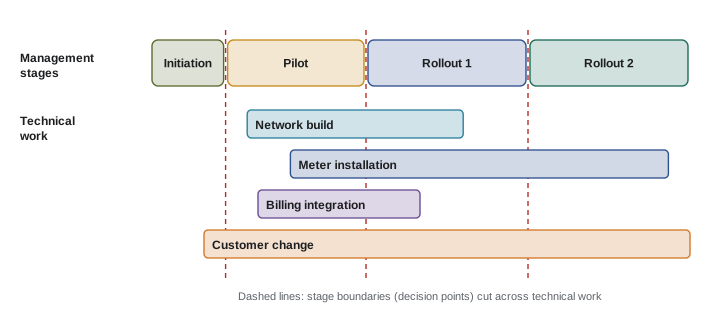
| Feature | Management stage | Technical stage |
|---|---|---|
| Purpose | Control: a decision point for the board | Grouping of similar specialist work |
| Overlap | Never overlaps with another management stage | May overlap with other technical stages |
| Boundary | Placed where a decision is needed | Placed where the type of work changes |
| Plan | Each has a stage plan | Usually appear within stage and team plans |
| Ridgeline Water | Pilot; rollout 1; rollout 2 | Network build; meter installation; billing integration; customer change |
How many stages, and how long
PRINCE2 requires at least two management stages: an initiation stage and at least one further stage. Beyond that, the number and length of stages is a planning decision. Shorter stages give the board more frequent control but more overhead; longer stages save board time but allow problems to grow before the next formal review. Good stage boundaries coincide with natural decision points: the end of a pilot, a major procurement, a go-live, or the release of significant funding.
| Factor | Favors shorter stages | Favors longer stages |
|---|---|---|
| Risk and uncertainty | High: decisions needed as information emerges | Low: work well understood |
| Planning horizon | Short: detail reliable only a few months ahead | Long: stable environment |
| Board capacity | Board can meet often | Board meets rarely or is senior and busy |
| Natural decision points | Several, close together | Few |
| Cost of stopping late | High: large sums committed each month | Low |
Worked problem
Choosing stages for Ridgeline Water
The project will take about 30 months: 3 months of initiation, a 6-month pilot, then 21 months of rollout across 20 districts. The board meets monthly but wants formal stage decisions no more than five or six times. Lesson 3 showed that the leak benefit is uncertain until measured in the pilot. How might the stages be set?
Show solution
- Stage 1: initiation, about 3 months, ending with project authorization.
- Stage 2: pilot, about 6 months, ending with a decision based on measured leak savings, the key uncertainty.
- Stages 3 to 5: rollout in three groups of districts, about 7 months each, each ending with a review of benefits realized so far and of supplier performance.
- This gives five stages, with the boundary that matters most, after the pilot, placed exactly where the main uncertainty is resolved.
Answer: Five stages: initiation, pilot and three rollout stages. The pilot boundary is the critical decision point, and the rollout boundaries let the board stop or adjust if early districts underperform.
Deriving tolerances from estimates
Tolerances are often set as round percentages without reference to the estimates. A better approach uses the uncertainty in the estimates. If the plan is built on expected values and the board wants a reasonable chance of avoiding an exception from normal variation, tolerances can be set to cover a chosen range around the plan. Lesson 7 showed how three-point estimates give an approximate standard deviation; for independent activities in sequence, variances add.
import math
# critical-path work packages for the pilot stage: (optimistic, most likely, pessimistic) weeks
critical = {
    "pilot radio network": (5, 6, 9),
    "head-end configured": (4, 5, 8),
    "billing interface":   (6, 8, 14),
    "pilot live and measured": (8, 8, 10),
}
mean = sum((o + 4 * m + p) / 6 for o, m, p in critical.values())
sd = math.sqrt(sum(((p - o) / 6) ** 2 for o, m, p in critical.values()))
print(f"expected stage duration {mean:.1f} weeks, sd {sd:.1f} weeks")
for z, label in [(0.84, "about 80 %"), (1.28, "about 90 %")]:
    print(f"plan {mean:.0f} weeks; tolerance +{z * sd:.1f} weeks covers {label} of normal variation")
# cost tolerance from a rough cost estimate range
budget, cost_sd = 1450, 70        # $000
for pct in (3, 5, 8):
    z = budget * pct / 100 / cost_sd
print(f"cost tolerance +{pct} % = {budget * pct / 100:.0f}k = {z:.1f} standard deviations")expected stage duration 28.7 weeks, sd 1.7 weeks plan 29 weeks; tolerance +1.4 weeks covers about 80 % of normal variation plan 29 weeks; tolerance +2.1 weeks covers about 90 % of normal variation cost tolerance +3 % = 44k = 0.6 standard deviations cost tolerance +5 % = 72k = 1.0 standard deviations cost tolerance +8 % = 116k = 1.7 standard deviations
The expected pilot duration is about 28.7 weeks, somewhat longer than the 27-week critical path from lesson 9 because the critical activities have longer pessimistic tails. With a standard deviation of about 1.7 weeks, and a plan rounded to 29 weeks, a time tolerance of about +1.4 weeks would absorb roughly four in five normal outcomes, and about +2.1 weeks nine in ten. For cost, a +5 % tolerance on a 1.45 million pilot budget is about one standard deviation of the cost estimate, while +8 % is about 1.7. These calculations rest on simplifying assumptions, such as independence and roughly normal totals, so they are a guide rather than a rule. Their value is that they connect the tolerance to the plan's real uncertainty, which helps the board choose tolerances that trigger exceptions for genuine problems rather than ordinary variation.
| Target | Pilot stage plan | Tolerance | Basis |
|---|---|---|---|
| Time | 29 weeks | +2 weeks / −2 weeks | Close to 90 % of normal variation on the critical path |
| Cost | 1,450 thousand | +5 % / −10 % | About one standard deviation upward; underspend allowed |
| Scope | Pilot in one district of about 3,000 connections | May reduce to 2,500 connections | Enough data for a valid leak measurement |
| Quality | 98 % daily read rate | 97–98 % accepted in difficult radio areas | From the project product description |
| Benefits | Measure leak saving | Measurement must be statistically valid | Purpose of the pilot |
| Risk | Supplier delivery risk owned and monitored | No single risk with expected impact above 100 thousand without board review | Board's risk appetite |
Tolerances at each level of plan
Tolerances appear at every level. The business layer sets project tolerances, which appear in the project plan. The board sets stage tolerances in each stage plan, within the project tolerances. The project manager sets work package tolerances, within the stage tolerances, and team managers plan their work within them. Each level keeps some tolerance in reserve: if the project manager passed the full stage tolerance down to each of three team managers, three small overruns could add up to a stage exception.
Worked problem
Allocating stage tolerance to work packages
The pilot stage has a cost tolerance of +5 % on 1,450 thousand, about 72 thousand. The three work packages have budgets of 600, 500 and 350 thousand. How might the project manager set work package cost tolerances?
Show solution
- Keep a reserve at stage level for overruns that span work packages, for example about a third, roughly 24 thousand.
- Allocate the remaining 48 thousand in proportion to risk rather than budget: the billing interface is the riskiest.
- For example: network 12 thousand (2 %), billing interface 24 thousand (about 5 %), customer change 12 thousand (about 3.4 %).
- Record the work package tolerances in each work package description.
Answer: Allocating part of the stage tolerance to work packages, weighted by risk, and holding a reserve at stage level stops several small overruns from adding up to a stage exception without warning.
Exception plans
When a stage or project tolerance is forecast to be exceeded, the project manager raises an exception report. If the board decides that the plan cannot be recovered within tolerance, it may ask for an exception plan. An exception plan replaces the current stage plan, or the project plan if project tolerances are affected, and covers the period from now to the end of that stage or project. It has the same format as the plan it replaces, plus an explanation of the exception and the chosen response. The board approves a stage exception plan; the business layer approves a project exception plan.
| Feature | Stage exception plan | Project exception plan |
|---|---|---|
| Triggered by | Forecast breach of stage tolerance | Forecast breach of project tolerance |
| Replaces | The current stage plan | The project plan |
| Approved by | Project board | Business layer, on the board's recommendation |
| Typically accompanied by | Updated business case and risks | Updated business case, risks and possibly revised project tolerances |
An exception plan is not a punishment. It is a normal mechanism for responding to new information, and an early, well-argued exception plan is a sign of good management. What would be a sign of poor management is carrying on with a plan everyone knows is unachievable, or quietly absorbing the problem until it is too large to fix.
Worked problem
Responding with an exception plan
Midway through rollout stage 1, a meter shortage means installations will run four weeks late, beyond the stage's +3-week time tolerance. Cost is unaffected. The board asks for an exception plan. What should it contain?
Show solution
- A description of the exception: the meter shortage, its cause and its forecast effect on time.
- The options considered, such as resequencing districts, sourcing meters from a second supplier, or accepting the delay.
- The chosen option and a replacement plan for the rest of rollout stage 1, with revised schedule, costs, risks and tolerances.
- The effect on the project plan and business case, for example whether later stages and benefit timing move.
Answer: The exception plan explains the problem and the chosen response and replaces the remainder of the stage plan, with updated tolerances, and it is approved by the board because only stage tolerance is affected.
Baselines and replanning
Once approved, a plan becomes a baseline against which progress is measured. Plans are revised as part of normal stage boundary work: the project plan is updated with actuals and revised forecasts, the next stage plan is created, and the business case is refreshed. Changing a baselined plan outside these points requires approval, either through change control or through an exception. This discipline is what makes progress reports meaningful; if the plan is quietly revised every month, the project is always on track and the board learns nothing.
| When | What happens to plans | Who approves |
|---|---|---|
| Initiation | Project plan and first stage plan baselined | Project board |
| During a stage | Stage plan updated with actuals and forecasts; baseline unchanged | No approval needed for updating forecasts |
| Approved change within tolerance | Stage plan revised to include the change | Change authority or board, depending on limits |
| Stage boundary | Project plan updated; next stage plan baselined | Project board |
| Exception | Exception plan replaces stage or project plan | Board (stage) or business layer (project) |
Planning closure
The final stage plan should include the activities and products needed to close the project: handing over products, confirming acceptance against the project product description, evaluating the project, handing over the benefits management approach and recommending follow-on actions. These are easily forgotten when teams are focused on delivery. Ridgeline Water's last rollout stage should therefore include decommissioning the reading routes, final acceptance after 60 days of live running, the end project report and the handover of benefits reviews to the utility's operations director.
Common mistakes
MistakeMaking management stages match technical stages.
InsteadPlace management stage boundaries at decision points, even mid-way through technical work.
MistakeSetting tolerances as round numbers with no link to the estimates.
InsteadDerive tolerances from the uncertainty in the plan and the board's appetite for exceptions.
MistakePassing the full stage tolerance to every work package.
InsteadAllocate tolerance by risk and keep a reserve at stage level.
MistakeTreating an exception plan as an addition to the current plan.
InsteadAn exception plan replaces the stage or project plan it modifies.
MistakeQuietly rebaselining plans every month.
InsteadRebaseline at stage boundaries, through approved changes or through exception plans.
Summary and key terms
- Management stages are decision points and never overlap; technical stages group similar work and may overlap.
- PRINCE2 needs at least two management stages; their number and length depend on risk, horizon and decision points.
- Tolerances can be derived from the uncertainty in the estimates.
- Tolerances are set at project, stage and work package levels, with reserves held at each level.
- Exception plans replace stage or project plans and are approved by the board or business layer respectively.
- Approved plans are baselines; changes to them follow stage boundaries, change control or exceptions.
- The final stage plan should include closure products such as acceptance and benefits handover.
- Management stage
- A section of the project managed on behalf of the board, ending with a decision.
- Technical stage
- A grouping of similar specialist work, which may overlap with others.
- Stage boundary
- The point between management stages where the board reviews and decides.
- Project tolerance
- Permitted deviation for the project as a whole, set by the business layer.
- Stage tolerance
- Permitted deviation for a stage, set by the board.
- Work package tolerance
- Permitted deviation for a work package, set by the project manager.
- Exception plan
- A plan that replaces a stage or project plan after a forecast tolerance breach.
- Baseline
- An approved version of a plan against which progress is measured.
- Standard deviation
- A measure of how widely values spread around their mean.
- Tolerance reserve
- Part of a tolerance kept at a higher level rather than allocated downward.
Practice problems
Work each problem on paper first, then reveal the answer to check.
Can two management stages overlap?
Show answer
No.
What is the minimum number of management stages?
Show answer
Two: initiation and at least one more.
Where should a management stage boundary be placed?
Show answer
At a point where the board needs to make a decision.
Three sequential activities have σ of 3, 4 and 12. Total σ?
Show answer
13.
Who sets work package tolerances?
Show answer
The project manager.
Who approves a project exception plan?
Show answer
The business layer.
Does an exception plan replace or add to the stage plan?
Show answer
It replaces it.
Why keep a tolerance reserve at stage level?
Show answer
So that several small work package overruns do not add up to a stage exception without warning.
When is the next stage plan baselined?
Show answer
At the stage boundary, when the board approves it.
Name two closure products to include in the final stage plan.
Show answer
For example acceptance confirmation and handover of the benefits management approach.
Lesson quiz · 5 questions
Score 60% or more to complete this lesson.
Create a free account to save your progress, take quizzes and earn a certificate.