
PRIN-101 · Lesson 6 of 12 · 27 min
The seven principles: an overview
The principles are the foundation of PRINCE2. They are guiding obligations and good practices that determine whether a project is genuinely being managed using PRINCE2. The manual is clear that all seven must be applied: you can tailor almost everything else in the method, from the number of stages to the format of reports, but a project that ignores a principle is not a PRINCE2 project. This lesson gives an overview of each principle, why it matters and how it shows up in practice. PRIN-110 studies them in depth.
Why principles come first
Principles are universal, self-validating and empowering. They are universal because they apply to every project, whatever its size, sector or delivery approach. They are self-validating because they have been proven in practice over many years. They are empowering because they give the people involved confidence and the ability to shape how the project is managed. Because principles are about what must be true rather than exactly how to do it, they are what make tailoring safe. When you shorten a report, combine roles or drop a management product on a small project, you check that the principles are still being honored.
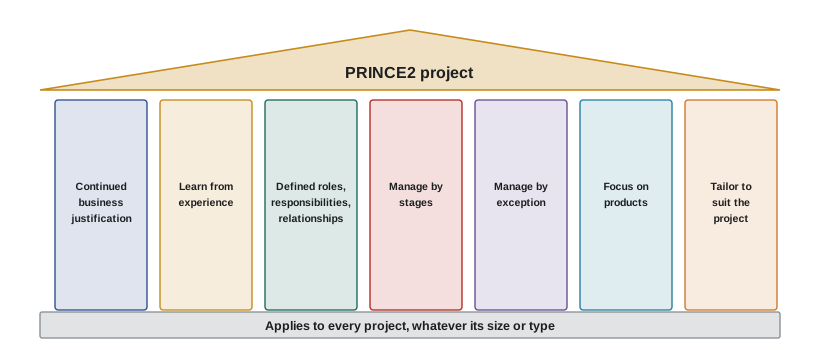
1. Ensure continued business justification
A PRINCE2 project must have a justifiable reason to start, and that justification must remain valid throughout its life. The justification is documented in a business case and checked at key points, especially at the end of each stage. If circumstances change so that the expected benefits no longer outweigh the costs and risks, the project should be changed or stopped. Even compulsory projects, such as those needed to comply with a new regulation, need a business case, because there are usually several ways to comply and the business case helps choose the best one.
This principle is what allows a project board to stop a failing project with a clear conscience. Stopping early is not a failure of PRINCE2; it is the method working as intended.
Worked problem
Checking continued justification
A project to build a customer portal was justified by expected savings of 900,000 over five years against a total cost of 600,000. At the end of stage 2, the forecast total cost has risen to 750,000 and a competitor has launched a similar portal, so expected savings are revised down to 700,000. Is the project still justified on these simple figures?
Show solution
- Original net benefit: 900,000 − 600,000 = 300,000.
- Revised net benefit: 700,000 − 750,000 = −50,000.
- The project now costs more than it is expected to save on these figures.
- The project board should consider changing the scope to reduce cost, finding other benefits or closing the project prematurely.
Answer: No: the revised net benefit is negative, so the board should change or stop the project. A fuller analysis would discount future savings, as Lesson 7 shows.
2. Learn from experience
PRINCE2 project teams seek, record and act on lessons throughout the project. At the start, they look for lessons from previous projects and from outside the organization. During the project, they record lessons as they arise. At the end, they pass lessons on so that future projects benefit. Projects are unique and temporary, so without a deliberate effort lessons are lost when the team disbands. The responsibility for seeking lessons belongs to everyone involved, not only the project manager.
3. Define roles, responsibilities and relationships
A PRINCE2 project has a defined and agreed organizational structure that engages the right people. Every project needs three primary stakeholder interests represented: the business, which needs the project to be worthwhile; users, who will use the products and benefit from them; and suppliers, who provide the skills and resources to create the products. The project board reflects these interests through the executive, senior user and senior supplier. PRINCE2 7 phrases this principle to include relationships, recognizing that roles on paper mean little without working relationships between the people who fill them.
4. Manage by stages
A PRINCE2 project is planned, monitored and controlled stage by stage. Management stages are partitions of the project with decision points at the end of each, where the project board reviews progress, checks the business case and decides whether to authorize the next stage. Planning in stages accepts that it is hard to plan accurately far into the future: the project plan stays high level, while each stage plan is detailed enough for day-to-day control. Every PRINCE2 project has at least two management stages: an initiation stage and one or more delivery stages.
5. Manage by exception
A PRINCE2 project has defined tolerances for each project objective, establishing limits of delegated authority. Each level of management manages the level below and is only involved when a tolerance is forecast to be exceeded. This lets senior people spend their time on direction rather than detail, and lets people closer to the work act without constant permission. The levels are typically the business or program management above the project, the project board, the project manager and team managers.
| Level | Sets tolerances for | Escalates to |
|---|---|---|
| Business, program or corporate management | The project as a whole | Not applicable |
| Project board | Each stage | Business, program or corporate management if project tolerance is threatened |
| Project manager | Each work package | Project board if stage tolerance is threatened |
| Team manager | Work within the work package | Project manager if work package tolerance is threatened |
6. Focus on products
A PRINCE2 project focuses on the definition and delivery of products, in particular their quality requirements. Before work starts, products are described so that everyone agrees what will be delivered and how its quality will be judged. Product descriptions guide planning, set expectations, guide quality checking and reduce the risk of scope creep and disputes about whether something is finished. This product focus is one of the distinctive features of PRINCE2, and it underpins product-based planning, which later courses cover.
7. Tailor to suit the project
PRINCE2 is tailored to suit the project's environment, size, complexity, importance, team capability and risk. Tailoring means adapting processes, practices, roles, management products and terminology so that the level of control is appropriate. A two-month internal project and a five-year infrastructure program both use PRINCE2, but very differently. Tailoring is not a way of avoiding the method: the principles must still be applied, and tailoring decisions should be documented, usually in the project initiation documentation, so that everyone knows how the method is being used.
Worked problem
Tailoring a small project
A three-person team will update an internal training course over 10 weeks for a budget of 25,000. Suggest a tailored approach that still honors all seven principles.
Show solution
- Business justification: a one-page business case confirmed at the start and at the single stage boundary.
- Learning: a short lessons discussion at the start and end, recorded in a shared document.
- Roles: one person acts as executive and senior user; the training manager is senior supplier; the project manager also acts as team manager.
- Stages: an initiation stage of one week and one delivery stage.
- Exception: tolerances of ±10 % on cost and ±1 week on time, with exceptions by email.
- Products: brief product descriptions for the course materials and assessment.
- Tailoring: decisions recorded in a two-page project initiation document.
Answer: A light-touch version of PRINCE2 that combines roles and simplifies products but still applies every principle.
How the principles connect
The principles reinforce one another. Manage by stages provides the decision points where the business case is checked, supporting continued business justification. Manage by exception relies on clearly defined roles to know who sets and holds tolerances. Focus on products gives the clear targets that make planning and tolerances meaningful. Learn from experience improves every one of them over time, and tailoring makes the whole system proportionate. Exam questions, particularly at Practitioner, often test these connections by asking which principle a situation illustrates or whether a tailoring choice undermines one.
| Principle | In one phrase | Typical evidence on a project |
|---|---|---|
| Continued business justification | Is it still worth doing? | A business case reviewed at each stage boundary |
| Learn from experience | What do we already know? | A lessons log and lessons reports |
| Roles, responsibilities and relationships | Who decides what? | An agreed project management team structure |
| Manage by stages | One stage at a time | Stage plans and end stage assessments |
| Manage by exception | Escalate only when needed | Tolerances and exception reports |
| Focus on products | What exactly are we delivering? | Product descriptions with quality criteria |
| Tailor to suit the project | Make it proportionate | Documented tailoring decisions |
Public-sector projects in the United States often have their own governance requirements, such as agency capital planning and investment control processes or state stage-gate reviews, and these can map neatly onto PRINCE2 principles: gates align with stage boundaries and investment reviews with business justification. Tailoring then means aligning PRINCE2's products and decisions with those required gates rather than running two parallel systems.
Principles in exam questions
Foundation questions on the principles usually ask you to identify a principle from a description, recognize its purpose or spot a statement that is not a principle. Common distractors include phrases that sound like principles but are not, such as "manage by milestones", "focus on activities" or "ensure stakeholder satisfaction". Practitioner questions go further: they describe what happened on the scenario project and ask which principle is being applied, or which is being neglected. For example, a project manager who starts work before product descriptions exist is neglecting focus on products, and a board that wants weekly detailed task reports instead of highlight reports and exceptions is undermining manage by exception.
A useful habit is to explain each principle in one sentence and give one example of it being applied and one of it being ignored. If you can do that for all seven from memory, you are well prepared for principle questions at both levels.
Remember too that principles describe obligations for everyone involved, not just the project manager. Board members apply continued business justification when they decide at stage boundaries; team managers apply focus on products when they check work against product descriptions; and every member of the team applies learn from experience by raising lessons when they notice them. A project in which only the project manager thinks about the principles is unlikely to apply them well, which is why many organizations brief their project boards on PRINCE2 as well as training their project managers.
In short, the principles are the test of whether a project is genuinely PRINCE2: check each one at initiation, at every stage boundary and whenever you are tempted to tailor something away.
Common mistakes
MistakeTreating a principle as optional on a small project.
InsteadApply all seven principles and tailor how they are applied.
MistakeSeeing an early project closure as a failure of PRINCE2.
InsteadRecognize that stopping an unjustified project is the method working.
MistakeLeaving lessons until the end of the project.
InsteadSeek lessons at the start and record them throughout.
MistakeEscalating every problem to the project board.
InsteadEscalate only when tolerances are forecast to be exceeded.
MistakeTailoring without recording the decisions.
InsteadDocument tailoring in the project initiation documentation.
Summary and key terms
- All seven principles must be applied for a project to be a PRINCE2 project.
- Continued business justification means the project must remain worth doing.
- Learn from experience means seeking, recording and acting on lessons throughout.
- Defined roles, responsibilities and relationships represent business, user and supplier interests.
- Manage by stages gives decision points and realistic planning horizons; there are at least two stages.
- Manage by exception uses tolerances to delegate authority level by level.
- Focus on products and tailor to suit the project complete the set.
- Principle
- A guiding obligation that must be applied on every PRINCE2 project.
- Business justification
- The reason a project is worth its costs and risks.
- Lesson
- Something learned that can improve this or future projects.
- Management stage
- A section of a project managed as a unit, ending with a board decision.
- Initiation stage
- The first management stage, in which the project is planned and set up.
- Delegated authority
- Decision rights passed from one management level to the next.
- Product description
- A description of a product's purpose, composition and quality criteria.
- Scope creep
- Uncontrolled growth in what a project is expected to deliver.
- Project initiation documentation
- The set of documents that defines how the project will be managed.
- Primary stakeholder interests
- Business, user and supplier.
Practice problems
Work each problem on paper first, then reveal the answer to check.
How many principles must be applied for a project to be PRINCE2?
Show answer
All seven.
Why do compulsory projects still need a business case?
Show answer
There are usually several ways to comply, and the business case helps choose the best.
Original net benefit 400,000 − 250,000; revised costs 350,000, benefits unchanged. Revised net benefit?
Show answer
50,000.
What are the three primary stakeholder interests?
Show answer
Business, user and supplier.
What is the minimum number of management stages?
Show answer
Two: initiation and at least one delivery stage.
Who sets tolerances for a work package?
Show answer
The project manager.
Which principle relies on product descriptions?
Show answer
Focus on products.
Where are tailoring decisions usually recorded?
Show answer
In the project initiation documentation.
Which principle does a lessons log support?
Show answer
Learn from experience.
Name one way tailoring can simplify roles on a small project.
Show answer
Combining the executive and senior user roles, for example.
Lesson quiz · 5 questions
Score 60% or more to complete this lesson.
Create a free account to save your progress, take quizzes and earn a certificate.