
PMP-160 · Lesson 6 of 12 · 27 min
Practicing adaptive and hybrid questions
About 60 % of questions on the 2026 exam are set in adaptive or hybrid contexts. Some test agile practices directly: who orders the backlog, what happens in a retrospective, how to read a burndown chart. Many more use an agile or hybrid setting as the background for a People, Process or Business Environment question. PMP-140 taught agile and hybrid delivery in depth. This lesson practices the question patterns and shows how the PMI mindset applies when the team, not the project manager, owns much of the work.
The key to adaptive questions is knowing who decides what. Most wrong options in agile questions give a decision to the wrong person, usually the project manager or a senior stakeholder, or bypass an agreed practice such as the sprint goal or the definition of done.
Who decides what
| Decision | Owner in Scrum | Common wrong option |
|---|---|---|
| What to build and in what order | Product owner, through the product backlog | Project manager or sponsor reorders the backlog |
| How to build it and how much to take into a sprint | Developers | Project manager assigns tasks or sets the sprint scope |
| Whether work meets the definition of done | Developers, against the shared definition | Product owner accepts unfinished work to hit a date |
| Whether an increment is released | Product owner, with stakeholders | Developers release whenever they like |
| How the team improves its process | The whole Scrum team in the retrospective | Manager imposes process changes from outside |
| Removing impediments the team cannot remove | Scrum Master or project manager as servant leader | Team is told to work around them |
In hybrid projects these rights often coexist with predictive governance. On Project Compass, the app team's product owner decides backlog order within the agreed release goal and budget, while changes to the overall budget, the opening date or the vendor contract still go to the change control board or sponsor, as PMP-150 described. Questions often test whether you route each decision to the right place.
Events and artifacts in questions
Questions frequently describe a Scrum event going wrong. The daily scrum becoming a status report to the project manager, the sprint review becoming a demonstration with no feedback, or the retrospective being skipped when the team is busy are classic examples. The best answer restores the purpose of the event: a short planning meeting for the developers, a working session to inspect the increment with stakeholders and adapt the backlog, and a team discussion of how to improve.
| Event or artifact | Purpose | Exam pattern |
|---|---|---|
| Sprint planning | Agree the sprint goal and plan the work | Developers select the work; the product owner explains priorities |
| Daily scrum | Inspect progress toward the goal and adapt the plan for the day | For developers; not a status meeting for managers |
| Sprint review | Inspect the increment with stakeholders and adapt the backlog | Invite real stakeholders; gather feedback |
| Sprint retrospective | Improve how the team works | Never skip it; the team chooses improvements |
| Product backlog | Ordered list of what may be built | Owned and ordered by the product owner |
| Sprint backlog | Sprint goal plus selected items and plan | Owned by the developers |
| Increment and definition of done | Usable output meeting the shared quality standard | Unfinished work does not count as done |
Worked problem
A daily scrum that has become a status meeting
On Project Compass, the library's IT director has started attending the app team's daily scrum and asking each developer to explain what they did yesterday and why it took so long. The meetings now run 40 minutes. What should Jordan Reyes, the Scrum Master, do?
Show solution
- The daily scrum is for the developers to plan their day toward the sprint goal; it is timeboxed to 15 minutes.
- Jordan should coach the IT director on the purpose of the event and offer other ways to see progress, such as the sprint review, the task board or a short conversation afterwards.
- Jordan should also help the developers keep the meeting focused and within the timebox.
- Canceling the daily scrum, asking the developers to send written reports or letting the meeting continue are all weaker options.
Answer: Coach the director on the event's purpose, offer other ways to see progress, and restore the 15-minute developer-focused meeting.
Reading agile charts
Graphic-based questions often use burndown charts, burnup charts, cumulative flow diagrams and velocity charts. A burndown chart shows work remaining against time; a line above the ideal means the team is behind, and a flat line means no work is being completed. A burnup chart shows work completed and total scope; if the scope line rises, the release is growing, which a burndown chart can hide. A cumulative flow diagram shows work in each state; a widening band means work is piling up in that state, often a bottleneck.
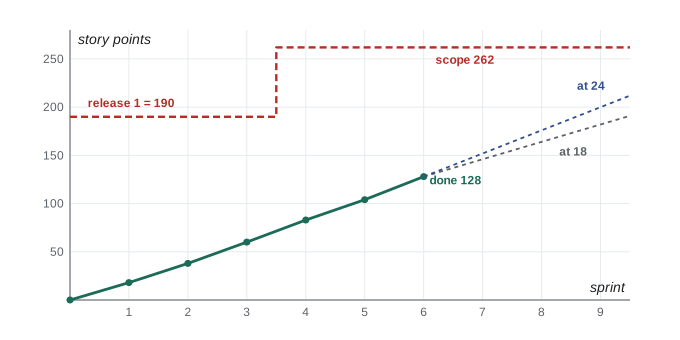
When a question asks what a chart shows, answer only what the data supports. If a burndown is flat for three days, the honest conclusion is that no work was completed in that period, not that the team is lazy. The best action would be to find out why, often in the daily scrum or a conversation with the team, and help remove whatever is blocking progress.
Forecasting with velocity
Velocity is the amount of work, usually in story points, that a team completes in a sprint. It is a planning tool for the team, not a performance target or a way to compare teams. Questions may ask how many sprints remain, whether a release date is realistic or what to do when velocity drops.
# Release forecast for the Project Compass app from past velocity (story points per sprint).
import math, statistics
velocity = [18, 20, 22, 23, 21, 24]
remaining = 62
avg = statistics.mean(velocity)
low, high = min(velocity), max(velocity)
print(f"average velocity {avg:.1f}, range {low}-{high}")
for label, v in (("pessimistic", low), ("average", avg), ("optimistic", high)):
    print(f"{label:12} {remaining / v:4.1f} sprints -> plan {math.ceil(remaining / v)}")
print()
# With 3 sprints left before the soft opening, how much scope fits?
for label, v in (("pessimistic", low), ("average", avg)):
print(f"{label:12} fits about {3 * v:.0f} of {remaining} points in 3 sprints")average velocity 21.3, range 18-24 pessimistic 3.4 sprints -> plan 4 average 2.9 sprints -> plan 3 optimistic 2.6 sprints -> plan 3 pessimistic fits about 54 of 62 points in 3 sprints average fits about 64 of 62 points in 3 sprints
The forecast uses the Project Compass app team's velocity from PMP-140: 18, 20, 22, 23, 21 and 24, averaging 21.3. With 62 points left, the average suggests about three sprints, but the lowest velocity suggests four. With only three sprints before the soft opening, the team and product owner decided to move the 12-point renewals feature to a later release, so that the remaining 50 points fit with high confidence. That decision illustrates a common exam answer: when time is fixed, adjust scope by priority rather than pressuring the team to raise velocity.
Kanban and flow questions
Kanban questions focus on visualizing work, limiting work in progress and managing flow. When work piles up in one column, the best answer is usually to stop starting new work and help finish what is stuck, to look at the cause of the bottleneck, and possibly to adjust work-in-progress limits. Little's law relates the measures: average cycle time equals average work in progress divided by average throughput. Reducing work in progress shortens cycle time without anyone working faster.
Hybrid and tailoring questions
Hybrid questions test whether you choose the right approach for each part of the work and connect them sensibly. On Project Compass the fit-out, which has fixed physical dependencies and regulatory inspections, is predictive; the app, whose requirements emerge from user feedback, is adaptive; the kiosks are procured on a fixed price incentive contract. The connection points are where questions arise: the app must be ready for the opening date fixed by the fit-out, and the kiosk firmware must integrate with the app's hold notifications.
Worked problem
Connecting the predictive and adaptive parts
The fit-out schedule slips by two weeks because a permit was late. The app team works in two-week sprints and was planning to release just before the original opening date. What should Priya do?
Show solution
- Assess the integrated impact: the opening date moves, which may change the app's release window and staff training dates.
- Communicate the change to the product owner and the app team so they can decide whether to use the extra sprint for priority backlog items, more testing or the deferred renewals feature.
- Update the integrated schedule and the communications plan, and inform stakeholders through the agreed channels.
- Wrong options would include telling the app team to slow down, adding scope to the app without the product owner, or keeping the original app date regardless of the opening.
Answer: Assess the integrated impact, involve the product owner in deciding how to use the extra time, and update the plans and stakeholders.
Agile contracts and scaling
Some questions involve contracts for agile work. Fixed-scope, fixed-price contracts fit poorly with adaptive development because scope is expected to change. Common alternatives include time and materials with a ceiling, fixed price per iteration or per increment, and contracts that allow the customer to change priorities or stop early. On Project Compass, the app firm works on time and materials with a ceiling, and the product owner adjusts scope within it.
Scaling questions may mention coordinating several teams. Strong answers focus on shared goals, regular integration, coordination roles and events, and reducing dependencies between teams. You do not need detailed knowledge of particular scaling frameworks, but you should recognize that adding more teams adds coordination needs.
Public sector agile procurement is increasingly common in the United States, with federal guidance on modular contracting and buying digital services in phases. Exam questions stay general; they test whether the contract allows learning and change.
Quick patterns for adaptive and hybrid questions
- The product owner orders the backlog; developers decide how to do the work and how much to take on.
- Restore the purpose of events that have drifted; never skip the retrospective.
- Velocity is for planning, not for targets or comparisons.
- When time is fixed, adjust scope by priority.
- Limit work in progress and help finish blocked work before starting more.
- In hybrid projects, assess impacts across predictive and adaptive parts and route each decision to its owner.
Common mistakes
MistakeHaving the project manager assign tasks to developers.
InsteadDevelopers self-organize; the project manager supports them.
MistakeTreating the daily scrum as a status report.
InsteadIt is a short planning meeting for the developers.
MistakeUsing velocity as a performance target.
InsteadUse it for forecasting and adjust scope when time is fixed.
MistakeReading a burndown without checking for scope changes.
InsteadA burnup shows whether total scope has grown.
MistakeApplying predictive change control to every backlog change.
InsteadBacklog changes belong to the product owner within guardrails.
Summary and key terms
- About 60 % of questions use adaptive or hybrid contexts, often as background to People, Process or Business Environment questions.
- Decision rights are central: the product owner orders, developers plan and build, the team improves its process.
- Events have specific purposes; restore them when they drift.
- Burndown, burnup, cumulative flow and velocity charts must be read carefully and only for what they show.
- Velocity supports forecasting; when time is fixed, adjust scope by priority.
- Hybrid questions test whether impacts are assessed across approaches and decisions go to the right owners.
- Product owner
- The person accountable for maximizing value and ordering the product backlog.
- Developers
- In Scrum, the people who create the increment, whatever their specialism.
- Definition of done
- The shared quality standard an increment must meet.
- Velocity
- The amount of work a team completes in a sprint, used for forecasting.
- Burnup chart
- A chart showing completed work and total scope over time.
- Cumulative flow diagram
- A chart showing the amount of work in each state over time.
- Work in progress limit
- A cap on how many items may be in a state at once.
- Hybrid approach
- A combination of predictive and adaptive practices tailored to different parts of a project.
Practice problems
Work each problem on paper first, then reveal the answer to check.
Who orders the product backlog?
Show answer
The product owner.
Who decides how much work to take into a sprint?
Show answer
The developers.
What is the timebox for the daily scrum?
Show answer
15 minutes.
What does a flat burndown line mean?
Show answer
No work was completed in that period.
Why can a burnup chart be more informative than a burndown?
Show answer
It shows total scope, so scope growth is visible.
With 62 points left and an average velocity of 21.3, about how many sprints remain?
Show answer
About three, or four at the lowest velocity.
What should a team do when work piles up in one Kanban column?
Show answer
Stop starting new work, help finish the blocked work and examine the bottleneck.
State Little's law.
Show answer
Average cycle time equals average work in progress divided by average throughput.
Why are fixed-scope, fixed-price contracts a poor fit for adaptive work?
Show answer
Scope is expected to change as the team learns.
In a hybrid project, who approves a change to the overall budget?
Show answer
The governance body with that authority, such as the change control board or sponsor.
Lesson quiz · 5 questions
Score 60% or more to complete this lesson.
Create a free account to save your progress, take quizzes and earn a certificate.