
PMP-160 · Lesson 4 of 12 · 32 min
Practicing People-domain questions
The People domain is about a third of the exam, roughly 56 scored questions. It covers leading teams, managing conflict, engaging stakeholders, building shared understanding, mentoring, supporting performance and working with distributed teams. PMP-120 and PMP-121 taught the theory. This lesson works through the kinds of questions the exam asks, explains why the best answers are best, and gathers the patterns you should recognize quickly.
People questions are often the ones candidates feel most confident about and get wrong most often. Everyone has managed people in some way, so it is tempting to answer from instinct. The exam expects a particular approach: direct, private, respectful conversation first; collaboration over force; support for a self-organizing team; and attention to the root cause of behavior rather than its symptoms.
The tasks behind the questions
| People task area (paraphrased) | What questions test | Patterns in strong answers |
|---|---|---|
| Lead and empower the team | Vision, delegation, decision making, servant leadership | Set direction, delegate, remove obstacles, avoid micromanaging |
| Manage conflict | Choosing a conflict approach, timing, root causes | Address early and privately; collaborate where possible |
| Engage stakeholders | Analysis, engagement levels, communication, expectations | Analyze, plan engagement, communicate in their terms, involve early |
| Build shared understanding | Ground rules, team charters, agreement on goals | Co-create charters and working agreements; revisit when things change |
| Mentor and develop | Coaching, training, career growth | Coach first, train where there is a skill gap |
| Support team performance | Recognition, feedback, performance issues | Discuss privately, find causes, agree improvements |
| Distributed and virtual teams | Time zones, tools, culture, trust | Clear working agreements, overlap hours, inclusive practices |
Conflict questions
Conflict is the most heavily tested People topic. The exam uses the familiar five approaches: collaborate (problem solve), compromise, smooth (accommodate), force (direct) and withdraw (avoid). Collaboration, which looks for a solution that meets everyone's underlying interests, is generally preferred because it resolves the cause. Compromise is acceptable when time is short or the parties have equal power. Smoothing can be right to calm emotions briefly or when the issue matters little. Forcing is right only in emergencies, such as safety or legal requirements. Withdrawing is sometimes right to let tempers cool, but not as a solution.
| Approach | When it fits | Exam signal |
|---|---|---|
| Collaborate | Important issue, time to explore, relationships matter | Usually the best answer when time allows |
| Compromise | Deadline pressure, equal power, temporary fix | Second best when collaboration is not possible |
| Smooth or accommodate | Emotions high, issue minor, preserving harmony | Short-term at most |
| Force or direct | Safety, legal or ethical emergency, no time | Right only in emergencies |
| Withdraw or avoid | Cooling-off period, trivial issue | Rarely a final answer |
Worked problem
A conflict between two experts
On Project Compass, Tess, the app's designer, and Luc, a developer, argue in the daily scrum about whether the hold screen should follow the library's brand colors or a higher-contrast design for accessibility. The argument is becoming personal and other team members are uncomfortable. What should Jordan Reyes, the Scrum Master, do?
Show solution
- The daily scrum is not the place to resolve this. Jordan should ask the two to continue after the meeting so the scrum stays short.
- Then Jordan should facilitate a discussion between Tess and Luc focused on the shared goal: an app that meets accessibility requirements and the brand. This is collaboration.
- If the accessibility requirement is part of the definition of done, as in PMP-150, the facts may resolve the disagreement: the contrast standard must be met; the brand can be adapted within it.
- Wrong options would include Jordan deciding the design himself (forcing a decision the team should own), telling them to stop arguing (smoothing) or reporting them to their manager (escalating too soon).
Answer: Move the discussion out of the daily scrum and facilitate a collaborative resolution focused on the shared goal and the definition of done.
Team development and performance
Questions about team development often use Tuckman's stages: forming, storming, norming, performing and adjourning. The exam may describe a team arguing about roles and ask what stage it is in (storming) or what the project manager should do (help the team agree on roles and working agreements). In the forming stage the project manager provides more direction; as the team matures, the project manager steps back and delegates more.
Performance problems with an individual follow a consistent pattern. Meet privately, describe the behavior and its effect, listen to understand the cause, agree on improvements and support, and follow up. Only if this fails, and the problem is serious, involve the functional manager or human resources according to the organization's policies. Options that begin with public criticism, immediate removal or reporting the person to their manager are usually wrong.
Worked problem
A team member who has gone quiet
Ravi, who tests the Project Compass app, used to be active in retrospectives but has said almost nothing for three sprints, and his testing is falling behind. What should the project manager do first?
Show solution
- This is a performance and engagement issue with an individual. The first step is a private conversation to understand what has changed.
- Ravi may be overloaded, unclear about expectations, facing a personal problem or unhappy with how his input was received.
- The project manager listens, then agrees on support, such as adjusting work in progress, pairing with a developer or clarifying acceptance criteria.
- Raising it in the retrospective in front of everyone, informing his functional manager or reassigning his work are all premature.
Answer: Talk with Ravi privately to understand the cause, then agree on support and follow up.
Stakeholder questions
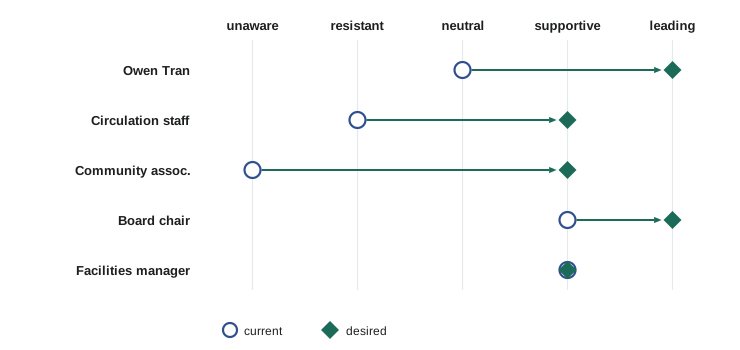
Stakeholder engagement questions test whether you analyze stakeholders, plan engagement and communicate in ways that fit their interests and influence. Remember the engagement levels used in the stakeholder engagement assessment matrix: unaware, resistant, neutral, supportive and leading. The gap between current and desired levels shows where effort is needed, and influence shows how much it matters.
# Stakeholder engagement gaps on Project Compass, ordered by influence times gap.
LEVELS = ["unaware", "resistant", "neutral", "supportive", "leading"]
stakeholders = [
    # name, current, desired, influence 1-5
    ("Owen Tran, branch manager", "neutral", "leading", 5),
    ("Circulation staff", "resistant", "supportive", 4),
    ("Facilities manager", "supportive", "supportive", 3),
    ("Library board chair", "supportive", "leading", 4),
    ("Community association", "unaware", "supportive", 2),
]
rows = []
for name, cur, want, infl in stakeholders:
    gap = LEVELS.index(want) - LEVELS.index(cur)
    rows.append((infl * gap, name, cur, want, gap))
print(f"{'Stakeholder':28}{'Current':>11}{'Desired':>11}{'Gap':>5}{'Priority':>10}")
for pri, name, cur, want, gap in sorted(rows, reverse=True):
print(f"{name:28}{cur:>11}{want:>11}{gap:>5}{pri:>10}")Stakeholder Current Desired Gap Priority Owen Tran, branch manager neutral leading 2 10 Circulation staff resistant supportive 2 8 Community association unaware supportive 3 6 Library board chair supportive leading 1 4 Facilities manager supportive supportive 0 0
The analysis shows why Owen Tran and the circulation staff deserve the most attention. Owen is highly influential and only neutral, yet the project needs him to lead the branch after opening. The circulation staff are resistant to self-checkout and will operate the new system every day. A strong exam answer would involve these groups early, address their concerns directly and use them as partners in planning the transition.
Virtual and distributed teams
The 2026 exam treats distributed work as normal rather than exceptional. Questions may involve teams across time zones, members from different cultures, or a mix of office and remote staff. Strong answers set clear working agreements about core overlap hours, response times and tools; rotate meeting times so the same people are not always inconvenienced; use video when relationships and trust matter; and make sure quieter or remote members have equal opportunity to contribute. Weak answers require everyone to work in one location or one time zone, or rely only on email.
Project Compass's development firm has staff on the East and West Coasts, three hours apart. Questions about meeting times, overlap hours and fairness to the western members follow the same principles as international teams, on a smaller scale.
Emotional intelligence, motivation and negotiation
Several People questions test emotional intelligence: noticing your own reactions and others', managing them, and responding with empathy. In practice the best option often involves listening, acknowledging feelings and then moving to problem solving. Motivation questions draw on ideas such as intrinsic motivation, recognition and autonomy. A team that has worked hard on a difficult release benefits more from specific, sincere recognition and a say in how the next release is planned than from a generic reward.
Negotiation questions usually favor principled negotiation: separate people from the problem, focus on interests rather than positions, generate options for mutual gain and use objective criteria. When negotiating with a functional manager for a shared resource, explaining the project's needs and exploring options, such as sharing the person at agreed times, beats demanding or escalating.
Quick patterns for People questions
- First conversation is private and direct.
- Listen to understand before proposing solutions.
- Collaborate where possible; compromise under time pressure; force only in emergencies.
- Let the team own team decisions; support rather than direct capable teams.
- Involve influential and affected stakeholders early and in their terms.
- Recognize good work specifically and fairly.
- Escalate interpersonal problems only after direct efforts have failed, and follow organizational policy for serious misconduct.
Two more People questions worked through
Worked problem
A sponsor who changes direction in meetings
During a steering meeting, Gloria Mensah, the Project Compass sponsor, tells the team in front of everyone that the app should also handle room bookings, which is not in the release plan. Team members look at Priya, unsure what to do. What should Priya do?
Show solution
- This is a stakeholder and governance situation with a People dimension: the sponsor is influential, the request is outside the agreed plan, and the team is uncertain.
- Contradicting the sponsor publicly would damage the relationship; agreeing on the spot would bypass the product owner and the release plan.
- The best response is to acknowledge the idea, say that Priya and the product owner will assess it, and then meet Gloria privately with Amara to explain the effect on the release and the options, such as adding room bookings to a later release.
- Afterwards, Priya clarifies with the team that the release goal has not changed unless the product owner and governance decide otherwise.
Answer: Acknowledge the idea, assess it with the product owner, and discuss the options with the sponsor privately before any change.
Worked problem
A cultural misunderstanding on a distributed team
A developer who recently joined the app firm from another country rarely disagrees in meetings, then raises concerns privately with Jordan afterwards. Other team members think the developer is not engaged. What should Jordan do?
Show solution
- Recognize that norms about open disagreement vary between cultures and individuals; silence in meetings does not mean lack of engagement.
- Talk with the developer privately about how they prefer to contribute, and adjust practices so that everyone can raise concerns, such as written comments before a decision or round-robin input.
- Help the team understand that different communication styles are normal, and revisit the working agreement together.
- Telling the developer to speak up more, or ignoring the private concerns, would both miss the point.
Answer: Understand the developer's preferences and adjust team practices so that all members can contribute comfortably.
Common mistakes
MistakeRaising a performance problem in front of the team.
InsteadDiscuss it privately first.
MistakeChoosing forcing because it is quickest.
InsteadForce only in safety, legal or ethical emergencies.
MistakeDeciding a technical disagreement for the team.
InsteadFacilitate the team to resolve it.
MistakeTreating a hostile stakeholder as an obstacle to work around.
InsteadMeet them, understand their concerns and update the engagement plan.
MistakeMaking remote members adapt to the office.
InsteadAgree inclusive working arrangements for everyone.
Summary and key terms
- The People domain is about 33 % of the exam and covers leadership, conflict, stakeholders, shared understanding, mentoring, performance and distributed teams.
- Collaboration is the preferred conflict approach when time allows; forcing fits only emergencies.
- Individual performance problems start with a private conversation to understand causes.
- Engagement gaps weighted by influence show which stakeholders need the most attention.
- Distributed teams need clear, fair working agreements and inclusive practices.
- Emotional intelligence, intrinsic motivation and principled negotiation underpin many correct answers.
- Collaborate (problem solve)
- A conflict approach that seeks a solution meeting all parties' underlying interests.
- Compromise
- A conflict approach in which each party gives up something to reach agreement.
- Tuckman model
- A model of team development through forming, storming, norming, performing and adjourning.
- Stakeholder engagement assessment matrix
- A tool comparing stakeholders' current and desired engagement levels.
- Working agreement
- Rules the team agrees on for how it works together.
- Emotional intelligence
- The ability to recognize and manage one's own emotions and to understand and influence others'.
- Principled negotiation
- Negotiation focused on interests, options for mutual gain and objective criteria.
- Intrinsic motivation
- Motivation that comes from the work itself, such as mastery, autonomy and purpose.
Practice problems
Work each problem on paper first, then reveal the answer to check.
Which conflict approach is generally preferred?
Show answer
Collaborate, or problem solve.
When is forcing appropriate?
Show answer
In emergencies such as safety, legal or ethical situations.
A team is arguing about roles. What Tuckman stage is it in?
Show answer
Storming.
What is the first step with an underperforming team member?
Show answer
A private conversation to understand the cause.
What two factors set stakeholder engagement priority in this lesson?
Show answer
Influence and the gap between current and desired engagement.
A stakeholder was never identified and now objects. What should have been done?
Show answer
Better stakeholder identification and analysis at the start.
Give one good practice for distributed teams.
Show answer
Agree overlap hours, rotate meeting times or use video for relationship building.
What should a Scrum Master do with an argument in the daily scrum?
Show answer
Take it offline after the scrum and facilitate a resolution.
What are the four elements of principled negotiation?
Show answer
Separate people from the problem, focus on interests, generate options and use objective criteria.
What kind of recognition works best?
Show answer
Specific, sincere and fair recognition, often with more autonomy.
Lesson quiz · 5 questions
Score 60% or more to complete this lesson.
Create a free account to save your progress, take quizzes and earn a certificate.