
PMP-160 · Lesson 3 of 12 · 26 min
Situational judgment: the PMI mindset
Most PMP questions have more than one reasonable answer. The exam is not asking what would work in your organization, or what a busy project manager might do on a bad day. It is asking what an experienced project manager following PMI's standards and code of ethics would do. Candidates often call this the PMI mindset. It is not a secret rulebook; it is a consistent set of values and habits that runs through the PMBOK Guide, the Agile Practice Guide and the Code of Ethics and Professional Conduct. This lesson sets out those habits and shows how to apply them when options are close.
The core habits
Across thousands of practice questions, the same habits keep deciding the best answer. They are summarized below in plain terms.
| Habit | What it means in a question | Typical wrong option it defeats |
|---|---|---|
| Understand before acting | Find out what happened and why before changing anything | Jumping to a fix based on one report |
| Assess impact | Work out the effect on objectives, value, schedule, cost and risk | Escalating with no analysis |
| Use the plan and processes | Check the risk register, change process, communications plan or team charter | Improvising when a planned response exists |
| Collaborate | Involve the team, the people affected and the right decision makers | Deciding alone on matters others own |
| Act within your authority | Solve what you can solve; route the rest to the right level | Escalating problems you could handle, or deciding beyond your authority |
| Lead as a servant | Remove impediments, coach and protect the team so it can deliver | Commanding or micromanaging a capable team |
| Be proactive | Spot risks and act early | Waiting until a risk becomes a crisis |
| Focus on value | Prefer the action that protects the outcomes the project exists for | Delivering on plan while value disappears |
| Act ethically | Honesty, responsibility, respect and fairness, even when costly | Hiding problems, bending rules or accepting improper gifts |
None of these habits is unusual. What makes them powerful on the exam is that they come in a fairly predictable order. When several options describe good actions, the best answer is usually the one that comes earliest in the sequence that has not already been done.
The decision ladder
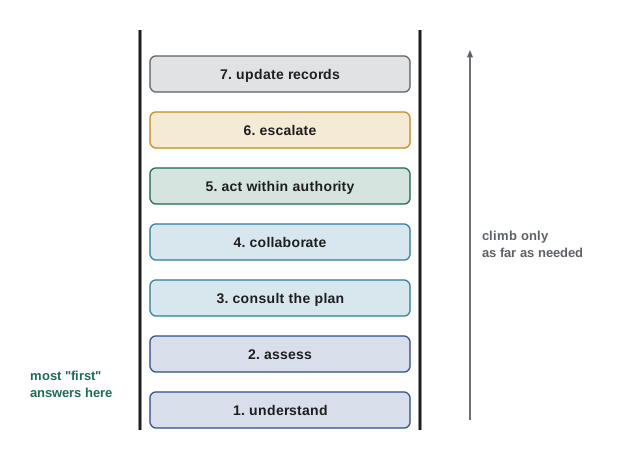
A useful way to remember the order is a ladder. Start at the bottom and climb only as far as the situation requires.
# Putting candidate actions in the order a project manager would normally take them.
# Each action is tagged with a step on the decision ladder used in this lesson.
LADDER = ["understand", "assess", "consult the plan", "collaborate", "act within authority",
          "escalate", "update records"]
actions = [
    ("Ask the sponsor to approve extra budget", "escalate"),
    ("Meet the vendor to learn exactly what is late and why", "understand"),
    ("Estimate the effect on the critical path and cost", "assess"),
    ("Check the risk register for a planned response", "consult the plan"),
    ("Work out options with the team and the vendor", "collaborate"),
    ("Use contingency within the project manager's authority", "act within authority"),
    ("Update the issue log and lessons learned", "update records"),
]
for step, (action, tag) in enumerate(sorted(actions, key=lambda a: LADDER.index(a[1])), 1):
print(f"{step}. {action:52} [{tag}]")1. Meet the vendor to learn exactly what is late and why [understand] 2. Estimate the effect on the critical path and cost [assess] 3. Check the risk register for a planned response [consult the plan] 4. Work out options with the team and the vendor [collaborate] 5. Use contingency within the project manager's authority [act within authority] 6. Ask the sponsor to approve extra budget [escalate] 7. Update the issue log and lessons learned [update records]
In the program, the same seven actions that might appear as options are sorted by their place on the ladder. If a question asks what to do first after learning that a vendor will be late, the answer is near the bottom: find out what exactly is late and why, then assess the effect. If the question says the project manager has already done those things and the delay exceeds the contingency within their authority, the answer moves up to escalation, with the analysis and options already prepared.
Updating records sits at the top because it accompanies other steps rather than replacing them. An option that only logs a problem is usually too passive, but keeping the issue log, risk register and lessons learned current is part of good practice once action is under way.
Servant leadership and the empowered team
Questions about teams, especially agile teams, assume that a capable team should be trusted to organize its own work. The project manager's role is to create the conditions for success: a clear goal, the right people, removed impediments, psychological safety and a shield from distractions. When a team member has a problem, the first step is usually to talk with them privately and help them solve it, not to report them to a manager or reassign their work.
This changes the answer to many conflict questions. If two developers disagree about a technical approach, the best response is to help them resolve it, perhaps by facilitating a discussion of the options against the sprint goal, rather than deciding for them. If the team keeps missing its sprint goals, the best response is to explore the causes with the team in a retrospective, rather than setting targets from outside.
Servant leadership does not mean passivity. A project manager who sees a team member harassing another, a safety breach or a serious ethical problem must act. The habit is to support and empower in normal situations and to intervene firmly when values, safety or the law are at stake.
Plans, processes and change control
The exam assumes that projects have plans and that plans exist to be used. When a risk occurs, check whether the risk register has a planned response. When someone wants to change scope on a predictive project, follow the change control process. When stakeholders are confused about who decides what, use or create a RACI chart or team charter. Options that improvise without regard to agreed processes are usually wrong.
In adaptive settings the process is lighter but still exists. The product owner orders the backlog; changes to scope are handled by adding, removing or reordering backlog items, not by a formal change request. Questions that ask a project manager to approve each backlog change themselves are testing whether you understand that adaptive governance delegates those decisions within agreed guardrails, as PMP-150 explained.
Worked problem
Choosing between close options
Project Compass, month 4. The library's facilities manager asks Priya to add an extra storage room to the fit-out because a donation of shelving has been offered. The fit-out is predictive, the scope baseline is approved, and the change would cost about $12,000 and add four days to a critical-path activity. Priya's change authority is up to $10,000 with no effect on the end date. Which option is best? A. Approve the change, because the donation is valuable. B. Refuse the change, because the scope baseline is fixed. C. Analyze the impact and options and submit a change request to the change control board with a recommendation. D. Ask the contractor to fit the room in without changing the schedule.
Show solution
- A is outside Priya's authority: the change exceeds $10,000 and affects the critical path.
- B is too rigid. Baselines can change through the agreed process; refusing without analysis ignores possible value.
- D bypasses change control and puts pressure on the contractor to absorb work without a contract change.
- C follows the ladder: assess, prepare options, and route the decision to the body with authority, which in Project Compass is the change control board for $10,000 to $50,000 or up to five days.
Answer: C. Analyze and bring a change request with a recommendation to the change control board.
Ethics: the Code of Ethics and Professional Conduct
PMI's code rests on four values: responsibility, respect, fairness and honesty. Ethics questions are often the easiest on the exam once you see them, because the right answer is the honest, fair and responsible one, even when it costs the project something. Typical situations include a vendor offering a gift during a procurement, a sponsor asking the project manager to hide a delay from a regulator, a team member falsifying test results, or a conflict of interest in a selection panel.
| Value | In a question | Best answer pattern |
|---|---|---|
| Responsibility | You made an error in a status report | Correct it promptly and inform those affected |
| Respect | A team member is belittled in meetings | Address it directly and privately; protect the person |
| Fairness | A relative works for a bidder | Disclose the conflict and step back from the decision |
| Honesty | The sponsor wants the report to show green when it is red | Report the true status, with explanation and options |
When your workplace and the exam disagree
Many experienced managers find that the exam's answer differs from what they would do at work. Perhaps in your organization the sponsor expects to be told about every problem immediately, or the project manager is expected to make decisions that the exam assigns to a product owner. For the exam, answer according to the standards. This is not because your workplace is wrong; it is because the exam measures a common professional standard that applies across industries and countries.
US candidates working on federal contracts sometimes find that the Federal Acquisition Regulation or agency rules are stricter than anything in a question. The exam generally will not test those specific rules; it tests whether you respect laws and policies in principle. If a question mentions a regulation, follow it.
A good test is to imagine a well-run project in a large, mature organization with sensible processes, a supportive sponsor and a capable team. What would the project manager there do? That imagined organization is the setting most questions assume.
Phrases that often signal the best answer
With practice you will notice that certain kinds of wording keep appearing in correct options. They are not guaranteed, but they are useful signals.
- Review, analyze or assess, when the question asks what to do first.
- Meet with, discuss with or talk to the person directly, in interpersonal questions.
- Facilitate, coach or support, in team questions, especially agile ones.
- Follow the change control process or submit a change request, on predictive scope changes.
- Work with the product owner, in questions about agile scope and priority.
- Update the plan or register after a decision, as part of a complete answer.
By contrast, wording such as immediately escalate, tell the team they must, ignore, replace the team member, or insist often signals a weaker option, unless the situation involves safety, law or ethics.
Common mistakes
MistakeAnswering from habits in your own organization.
InsteadAnswer as an experienced manager following PMI standards would.
MistakeEscalating before assessing.
InsteadUnderstand and assess first; escalate with analysis and options.
MistakeDeciding things the team or product owner owns.
InsteadFacilitate and support; respect delegated decisions.
MistakeTreating servant leadership as passivity.
InsteadIntervene firmly on safety, legal and ethical issues.
MistakeChoosing a convenient but dishonest option.
InsteadResponsibility, respect, fairness and honesty come first.
Summary and key terms
- The PMI mindset is a set of habits: understand, assess, use the plan, collaborate, act within authority, lead as a servant, be proactive, focus on value and act ethically.
- The decision ladder orders actions; the best answer to a first question is usually the lowest rung not yet done.
- Safety, legal and ethical emergencies require immediate action and override the usual order.
- Agile teams are trusted to self-organize; the project manager facilitates and removes impediments.
- Plans and processes, including change control and the product backlog, should be used rather than bypassed.
- The four values of PMI's code are responsibility, respect, fairness and honesty.
- PMI mindset
- An informal term for the professional judgment the exam expects, based on PMI standards and ethics.
- Decision ladder
- A sequence of steps from understanding a problem to escalating it, used to choose the best next action.
- Servant leadership
- Leading by supporting the team, removing obstacles and enabling others to perform.
- Psychological safety
- A shared belief that team members can speak up, admit mistakes and take risks without fear of humiliation.
- Change control
- The formal process for reviewing, approving and recording changes to baselines.
- Conflict of interest
- A situation in which personal interests could improperly influence professional decisions.
- Code of Ethics and Professional Conduct
- PMI's statement of the values and conduct expected of practitioners.
- Proactive
- Acting in advance to address risks and opportunities rather than reacting after events.
Practice problems
Work each problem on paper first, then reveal the answer to check.
What is usually the first rung of the decision ladder?
Show answer
Understand what has happened.
When should a project manager escalate?
Show answer
When the problem is beyond their authority or their attempts to solve it have failed, with analysis and options.
What situations override the usual order?
Show answer
Safety, legal and ethical emergencies.
Two developers disagree about a design. What is the best response?
Show answer
Facilitate a discussion of the options against the goal and let them resolve it.
Who orders the product backlog?
Show answer
The product owner.
What are the four values in PMI's code?
Show answer
Responsibility, respect, fairness and honesty.
A relative works for a bidder. What should you do?
Show answer
Disclose the conflict of interest and step back from the decision.
Why is an option that only logs a problem usually wrong?
Show answer
It is passive; recording should accompany action, not replace it.
What organization should you imagine when answering?
Show answer
A well-run, mature organization with sensible processes and a capable team.
A change exceeds your authority. What is the best action?
Show answer
Analyze it and submit it to the body with authority, with a recommendation.
Lesson quiz · 5 questions
Score 60% or more to complete this lesson.
Create a free account to save your progress, take quizzes and earn a certificate.