
PMP-160 · Lesson 2 of 12 · 26 min
How exam questions are written
Every PMP question is written by trained item writers, reviewed by other practitioners, tested as an unscored pretest item and analyzed statistically before it becomes a scored question. That process produces questions with a recognizable structure. Once you can see the structure, you read faster, you notice the words that decide the answer, and you are far less likely to fall for options that are attractive but wrong. This lesson takes a question apart, then looks at how the different formats work and how wrong options are built.
The questions below are written in the same style as the exam, using Project Compass. They are practice items written for this course, designed to teach the patterns you will meet.
The anatomy of a situational question
Most PMP questions are situational. They describe a project, a moment in its life and a problem, then ask what the project manager should do or what is most likely true. A typical question has four parts.
| Part | What it contains | What to look for |
|---|---|---|
| Context | The kind of project, approach and organization | Predictive, agile or hybrid? Public or private? Contract or in-house? |
| Situation | What has happened, and at what stage | Planning, execution, closing? Has the problem already occurred or might it occur? |
| Stem | The actual question | Words such as first, next, best, most likely, should have |
| Options | Usually four choices | One best answer; others plausible but weaker, premature, out of order or outside your role |
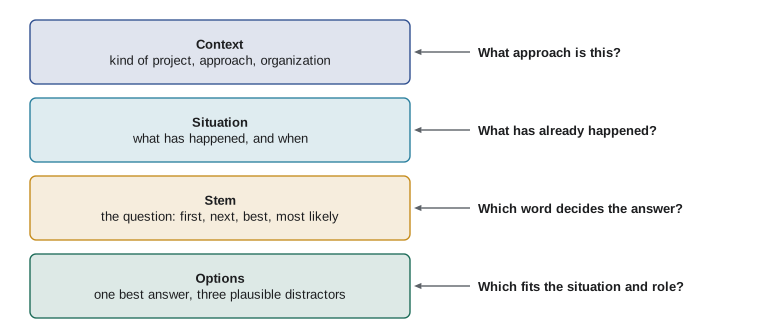
Consider this question. "Project Compass is using a hybrid approach. Midway through the fit-out, the electrical contractor tells the project manager that a shortage of a type of breaker panel will delay delivery by three weeks. The panels are on the critical path. What should the project manager do first?" The context is hybrid, but this part of the work is predictive construction. The situation is that a risk has become a real problem on the critical path. The stem asks what to do first. A good answer would involve assessing the impact on the schedule and looking at options, such as alternative suppliers or resequencing, before escalating or changing the baseline.
Each part narrows the answer. If the situation said the shortage might happen, the answer would involve risk responses. If the stem asked what should have been done, the answer would point to earlier planning, such as identifying long-lead items. If the context were an agile software team, the answer would probably involve the team and product owner in reordering work. Reading all four parts before looking at the options is the single habit that does most to improve accuracy.
The words that decide the answer
Item writers use a small set of words to signal what kind of answer they want. Read them as instructions.
| Word or phrase | What it asks for | Typical correct answer |
|---|---|---|
| First | The action that should come before all others | Understand or assess the situation, review the plan or speak with the person directly |
| Next | The step after something already done | The logical following step; check what the question says has been done |
| Best | The most effective option among several reasonable ones | The option that solves the root problem within your role |
| Most likely | A cause or result to infer from the facts | The explanation the facts best support |
| Should have | What earlier action would have prevented the problem | A planning, risk or communication step that was skipped |
| Least likely or except | The option that does not fit | Read twice; these are rare but easy to get backwards |
The word first deserves special attention. When several options are good actions, the question is about order. Gathering information and assessing impact usually come before acting, acting within your authority usually comes before escalating, and talking to the person involved usually comes before going to their manager. When a question says the project manager has already reviewed the impact, the first remaining step moves on to the next stage, such as discussing options with the team.
Single and multiple response
In single-response questions, choose the one best option. In multiple-response questions, the stem says how many to choose, for example: "Which two actions should the project manager take?" Preparation providers generally report no partial credit for multiple-response items, so every choice must be right. Treat each option as a true or false statement about the situation, keep the ones that are clearly true and compare the remaining candidates carefully.
# Why eliminating wrong options matters: expected marks from 20 questions you are unsure about.
# Never leave a question blank; there is no penalty for a wrong answer.
unsure = 20
for left in (4, 3, 2):
    expected = unsure / left
    print(f"options left {left}: expected correct {expected:4.1f} of {unsure}  ({1 / left:.0%} each)")
print()
# Multiple response "choose two of five": a blind guess is rarely right.
from math import comb
print(f"choose 2 of 5 blind: {1 / comb(5, 2):.0%} chance")
print(f"choose 2 of 5 after ruling out 2: {1 / comb(3, 2):.0%} chance")
print(f"choose 2 of 5 when sure of 1, guessing the other from 3: {1 / 3:.0%} chance")options left 4: expected correct 5.0 of 20 (25% each) options left 3: expected correct 6.7 of 20 (33% each) options left 2: expected correct 10.0 of 20 (50% each) choose 2 of 5 blind: 10% chance choose 2 of 5 after ruling out 2: 33% chance choose 2 of 5 when sure of 1, guessing the other from 3: 33% chance
The numbers show why elimination matters. If you can rule out two of four options, a forced choice between the last two is right half the time, compared with a quarter when guessing blind. There is no penalty for wrong answers, so never leave a question unanswered. For a choose-two-of-five question, a blind guess succeeds only one time in ten, but ruling out two clearly wrong options raises that to one in three.
Case or scenario sets
A case set gives a longer scenario and then several questions about it. The scenario may include a stakeholder list, a status report, a burndown chart or a short email thread. The questions may test different domains: one might ask about a conflict, another about the schedule, another about a compliance requirement. On the 2026 exam the first break comes after the case-study section, and once a section is closed you cannot return to it, so finish and review the case questions before you take the break.
An efficient routine for case sets is:
- Skim the questions first, so you know what to look for.
- Read the scenario once, carefully, noting the approach, the stage, the key people and any numbers.
- Answer each question from the facts in the scenario, not from assumptions. If the scenario says the team is self-organizing, that fact governs every question in the set.
- Watch for questions that add new information. A later question may say "Two weeks later, the sponsor resigns." That fact applies to that question only, unless it says otherwise.
Worked problem
A short case set
Scenario: Project Compass is in month 5. The mobile app team works in two-week sprints with Amara Osei as product owner. The fit-out is predictive and two weeks behind because a permit was late. A status report shows SPI 0.90 and CPI 0.92 for the fit-out. Owen Tran, the future branch manager, emails Priya to complain that he has not seen the app since sprint 2 and that his staff are anxious about self-checkout. Question 1: What should Priya do about Owen's concerns about the app? Question 2: What does the status report indicate about the fit-out?
Show solution
- Question 1 is a People and agile question. Owen is a key stakeholder who has missed sprint reviews. The best response is to invite him to the next sprint review and work with Amara so that his feedback reaches the backlog, while also addressing staff anxiety through the change plan.
- Question 1 wrong options might include sending him a written status report (passive), asking the team to build what he wants immediately (bypasses the product owner) or telling him to wait for the launch (ignores engagement).
- Question 2 is a Process question. SPI 0.90 means the fit-out has earned 90 % of the planned value of work, so it is behind schedule; CPI 0.92 means it earns 92 cents of value for each dollar spent, so it is over budget.
- Keep the facts separate. The app team's agile practices do not change the interpretation of the fit-out's earned value, and the fit-out delay does not change the right way to engage Owen.
Answer: Question 1: involve Owen in sprint reviews and route feedback through the product owner, with change support for staff. Question 2: behind schedule and over budget.
Graphic-based questions
Graphic-based questions show a chart, task board, network diagram, histogram or table. The commonest errors come from reading the graphic too quickly. Before reading the question, read the title, the axes and their units, the legend and any notes. On a burndown chart, check whether the line shows work remaining or work completed; on a cumulative flow diagram, check which band is which state; on a network diagram, check whether durations are in days or weeks. Then read the question and return to the graphic for exactly the value you need.
How wrong options are built
Wrong options, called distractors, are written to be plausible. Knowing the common types helps you see through them.
| Distractor type | What it looks like | Example on Project Compass |
|---|---|---|
| Premature action | A good step taken too early, before assessment | Updating the schedule baseline as soon as a delay is reported |
| Escalation too soon | Passing a problem upward that you could handle | Asking the sponsor to resolve a disagreement between two developers |
| Passive response | Waiting, ignoring or only documenting | Noting a vendor delay in the issue log and taking no further action |
| Outside your role | Doing someone else's job or overriding their authority | Reordering the product backlog without the product owner |
| Rule breaking | Bypassing change control, contracts, law or ethics | Letting the contractor add work without a change request |
| Extreme or absolute | Firing, canceling or always and never | Removing a team member after one missed deadline |
| True but irrelevant | A correct statement that does not answer the question | Explaining what a RACI chart is when asked how to resolve a conflict |
Many wrong options are not bad actions in general; they are wrong for this situation. Updating a baseline is sometimes right, but only after an approved change. Escalating is sometimes right, but only when the problem is beyond your authority or attempts to solve it have failed. That is why reading the situation carefully matters more than memorizing rules such as never escalate.
Questions with incomplete information
Exam scenarios are short, so they leave things out. A common mistake is to fill the gaps with assumptions from your own workplace. If the question does not say that a process exists, do not assume it does not; if it does not mention a contract, do not invent one. Answer from the facts given and from the practices described in PMI's standards. When a key fact really is missing, the best answer is often the one that gathers it, such as reviewing the risk register or meeting the stakeholder.
This matters for US candidates in a particular way. Many questions describe practices in general terms, without the state rules or federal contracting requirements you may know from work, such as retainage or specific procurement thresholds. Answer the question as asked; if a law is relevant, the question will say so.
Common mistakes
MistakeReading the options before the stem.
InsteadRead context, situation and stem first, then the options.
MistakeIgnoring the word first or next.
InsteadThese words make the question about order; several options may be good actions.
MistakeChoosing only one option in a choose-two question.
InsteadSelect exactly the number of options asked for.
MistakeReading a chart before checking its axes and units.
InsteadRead title, axes, units and legend first.
MistakeFilling in missing facts from your own workplace.
InsteadAnswer from the facts given and the standard practices the exam assumes.
Summary and key terms
- Situational questions have a context, a situation, a stem and options; read them in that order.
- Signal words such as first, next, best, most likely and should have tell you what kind of answer is wanted.
- Multiple-response questions state how many options to choose; treat each option as true or false.
- Case sets share one scenario across several questions; read the questions first and keep facts separate.
- Graphic-based questions reward careful reading of titles, axes, units and legends.
- Distractors are often good actions done at the wrong time, by the wrong person or outside the rules.
- Situational question
- A question that describes a project situation and asks what to do or what is most likely true.
- Stem
- The part of a question that states what is being asked.
- Distractor
- A plausible but incorrect option.
- Signal word
- A word in the stem, such as first or best, that defines what kind of answer is wanted.
- Multiple response
- A question that asks for a stated number of correct options.
- Case set
- A scenario followed by several linked questions.
- Graphic-based question
- A question that requires interpreting a chart, diagram, board or table.
- Elimination
- Ruling out clearly wrong options to improve the chance of choosing correctly.
Practice problems
Work each problem on paper first, then reveal the answer to check.
Name the four parts of a situational question.
Show answer
Context, situation, stem and options.
What does the word first usually signal?
Show answer
That several options may be good and the question is about which comes before the others.
What usually comes before escalating a problem?
Show answer
Assessing it and acting within your own authority.
Is there a penalty for a wrong answer?
Show answer
No, so never leave a question blank.
What is the chance of guessing a choose-two-of-five item blind?
Show answer
One in ten.
What should you read first in a case set?
Show answer
The questions, then the scenario.
Why must case questions be finished before the first break?
Show answer
The break closes the section and you cannot return to it.
Give an example of a premature action distractor.
Show answer
Updating the baseline before a change is approved.
What should you check before reading a burndown chart question?
Show answer
The title, axes, units and whether the line shows work remaining.
What is the best answer when a key fact is missing?
Show answer
Often the option that gathers that information first.
Lesson quiz · 5 questions
Score 60% or more to complete this lesson.
Create a free account to save your progress, take quizzes and earn a certificate.