
PMP-140 · Lesson 7 of 12 · 25 min
Product backlogs and user stories
In an adaptive project, the product backlog plays the role that the scope statement and WBS play in a predictive one, but it behaves very differently. It is never finished, it is ordered rather than just listed, and its items become more detailed as they rise toward the top. This lesson looks at how a good backlog is built and kept healthy, and at the user story, the most common format for backlog items. Lesson 8 covers how items are prioritized and sized.
What makes a good product backlog
The product backlog is an emergent, ordered list of what is needed to improve the product. It is the single source of work for the Scrum Team. A widely used summary of a healthy backlog is DEEP: detailed appropriately (items near the top are small and well understood; items further down are larger and vaguer), estimated (items have size estimates, rough for lower items), emergent (it changes as the team and stakeholders learn) and prioritized, or more precisely ordered (there is a clear sequence, not a list of "high priority" items with equal rank).
A backlog can hold many kinds of items: features, defects, technical work such as upgrading a library, knowledge-acquisition work such as a prototype, and improvements from retrospectives. Keeping them all in one ordered list forces honest trade-offs. If the Compass team kept bug fixes in a separate list, the product owner would never see that fixing the login timeout matters more to patrons than the room booking feature.
The hierarchy of backlog items
Teams use different words, but a common hierarchy runs from themes or initiatives (broad goals) to epics (large bodies of work that will take several sprints), features (meaningful capabilities that might fit in a release) and user stories (small slices of value that fit easily in one sprint). Developers may break stories into tasks during sprint planning, but tasks are the team's internal plan, not backlog items the product owner orders. On the Compass app, "Get the item" is an epic, "Holds" is a feature and "As a patron, I can see my position in the holds queue" is a story.
| Level | Typical size | Who uses it | Compass example |
|---|---|---|---|
| Theme or goal | Months or longer | Sponsor, product owner | Patrons can use library services from their phones |
| Epic | Several sprints | Product owner, stakeholders | Get the item (holds, pickup, renewals) |
| Feature | A sprint to a release | Product owner, team | Holds |
| User story | A few days | Product owner, developers | As a patron, I can see my position in the holds queue |
| Task | Hours to a day | Developers only | Add queue position to the holds API response |
User stories
A user story describes a small piece of functionality from the point of view of someone who wants it. The classic template is "As a [type of user], I want [some capability] so that [some benefit]". The template is a prompt, not a rule. Its strength is that it keeps three things in view: who the work is for, what they need, and why. The "so that" clause is the part teams most often skip and most often regret skipping, because it lets developers find a simpler way to deliver the same benefit.
Ron Jeffries described stories with three Cs. The card is a short written statement, small enough to fit on an index card, that serves as a reminder. The conversation is the discussion between the product owner, developers and stakeholders that fills in the details; it matters more than the card. The confirmation is the set of acceptance criteria that will show the story is done. A story is a promise of a conversation, not a full specification.
| Weak story | Problem | Better story |
|---|---|---|
| Build the holds database table | Technical task, no user or value | As a patron, I can place a hold on an item that is checked out so that I get it when it is returned |
| As a user, I want the app to be good | Not testable or specific | As a patron with low vision, I can increase text size in the app so that I can read search results |
| As a patron, I want search, holds, accounts and room booking | Far too big | Split into separate stories for each capability, then split further |
| As the system, I want to log errors | No human user or benefit | As a support technician, I can see recent app errors for a patron so that I can resolve their problem quickly |
INVEST
Bill Wake's INVEST acronym lists qualities of a good story. Independent: it can be built and delivered without waiting for other stories, as far as possible. Negotiable: details are worked out in conversation, not fixed in advance. Valuable: it delivers something a user or customer cares about. Estimable: the team understands it well enough to size it. Small: it fits comfortably in a sprint, ideally taking a few days. Testable: there is a clear way to tell it is done. When a story is hard to estimate, that usually means it is too big or too vague, and the team should split it or run a spike first.
A spike is a timeboxed research or experiment item whose output is knowledge rather than product. When the Compass team did not know whether the library's room booking system could be reached from the app at all, they added a two-day spike to find out. The answer (no interface existed, but one could be built by the system's vendor for a fee) changed the release plan for room booking and became a cost item for the project manager.
Acceptance criteria and the definition of done
Acceptance criteria are the conditions a particular story must satisfy to be accepted by the product owner. They are specific to the story. A popular format, borrowed from behavior-driven development, is "Given [a context], when [an action], then [an outcome]". The definition of done, in contrast, applies to every item: code reviewed, tests automated, accessibility checked and so on. A story is complete only when it meets both its own acceptance criteria and the shared definition of done.
| Acceptance criteria | Definition of done | |
|---|---|---|
| Applies to | One story | Every item and the increment |
| Written by | Product owner with developers and stakeholders | The Scrum Team (or the organization as a minimum) |
| Describes | What the story must do | The quality standard all work must meet |
| Compass example | Given I have three holds, when I open My holds, then I see each item's queue position | Reviewed, automated tests pass, WCAG 2.1 AA checks pass, tested against catalog test system |
Non-functional requirements, such as performance, security and accessibility, can appear in three places: in the definition of done when they apply to everything (all screens meet WCAG 2.1 AA), as acceptance criteria on particular stories (search results appear within two seconds) or as stories in their own right when they need dedicated work (penetration test before release 1). The exam may ask where a requirement belongs; the deciding question is whether it applies universally or to one piece of work.
Splitting stories
Large stories are split into smaller ones that still deliver value. The key word is vertical: each slice should cut through all the layers needed to give a user something working, not deliver one layer (all the screens, then all the database work) at a time. Common splitting patterns include splitting by workflow step, by business rule, by data variation, by interface or channel, by simple case first and complex cases later, and by performance (make it work, then make it fast). A useful test is whether the product owner would see value in releasing the smaller story by itself.
| Pattern | Original story | Split |
|---|---|---|
| Workflow steps | As a patron, I can book a meeting room | See available rooms; request a booking; receive confirmation; cancel a booking |
| Business rules | As a patron, I can renew an item | Renew when no holds exist; show a message when renewal is blocked by a hold; limit renewals to two |
| Data variations | As a patron, I can search the collection | Search books first; add DVDs and audiobooks; add e-books from the external platform |
| Simple then complex | As a patron, I get notified when a hold is ready | Email notification first; add text messages later |
| Spike then build | Integrate with room booking system | Two-day spike to test feasibility, then stories based on the findings |
Story mapping and the minimum viable product
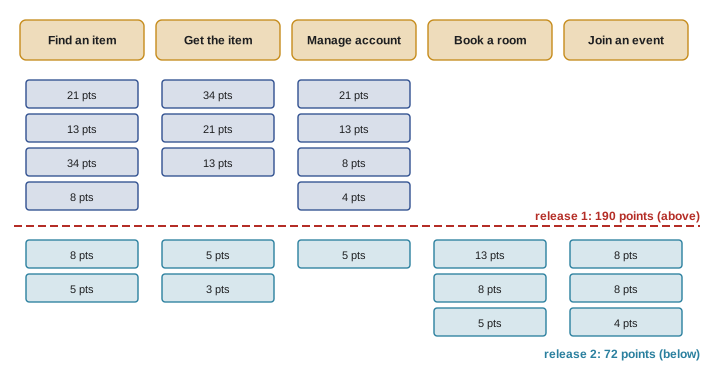
Jeff Patton's story mapping arranges the backlog in two dimensions. Across the top runs the user's journey as a sequence of activities, such as find an item, get the item, manage my account. Under each activity, stories are stacked by priority. Horizontal lines then slice the map into releases: the top slice is the smallest set of stories that lets a user complete the whole journey in a basic way. This prevents a common mistake of building one activity perfectly while users cannot complete the journey at all.
That top slice is closely related to the minimum viable product (MVP): the smallest version of the product that delivers value to users and lets the team learn from real use. A related idea is the minimum marketable feature (MMF), the smallest piece of functionality that is valuable enough to release. The Compass team's map put search, holds and account management in release 1 and room booking and event sign-up in release 2.
# Story map: points per activity, split into release slices.
story_map = {
    "Find an item":   {"R1": [21, 13, 34, 8], "R2": [8, 5]},
    "Get the item":   {"R1": [34, 21, 13],    "R2": [5, 3]},
    "Manage account": {"R1": [21, 13, 8, 4],  "R2": [5]},
    "Book a room":    {"R1": [],              "R2": [13, 8, 5]},
    "Join an event":  {"R1": [],              "R2": [8, 8, 4]},
}
for release in ("R1", "R2"):
    total = sum(sum(acts[release]) for acts in story_map.values())
    print(f"{release}: {total} points across "
f"{sum(1 for a in story_map.values() if a[release])} activities")R1: 190 points across 3 activities R2: 72 points across 5 activities
Release 1 holds 190 points across the three core activities; release 2 holds 72, including two activities that are not in release 1 at all. Together they make up the 262 points of total scope at the end of sprint 6 that PMP-130 tracked on the burn-up chart. The story map makes the trade-off visible: if release 1 must shrink, the product owner can move lower stories in a column down to release 2 without breaking the journey.
Worked problem
Fixing a backlog
When the project manager first looked at the app backlog in sprint 0, it held 140 items. Twenty were marked "high priority", most had no estimates, half were technical tasks such as "set up the API gateway", and defects were tracked in a separate spreadsheet. What should she suggest to the product owner?
Show solution
- Replace priority labels with a single order so that the top items are unambiguous.
- Rewrite technical tasks as user-focused stories where possible, or fold them into the stories they enable; keep genuinely necessary technical items but make their value clear.
- Bring defects into the same backlog so they compete fairly with features.
- Refine the top few sprints' worth of items into small, estimated stories with acceptance criteria; leave lower items as larger, rough epics.
Answer: Make the backlog DEEP: one ordered list including defects, user-focused items, detailed and estimated near the top and coarser further down.
Common mistakes
MistakeWriting the whole backlog in full detail at the start.
InsteadDetail items just in time as they near the top; keep lower items coarse.
MistakeSplitting stories by technical layer.
InsteadSplit vertically so each slice delivers working value.
MistakeTreating acceptance criteria and the definition of done as the same thing.
InsteadAcceptance criteria are per story; the definition of done applies to all work.
MistakeKeeping defects and technical work in separate lists.
InsteadUse one ordered backlog so trade-offs are visible.
MistakeUsing the story card as a complete specification.
InsteadThe card is a reminder; the conversation and confirmation matter more.
Summary and key terms
- A good product backlog is DEEP: detailed appropriately, estimated, emergent and ordered.
- Backlog items range from themes and epics to features and stories; tasks belong to the developers.
- User stories state who, what and why; the three Cs are card, conversation and confirmation.
- INVEST: independent, negotiable, valuable, estimable, small, testable.
- Acceptance criteria are story-specific; the definition of done applies to everything.
- Split stories vertically by workflow, rules, data or complexity; use spikes to reduce uncertainty.
- Story maps show the user journey and slice releases; the top slice approximates the MVP.
- Product backlog
- An emergent, ordered list of what is needed to improve the product.
- Epic
- A large body of work that will be split into smaller items.
- User story
- A short description of functionality from a user's point of view, with its purpose.
- INVEST
- Independent, negotiable, valuable, estimable, small and testable: qualities of a good story.
- Acceptance criteria
- Conditions a specific story must meet to be accepted.
- Spike
- A timeboxed item to research or experiment, producing knowledge rather than product.
- Story map
- A two-dimensional arrangement of stories under user activities, sliced into releases.
- Minimum viable product
- The smallest product version that delivers value and enables learning from real use.
Practice problems
Work each problem on paper first, then reveal the answer to check.
What does DEEP stand for?
Show answer
Detailed appropriately, estimated, emergent, prioritized (ordered).
What are the three Cs of a user story?
Show answer
Card, conversation and confirmation.
What does the S in INVEST mean?
Show answer
Small.
Where does "all screens meet WCAG 2.1 AA" belong?
Show answer
In the definition of done, because it applies to all work.
What is a spike?
Show answer
A timeboxed research or experiment item that produces knowledge.
Why split stories vertically?
Show answer
So each slice delivers working value through all layers.
Who owns tasks created during sprint planning?
Show answer
The developers.
What does the top slice of a story map represent?
Show answer
The smallest set of stories that lets a user complete the journey, close to the MVP.
How many points were in Compass release 1 and release 2?
Show answer
190 and 72.
A story cannot be estimated. What should the team do?
Show answer
Split it or run a spike to learn more.
Lesson quiz · 5 questions
Score 60% or more to complete this lesson.
Create a free account to save your progress, take quizzes and earn a certificate.