
PMP-140 · Lesson 1 of 12 · 27 min
The agile mindset: values and principles
PMP-130 and PMP-131 planned and controlled Project Compass mostly from the predictive side: a scope baseline for the fit-out, a critical path, earned value and formal change control. One part of the project never fitted that mold. The mobile app that lets patrons search the collection, place holds, book rooms and sign up for events was always going to be built iteratively, because nobody could say in advance exactly which features patrons would use or how they would want them to work. This course follows that app team, and the people around it, through agile and hybrid delivery.
Agile and hybrid approaches matter well beyond this one app. At the time of writing (October 2026), PMI describes the PMP exam that took effect on 9 July 2026 as drawing roughly 40 % of its questions from predictive approaches and about 60 % from adaptive and hybrid ones, spread across all three domains rather than kept in a separate section. A question about conflict, stakeholders or risk may well be set on an agile team. Knowing how agile teams think, not only which meetings they hold, is what lets you pick the best answer.
Where this course sits
| Topic | Main exam connection (2026 outline) | Lessons |
|---|---|---|
| Agile values, principles and mindset | All domains; how adaptive questions are framed | 1 |
| Choosing and tailoring a delivery approach | Process: plan delivery and the integrated plan; Business Environment: governance | 2, 12 |
| Scrum, Kanban, lean, XP and scaling | Process: deliver value; People: lead the team | 3 to 6 |
| Backlogs, stories, prioritization and estimation | Process: scope, schedule and value | 7 and 8 |
| Release planning, forecasting and metrics | Process: evaluate status and plan delivery | 9 and 10 |
| Servant leadership and self-managing teams | People: lead, empower and support the team | 11 |
| Hybrid governance, contracts and exam technique | Business Environment and Process | 12 |
The PMBOK Guide, eighth edition, released in late 2025, treats delivery approach as something to tailor rather than a choice between camps, and PMI's Agile Practice Guide appeared in a second edition in 2025 and 2026. That edition moves away from treating "hybrid" as a single label and talks instead about a range of approaches that mix predictive and adaptive practices to fit the situation. It also adds material on flow metrics, product management and the use of generative AI. This course follows the same idea: approaches are tools, and the skill is in choosing and combining them.
Why agile approaches emerged
Through the 1990s, many software projects were planned like construction: gather all requirements, design everything, build, then test. The results were often disappointing. Requirements written a year earlier no longer matched what users needed, problems surfaced only in late testing, and teams delivered nothing usable until the very end. Practitioners experimented with lighter methods, among them Scrum, Extreme Programming (XP), Crystal, Dynamic Systems Development Method (DSDM) and Feature-Driven Development. In 2001, seventeen of them met and wrote the Manifesto for Agile Software Development, a short statement of what they had found worked.
The core insight is about uncertainty. When the product is well understood and change is expensive, careful upfront planning pays off: you would not pour a foundation and then decide where the walls go. When the product is new, the technology is changing or users cannot describe what they want until they see it, upfront plans become guesses. In those conditions it is cheaper to build a small piece, show it to real users, learn and adjust. Agile methods are organized around making that learning loop short and cheap.
The four values
The Manifesto states four values, each as a preference of one thing over another. The wording matters for the exam: the items on the right still have value, but the items on the left are valued more. Agile teams still write documents, follow plans and sign contracts; they just do not let those things get in the way of the items on the left. In paraphrase:
| Valued more | Valued, but less | What it looks like on the Compass app |
|---|---|---|
| Individuals and interactions | Processes and tools | The product owner sits with developers when a story is unclear instead of filing a ticket and waiting |
| Working software | Comprehensive documentation | Branch staff try a working build of holds every two weeks; the specification is a short set of stories and acceptance criteria |
| Customer collaboration | Contract negotiation | The library and the development firm agree the release order together each sprint under a time and materials contract with a ceiling |
| Responding to change | Following a plan | When testing shows patrons rarely use the fines screen, the product owner moves it down and brings hold notifications forward |
A common exam trap is an answer that treats a value as a ban. "The team should not write documentation because agile values working software" is wrong. Documentation that someone needs, such as accessibility test results the library must keep, or a hand-over guide for the library's IT staff, is still produced. What changes is that the team writes what is needed, when it is needed, and keeps it light.
The twelve principles in practice
Behind the values sit twelve principles. You do not need to recite them, but you should recognize them in a scenario. They group naturally into a few themes.
| Theme | Principles in paraphrase | Typical exam signal |
|---|---|---|
| Customer value, early and often | Satisfy the customer through early and continuous delivery of valuable software; deliver working software frequently, from every couple of weeks to every couple of months; working software is the primary measure of progress | A stakeholder wants proof of progress: show a working increment, not a percent-complete report |
| Welcome change | Welcome changing requirements, even late, when they give the customer an advantage | A late request arrives: add it to the backlog for the product owner to order, rather than refusing or squeezing it into the current sprint |
| People and collaboration | Business people and developers work together daily; build projects around motivated individuals and trust them; face-to-face conversation is the most effective way to share information | A team waits for written approvals: bring the decision maker closer to the team |
| Sustainable pace and excellence | Maintain a constant pace indefinitely; continuous attention to technical excellence and good design; simplicity, the art of maximizing the amount of work not done | Repeated overtime to hit a date: address scope or capacity, not hours |
| Self-organization and improvement | The best architectures, requirements and designs emerge from self-organizing teams; at regular intervals the team reflects and adjusts | A manager wants to assign tasks to individuals: let the team plan its own work and improve through retrospectives |
Two principles deserve extra attention. "Simplicity, the art of maximizing the amount of work not done" is not laziness; it means not building features, reports or abstractions that nobody needs, which links directly to the lean idea of waste in lesson 6. "Working software is the primary measure of progress" explains why agile status reporting emphasizes demonstrations and burn-up charts rather than estimates of percent complete. Outside software, read "working software" as "a usable increment of the product", such as a finished room, a tested process or a trained group of staff.
Mindset before mechanics
Teams often adopt the visible parts of agile, such as daily stand-ups, sprints and sticky notes, without the thinking behind them. The result is sometimes called "doing agile" rather than "being agile": two-week mini-waterfalls, stand-ups that are status reports to a manager, and backlogs that are really fixed requirements lists. PMI and most agile writers stress that the mindset comes first. The practices exist to support transparency, short feedback loops, collaboration and continuous improvement; if a practice stops doing that, the team should change it.
The empirical idea underneath Scrum, and most agile methods, is often summarized as three pillars: transparency (the work and the problems are visible to everyone who needs to see them), inspection (the team and stakeholders look at the product and the process frequently) and adaptation (when something is off track, they change course quickly). If you are unsure which answer is best in an agile scenario, ask which option makes the situation more transparent, inspects it sooner or adapts faster.
Why delivering early adds value
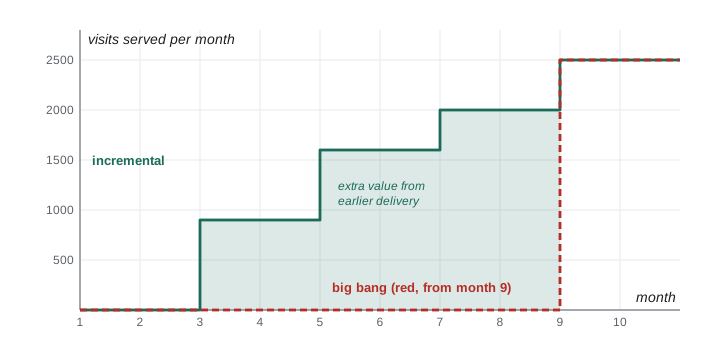
Delivering in increments is not only about learning. A feature that is live earlier starts producing value earlier, and that value accumulates. The library estimated how many patron visits per month each feature group of the app would serve once it was released. The code compares releasing everything at once in month 9 with releasing one group every two months from month 3.
# Cumulative value delivered by two delivery patterns for the Compass app.
# Each feature group is worth an estimated number of patron visits per month once live.
features = [("Search and availability", 900), ("Holds and renewals", 700),
            ("Account and fines", 400), ("Room booking", 300), ("Event sign-up", 200)]
months = 10
# Big bang: everything goes live in month 9.
big_bang = [sum(v for _, v in features) if m >= 9 else 0 for m in range(1, months + 1)]
# Incremental: one feature group goes live every two months from month 3.
live_from = [3, 5, 7, 9, 9]
incremental = [sum(v for (_, v), start in zip(features, live_from) if m >= start)
               for m in range(1, months + 1)]
print("Month  Big bang  Incremental")
for m in range(months):
    print(f"{m + 1:>5}  {big_bang[m]:>8}  {incremental[m]:>11}")
print("Visits served over 10 months:", sum(big_bang), "vs", sum(incremental))Month Big bang Incremental
1 0 0
2 0 0
3 0 900
4 0 900
5 0 1600
6 0 1600
7 0 2000
8 0 2000
9 2500 2500
10 2500 2500
Visits served over 10 months: 5000 vs 14000Over ten months, incremental delivery serves almost three times as many visits, even though both approaches finish the same features in the same month. The numbers are invented, but the shape is general: the most valuable features delivered first produce the biggest gain. Incremental delivery also reduces risk, because if funding were cut in month 7, the library would still have a working app with search, holds and accounts, instead of an unfinished one.
The inverted triangle
Predictive planning usually fixes scope and estimates the time and cost needed to deliver it. Agile planning often turns this around: the team and the timebox are fixed (a set number of people for a set number of sprints), so time and cost are known, and scope is the variable. The product owner chooses the most valuable scope that fits. For Project Compass, the soft opening date is fixed by the lease and the app budget is capped by the contract ceiling, so the app is a natural fit for fixed time and cost with flexible scope. Quality is not one of the variables: the team does not cut testing or accessibility to fit more features in.
Agile beyond software
Although agile grew up in software, the ideas are now used for marketing campaigns, policy work, research, hardware and parts of construction. The test is not the industry but the conditions: can the work be split into pieces that are useful or informative on their own, can users or stakeholders give feedback quickly, and is the cost of changing direction low enough? On Project Compass, the library's communications team used two-week cycles to plan the opening campaign, testing messages with patron focus groups, while the fit-out stayed predictive because walls and wiring are expensive to change. Lesson 2 turns these conditions into a structured way of choosing an approach.
Worked problem
Value or plan?
In sprint 5, the branch manager watches a demonstration of the holds feature and says patrons will expect a text message when an item is ready for pickup. Notifications were planned for release 2. The development lead says the plan is agreed and should not change. What should the project manager suggest?
Show solution
- The request is new information from a key stakeholder, gathered exactly when an agile process is designed to gather it: at a demonstration of working software.
- Agile principles welcome change when it adds value, but the current sprint's goal should be protected, so the request is not squeezed into sprint 5.
- The right move is to add notifications to the product backlog, with the branch manager's reasons, so the product owner can weigh it against other release 1 items.
- If the product owner moves it into release 1, something of similar size may need to move out to keep the date, which the burn-up chart will make visible.
Answer: Capture the request in the backlog and let the product owner order it against the rest of release 1; neither refuse it nor change the current sprint.
Common mistakes
MistakeReading the values as bans: no documents, no plans, no contracts.
InsteadThe items on the right still have value; the items on the left are valued more.
MistakeTreating agile as a set of meetings and tools.
InsteadStart from the mindset: transparency, inspection, adaptation and delivering value early.
MistakeReporting percent complete as the main progress measure on an agile team.
InsteadShow working increments and burn-up charts; working product is the primary measure.
MistakeFitting more scope into a fixed date by cutting quality or adding overtime.
InsteadIn a fixed time and cost model, scope flexes; quality and sustainable pace do not.
MistakeAssuming agile only applies to software.
InsteadJudge by the conditions: uncertainty, quick feedback and low cost of change.
Summary and key terms
- About 60 % of PMP questions draw on adaptive or hybrid approaches, spread across all domains.
- Agile arose to handle uncertainty with short loops of building, showing and adjusting.
- Four values prefer individuals, working product, collaboration and responding to change, without discarding the alternatives.
- Twelve principles stress early and frequent delivery, welcoming change, daily collaboration, sustainable pace, technical excellence, simplicity and regular reflection.
- Transparency, inspection and adaptation are the empirical pillars behind the practices.
- Incremental delivery brings value earlier and reduces the risk of ending with nothing usable.
- Adaptive work often fixes time and cost and lets scope vary; quality is not traded away.
- Agile mindset
- A way of thinking that values collaboration, learning through short feedback loops, delivering value early and continuous improvement.
- Manifesto for Agile Software Development
- The 2001 statement of four values and twelve principles that named the agile movement.
- Increment
- A usable, tested piece of the product that adds to all earlier increments.
- Empiricism
- Making decisions based on what is observed rather than on detailed prediction.
- Transparency
- Making work, progress and problems visible to those who need to see them.
- Sustainable pace
- A pace of work the team can keep up indefinitely without burning out.
- Inverted triangle
- The agile planning model in which time and cost are fixed and scope varies.
Practice problems
Work each problem on paper first, then reveal the answer to check.
Does the agile value "working software over comprehensive documentation" mean no documentation?
Show answer
No. Needed documentation is still produced; working product is valued more.
What is the primary measure of progress on an agile team?
Show answer
A working, usable increment of the product.
Name the three empirical pillars.
Show answer
Transparency, inspection and adaptation.
In the inverted triangle, which constraint usually varies?
Show answer
Scope.
Why did incremental delivery serve more visits in the example?
Show answer
Valuable features went live earlier and produced value for more months.
How should a late change request be handled on an agile team?
Show answer
Add it to the backlog for the product owner to order; protect the current iteration.
What does "maximizing the amount of work not done" mean?
Show answer
Avoid building features or artifacts that nobody needs.
What share of the 2026 PMP exam relates to adaptive and hybrid approaches?
Show answer
About 60 %, according to PMI.
Give one condition that favors an adaptive approach.
Show answer
High uncertainty, fast feedback available, or a low cost of change.
Which part of Project Compass is least suited to agile, and why?
Show answer
The fit-out, because physical changes late in the work are expensive.
Lesson quiz · 5 questions
Score 60% or more to complete this lesson.
Create a free account to save your progress, take quizzes and earn a certificate.