
PMP-121 · Lesson 9 of 12 · 25 min
Negotiation for project managers
Project managers negotiate constantly: with functional managers for people, with sponsors for budget and time, with clients over scope, with vendors over price and terms, and with other project managers over shared resources. Most of these are not one-off bargains with strangers but repeated dealings with people the project manager will need again tomorrow. That shapes what good negotiation looks like. BUS-130 introduced distributive and integrative bargaining in organizational behavior; this lesson applies them to project situations, with the tools project managers use most: preparation, BATNA and reservation points, the zone of possible agreement, principled negotiation, trading across issues and recognizing common tactics.
Two kinds of negotiation
Distributive negotiation divides a fixed amount: every dollar the vendor gains in price, the project loses. It is competitive, and the main skills are knowing your limits, anchoring well and conceding carefully. Integrative negotiation looks for ways to increase the total value available, by finding issues that the parties value differently and trading across them. It is collaborative, and the main skills are asking questions, sharing information about interests and inventing options. Most real project negotiations mix the two: there is a price to divide, but also delivery dates, warranty terms, payment schedules and scope that can be traded.
Preparation: BATNA, reservation point and target
Preparation is where most negotiations are won or lost. Three numbers or positions matter most. Your BATNA, the best alternative to a negotiated agreement, is what you will do if this negotiation fails: use another vendor, delay the work, reassign internal staff. Your reservation point is the least favorable deal you will accept, set by your BATNA; there is no point accepting a deal worse than your alternative. Your target is what you realistically aim for, which should be ambitious but defensible. Estimate the other party's BATNA and reservation point too. The stronger your BATNA relative to theirs, the more bargaining power you have.
| Preparation item | Questions to answer |
|---|---|
| Interests | What do we really need? What does the other party need, and why? |
| Issues | Which items are on the table: price, date, scope, warranty, payment terms, people? |
| Priorities | Which issues matter most to us? Which probably matter most to them? |
| BATNA | What will we do if we cannot agree? How strong is it? Can we improve it before we start? |
| Reservation point and target | What is our walk-away point? What is our ambitious, defensible target? |
| Their BATNA | What will they do without us? How urgent is their need? |
| Objective criteria | What market rates, standards, precedents or data support a fair outcome? |
| Authority | What can I agree on the spot? Who else must approve? |
| Relationship | Will we work together again? What would damage trust? |
The zone of possible agreement
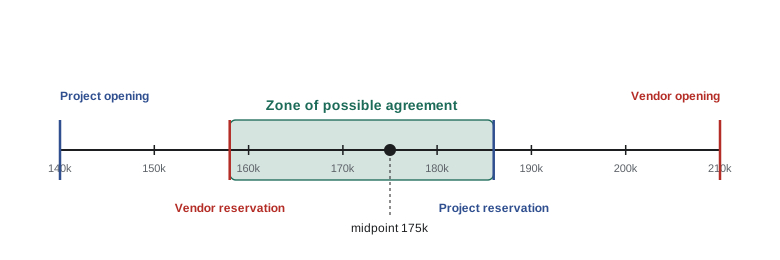
If the buyer's reservation point is higher than the seller's, there is a zone of possible agreement (ZOPA): any price within it is better for both parties than walking away. If the reservation points do not overlap, there is no ZOPA, and the parties should use their BATNAs or change the deal, for example by adding issues. Where the final price lands within the ZOPA depends on information, anchors, concessions and skill.
# Distributive negotiation: find the zone of possible agreement (ZOPA)
buyer_reservation = 186_000   # most the project will pay for the vendor's work
seller_reservation = 158_000  # least the vendor will accept
buyer_opening, seller_opening = 140_000, 210_000

if buyer_reservation >= seller_reservation:
    low, high = seller_reservation, buyer_reservation
    print(f"ZOPA exists: ${low:,} to ${high:,} (width ${high - low:,})")
    midpoint = (buyer_opening + seller_opening) / 2
    print(f"Midpoint of openings: ${midpoint:,.0f}",
          "(inside ZOPA)" if low <= midpoint <= high else "(outside ZOPA)")
else:
    print("No ZOPA: each side should use its BATNA")

# Integrative move: add a second issue both sides value differently
# Vendor values earlier payment; project values a longer warranty.
for price, warranty, early_pay in [(175_000, 12, False), (172_000, 24, True)]:
    vendor_value = price + (8_000 if early_pay else 0) - (warranty - 12) * 300
    project_value = -price + (warranty - 12) * 900 - (1_500 if early_pay else 0)
    print(f"price ${price:,}, warranty {warranty} mo, early pay {early_pay}: "
f"vendor {vendor_value:,}, project {project_value:,}")ZOPA exists: $158,000 to $186,000 (width $28,000) Midpoint of openings: $175,000 (inside ZOPA) price $175,000, warranty 12 mo, early pay False: vendor 175,000, project -175,000 price $172,000, warranty 24 mo, early pay True: vendor 176,400, project -162,700
In this illustrative case the project will pay up to $186,000 and the vendor will accept as little as $158,000, so a ZOPA of $28,000 exists. Splitting the difference between opening offers gives $175,000, inside the zone. The second part of the output shows the integrative move: by adding two issues the parties value differently, the deal improves for both. The vendor values early payment more than it costs the project, and the project values a longer warranty more than it costs the vendor. At $172,000 with a 24-month warranty and early payment, the vendor's value rises from 175,000 to 176,400 and the project's cost position improves from −175,000 to −162,700 in these illustrative units. Neither side gave anything up; value was created by trading.
Principled negotiation
Roger Fisher and William Ury's Getting to Yes, from the Harvard Negotiation Project, set out an approach often called principled negotiation. In short: deal with the people and the problem separately, so that relationship issues do not poison the substance and substantive disagreement does not become personal; focus on the interests behind positions; generate a range of options before deciding; and insist that the result be judged by objective criteria such as market data, standards, precedent or expert opinion. Their concept of the BATNA, discussed above, completes the approach.
| Principle | Project example |
|---|---|
| Separate people from the problem | Acknowledge the functional manager's pressure before discussing staffing numbers |
| Focus on interests, not positions | The client wants "all features by June" because a regulator reviews in July; only three features are needed for the review |
| Invent options for mutual gain | Phase delivery, share a specialist part time, swap a lower-value feature for a higher-value one |
| Use objective criteria | Use published labor rates, the contract's change pricing schedule or benchmark data |
Negotiating for resources
In matrix organizations, the project manager often has to negotiate with functional managers for people. The functional manager's interests usually include delivering their own department's work, developing their people and not being blamed for project delays. A request that addresses those interests, such as a clear schedule of when each person is needed, a development opportunity for a junior staff member, or a release date so the person returns on time, is more likely to succeed than a demand. The project manager's BATNA might be contractors, a revised schedule or escalation; it is wise to know it before the conversation but not to open with it.
Worked problem
Negotiating with a functional manager
A project needs a senior database administrator (DBA) for 50 percent of her time for eight weeks. The functional manager says she is fully booked with operations work. Prepare and conduct the negotiation.
Show solution
- Interests: the project needs database tuning before load testing; the manager needs operations covered and is short-staffed after a resignation.
- BATNA: hire a contract DBA for about $40,000, with a two-week onboarding delay.
- Options: the senior DBA advises 20 percent of her time while a junior DBA does hands-on work, developing his skills; the project funds a contractor to cover operations tasks, freeing the senior DBA; or shift the tuning work two weeks to after the operations month-end peak.
- Objective criteria: the resource plan and the cost of a two-week delay to the project.
- Agreement: the senior DBA spends 20 percent advising, the junior DBA 60 percent on the project, and the project pays for two weeks of contractor cover at month-end. Confirm in writing.
Answer: By addressing the manager's interests in operations coverage and staff development, the project gets the expertise it needs at lower cost than its BATNA.
Negotiating scope and schedule with clients and sponsors
When a client or sponsor asks for more than the project can deliver within its constraints, the project manager negotiates trade-offs. The constraint priority agreed at kickoff (lesson 3) is the starting point. Useful moves include separating must-haves from nice-to-haves, offering phased delivery, offering alternative solutions that meet the underlying need more cheaply, showing the cost and risk of each option openly, and asking which constraint the stakeholder is willing to relax. Promising everything to avoid an uncomfortable conversation simply moves the conflict to a later, more expensive point.
Vendor negotiations follow the same principles but within procurement rules. Many organizations, especially in the public sector, restrict who may negotiate with vendors and when, for example forbidding contact with bidders during an evaluation period. The project manager should know these rules and involve procurement, which leads formal contract negotiations.
Recognizing common tactics
Experienced negotiators use tactics, and a project manager should recognize them without necessarily using them. Naming a tactic calmly often neutralizes it.
| Tactic | What it looks like | Response |
|---|---|---|
| Anchoring | An extreme first offer that pulls the discussion toward it | Prepare your own anchor; refer back to objective criteria |
| Deadline pressure | "This price is only good until five o'clock." | Check whether the deadline is real; do not decide beyond your reservation point |
| Limited authority | "I would have to get my director to approve that." | Ask early who decides; reserve your own approvals too |
| Good cop, bad cop | One negotiator is hostile, the other appears friendly | Treat both as one side; focus on criteria |
| Nibbling | Small extra requests after agreement seems reached | Ask for something in return for any addition |
| Fait accompli | Acting first and presenting the result as settled | Do not accept unilateral changes; return to agreed processes |
Ethics apply throughout. Negotiators may keep their reservation point private, but they should not lie about material facts, invent competing offers or make commitments they do not intend to keep. Apart from being wrong, deception destroys the trust that repeated project relationships depend on. Lesson 10 returns to this under the PMI Code of Ethics and Professional Conduct.
Culture and virtual negotiation
Negotiation norms vary between cultures: how directly offers are made, how long relationship building takes before business, who has authority to agree, and whether a signed agreement is seen as final or as the start of a relationship. Virtual negotiation by video or email removes many nonverbal cues and makes misunderstanding more likely. Prepare more explicitly, summarize agreements frequently, and confirm them in writing promptly.
After the agreement
A negotiation is not finished when the parties shake hands. Write down what was agreed promptly, in terms both sides recognize, and circulate it for confirmation. Where a contract is involved, make sure the agreement is formalized through the proper change or amendment process. Then follow through visibly on your own commitments, because the next negotiation with the same party will start from the trust built, or lost, in this one.
Common mistakes
MistakeEntering a negotiation without knowing your BATNA.
InsteadIdentify and, if possible, strengthen your BATNA and set a reservation point before you start.
MistakeTreating every negotiation as a fixed pie.
InsteadLook for issues the parties value differently and trade across them.
MistakeOpening with threats of escalation in resource negotiations.
InsteadAddress the other party's interests first; keep your BATNA in reserve.
MistakePromising a client everything to avoid conflict.
InsteadNegotiate trade-offs openly using agreed constraint priorities.
MistakeBluffing about competing offers.
InsteadKeep your reservation point private but never misrepresent facts.
Summary and key terms
- Distributive negotiation divides fixed value; integrative negotiation creates value by trading across issues.
- Prepare interests, issues, priorities, BATNA, reservation point, target, objective criteria and authority.
- A ZOPA exists when the reservation points overlap; without one, use your BATNA or add issues.
- Principled negotiation separates people from the problem, focuses on interests, invents options and uses objective criteria.
- Resource negotiations succeed by addressing functional managers' interests.
- Scope negotiations use agreed constraint priorities, phasing and alternatives.
- Recognize tactics such as anchoring and nibbling, and never deceive.
- BATNA
- Best alternative to a negotiated agreement: what you will do if negotiation fails.
- Reservation point
- The least favorable deal a party will accept; its walk-away point.
- Target point
- The outcome a negotiator realistically aims for.
- ZOPA
- Zone of possible agreement: the range between the parties' reservation points.
- Distributive negotiation
- Negotiation over a fixed amount of value, where one side's gain is the other's loss.
- Integrative negotiation
- Negotiation that seeks to create value by meeting both parties' interests.
- Principled negotiation
- An interest-based approach using objective criteria, from Fisher and Ury.
- Anchoring
- Setting a reference point, often an extreme first offer, that influences later offers.
- Logrolling
- Trading concessions on issues the parties value differently.
- Objective criteria
- Independent standards, such as market data or precedent, used to judge fairness.
Practice problems
Work each problem on paper first, then reveal the answer to check.
What is a BATNA?
Show answer
The best alternative to a negotiated agreement.
A buyer will pay up to $90,000 and a seller will accept at least $95,000. Is there a ZOPA?
Show answer
No; the reservation points do not overlap.
A buyer will pay up to $120,000 and a seller will accept at least $105,000. What is the ZOPA?
Show answer
$105,000 to $120,000, a width of $15,000.
How should a reservation point relate to your BATNA?
Show answer
It should be no worse than your BATNA.
Name the four principles of principled negotiation.
Show answer
Separate people from the problem, focus on interests, invent options for mutual gain and use objective criteria.
What makes integrative trades possible?
Show answer
Issues that the parties value differently.
How should you respond to nibbling?
Show answer
Ask for something in return for any addition.
Why involve procurement in vendor negotiations?
Show answer
Procurement rules may restrict who can negotiate and when, and procurement leads formal contract negotiations.
In the DBA example, what interest of the functional manager did the deal address?
Show answer
Operations coverage and development of a junior staff member.
Is it acceptable to keep your reservation point private?
Show answer
Yes, but you should not misrepresent material facts.
Lesson quiz · 5 questions
Score 60% or more to complete this lesson.
Create a free account to save your progress, take quizzes and earn a certificate.