
PMP-121 · Lesson 8 of 12 · 27 min
Stakeholder conflict and escalation
PMP-120 dealt with conflict inside the project team: its sources, Leas's levels, the five Thomas-Kilmann modes and a process for moving from positions to interests. Conflict among stakeholders is different in important ways. The parties often sit outside the project manager's authority, may outrank the project manager, may belong to different organizations bound by contracts, and may have legitimately opposed interests rather than misunderstandings. This lesson covers the sources of stakeholder conflict, mapping interests across parties, deciding whether to resolve or escalate, escalating well, and handling contractual and inter-group disputes.
Sources of stakeholder conflict
Stakeholder conflicts usually trace back to a small number of sources. Competing objectives arise when stakeholders want different outcomes from the same project, such as speed versus thoroughness or cost reduction versus service quality. Resource contention arises when departments compete for the same people, budget or equipment. Scope disputes arise over what was agreed and what counts as a change. Distribution disputes arise over who bears costs or risks and who gets benefits. Value conflicts arise when stakeholders disagree about what is right, for example over environmental or community impacts. Relationship and history matter too: departments that have clashed before bring that history into every meeting.
| Source | Example | Early warning sign | Prevention |
|---|---|---|---|
| Competing objectives | Sales wants launch in May; quality wants full certification first | Conflicting success criteria | Agree success criteria and constraint priorities at kickoff |
| Resource contention | Two programs need the same data team in Q3 | Functional managers delaying commitments | Portfolio-level resource planning; early negotiation |
| Scope disputes | Client says reporting was in scope; contractor says it was not | Different readings of the same document | Clear scope statements, acceptance criteria, change control |
| Distribution of costs and benefits | One department pays, another benefits | Budget owners questioning charges | Transparent funding agreements; benefits ownership |
| Values | Residents oppose a site for environmental reasons | Organized opposition, media interest | Early, honest engagement; impact assessment |
Mapping interests across stakeholders
Behind most stakeholder conflicts are positions that look incompatible and interests that may not be. Mapping interests for each party, side by side, often reveals overlap or trade-offs that a direct argument hides. The technique extends the positions-and-interests idea from PMP-120 to multiple parties.
Worked problem
Mapping interests in a launch-date conflict
The vice-president of sales insists the new product launch in May for a trade show. The quality director insists on completing full certification testing, which would push launch to July. Both have gone to the sponsor. Map their interests and look for options.
Show solution
- Sales position: launch in May. Interests: be visible at the trade show where most annual orders start; meet revenue targets; avoid losing customers to a competitor launching in June.
- Quality position: complete certification first. Interests: avoid regulatory penalties and recalls; protect the brand; avoid rework from shipping uncertified units.
- Shared interests: revenue, reputation, avoiding a failed launch.
- Options: show working pre-production units at the trade show and take orders for July delivery; certify the core model first for limited May shipments while certifying variants later; add test resources to shorten certification.
- Bring the options, with costs and risks, to the sponsor for a decision if the parties cannot agree.
Answer: Taking orders at the show for July delivery meets the trade show interest and the certification interest. Mapping interests turned a two-option argument into several options the sponsor could choose among.
Resolve or escalate?
A project manager should resolve conflicts at the lowest level that has the authority and information to do so, and escalate when that level is exceeded. Escalating too early undermines the project manager's credibility and clogs governance with trivia; escalating too late lets problems grow until they are expensive. The communications management plan, the project charter and the governance structure should define escalation thresholds in advance, such as "variances beyond 10 percent of the phase budget or two weeks of milestone slip go to the steering committee".
| Escalate when | Resolve at project level when |
|---|---|
| The decision exceeds the project manager's delegated authority or tolerance | The decision is within agreed tolerances |
| Parties are senior to the project manager and cannot agree | Parties are willing to work through options with facilitation |
| Conflict involves strategy, portfolio priorities or funding | Conflict concerns how work is done within agreed scope |
| Legal, ethical or safety issues are involved | Issues are operational and reversible |
| Agreed escalation thresholds have been reached | The issue is within time frames for resolution at the current level |
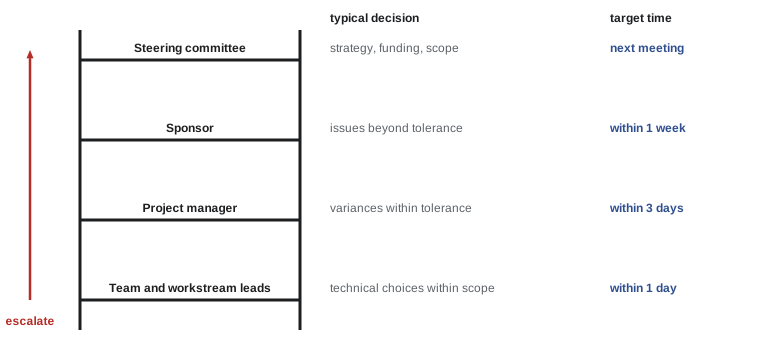
On the exam, watch for answers that escalate immediately to the sponsor or senior management when the project manager has not yet tried to understand or resolve the issue. These are usually wrong. The preferred sequence is to gather facts, understand the parties' interests, try to resolve within your authority, and escalate with options and a recommendation if that fails or if the issue exceeds your authority.
Escalating well
Escalation is not failure; it is the governance system working as designed. But how it is done matters. Good escalation is timely, factual and solution-oriented. It describes the problem, its impact on objectives, what has been tried, the options with their costs and risks, a recommendation and the decision needed by a specific date. It escalates the problem, not the person: the purpose is a decision, not blame. And it keeps the other parties informed, so nobody is surprised to learn they have been escalated about.
| Element | Example |
|---|---|
| Issue | Data team capacity for Q3 is committed to both the billing replacement and the CRM upgrade. |
| Impact | Without four analysts from July, billing go-live slips from October to January, delaying $1.4 million in annual savings. |
| What has been tried | Discussed with the CRM project manager and the data team lead; contractor availability checked. |
| Options | A: prioritize billing, CRM slips six weeks. B: hire two contractors for both ($180,000). C: phase billing data migration (adds risk). |
| Recommendation | Option B, funded from the program contingency. |
| Decision needed | Steering committee decision by 12 June to allow contractor onboarding. |
Worked problem
An escalation that went wrong
A project manager, frustrated that a functional manager keeps withdrawing promised staff, emails the sponsor and copies the functional manager's director: "Ahmed is blocking my project again. Please intervene." What went wrong and what should she have done?
Show solution
- She escalated the person, not the problem, and copied his director without warning, damaging the relationship.
- She gave no facts, impact, options or decision needed.
- Better: first meet Ahmed to understand why staff are being withdrawn; perhaps his department has its own urgent work.
- If unresolved, tell Ahmed she will raise the resource conflict with the sponsor and invite him to contribute his view.
- Then send a factual brief: the commitments made, the shortfall, the schedule impact, options and the decision needed.
Answer: Escalation should be factual, problem-focused, transparent to the other party and accompanied by options and a clear request.
Contractual disputes
When conflicts involve suppliers, contractors or clients, the contract governs much of the response. Most contracts include a dispute resolution clause that sets out a sequence: negotiation between the project representatives, then between senior executives, then mediation (a neutral third party helps the parties reach agreement), and finally arbitration (a neutral third party decides, usually with a binding result) or litigation in court. Claims, the formal assertion that one party is owed money or time under the contract, must usually follow notice requirements and deadlines; missing them can forfeit a valid claim. Contract law is introduced in BUS-210, and claims in construction are covered in CON-350.
For the project manager, the practical rules are to read the contract's notice and dispute clauses early, document facts as they happen, keep communication professional and factual, involve procurement or legal before making formal statements, and keep trying to settle disputes at the lowest level. Most disputes are cheaper to negotiate than to arbitrate, and the relationship often matters for the rest of the project.
In the United States, commercial contracts commonly provide for mediation and binding arbitration, often under the rules of organizations such as the American Arbitration Association, and the Federal Arbitration Act generally supports enforcement of arbitration agreements. Federal government contracts follow the Contract Disputes Act, which routes claims through the contracting officer and then to a board of contract appeals or the Court of Federal Claims.
Conflict between stakeholder groups
Sometimes the conflict is not with the project but between stakeholders, such as two communities with opposite preferences for a transit route, or two departments that each want the system configured their way. The project manager usually should not decide between them alone. Useful approaches include making the decision process and criteria transparent before the decision, giving each group a fair hearing, using a neutral facilitator when feelings run high, separating facts that can be tested from values that must be weighed, and making sure the decision is taken by the person or body with legitimate authority, then explained to all parties with its reasons.
Preventing stakeholder conflict
Many stakeholder conflicts are cheaper to prevent than to resolve. The practices covered earlier in this course are, in large part, conflict prevention: identifying stakeholders early, aligning expectations and constraint priorities at kickoff, agreeing decision rights and escalation thresholds, using change control consistently, and keeping stakeholders informed so that they are not surprised. A useful habit is a short conflict risk review at each phase start, asking where stakeholders' objectives diverge, which decisions are likely to be contested and whether the governance structure can resolve them quickly. Conflicts identified as risks can be planned for, for example by scheduling a decision workshop before the issue becomes urgent.
| Prevention practice | Conflict it prevents |
|---|---|
| Agreed success criteria and constraint priorities | Disputes over what matters most when trade-offs arise |
| Clear scope and acceptance criteria | Disputes over whether work is a change or a defect |
| Decision rights and escalation thresholds | Stalled decisions and arguments over who decides |
| Consistent change control | Perceptions that some stakeholders get favored treatment |
| Transparent funding and benefits agreements | Disputes over who pays and who gains |
When prevention fails, record the conflict in the issue log with an owner and a target date, so that it is visible to governance and does not quietly fester between meetings.
Common mistakes
MistakeEscalating to the sponsor before trying to understand or resolve the conflict.
InsteadGather facts, explore interests and try to resolve within your authority first, unless the issue clearly exceeds it.
MistakeEscalating the person rather than the problem.
InsteadPresent facts, impact, options and the decision needed, and tell the other party you are escalating.
MistakeWaiting until a problem is critical before escalating.
InsteadUse agreed thresholds and escalate in time for options to remain open.
MistakeMaking informal promises to a contractor during a dispute.
InsteadFollow the contract's notice and dispute clauses and involve procurement or legal.
MistakeDeciding between two stakeholder groups yourself.
InsteadRun a transparent process and have the legitimate authority decide and explain.
Summary and key terms
- Stakeholder conflicts often involve parties outside the project manager's authority, with legitimately different interests.
- Common sources are competing objectives, resource contention, scope disputes, distribution of costs and benefits, and values.
- Mapping interests across parties reveals options that positional arguments hide.
- Resolve at the lowest level with authority; escalate when thresholds, authority or legal, ethical or safety issues require it.
- Good escalation is timely, factual, problem-focused, transparent and offers options and a recommendation.
- Contract disputes follow notice and dispute clauses: negotiation, mediation, then arbitration or litigation.
- For conflicts between stakeholder groups, run a fair, transparent process and let the legitimate authority decide.
- Escalation
- Raising an issue to a higher level of authority for a decision.
- Escalation threshold
- A pre-agreed limit beyond which an issue must be escalated.
- Escalation brief
- A short document presenting an issue, impact, options, recommendation and decision needed.
- Mediation
- A process in which a neutral third party helps disputing parties reach their own agreement.
- Arbitration
- A process in which a neutral third party decides a dispute, usually with a binding result.
- Claim
- A formal assertion that a party is owed money or time under a contract.
- Adjudication
- A fast, interim dispute decision process, often used for construction payment disputes.
- Tolerance
- The permitted variation from a plan before escalation is required.
- Resource contention
- Competition between projects or departments for the same resources.
- Interest mapping
- Listing the underlying interests of each party to find shared ground and options.
Practice problems
Work each problem on paper first, then reveal the answer to check.
Name three sources of stakeholder conflict.
Show answer
For example, competing objectives, resource contention and scope disputes.
What is the purpose of mapping interests across stakeholders?
Show answer
To find shared interests and options that positional arguments hide.
When should a project manager escalate?
Show answer
When the issue exceeds their authority or tolerance, involves strategy, legal, ethical or safety matters, or agreed thresholds are reached.
List the elements of a good escalation brief.
Show answer
Issue, impact, what has been tried, options, recommendation and decision needed by a date.
What does "escalate the problem, not the person" mean?
Show answer
Focus on facts and decisions needed rather than blaming an individual.
What is the difference between mediation and arbitration?
Show answer
A mediator helps the parties agree; an arbitrator decides.
Why read a contract's notice clauses early?
Show answer
Missing notice deadlines can forfeit valid claims.
Who should decide between two stakeholder groups with opposing preferences?
Show answer
The person or body with legitimate authority, after a fair and transparent process.
In the launch example, what option met both sales and quality interests?
Show answer
Showing pre-production units at the trade show and taking orders for July delivery.
Why should the other party be told before you escalate?
Show answer
To maintain trust and give them a chance to contribute their view.
Lesson quiz · 5 questions
Score 60% or more to complete this lesson.
Create a free account to save your progress, take quizzes and earn a certificate.