
PMP-101 · Lesson 12 of 12 · 29 min
After the exam: maintaining and using the PMP
Passing the exam is the start of holding the credential, not the end. The PMP must be maintained through continuing professional development, and its value depends on how you use it. This lesson explains PMI's Continuing Certification Requirements (CCR) program as it stood at the time of writing, including professional development units (PDUs), the education and giving-back categories, the Talent Triangle, reporting, renewal and audit; looks at how to present and use the credential; and closes with a capstone exercise in which you build your own route from today to certification and beyond.
The certification cycle
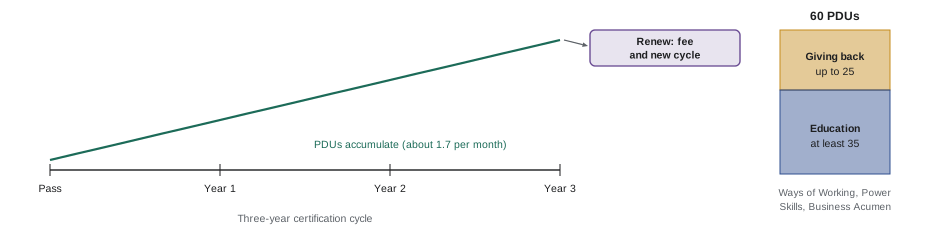
When you pass, your PMP certification cycle begins and lasts three years. To renew at the end of each cycle, you must earn and report 60 professional development units during the cycle and pay a renewal fee. One PDU generally corresponds to one hour of a qualifying activity. If you do not meet the requirements by the end of the cycle, your credential enters a suspended status for a limited period, during which you cannot use the PMP designation until you complete the requirements; if they are still not met, the credential expires. Check PMI's current CCR handbook for exact rules and time limits.
Education and giving back
PDUs fall into two categories. Education PDUs come from learning activities such as courses, webinars, conferences, chapter events, reading, and structured self-study. Giving-back PDUs come from contributing to the profession, such as working as a project practitioner, creating content, presenting, mentoring or volunteering. At the time of writing, a maximum of 25 of the 60 PDUs could come from giving back, so at least 35 must come from education. Within giving back, PDUs for working as a practitioner were capped at a lower amount; check the handbook for current limits.
| Category | Examples | Limit per cycle (at the time of writing) |
|---|---|---|
| Education | Courses, webinars, conferences, reading, online learning | At least 35 PDUs (no maximum) |
| Giving back | Working as a practitioner, creating content, presenting, mentoring, volunteering | Up to 25 PDUs |
The Talent Triangle
PMI organizes education PDUs by the Talent Triangle, a model of the skills project professionals need. At the time of writing, its three areas were Ways of Working (technical approaches such as predictive, agile and hybrid methods and tools), Power Skills (interpersonal skills such as communication, leadership, collaboration and empathy) and Business Acumen (understanding strategy, finance, markets and organizational context). PMI has required a minimum number of education PDUs in each area, which had been eight per area for the PMP; confirm the current requirement in the CCR handbook. The model encourages balanced development rather than accumulating PDUs in one comfortable area.
Worked problem
Planning a cycle of PDUs
Kwame passed the PMP in January. He mentors two junior colleagues, works full time as a project manager and attends his chapter's monthly events. Plan 60 PDUs over three years that satisfy the categories and Talent Triangle minimums described above.
Show solution
- Giving back: working as a practitioner (up to the practitioner cap, say 8 PDUs), plus mentoring and a chapter presentation to reach about 20 PDUs, below the 25 cap.
- Education target: 60 − 20 = 40 PDUs.
- Chapter events: 12 per year × 1.5 hours × 3 years = 54 hours, but only some are relevant; count about 18 PDUs spread across areas.
- Add an online agile course (10 PDUs, Ways of Working), a negotiation workshop (6, Power Skills) and a finance for non-financial managers course (6, Business Acumen).
- Education total: 18 + 10 + 6 + 6 = 40 PDUs, with at least 8 in each area.
Answer: About 20 giving-back and 40 education PDUs, with each Talent Triangle area above its minimum; spread activities across the three years and report as he goes.
At about 1.7 PDUs per month, maintaining the credential needs only a modest, steady effort; the main risk is postponement until the final months of the cycle.
Reporting, renewal and audit
PDUs are reported through PMI's online certification system, with details of the activity, provider, date and hours. Keep records, such as certificates, agendas or notes, for 18 months after the cycle ends, since PMI audits a sample of renewals. Once 60 PDUs are reported, you pay the renewal fee, which at the time of writing was lower for members than non-members (in the region of US$60 and US$150 respectively, based on PMI's published fee schedule before 2026; check current fees). A new three-year cycle then begins.
For US credential holders, many PMI chapters offer low-cost events that earn PDUs, and employers commonly reimburse renewal fees and training costs as professional development. Renewal fees are charged in US dollars.
Using the credential
Once certified, you may use the PMP designation after your name and display the digital badge PMI provides. Use the credential accurately: list it with the certification date and, if relevant, your certification number, which employers can verify through PMI's online certification registry. Do not use the PMP mark in ways that suggest an endorsement by PMI of your products or services, and follow PMI's published usage guidelines. Beyond the letters, the value of the PMP comes from applying what you learned: structuring projects more clearly, engaging stakeholders more effectively, using appropriate approaches, and communicating in a shared professional language.
| Where | How to present the PMP |
|---|---|
| Résumé or CV | Name, PMP, with certification year in a certifications section |
| Professional networking profile | Licenses and certifications section, with badge link |
| Email signature | Name, PMP (if consistent with employer policy) |
| Proposals and bids | Team credentials, with verification details if requested |
Capstone: your personal route
Bring the course together by drafting your own plan. The worked example below shows the type of document you should produce.
Worked problem
A personal PMP route
Noor holds a bachelor's degree and has 41 months of non-overlapping project experience within the last 10 years. She has not taken any project management training. She wants to be certified within nine months. Draft her route.
Show solution
- Eligibility: with a degree she needs 36 months; she has 41, so she qualifies (Lesson 3).
- Training: sign up for an outline-aligned course from an Authorized Training Partner in month 1, especially since live classes from other providers taken from 1 December 2026 will not count (Lesson 4).
- Study estimate: about 140 hours including training (Lesson 11), about 8 hours per week over 18 weeks.
- Application: prepare descriptions and referees in month 2 and apply in month 2 or 3 (Lesson 8).
- Exam: book for about month 5 or 6, leaving three months of buffer before her nine-month target for a possible retake (Lessons 9 and 10).
- After the exam: start the CCR cycle with a simple PDU plan (this lesson).
Answer: Eligible now; train in month 1, apply by month 3, sit the exam around month 5 or 6 with buffer for a retake, then maintain the credential with a planned 60 PDUs.
Write your own version using the same headings: eligibility check, training, study estimate and weekly schedule, application timing, exam booking with buffer, and maintenance plan. Revisit it every month.
Beyond the PMP
Some holders later add related credentials, such as the PMI Agile Certified Practitioner (PMI-ACP) for agile depth, the PMI Risk Management Professional (PMI-RMP), or the Program Management Professional (PgMP) as they move to program leadership. Others pair the PMP with industry knowledge, such as construction management, IT service management or engineering credentials. The rest of this stream covers the PMP domains in depth (PMP-120 to PMP-150) and practice for the exam itself (PMP-190).
Ways to earn education PDUs
Education PDUs can be earned in many ways, and choosing activities that serve your development makes maintenance worthwhile rather than a chore. PMI and its chapters run webinars and events, many free or low cost to members. Conferences, both PMI's and industry events with relevant sessions, offer several PDUs in a few days. Self-directed learning, such as reading books, listening to podcasts or watching recorded talks on project topics, can also count when documented. Organization-provided training in leadership, finance, technical methods or tools often fits one of the Talent Triangle areas.
Ways to give back
Giving-back PDUs recognize contributions to the profession. Working as a project practitioner earns a limited number of PDUs. Creating new knowledge, such as writing articles, blog posts, white papers or books on project topics, and presenting at conferences or chapter meetings, can count, as can volunteering for PMI, a chapter or a community organization in a project-related role, and mentoring other practitioners. These activities often benefit the holder too, by deepening understanding and building a professional network.
Common renewal problems
The most common renewal problem is simple postponement: holders intend to earn PDUs steadily, but busy years pass and the final months of the cycle arrive with a large gap. Other problems include claiming activities that do not relate to project management, failing to meet the Talent Triangle minimums, exceeding the giving-back cap, and not keeping records. A simple routine prevents most of these: report each activity soon after completing it, review the CCR dashboard twice a year, and keep certificates and notes in a dedicated folder.
Keeping knowledge current
Maintaining the credential is also a way of keeping knowledge current. Project practice will continue to change between exam outlines: new tools, new regulations, new expectations around sustainability and the responsible use of artificial intelligence. Holders who use their PDUs to explore these changes, rather than repeating familiar topics, remain more valuable to their employers and clients. Periodically review PMI's current standards and guides to see how thinking has moved on since you passed.
Sharing what you have learned
Many new holders find that helping others prepare consolidates their own knowledge. Answering questions in a study group, mentoring a colleague through the application, or presenting a short session on your experience of the exam to your team all build understanding and can contribute giving-back PDUs. They also reinforce the professional community the PMP represents. When sharing, respect exam confidentiality: you can discuss the format, your study methods and the concepts, but never the content of specific questions.
| Year | Planned activities | PDUs | Category or area |
|---|---|---|---|
| Year 1 | Practitioner work; chapter events; agile course | 8 + 6 + 10 | Giving back; mixed; Ways of Working |
| Year 2 | Mentoring; negotiation workshop; chapter events | 6 + 6 + 6 | Giving back; Power Skills; mixed |
| Year 3 | Chapter presentation; finance course; chapter events | 6 + 6 + 6 | Giving back; Business Acumen; mixed |
Worked problem
Checking a PDU claim against the rules
At the end of year three, Lena has reported 22 PDUs for working as a practitioner and mentoring, 30 education PDUs in Ways of Working, 6 in Power Skills and 2 in Business Acumen. Has she met the requirements described in this lesson?
Show solution
- Total: 22 + 30 + 6 + 2 = 60 PDUs.
- Giving back: 22, within the 25 cap.
- Education: 38, above the 35 minimum.
- Talent Triangle: Power Skills 6 and Business Acumen 2 are both below a minimum of 8 per area.
Answer: No: although she has 60 PDUs, she needs at least 2 more Power Skills and 6 more Business Acumen PDUs if the minimum of 8 per area applies; she should plan these before the cycle ends.
Reflecting on the course
This course has followed the path a candidate takes: understanding what the PMP is, checking eligibility, completing the education requirement, studying the outline and its domains, applying, preparing for exam day and the question formats, planning study, and maintaining the credential. Each step is manageable on its own, and the main risks are delay, outdated materials and lack of a plan. With a realistic schedule and steady effort, most experienced project practitioners can move from first enquiry to certification within six to nine months, and then keep the credential current with a modest ongoing commitment.
Finally, set a calendar reminder six months before your cycle ends to check your PDU total, Talent Triangle balance and renewal fee, so that renewal is a routine task rather than a last-minute scramble.
Common mistakes
MistakeLeaving PDUs to the last months of the cycle.
InsteadEarn and report about 1.7 PDUs per month.
MistakeClaiming more than 25 giving-back PDUs.
InsteadEarn at least 35 through education.
MistakeIgnoring Talent Triangle minimums.
InsteadPlan education across all three areas.
MistakeDiscarding PDU records after reporting.
InsteadKeep records in case of audit.
MistakeUsing the PMP mark to imply PMI endorsement.
InsteadFollow PMI's usage guidelines.
Summary and key terms
- The PMP runs in three-year cycles requiring 60 PDUs and a renewal fee.
- At least 35 PDUs come from education; up to 25 from giving back.
- Education PDUs follow the Talent Triangle: Ways of Working, Power Skills, Business Acumen.
- Report PDUs online and keep records for audit.
- Missing requirements leads to suspension and then expiry.
- Use the designation accurately and verifiably.
- A written personal route ties eligibility, training, study, exam and maintenance together.
- CCR
- Continuing Certification Requirements program.
- PDU
- Professional development unit, about one hour of activity.
- Certification cycle
- Three-year period for earning PDUs.
- Education PDU
- PDU from a learning activity.
- Giving back PDU
- PDU from contributing to the profession.
- Talent Triangle
- PMI skills model of three areas.
- Ways of Working
- Technical project approaches and tools.
- Power Skills
- Interpersonal and leadership skills.
- Business Acumen
- Understanding of strategy and organization.
- Suspension
- Status when renewal requirements are not met.
Practice problems
Work each problem on paper first, then reveal the answer to check.
How long is a PMP cycle?
Show answer
Three years.
How many PDUs are required per cycle?
Show answer
60.
Maximum giving-back PDUs?
Show answer
25.
Minimum education PDUs?
Show answer
35.
Name the three Talent Triangle areas.
Show answer
Ways of Working, Power Skills, Business Acumen.
PDUs per month to reach 60 in 36 months?
Show answer
About 1.7.
With 20 giving-back PDUs, how many education PDUs are needed?
Show answer
40.
What happens if requirements are not met?
Show answer
Suspension, then expiry.
Where can employers verify a PMP?
Show answer
PMI's online certification registry.
Name a credential some PMPs add later.
Show answer
PMI-ACP, PMI-RMP or PgMP.
Lesson quiz · 5 questions
Score 60% or more to complete this lesson.
Create a free account to save your progress, take quizzes and earn a certificate.