
PMP-101 · Lesson 11 of 12 · 31 min
Building a study plan
Most PMP candidates are working adults with jobs, families and other commitments, and the difference between those who pass and those who drift is usually a realistic, written plan followed consistently. This lesson explains how to estimate the total effort you need, choose resources, structure study into phases, convert hours into a weekly schedule, use practice exams properly, and adjust the plan when life intervenes. It finishes with two worked schedules for different situations, which you can adapt to your own.
How much study?
There is no official figure. Surveys by training providers and candidate reports commonly suggest totals of roughly 100 to 200 hours including the 35 hours of training, with experienced agile and predictive practitioners at the lower end and those new to agile, governance or formal methods at the higher end. A practical way to estimate is to start with a baseline and adjust:
| Factor | Adjustment to a 120-hour baseline |
|---|---|
| Strong agile and hybrid experience | −15 hours |
| Little or no agile experience | +25 hours |
| Regular involvement in governance, risk and compliance | −10 hours |
| No exposure to governance or business environment work | +20 hours |
| English is a second language (exam in English) | +15 hours for reading practice |
| Recent formal study habits | −5 hours |
Worked problem
Estimating total hours
Daniel is a construction project manager with strong predictive experience, no agile experience and some involvement in safety compliance but none in governance. Using the table, estimate his total preparation.
Show solution
- Baseline: 120 hours.
- No agile experience: +25, giving 145.
- Limited governance exposure: count half of the +20, giving +10 and 155.
- No other adjustments apply.
- His 35 training hours are part of this total, leaving about 120 hours of self-study.
Answer: About 155 hours in total, roughly 120 beyond the required training.
Choosing resources
Good preparation usually combines four kinds of resources: a training course aligned with the 2026 outline to meet the 35 hours and give structure; one main reference or prep book; a large bank of practice questions with explanations, including the new formats; and, optionally, PMI's own materials such as the outline, the PMBOK Guide and practice tests available through PMI's study offerings. Avoid using too many books, which leads to skimming rather than understanding. Check publication dates: any resource that predates the July 2026 outline is likely to underweight business environment topics and lack case-study practice.
The three phases
A plan typically moves through three phases:
| Phase | Share of time | Focus |
|---|---|---|
| Learn | About 50 % | Training course, reading, concept notes, short domain quizzes |
| Practice | About 35 % | Topic and mixed question sets, reviewing every explanation, filling gaps |
| Simulate | About 15 % | Full-length timed practice exams, timing strategy, final review |
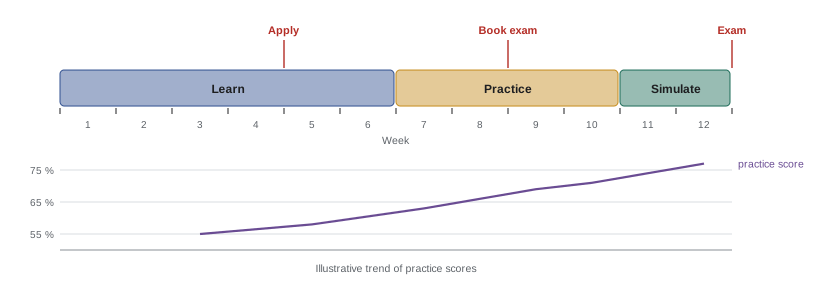
The proportions are flexible, but candidates who spend all their time reading and leave practice to the end often discover gaps too late. Begin answering questions early, even during the learn phase.
From hours to a weekly schedule
Divide your total self-study hours by the number of weeks available, then check that the weekly load is sustainable. Ten hours per week is demanding alongside a full-time job; five is comfortable but slow. Spread study across several short sessions rather than one long one; spaced repetition improves retention. Protect fixed slots in your calendar, such as early mornings or two weekday evenings plus a weekend block, and tell family or colleagues about them.
Worked problem
A twelve-week schedule for a full-time worker
Asha has 110 hours to prepare (including 35 hours of training) and wants to sit the exam in 12 weeks. How should she schedule her time?
Show solution
- Average weekly load: 110 / 12 ≈ 9.2 hours.
- Learn (weeks 1 to 6, about 55 hours): training course and reading, about 9 hours per week, for example three 2-hour weekday sessions and a 3-hour weekend session.
- Practice (weeks 7 to 10, about 38 hours): about 9.5 hours per week of question sets and review.
- Simulate (weeks 11 and 12, about 17 hours): two full-length 4-hour practice exams with review, plus targeted revision.
- Milestones: submit the application by week 4, book the exam around week 8 once practice scores are improving.
Answer: About 9 hours per week in three phases (6, 4 and 2 weeks), with application in week 4 and booking in week 8.
Worked problem
A slower plan around a busy job
Tomás can reliably study only 5 hours per week and estimates 130 hours in total, of which 35 are training. How long will his preparation take, and what should he watch for?
Show solution
- Weeks needed: 130 / 5 = 26 weeks, about six months.
- Risk: knowledge from early weeks fades; schedule a short weekly review of earlier topics.
- Risk: the one-year eligibility period; apply around week 12 so the eligibility year comfortably covers the exam date.
- Consider a bootcamp week of leave to accelerate the training component if possible.
Answer: About 26 weeks; build in weekly review, apply around week 12 and consider an intensive training block to shorten the plan.
Using practice exams well
Practice questions are most valuable for the explanations, not the scores. After each set, review every question, including those you answered correctly, and note why the right answer is right and why each distractor is wrong. Keep an error log by domain and task, and look for patterns: misreading the question, not identifying the approach, choosing escalation too early, or confusing terms. Full-length simulations train stamina and timing; take at least two under realistic conditions, with breaks timed as on the real exam. Many providers suggest that consistent scores of about 70 to 75 % or more on reputable full-length simulations indicate readiness, but this is only a rough guide, since banks vary in difficulty and PMI does not publish a passing score.
Adjusting the plan
Plans meet reality: illness, busy periods at work, family events. Build in a buffer of one or two weeks, review progress every two weeks against your milestones, and adjust rather than abandon the plan. If practice scores stall, change method, perhaps by explaining concepts aloud, joining a study group, or using a different question bank, instead of simply doing more of the same. If the exam date becomes unrealistic, reschedule within the free change window rather than sitting the exam underprepared.
In the United States, local PMI chapters often run study groups and exam preparation sessions, and some employers fund preparation through tuition assistance programs; ask your employer or chapter about current programs.
Study techniques that work
Research on learning supports several techniques that suit PMP preparation: retrieval practice (testing yourself rather than rereading), spacing (reviewing topics over several weeks), interleaving (mixing domains and approaches in a practice session), and elaboration (explaining why a practice applies and connecting it to your own projects). Creating short summaries for each task in your own words, and linking each to an example from your experience, makes concepts memorable and prepares you for scenario questions.
Building an error log
An error log turns mistakes into a study plan. For each question you get wrong, or right by guessing, record the domain and task, the approach involved, the type of error (content, reading or judgment), the concept involved, and a one-line note on the correct reasoning. Once a week, sort the log by task and error type. Clusters reveal priorities: a run of judgment errors on stakeholder questions in agile settings suggests revisiting servant leadership and product ownership, while frequent reading errors suggest slowing down and underlining qualifiers mentally.
Study groups and accountability
Studying with others can help, particularly for situational questions where discussion reveals different reasoning. A small group of three to five candidates at a similar stage, meeting weekly online or in person, can review difficult questions, explain concepts to one another and keep each other on schedule. Explaining a concept to someone else is a powerful test of your own understanding. If a group is not available, an accountability partner, such as a colleague or friend who asks each week whether you met your study goals, can provide similar motivation.
Balancing study with work and family
Long preparation competes with other responsibilities. Agree expectations with family and, if appropriate, your manager, and make study time visible in a shared calendar. Use small pockets of time for light tasks, such as reviewing flashcards on a commute or answering ten questions during a lunch break, and protect longer sessions for reading and full-length practice. Expect some weeks to go badly, and use the buffer in your plan rather than abandoning it. Look after sleep, exercise and breaks: consistent, rested study is more productive than late-night cramming.
Using your own projects as study material
Your experience is a resource. For each task in the outline, think of a time when you performed it well and a time when it went badly, and ask what the PMP approach would have suggested. This links abstract concepts to memorable situations and builds the judgment that situational questions test. Be aware, though, that your organization's practices may differ from PMI's view of good practice; on the exam, answer according to PMI's principles rather than what your workplace usually does.
The final two weeks
In the final two weeks, shift from learning to consolidation. Take a last full-length practice exam about a week before the real one, review it thoroughly, and focus remaining study on your weakest tasks. Reread your summaries and error log rather than starting new materials. In the last two days, keep study light, confirm logistics, and rest. Arriving at the exam well rested and calm is worth more than a few extra hours of last-minute reading.
Measuring progress honestly
It is tempting to retake familiar practice questions and take comfort in rising scores, but repeated questions measure memory of answers rather than understanding. Use fresh questions to measure progress, and treat repeated sets only as review. Track results over time on a simple chart, noting the question bank used, since difficulty varies between providers.
| Week | Main activity | Hours | Milestone |
|---|---|---|---|
| 1 to 2 | Training course part 1; read outline | 18 | Tracker set up |
| 3 to 4 | Training course part 2; diagnostic test | 18 | Training complete; apply |
| 5 to 6 | Domain reading; topic quizzes | 18 | Application approved |
| 7 to 8 | Mixed question sets; error log | 19 | Book exam |
| 9 to 10 | Weak-area review; case-study practice | 19 | Practice scores rising |
| 11 | Full-length simulation 1 and review | 10 | Timing plan tested |
| 12 | Simulation 2; light review; rest | 8 | Exam |
Worked problem
Checking readiness with a trend
A candidate records full-length simulation scores of 64 %, 69 % and 74 % from the same provider over three weeks, with Business Environment rising from Below Target to Target in the provider report. The exam is booked for ten days later. Should they keep the date?
Show solution
- The trend is rising steadily by about 5 points per simulation.
- The latest score is within the range providers often associate with readiness, though this is only a rough guide.
- The weakest domain has improved to target level.
- Remaining risk: one more simulation would confirm the trend and test timing.
Answer: Keeping the date is reasonable if one further simulation confirms the trend; if scores fall, reschedule within the free change window.
Flashcards and summaries
Flashcards suit terms, formulas and short distinctions, such as the difference between a risk and an issue or the formula for CPI. Digital flashcard apps with spaced repetition schedule reviews automatically, showing cards you find difficult more often. Summaries suit larger ideas: a single page for each task, written in your own words, with a short example from your experience and a note of how the task looks in predictive, agile and hybrid settings. Avoid copying text from books into notes; the effort of rephrasing is what makes the learning stick.
Adapting the plan to your learning style
Some people learn best from reading, others from video, discussion or practice. While a balanced plan uses all of these, you can tilt it toward what works for you, provided you still include plenty of retrieval practice through questions and simulations. If you find a resource dull and keep postponing it, replace it with another that covers the same material; a resource you actually use is better than a highly recommended one you avoid. Review the plan every two weeks and record what is and is not working.
Common mistakes
MistakeStudying without a written plan.
InsteadWrite a schedule with phases, hours and milestones.
MistakeLeaving all practice questions to the end.
InsteadStart practice during the learn phase.
MistakeUsing many books superficially.
InsteadUse one main reference plus a strong question bank.
MistakeJudging readiness by one high score.
InsteadLook for consistent results across full-length exams.
MistakeAbandoning the plan after a setback.
InsteadUse buffers and adjust the schedule.
Summary and key terms
- Total preparation commonly ranges from about 100 to 200 hours.
- Estimate hours from a baseline adjusted for your experience.
- Combine a course, one main reference and a large question bank.
- Plan learn, practice and simulate phases.
- Convert hours into sustainable weekly sessions with milestones.
- Review every practice explanation and keep an error log.
- Use retrieval, spacing, interleaving and elaboration.
- Study plan
- Written schedule of phases, hours and milestones.
- Baseline estimate
- Starting figure adjusted for personal factors.
- Learn phase
- Building conceptual understanding.
- Practice phase
- Applying concepts through question sets.
- Simulate phase
- Full-length timed practice exams.
- Error log
- Record of mistakes by domain and cause.
- Retrieval practice
- Testing yourself to strengthen memory.
- Spacing
- Reviewing material over time.
- Interleaving
- Mixing topics within a session.
- Buffer
- Spare time built into a schedule.
Practice problems
Work each problem on paper first, then reveal the answer to check.
Typical total preparation range?
Show answer
About 100 to 200 hours including training.
Weekly hours for 96 hours over 12 weeks?
Show answer
8 hours.
Weeks for 150 hours at 6 hours per week?
Show answer
25 weeks.
Name the three phases.
Show answer
Learn, practice, simulate.
What share of time goes to simulation?
Show answer
About 15 %.
Why review correct answers too?
Show answer
To confirm the reasoning and learn from explanations.
What does an error log record?
Show answer
Mistakes by domain, task and cause.
What is interleaving?
Show answer
Mixing domains and approaches in practice.
When might you apply in a 12-week plan?
Show answer
Around week 4.
What to do if scores stall?
Show answer
Change method rather than repeating the same approach.
Lesson quiz · 5 questions
Score 60% or more to complete this lesson.
Create a free account to save your progress, take quizzes and earn a certificate.