
PLB-410 · Lesson 9 of 12 · 22 min
Plumbing math and science review
Math and science questions are scattered through every part of the exam. A drainage question needs the fall over a run; a water supply question needs the pressure at a height; a hydronic question needs heat and flow; a pipe preparation question needs an offset length; a water heater question needs a temperature rise. None of these is hard on its own, but each one can be lost to a units mistake or a slip under time pressure, and together they add up to a large share of the marks.
Maya was good at math in school, and she was surprised how many practice questions she got wrong anyway. Her error log showed the pattern: almost every mistake was a units mistake, a wrong constant or an answer she did not check against common sense. Luis's cure was a one-page formula sheet that she wrote herself, a set of quick sanity checks, and a daily drill of five mixed calculations.
Units and conversions
Plumbing work in the United States uses US customary units, but many products, standards and engineered drawings use metric values, and some exam questions give one and ask for the other. Knowing a handful of conversions well beats knowing many vaguely.
| Quantity | Conversion | Use |
|---|---|---|
| Length | 1 ft = 12 in; 1 in = 25.4 millimeters | Pipe lengths, offsets, drawing scales |
| Volume | 1 gal = 231 in³; 1 ft³ = 7.48 gal; 1 gal of water weighs 8.33 lb | Tanks, pipes, water use |
| Pressure | 1 psi = 2.31 ft of water; 1 atmosphere = 14.7 psi | Test pressures, PRV settings |
| Pressure from height | 0.433 psi per ft of water | Elevation loss, static head |
| Energy and power | 1 kW = 3412 Btu/h; 1 therm = 100,000 Btu | Heaters, boilers, gas loads |
| Temperature | a rise of 1 degree Celsius = a rise of 1.8 °F | Equipment data given in metric |
| Flow | 1 ft³/s = 449 gpm; 1 gpm = 1,440 gal per day | Pumps, demand, storm |
The temperature line has a trap. Converting a temperature uses the full formula with the 32; converting a temperature difference uses only the 1.8. A rise of 50 degrees Celsius is a rise of 90 °F, not 122 °F. Questions that mix equipment data in metric with US units depend on this.
The best protection against units errors is to carry the units through every line of a calculation and cancel them like numbers. If the units at the end are not the units of the answer, the calculation is wrong somewhere, and the units show where.
Area and volume
Pipe and tank volumes appear in questions about test water, flushing, disinfection and storage. The internal volume of a pipe is its cross-sectional area times its length. A handy shortcut in US units: a pipe of internal diameter d in inches holds about 0.0408 d squared gallons per foot, because the area is pi d squared over 4 square inches, a foot of pipe is 12 inches long, and a gallon is 231 cubic inches.
Worked problem
Water needed to disinfect a new main
A new 6 in water main, internal diameter 6.1 in, is 400 ft long. It is to be filled with a chlorine solution. How many gallons does it hold?
Show solution
- \[\text{per foot} = 0.0408 \times 6.1^2 \approx 1.52\ \text{gal/ft}\]
- \[V = 1.52 \times 400 \approx 607\ \text{gal}\]
Answer: The main holds about 607 gallons. A sanity check: a 6 in pipe is about the size of a large paint can across, and 400 ft of it is a lot of water, so several hundred gallons is reasonable; 6 gallons or 60,000 gallons would not be.
Rectangular tanks are length times width times depth. Cylindrical tanks are the area of the circle times the height. A cylinder lying on its side, like many oil and propane tanks, is harder to calculate partly full, and exam questions on it usually give a chart.
Pressure, head and the atmosphere
Water pressure from height is the most used piece of science in plumbing. A column of water 1 ft high exerts about 0.433 psi at its base, whatever the shape or size of the pipe. This is why the pressure at the bottom of a tall riser is so much higher than at the top, and why a test with a water column 10 ft high applies about 4.3 psi to the joints at the bottom.
Atmospheric pressure at sea level is about 14.7 psi, which can support a column of water about 34 ft high. That number limits suction lift: no pump can lift water by suction more than about 34 ft in theory, and much less in practice, because of friction, vapor pressure and the pump's own needs. It also explains siphons, which work only while the high point is less than that height above the supply surface, and it explains why trap seals can be pulled out by the small pressure differences that venting is designed to prevent.
Gauge pressure is measured relative to the atmosphere; absolute pressure includes it. A gauge reading 45 psi means 59.7 psia. Use absolute pressure whenever a gas is involved: expansion tanks, air chambers, compressed air tests. Use gauge pressure for everything else.
Offsets, angles and grade
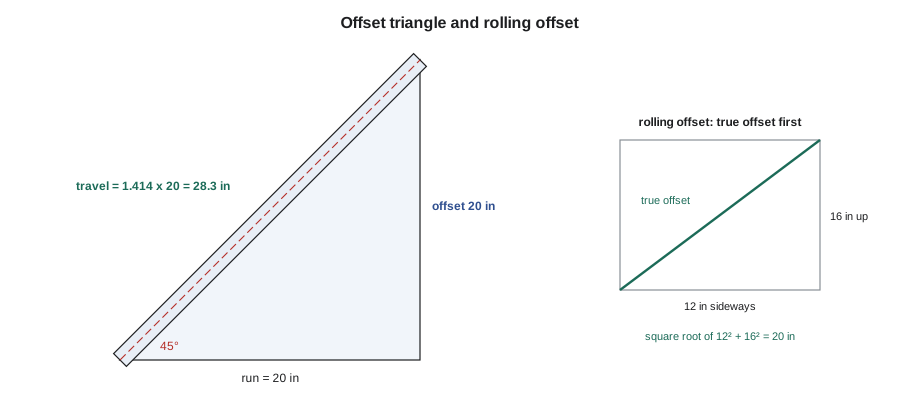
Offsets with fittings are a pipe preparation topic, and they appear on the exam as calculations. A rolling or simple offset moves a line sideways by a set distance, the offset, using two fittings at the same angle. The length of pipe between the fittings, measured center to center, is the travel. Travel equals the offset times a constant that depends on the fitting angle, the cosecant of the angle.
| Fitting angle | Travel = offset × | Run = offset × |
|---|---|---|
| 22-1/2° | 2.613 | 2.414 |
| 45° | 1.414 | 1.000 |
| 60° | 1.155 | 0.577 |
| 11-1/4° | 5.126 | 5.027 |
Worked problem
A rolling offset
A drain must move 12 in to the side and 16 in up while it travels along a wall, using two 45° fittings. What is the true offset, the travel and the run? How much pipe is cut if each fitting takes up 1 in?
Show solution
- \[\text{true offset} = \sqrt{12^2 + 16^2} = 20\ \text{in}\]
- \[\text{travel} = 1.414 \times 20 \approx 28.3\ \text{in}, \quad \text{run} = 1.000 \times 20 = 20\ \text{in}\]
- \[\text{cut} = 28.3 - 2 \times 1 = 26.3\ \text{in}\]
Answer: The true offset is 20 in, the travel about 28-5/16 in, and the pipe is cut to about 26-5/16 in after the fitting take-offs.
Grade, the slope of a drain, is the fall divided by the run. A slope of 1/4 in per ft is about 2 percent; 1/8 in per ft is about 1 percent. The fall over a run is the run times the slope. A 50 ft building drain at 1/4 in per ft falls 12.5 in, which decides whether it can reach the sewer connection at the depth available.
Heat, expansion and materials
Pipes grow when they get warm. The change in length is the original length times the coefficient of expansion times the temperature change. Plastic pipe expands several times as much as metal: PVC and CPVC move roughly 0.03 to 0.04 in per 10 ft per 10 °F, about 3.4 to 4.2 in per 100 ft per 100 °F, copper about 1.1 in per 100 ft per 100 °F. A 100 ft run of CPVC hot water pipe heated by 90 degrees grows by about 3.5 in, which is why long plastic runs need expansion loops, offsets or compensators, and why hangers must let them move.
Heat calculations follow the same pattern as the hydronic and water heater lessons: heat equals mass times specific heat times temperature change. Latent heat, the heat taken in or given out when water changes state, is much larger: melting ice and boiling water both absorb a great deal of heat at a constant temperature. That is why steam carries so much heat, and why a frozen pipe takes so long to thaw.
Two pieces of chemistry also appear. Galvanic corrosion happens when two different metals are joined in water; the less noble metal, such as steel or zinc next to copper, corrodes. Dielectric unions or fittings break the electrical path. And pH measures acidity: water below about 7 is acidic and attacks copper and cement, while condensate from high-efficiency appliances is acidic enough to need neutralizing before it enters some drains.
Sanity checks
Under time pressure, a quick check catches more errors than recalculating. Maya used four checks on every calculation question.
- Size: is the answer the right order of magnitude? A house does not use 13,000 gallons of water a day, and a residential water service does not carry 300 gpm.
- Units: do the units at the end match the units the question asks for?
- Direction: does the answer move the right way? A larger pipe should lose less pressure; a colder inlet should need more heat.
- Options: if your answer is between two options, recheck the step where a factor of 2, 10 or 1.8 could have slipped in, because distractors are built from those slips.
A mixed math drill
Maya's drill program prints five random calculations with their answers hidden at the bottom, using a fixed seed so that the same drill can be repeated. Changing the seed gives a new drill.
# Mixed plumbing math drill: questions first, answers at the end
import math, random
random.seed(410)
qs = []
off = random.choice([8, 12, 18, 24])
qs.append((f"Two 45 degree fittings make a {off} in offset. Travel?", f"{1.414 * off:.1f} in"))
run, slope = random.choice([(40, 0.25), (60, 0.125), (80, 0.25)])
qs.append((f"A {run} ft drain at {slope} in per ft. Fall?", f"{run * slope:.1f} in"))
h = random.choice([20, 30, 45, 70])
qs.append((f"Static pressure lost lifting water {h} ft?", f"{h * 0.433:.1f} psi"))
d, L = random.choice([(1.025, 130), (1.265, 80), (1.985, 200)])
qs.append((f"Volume of {L} ft of pipe, internal diameter {d} in?", f"{0.0408 * d ** 2 * L:.1f} gal"))
btu, rise = random.choice([(30700, 80), (41000, 90), (61400, 70)])
qs.append((f"Recovery of a {btu:,} Btu/h electric heater at a {rise} F rise?", f"{btu / (8.33 * rise):.1f} gal/h"))
for i, (q, a) in enumerate(qs, 1):
    print(f"{i}. {q}")
print()
for i, (q, a) in enumerate(qs, 1):
print(f"Answer {i}: {a}")1. Two 45 degree fittings make a 12 in offset. Travel? 2. A 80 ft drain at 0.25 in per ft. Fall? 3. Static pressure lost lifting water 45 ft? 4. Volume of 130 ft of pipe, internal diameter 1.025 in? 5. Recovery of a 61,400 Btu/h electric heater at a 70 F rise? Answer 1: 17.0 in Answer 2: 20.0 in Answer 3: 19.5 psi Answer 4: 5.6 gal Answer 5: 105.3 gal/h
Try working the five questions on paper before scrolling to the answers, then change the seed and repeat. Five a day for six weeks is two hundred calculations, and by then the constants are automatic.
Levers, pulleys and sling angles
Rigging questions in the common occupational skills area are math questions in disguise. A lever balances when the load times its distance from the pivot equals the effort times its distance, so a pry bar with the pivot close to the load multiplies the effort. A block and tackle has a mechanical advantage equal to the number of rope parts supporting the moving block, less friction losses, so a four-part tackle lifts a load with about a quarter of the pull but needs four times the rope to be pulled through.
Sling angles matter even more, because they change the load in each leg. When two sling legs lift a load, the tension in each leg is half the load divided by the sine of the angle between the leg and the horizontal. At 60 degrees, each leg of a two-leg sling carries about 58 percent of the load; at 45 degrees, about 71 percent; at 30 degrees, a full 100 percent. A water heater of 330 lb lifted on a two-leg sling at 30 degrees puts about 330 lb in each leg, the same as if one leg carried it alone.
The practical rule follows: keep sling angles at 45 degrees or steeper from the horizontal, and never below 30, and check the rated capacity of the sling at the angle being used, not its vertical rating. An exam question that gives a load, a sling angle and a sling rating is testing whether you apply the angle before comparing.
Common mistakes
MistakeUsing the full temperature formula for a temperature difference.
InsteadA difference of 1 degree Celsius is 1.8 °F; the 32 applies only to temperatures.
MistakeUsing gauge pressure in a gas law problem.
InsteadAdd about 14.7 psi to get absolute pressure.
MistakeUsing the side or vertical displacement as the offset in a rolling offset.
InsteadFind the true offset with the Pythagorean theorem first.
MistakeCutting pipe to the travel length.
InsteadSubtract the fitting take-offs from the center-to-center travel.
MistakeAccepting an answer without a sanity check.
InsteadCheck size, units, direction and the factors that distractors are built from.
Summary and key terms
- Carry units through every calculation; most math errors on the exam are units errors.
- Pressure from height is about 0.433 psi per foot of water; the atmosphere supports about 34 ft.
- Use absolute pressure whenever a gas is involved; gauge pressure otherwise.
- Travel equals offset times the fitting constant, 1.414 for 45°; find the true offset of a rolling offset first.
- Expansion equals length times coefficient times temperature change; plastic moves several times as much as copper.
- Check every answer for size, units, direction and the common factor slips.
- Travel
- The center-to-center length of pipe between two offset fittings.
- True offset
- The straight-line displacement of a rolling offset, from both of its components.
- Gauge pressure
- Pressure measured relative to the atmosphere.
- Absolute pressure
- Gauge pressure plus atmospheric pressure.
- Coefficient of expansion
- The change in length per unit length per degree of temperature change.
Practice problems
Work each problem on paper first, then reveal the answer to check.
Convert a temperature rise of 40 degrees Celsius to °F.
Show answer
72 °F.
What pressure does a 10 ft water test apply at its base?
Show answer
About 4.3 psi.
Two 22-1/2° fittings make a 10 in offset. What is the travel?
Show answer
2.613 × 10, about 26.1 in.
How much does a 60 ft drain at 1/4 in per ft fall?
Show answer
15 in.
A gauge reads 30 psi. What is the absolute pressure?
Show answer
About 44.7 psia.
Lesson quiz · 5 questions
Score 60% or more to complete this lesson.
Create a free account to save your progress, take quizzes and earn a certificate.