
PLB-410 · Lesson 10 of 12 · 21 min
Safety, tools and trade practices review
The F25 is a code exam, so safety and tools are not separate content areas, but they are in every plumber's license responsibilities, and testing, joining methods and pipe support live in the code's general regulations chapter, about 8 percent of the exam. Plan-reading questions also depend on reading symbols and drawings. Luis's warning was blunt. "You can lose points on the questions you think are free."
This lesson reviews the safety rules a journeyworker is responsible for on site, the main joining methods and the tools that make them, the code's test requirements for drainage and water systems, pipe support and protection, and the drawing skills that plan-reading questions rely on.
The safety framework
In the United States, the Occupational Safety and Health Act and the OSHA construction standards set the rules on site. Employers must provide a workplace free of recognized hazards, train workers and provide protective equipment, and workers have the right to raise safety concerns without retaliation. The Hazard Communication standard, aligned with the Globally Harmonized System, governs labels and safety data sheets. A journeyworker who leads a crew is often the competent person on site, which carries the duty to identify hazards and the authority to correct them.
| Hazard | Key rule to remember | Plumbing example |
|---|---|---|
| Falls | Fall protection in construction at 6 ft or more above a lower level | Installing roof drains and vents on a flat roof without parapets |
| Trenches | Trenches 5 ft deep or more need a protective system unless in stable rock; a ladder within 25 ft of lateral travel in trenches 4 ft deep or more | A sewer lateral or water service trench |
| Confined spaces | Permit-required confined spaces need evaluation, a permit, atmospheric testing, an attendant and rescue arrangements | Manholes, large sumps, tanks and crawlspaces with poor ventilation |
| Hazardous energy | Lock out and tag out pumps, heaters and equipment; verify zero energy before work | Replacing a booster pump or an electric water heater element |
| Hot work | A fire watch and an extinguisher; clear combustibles; follow the site hot work permit | Soldering or brazing near framing or insulation |
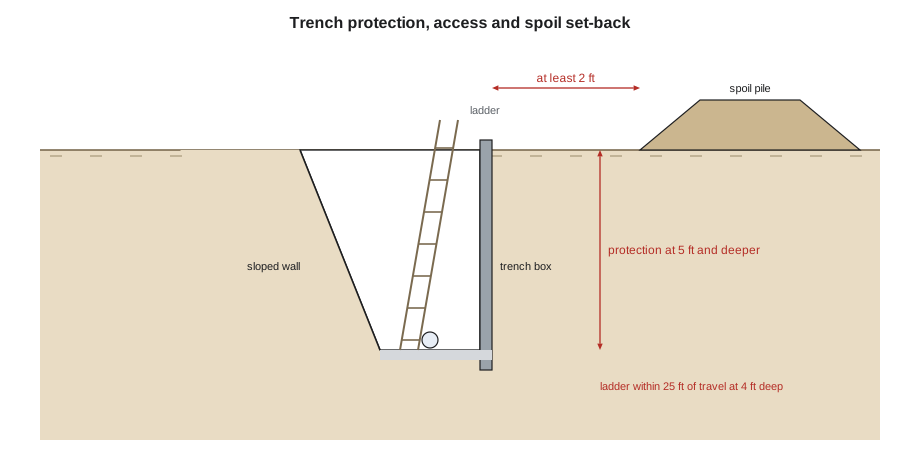
Excavated soil and equipment must be kept at least 2 ft back from the edge of a trench, so that their weight does not collapse the wall and so that nothing falls in. A trench wall that looks solid can fail without warning, especially after rain or near vibrating equipment, and a cubic yard of soil weighs well over a ton.
Silica and lead are the two health hazards most specific to plumbing. Cutting and grinding concrete or masonry releases crystalline silica, which is controlled with water, vacuum dust collection and respirators. Old lead joints, lead service lines and lead-based solder release lead when they are heated or cut, which is controlled by avoiding heat, wet methods, hygiene and testing. Asbestos may be present in old pipe insulation and must not be disturbed until it has been assessed.
Trench geometry
Sloping a trench back is often cheaper than shoring it, but it takes more room. For a soil that requires a slope of one horizontal to one vertical from the bottom, a trench 7 ft deep and 3 ft wide at the bottom needs a top width of 3 plus 2 times 7, or 17 ft, before the spoil set-back on each side. On a narrow lot, that may not fit, and a trench box becomes the practical choice.
# Trench check: is protection required, and how wide is a sloped trench?
trigger_ft, ladder_ft, setback_ft = 5, 4, 2          # OSHA construction rules
for depth, bottom, slope in ((3.5, 2, 1.0), (7, 3, 1.0), (10, 3, 1.5)):
    need = depth >= trigger_ft
    ladder = depth >= ladder_ft
    top = bottom + 2 * slope * depth                  # slope = horizontal per vertical
    footprint = top + 2 * setback_ft
    print(f"Depth {depth:4.1f} ft: protection {'required' if need else 'not required by depth'}, "
f"ladder {'required' if ladder else 'not required'}; sloped top {top:.0f} ft, footprint {footprint:.0f} ft")Depth 3.5 ft: protection not required by depth, ladder not required; sloped top 9 ft, footprint 13 ft Depth 7.0 ft: protection required, ladder required; sloped top 17 ft, footprint 21 ft Depth 10.0 ft: protection required, ladder required; sloped top 33 ft, footprint 37 ft
The program shows how quickly a sloped trench grows: doubling the depth more than doubles the width at the top. Slope ratios depend on the soil type, which a competent person classifies; the program takes the ratio as an input rather than assuming one.
Joining methods
Pipe preparation questions ask which joint suits which material and service, what the steps are, and what goes wrong. The table below summarizes the common joints.
| Joint | Materials | Key points |
|---|---|---|
| Soldered (soft) | Copper water tube | Lead-free solder for potable water; flux, clean and heat the fitting, not the solder; below about 840 °F |
| Brazed (hard) | Copper, especially medical gas and refrigeration | Filler above about 840 °F; nitrogen purge inside medical gas piping to prevent oxide scale |
| Press | Copper, stainless, some steel | Correct jaw and profile; insertion depth marked; no heat, so no hot work permit |
| Threaded | Steel and brass | Tapered pipe threads, 1 in 16 taper; sealant on male threads only; a few threads visible after make-up |
| Grooved mechanical | Steel, larger copper | Roll or cut groove; gasket lubricated; coupling sized and rated |
| Solvent cement | PVC, ABS, CPVC | Primer where required, correct cement for the material, full insertion, a quarter turn, cure time before test |
| Crimp, clamp or expansion | PEX | Manufacturer's system and tools; go/no-go gauge for crimp rings |
| No-hub coupling | Cast iron soil pipe | Stainless band and neoprene gasket; torque to the rating with a torque wrench |
| Heat fusion | Polyethylene, polypropylene | Clean, aligned, correct temperature and time; joint as strong as the pipe |
Joining questions often hinge on a detail that ruins a joint: using the wrong cement on ABS, not reaming copper after cutting, overheating a soldered joint so the flux burns, threading sealant onto the female threads where it is pushed into the pipe, or under-inserting a press fitting. A useful study method is to write, for each joint, the one thing that most often goes wrong.
Testing drainage and water systems
Every new drainage and venting system is tested before it is concealed. The usual test is a water test: plug the openings and fill the system to a head of at least 10 ft above the highest joint in the section being tested, and hold it for at least 15 minutes with no drop in level and no leaks. An air test, at 5 psi for the same time, is allowed for some materials and is useful where water would freeze, but many plastic pipe manufacturers prohibit air testing because of the stored energy in compressed air. A final test, such as a smoke or peppermint test, may be required after fixtures are set.
Water supply systems are tested with water at not less than the working pressure, and not less than 100 psi in the IPC, for at least 15 minutes, or by air at a pressure set by the code where the pipe manufacturer permits it. Air testing of plastic water piping is generally not permitted. The exam asks which test, at what pressure and for how long, and what happens if the system fails: find the leak, repair it and repeat the full test.
Worked problem
Head on a tall test section
A drainage stack is tested in one section from the basement to the third floor, 33 ft high, filled to the top. What pressure do the joints at the bottom see? Is this test acceptable?
Show solution
- \[P = 33 \times 0.433 \approx 14.3\ \text{psi at the lowest joint}\]
- \[\text{head at the highest joint} = 0\ \text{ft} < 10\ \text{ft} \to \text{the top joints are not tested to the minimum}\]
Answer: The bottom joints see about 14.3 psi, far more than they need, and the top joints see almost nothing. The fix is to extend the test pipe at least 10 ft above the top of the section, or to test the stack in shorter sections so that every joint sees at least 10 ft of head and none sees an unreasonable pressure.
Support, protection and penetrations
Pipe must be supported at intervals that depend on the material, the size and whether the pipe is horizontal or vertical. Plastic pipe needs much closer supports than steel, and hot plastic pipe needs closer supports still. The exam usually gives the table and asks for a spacing or the number of hangers in a run; the trap is counting the hangers, since a run of a given length needs one more hanger than the number of spaces, unless the ends are supported by something else.
Pipes in framed walls need protection from nails and screws where they are close to the face of a stud or joist, commonly with steel plates. Pipes through fire separations need a listed firestop system that matches the pipe material and size, because plastic pipe burns away and leaves an open hole. Holes and notches in structural members are limited by the building code, and cutting a joist to fit a drain is a structural problem, not a plumbing shortcut. Pipes in exterior walls or unheated spaces need protection from freezing.
Drawings and communication
Plan-reading questions are the largest share of the F25. They give a plan, an isometric or a schedule and ask for a size, a count or a load. A scale of 1/4 in = 1 ft means a measured 3-1/2 in on the drawing is 14 ft in the building. Isometric drawings show pipe in three directions at 30 degrees, and their dimensions are along the pipe, not across the page.
Symbols for valves, fittings, fixtures and devices follow common conventions, but drawings always have a legend, and the legend wins. Specifications tell what materials and methods to use; drawings tell where things go. When they disagree, the contract decides which governs, and the plumber's job is to raise the conflict with the supervisor or designer before installing, not to choose.
Tools, ladders and protective equipment
Tool questions test safe use more than names. Power threading machines need a foot switch and a support for long pipe, and loose clothing and gloves near the rotating chuck are a classic cause of injury. Powder-actuated tools need training and the right load for the material, and must never be fired into hard or brittle material where the fastener can ricochet. Grinders need the guard in place and a wheel rated for the speed of the tool. Press tools and battery tools are quieter and need no flame, but their jaws can trap fingers, and their batteries can start fires if damaged.
Ladders follow a few rules that appear in almost every safety review. Set an extension ladder at a slope of about one horizontal for every four vertical, extend it about 3 ft above the landing, tie it off, and keep three points of contact when climbing. Never stand on the top two rungs of a stepladder, and never use a metal ladder near live electrical equipment.
Personal protective equipment is the last line of defense, after eliminating the hazard, substituting something safer, engineering controls and safe work procedures. That order, the hierarchy of controls, is itself a favorite exam question. Hearing protection is needed around cutting, grinding and powder tools; eye protection is needed for almost every task, and a face shield as well for grinding and for opening a pressurized or blocked drain; respirators need a fit test and the right cartridge for the hazard. Gloves protect hands from cuts and chemicals but must not be worn near rotating machinery where they can be caught.
Maya added one line to her summary page for each tool she had used in four years, with the single most important safety point for it. The page had forty lines. Writing it took an evening, and it turned a dozen easy marks from luck into certainty.
Common mistakes
MistakeEntering a trench 5 ft deep or more without a protective system because the soil looks firm.
InsteadTrench walls fail without warning; slope, shore or use a box as the rules require.
MistakeAir testing plastic drainage or water pipe that the manufacturer says must be water tested.
InsteadUse the test the code and the manufacturer allow; compressed air stores dangerous energy.
MistakeTesting a tall stack in one section.
InsteadTest in sections so that every joint sees at least 10 ft of head.
MistakeCounting spaces instead of hangers.
InsteadA run needs one more support than the number of spaces, unless its ends are supported.
MistakeChoosing between a drawing and a specification yourself when they disagree.
InsteadRaise the conflict with the supervisor or designer before installing.
Summary and key terms
- OSHA construction rules require fall protection at 6 ft, trench protection at 5 ft and deeper, a ladder at 4 ft, and a 2 ft spoil set-back; Hazard Communication covers chemicals.
- Confined spaces need assessment, a plan, testing, an attendant and rescue arrangements; hazardous energy needs lockout and verification.
- Each joining method has a short list of steps and one common failure worth knowing.
- Drainage systems are tested with at least 10 ft of head for 15 minutes, or air at 5 psi where permitted; water supply at working pressure, not less than 100 psi, for 15 minutes.
- Supports depend on material, size and orientation; firestops must be listed for the pipe.
- Read the legend, the scale and the specifications; raise conflicts rather than resolving them yourself.
- Competent person
- A person trained and authorized to identify hazards and correct them on site.
- Spoil set-back
- The minimum distance between excavated soil and the edge of a trench.
- Lockout
- Isolating and locking an energy source so equipment cannot start during work.
- Head
- The height of a water column, which sets the pressure it applies.
- Firestop system
- A listed assembly that restores the fire rating where a pipe passes through a fire separation.
Practice problems
Work each problem on paper first, then reveal the answer to check.
At what depth does a trench need a protective system under OSHA?
Show answer
At 5 ft or more, unless it is in stable rock.
What is the minimum head for a drainage water test?
Show answer
At least 10 ft above the highest joint in the section, for at least 15 minutes.
A 40 ft run needs supports every 4 ft. How many hangers, if neither end is otherwise supported?
Show answer
11, because 10 spaces need 11 supports.
On a 1/4 in = 1 ft drawing, a pipe measures 5-1/4 in. How long is it?
Show answer
21 ft.
Which solder is required on potable water piping?
Show answer
Lead-free solder.
Lesson quiz · 5 questions
Score 60% or more to complete this lesson.
Create a free account to save your progress, take quizzes and earn a certificate.