
PLB-310 · Lesson 6 of 12 · 21 min
Piping layouts: series loops, zoning and primary-secondary
Maya's question from the first day, why the Kingsway boilers had their own pumps and why the risers connected through a pair of tees a few centimeters apart, finally got its answer in this part of the course. Luis drew the system on the back of a submittal sheet. "There are only a handful of ways to pipe a hydronic system," he said. "Each one solves a problem the simpler ones cannot. Once you know the problem each layout solves, you can read any boiler room." This lesson works through the main piping layouts, from the simplest series loop to primary-secondary systems and hydraulic separators.
The series loop
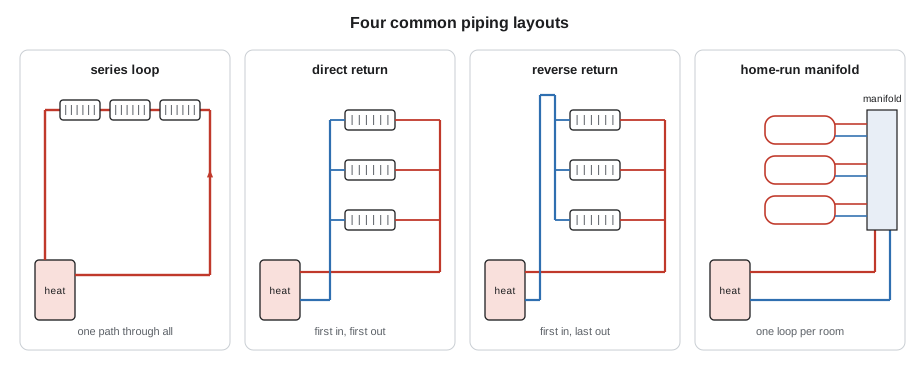
The simplest system is a single series loop: the water leaves the boiler, passes through every emitter in turn and returns. It needs one circulator, little pipe and no balancing. Its weaknesses are just as simple. Every emitter must share one thermostat, so the whole house is one zone. The water cools as it passes each emitter, so the last one in the loop gets the coolest water and needs to be larger to give the same output. And if one emitter is isolated for service, the whole loop stops.
A series loop of baseboard in a small house can work well if it is short and the emitters near the end are lengthened. In a loop with a 20 °F drop, the average water temperature in the last emitter may be 15 °F cooler than in the first, enough to reduce its output by roughly a quarter.
One-pipe diverter-tee systems, common in older houses, improve on the series loop. A single main runs around the building, and each emitter connects to it with a supply and return branch; a special diverter tee on one branch creates enough resistance in the main to push part of the flow through the emitter. Each emitter can then be shut off or controlled without stopping the others, but the water in the main still cools as it passes each emitter, so the later ones still see cooler water.
Two-pipe systems
In a two-pipe system, a supply main feeds every emitter and a separate return main collects from every emitter. Each emitter gets water at nearly the supply temperature, so all can be sized the same way. In a direct-return arrangement, the first emitter supplied is also the first returned, so it has the shortest circuit and gets the most flow, while the last emitter has the longest circuit and the least. Balancing valves are needed to even out the flows. In a reverse-return arrangement, the first emitter supplied is the last returned, so every circuit has about the same length and the flows balance themselves, at the cost of more return pipe. Kingsway's suite risers use reverse return for exactly that reason.
A modern variation is the home-run manifold system. A supply and return manifold sit near the heat source, and each emitter or radiant floor loop gets its own pair of small tubes running all the way back to the manifold. Each circuit can be valved, balanced and controlled individually at the manifold. Radiant floors are almost always piped this way, and many panel radiator systems are too, using flexible PEX tubing.
Zoning
A zone is an area controlled by its own thermostat. Zoning lets bedrooms run cooler than living areas, keeps a sunny room from overheating, and saves energy by heating only what needs heat. There are two main ways to zone a hydronic system: with zone valves or with zone circulators.
With zone valves, one circulator serves all zones and a motorized valve on each zone opens when its thermostat calls. An end switch on each valve starts the circulator and the heat source when any valve opens. When only one small zone is open, the circulator's head rises and can push water too fast through that zone, causing velocity noise. The old cure was a differential pressure bypass valve between supply and return. The modern cure is an ECM circulator in constant or proportional pressure mode, which slows down automatically as valves close.
With zone circulators, each zone has its own small circulator with a flow check, controlled by a relay panel. Each zone gets its own pump curve and a failure affects only one zone. Zone circulators use more electricity than a single variable-speed pump with zone valves, which is why zone valves with an ECM circulator have become more common, but both approaches work well when designed properly.
Thermostatic radiator valves (TRVs) are a third approach, common on panel radiators. A TRV is a self-acting valve with a sensing head that throttles flow as the room warms, turning each radiator into its own zone without wiring. A system with TRVs needs a variable-speed circulator in proportional pressure mode or a bypass so that flow and pressure stay reasonable as valves close.
Primary-secondary piping
Many modern heat sources and systems have conflicting flow needs. A low-mass condensing boiler needs a steady minimum flow through its heat exchanger, but the zones may want anything from zero to full flow as valves open and close. A large building may have several boilers and several groups of loads, each with different flow rates and temperatures. Primary-secondary piping solves these conflicts by making the circuits hydraulically independent.
The key is a pair of closely spaced tees: two tees on the primary loop, no more than four pipe diameters apart and commonly within about 12 in, with the secondary circuit's supply and return connected to them. Because the short pipe between the tees has almost no pressure drop, the primary circulator cannot push water into the secondary circuit, and the secondary circulator cannot push water into the primary loop. Each circulator moves only its own circuit's water. Heat moves between them because the water mixes in the common pipe between the tees.
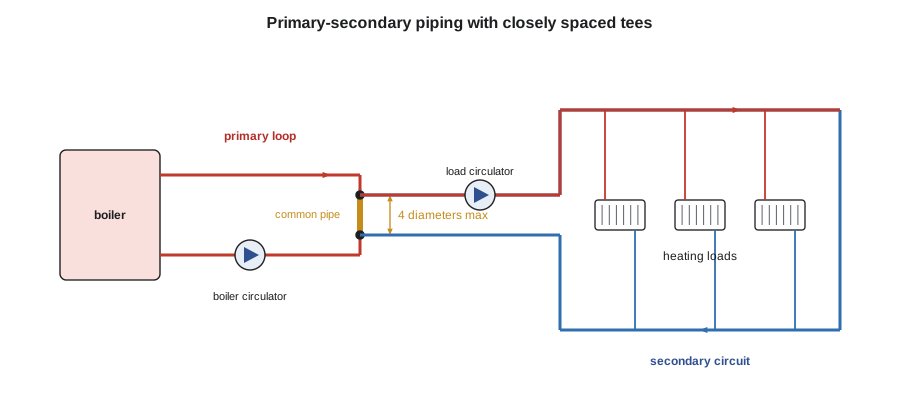
The common pipe between the tees can carry flow in either direction, depending on which circuit moves more water. If the primary flow is larger than the secondary flow, the extra primary water passes through the common pipe from supply tee to return tee, and the secondary circuit gets water at the full primary supply temperature. If the secondary flow is larger, some secondary return water passes backward through the common pipe and mixes with the primary supply, so the secondary circuit gets water cooler than the primary supply. Designers use that mixing deliberately to lower temperatures; the mixing equation predicts the result.
Worked problem
Mixing at the Kingsway tees
On a cold day, the Kingsway boiler loop delivers 143 gpm at 158 °F. The secondary riser circuit is moving 174 gpm and its return water is at 126 °F. What temperature reaches the risers?
Show solution
- The secondary circuit moves 31 gpm more than the primary, so 31 gpm of 126 °F return water flows backward through the common pipe.
- The riser supply is a mix of 143 gpm at 158 °F and 31 gpm at 126 °F.
- T = (143 × 158 + 31 × 126) ÷ (143 + 31) = (22,594 + 3,906) ÷ 174 = 152.3 °F.
Answer: The risers get about 152 °F water. If the riser pumps slow down to below 143 gpm, the mixing stops and the risers get the full 158 °F, while the extra boiler water returns directly to the boilers, raising their return temperature and reducing condensing.
# Temperature delivered to a secondary circuit through closely spaced tees
def secondary_supply(prim_flow, prim_t, sec_flow, sec_return_t):
    if sec_flow <= prim_flow:                  # surplus primary water bypasses back to the boilers
        boiler_return = (sec_flow * sec_return_t + (prim_flow - sec_flow) * prim_t) / prim_flow
        return prim_t, boiler_return
    back = sec_flow - prim_flow                # secondary return flows backward and mixes
    return (prim_flow * prim_t + back * sec_return_t) / sec_flow, sec_return_t

for sec in (95, 143, 174, 206):
    supply, ret = secondary_supply(143, 158.0, sec, 126.0)
print(f"secondary {sec:3d} gpm: riser supply {supply:5.1f} F, boiler return {ret:5.1f} F")secondary 95 gpm: riser supply 158.0 F, boiler return 136.7 F secondary 143 gpm: riser supply 158.0 F, boiler return 126.0 F secondary 174 gpm: riser supply 152.3 F, boiler return 126.0 F secondary 206 gpm: riser supply 148.2 F, boiler return 126.0 F
The script shows the trade-off clearly. When the boiler loop moves more water than the load needs, the surplus hot water short-circuits back to the boilers and raises their return temperature, which hurts condensing. When the loads move more water than the boilers, the supply to the loads is diluted. Good plants keep the primary flow close to, or slightly below, the secondary flow, which variable-speed boiler pumps controlled by temperature make possible.
Hydraulic separators and buffer tanks
A hydraulic separator, sometimes called a low-loss header, does the same job as closely spaced tees in a single fitting. It is a vertical chamber with the primary connections on one side and the secondary connections on the other. The water slows down inside it, so the circuits stay independent, and the low velocity lets air rise to a vent at the top and dirt settle to a drain at the bottom, often helped by a magnet. A buffer tank piped with four connections works the same way while also adding volume, which is why the bungalow's hybrid system uses one between the heat pump and boiler on one side and the radiators on the other.
Multiple boilers are usually piped in parallel on a primary header, each with its own circulator or isolation valve, so any boiler can be shut off while the others keep running. A boiler controller stages and rotates the boilers to match the load and spread the running hours.
Mixing for low-temperature zones
A radiant floor may need water at 95 °F while baseboard on the same system needs 160 °F. A mixing device lowers the temperature for the low-temperature zone. A thermostatic mixing valve blends hot supply water with cool return water to a set temperature. A motorized mixing valve or a variable-speed injection pump, controlled by an outdoor reset controller, adjusts the mix continuously. Both protect the floor from water that is too hot and, with non-condensing boilers, protect the boiler from return water that is too cold.
At Kingsway, the lobby and café radiant slabs are served by an injection mixing station on the secondary loop: a small variable-speed pump injects hot water from the risers into the slab loop through closely spaced tees, sped up or slowed down to hold the slab supply at its target temperature.
Piping the bungalow's hybrid system
Grace's drawing for the bungalow put the four-port buffer tank at the center. The heat pump's circulator moves water between the outdoor unit and two connections on one side of the tank. The boiler connects to the same side through its own circulator and a motorized valve that opens only when the boiler is called. On the other side, a single ECM circulator in proportional pressure mode sends water to the radiators through a pair of small supply and return manifolds, with a thermostatic radiator valve on each radiator so every room controls itself.
The indirect water heater is piped as a priority zone from the boiler, upstream of the buffer tank connections, so that domestic hot water can be heated at a higher temperature without warming the whole buffer. A controller decides which heat source runs: the heat pump whenever it can meet the load, and the boiler below the changeover temperature or when the heat pump cannot keep the buffer at its target.
Luis looked over the drawing when Maya brought it back to the shop. He pointed to the buffer tank's four connections and asked her which circulator could push water into the other circuit. Maya answered that neither could, because the tank's large volume and low velocity made the pressure drop between its connections almost zero, just like closely spaced tees. "Then you understand primary-secondary," he said. "Everything else in a plant room is detail."
Common mistakes
MistakeExpecting the last emitter on a series loop to give full output.
InsteadAllow for the cooler water at the end of a series loop by enlarging the last emitters.
MistakeSpacing closely spaced tees too far apart.
InsteadKeep them within four pipe diameters so the circuits stay independent.
MistakeRunning the primary flow much higher than the secondary flow with a condensing boiler.
InsteadMatch the primary flow to the load to keep the boiler return cool.
MistakeZoning with valves but a fixed-speed circulator and no bypass.
InsteadUse an ECM circulator in constant or proportional pressure mode, or a differential bypass.
MistakeSending boiler-temperature water directly to a radiant floor.
InsteadUse a mixing device to supply the floor at its design temperature.
Summary and key terms
- Series loops are simple but give one zone and cooler water at the last emitter.
- Two-pipe direct return needs balancing; reverse return balances itself with more pipe; home-run manifolds give each circuit its own control.
- Zones use zone valves with one circulator, zone circulators, or thermostatic radiator valves.
- Closely spaced tees make circuits hydraulically independent; the common pipe carries the difference in flow.
- The mixing equation predicts the temperature when flows combine.
- Hydraulic separators and four-port buffer tanks separate circuits and remove air and dirt.
- Mixing devices supply low-temperature zones such as radiant floors.
- Series loop
- A layout in which water passes through each emitter in turn.
- Reverse return
- A two-pipe layout in which the first emitter supplied is the last returned, equalizing circuit lengths.
- Zone
- An area controlled by its own thermostat.
- Zone valve
- A motorized valve that opens a zone circuit when its thermostat calls for heat.
- Closely spaced tees
- Two tees on a primary loop, a few pipe diameters apart, used to connect a secondary circuit independently.
- Hydraulic separator
- A chamber that decouples primary and secondary circuits and helps remove air and dirt.
- Thermostatic radiator valve
- A self-acting valve that throttles a radiator's flow according to room temperature.
Practice problems
Work each problem on paper first, then reveal the answer to check.
Why does the last emitter on a series loop need to be larger?
Show answer
It receives the coolest water.
How far apart can closely spaced tees be?
Show answer
No more than four pipe diameters.
Primary: 80 gpm at 165 °F. Secondary: 96 gpm returning at 130 °F. What is the secondary supply temperature?
Show answer
(80 × 165 + 16 × 130) ÷ 96 ≈ 159.2 °F.
What controls flow noise in a zone valve system with one small zone open?
Show answer
An ECM circulator in constant or proportional pressure mode, or a differential bypass valve.
Why does Kingsway use reverse return on its suite risers?
Show answer
Every circuit has about the same length, so flows balance themselves.
Name two jobs a hydraulic separator does besides decoupling circuits.
Show answer
Removing air and separating dirt.
Lesson quiz · 5 questions
Score 60% or more to complete this lesson.
Create a free account to save your progress, take quizzes and earn a certificate.