
PLB-310 · Lesson 12 of 12 · 23 min
Service and troubleshooting hydronic systems
In the first cold week of January, Maya's phone lit up with three service calls before eight in the morning. A tenant at Kingsway had no heat. The owners of the bungalow reported a dripping pipe beside the boiler. And a homeowner across town said her radiators were banging so loudly that her children were awake at night. Grace handed Maya the keys to the van. "You know how these systems are built," she said. "Now you get to find out how they fail. Start with the readings, not with the parts catalog." This lesson brings the whole course together into a method for servicing and troubleshooting hydronic systems.
A method for troubleshooting
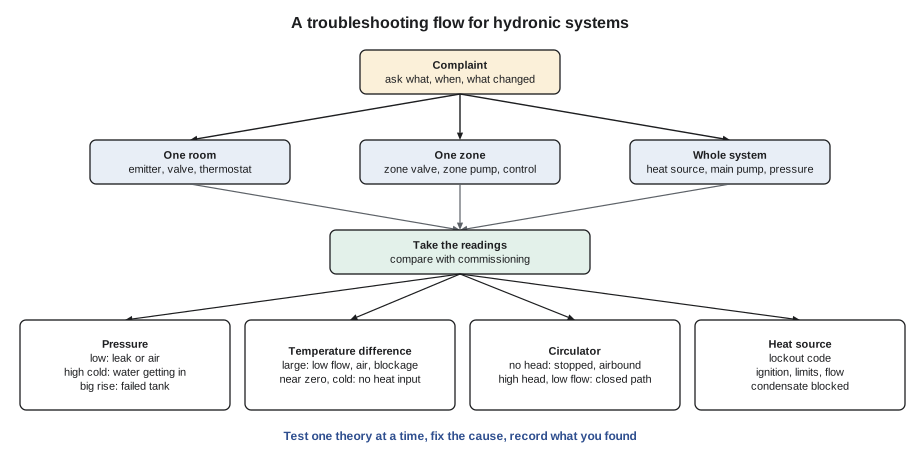
Good troubleshooting is a process of elimination that starts with facts. Before touching a tool, Maya asks the occupant what happened, when it started, whether anything changed recently, and whether the problem affects one room, one zone or the whole building. A problem in one room points to that room's emitter, valve or thermostat. A problem in a whole zone points to the zone valve, zone circulator or its control. A problem everywhere points to the heat source, the main circulator, the system pressure or the controller.
Next come the readings. Most hydronic faults show up in four numbers: the system pressure cold and hot, the supply and return temperatures, the pressure difference across the circulator, and the heat source's status or fault code. Comparing these with the commissioning sheet from Lesson 11 shows what has changed. Only then does Maya form a theory, test it with one more reading or a simple action, and fix the cause rather than the symptom.
| Reading | Normal | What an abnormal reading suggests |
|---|---|---|
| Cold system pressure | At the commissioned fill pressure | Low: leak or air loss. High: fill valve passing, coil leak in a water heater |
| Rise from cold to hot | Small, as set by the tank sizing | Large: waterlogged or undersized expansion tank |
| Supply-return ΔT | Near design at full load | Large: low flow. Near zero with cold rooms: no heat input |
| Circulator pressure difference | On its expected curve | Near zero: pump stopped, airbound or impeller failed |
| Heat source status | Running or waiting, no fault | Lockout code points to ignition, flow, limits or condensate |
No heat
At Kingsway, the no-heat complaint was a single suite on the eleventh floor of the north riser. Every other suite on the riser was warm, so the boilers, main circulators and riser were working. The suite's fan coil had power and its fan ran, but the coil was cold. The thermostat was calling, and the control valve actuator showed open. Maya put a surface thermometer on the coil supply and return: both were at room temperature. Water was not getting through.
She closed the suite's isolation valves, opened the strainer on the coil supply and found it packed with black magnetite and a fragment of pipe sealant. Cleaning the strainer and venting the coil restored flow, and the coil warmed in minutes. The real cause was dirty system water, so she noted it for the property manager and recommended a water test and a check of the plant's dirt separator.
In homes, no-heat calls follow the same order. Check that the thermostat is calling and has batteries or power. Check the service switch and any breakers. Look at the heat source's display for a fault or lockout code. Feel or measure the supply pipe: if it is hot at the heat source but cold at the emitters, the problem is flow; if it is cold at the heat source, the problem is the heat source or its control. Check whether the circulator is running and whether the zone valve's end switch has closed.
Low flow and air
A large temperature difference with cold emitters is the signature of low flow: the little water that gets through gives up all its heat before it returns. Common causes are air trapped at a high point, a closed or partly closed valve, a blocked strainer, a failed zone valve that does not open fully, and a circulator running at too low a speed or not at all. Air is the most common, especially after a system has been drained or topped up.
Air announces itself with gurgling, cold tops on radiators, and a circulator that hums but moves little water. Bleeding the high-point vents and purging the zone, as in commissioning, usually cures it. If air keeps coming back, the cause is a leak or low system pressure that lets air in at the high points, a failed air separator, or an automatic air vent that has stuck. Topping up again without finding the reason only delays the next call.
A circulator's pressure difference tells whether it is moving water. Many variable-speed circulators display their estimated flow and head directly; on others, gauges on either side of the pump, read as in Lesson 5, give the head. A running pump with almost no pressure difference is airbound or has a broken impeller. A pump showing a high head with little flow is pushing against a closed or blocked path.
Pressure problems and a dripping relief valve
At the bungalow, the dripping pipe was the boiler's relief valve discharge. Maya checked the gauge: cold, the system sat at 22 psi, well above its commissioned 15 psi, and as the boiler fired it climbed to the 30 psi relief setting and the valve opened. That pattern, high pressure even when cold, pointed to water entering the system from somewhere.
Two sources can push water in. A fill valve that passes water when it should be shut lets the higher city pressure creep in. An indirect water heater with a leaking coil lets domestic water, at higher pressure, leak into the boiler loop. Maya closed the isolation valve before the fill valve and watched the pressure for an hour: it stayed steady, so the fill valve was the culprit. She replaced it, drained the system back to 15 psi cold, and checked the expansion tank's precharge to be sure it had not been damaged. The relief valve stopped dripping.
The other common cause of a dripping relief valve is a failed expansion tank. When the tank's membrane fails or the precharge leaks away, the tank fills with water and can no longer absorb expansion, so the pressure climbs steeply each time the system heats. Tapping the tank tells part of the story: a healthy tank sounds hollow at the top. The proper test is to isolate the tank, drain its water side and check the air precharge with a tire gauge. A tank that shows water at its air valve has a failed membrane and must be replaced.
A relief valve that has opened many times may not reseat cleanly and can keep weeping even after the cause is fixed. It is replaced, never plugged, capped or turned down. Every relief valve discharge pipe stays full size, open and ends where hot water can be seen without harming anyone.
Worked problem
Diagnosing from the readings
A boiler loop reads 23 psi cold and climbs to 30 psi hot. The commissioned fill was 15 psi and the commissioned rise was 5 psi. The supply is 160 °F and the return 140 °F. What do the readings say?
Show solution
- Cold pressure is 8 psi above the commissioned fill: water is entering the system, from a passing fill valve or a leaking water heater coil.
- The rise from cold to hot is 7 psi against a commissioned 5 psi: the expansion tank is partly waterlogged, or its precharge no longer matches the higher fill.
- A ΔT of 20 °F is normal: flow and heat output are fine.
Answer: Find the water source first, then reset the fill pressure and check the tank precharge.
# Rule-based hydronic diagnosis from service readings
def diagnose(p_cold, p_hot, t_supply, t_return, pump_dp, fill=15, rise=5, design_dt=20):
    notes = []
    if p_cold < fill - 3:
        notes.append("low cold pressure: look for a leak, then refill and purge")
    if p_cold > fill + 3:
        notes.append("high cold pressure: fill valve passing or water heater coil leaking")
    if p_hot - p_cold > rise * 1.3:
        notes.append("large pressure rise: check expansion tank precharge and membrane")
    if pump_dp < 2:
        notes.append("almost no pump head: circulator stopped, airbound or impeller failed")
    dt = t_supply - t_return
    if dt > design_dt * 2:
        notes.append(f"dT {dt:.0f} F is high: low flow from air, a closed valve or a blocked strainer")
    if dt < 4 and t_supply < 95:
        notes.append("no heat input: check the heat source status and its controls")
    return notes or ["readings normal"]

calls = {"bungalow relief": (23, 30, 160, 140, 10),
         "airbound zone":   (15, 19, 160, 100, 1),
         "no heat":         (15, 16, 75, 73, 10)}
for name, r in calls.items():
    print(name + ":")
    for n in diagnose(*r):
print(" -", n)bungalow relief: - high cold pressure: fill valve passing or water heater coil leaking - large pressure rise: check expansion tank precharge and membrane airbound zone: - almost no pump head: circulator stopped, airbound or impeller failed - dT 60 F is high: low flow from air, a closed valve or a blocked strainer no heat: - no heat input: check the heat source status and its controls
A short script like this is no substitute for judgment, but it shows how the readings combine. Each rule ties one measurement to a short list of causes, and several readings together usually point to one answer.
Noise
The banging radiators across town turned out to be an old system, converted from steam to hot water decades ago, with steel mains and newer copper branches. Banging that comes as the system heats up and cools down is usually expansion: a pipe that is clamped too tightly or that rubs against a joist or a sleeve as it lengthens. Maya found a long copper branch pinned under a floor joist with no room to move. Loosening the strap and fitting a plastic isolator ended the noise.
Other noises have their own causes. Gurgling and trickling mean air. A steady whoosh or whistle means excess velocity, often in an unbalanced near branch or with the circulator speed set too high. A rumbling or kettling sound from the boiler, like a kettle about to boil, means local boiling on the heat exchanger surface, usually from scale or low flow, and needs attention quickly because it damages the exchanger. A grinding or rattling circulator has worn bearings or debris in its impeller. Clicking from a zone valve or relay is normal; a buzzing transformer or a humming zone valve motor that never finishes its stroke is not.
Condensate, frozen lines and heat pump faults
Condensing boilers drain their condensate through a trap and a line to a drain or condensate pump, often through a neutralizer. If the line freezes or clogs, condensate backs up into the boiler and a sensor shuts it down. In cold snaps, the most common cause is a condensate line run outdoors or through an unheated space, or an exhaust that drips condensate back into a frozen termination. Maya's fix is to reroute the line inside, keep it sloped, and add a heat trace where an exposed section is unavoidable. The neutralizer's media also wears out and is replaced on a schedule.
Heat pumps bring their own service calls. A heat pump that shows a low flow fault may have a blocked strainer, air in its water circuit or a circulator problem, the same causes as any low flow fault. An outdoor unit that is heavily iced may have a failed defrost sensor or be sitting in snow with its drain blocked. A loss of capacity in very cold weather may simply be the design working as intended, with the hybrid controller bringing in the boiler. Any work on the sealed refrigerant circuit itself is done only by a technician certified for refrigerants, as Lesson 4 explained.
Preventive maintenance
Most emergency calls are avoidable. A yearly maintenance visit catches problems before they leave someone without heat. Grace's maintenance checklist covers the heat source's combustion or refrigerant readings, as the appropriate technician requires, a check of the system pressure cold, the expansion tank precharge, the relief valve's condition and discharge, a cleaning of strainers, dirt separators and the condensate trap, a water quality test, a review of the reset curve and controller logs, and a check of every circulator's speed and sound.
At Kingsway, the maintenance contract also includes quarterly checks of the boilers' low-water cutoffs and limits, a yearly inspection under the boiler regulations, and a review of the building automation logs for zones that run constantly or alarms that repeat. Each visit is recorded against the commissioning baseline, so slow changes, such as a pressure that drops a little each month, are noticed long before they become failures.
Finally, service work has the same safety rules as installation. System water can be hot enough to scald and the system is under pressure, so it is isolated, cooled and relieved before opening. Power is locked out. Gas appliances are checked with a combustion analyzer for carbon monoxide after any work on the burner, by a technician licensed for gas work. Maya leaves every system as it was commissioned or better, and writes down what she found and what she did.
Common mistakes
MistakeReplacing parts before taking readings.
InsteadNarrow the scope, take pressure, temperature and pump readings, then test one theory.
MistakeTopping up a system that keeps losing pressure.
InsteadFind and fix the leak or air entry before refilling.
MistakePlugging or capping a dripping relief valve.
InsteadFind the cause of the high pressure and replace a worn valve.
MistakeChecking an expansion tank only by tapping it.
InsteadIsolate it, drain the water side and measure the precharge.
MistakeIgnoring a kettling boiler.
InsteadCheck flow and scale at once; local boiling damages the exchanger.
Summary and key terms
- Narrow the problem to one room, one zone or the whole system before testing parts.
- Pressure cold and hot, supply-return ΔT, pump head and fault codes reveal most faults.
- A large ΔT with cold emitters means low flow; air is the most common cause.
- High cold pressure means water is getting in; a large rise on heating means a failed tank.
- Noises point to expansion, air, velocity, kettling or worn circulators.
- Frozen or blocked condensate lines shut down condensing boilers; reroute and protect them.
- Yearly maintenance against the commissioning baseline prevents most emergency calls.
- Lockout
- A safety shutdown of a heat source that requires a reset after a fault.
- Airbound
- A condition in which trapped air stops a circulator or circuit from moving water.
- Kettling
- A rumbling noise from local boiling on a heat exchanger, usually from scale or low flow.
- Waterlogged tank
- An expansion tank that has lost its air cushion and can no longer absorb expansion.
- Passing valve
- A valve that lets water through when it should be fully shut.
- Neutralizer
- A cartridge of alkaline media that raises the pH of condensate before it drains.
- Commissioning baseline
- The readings recorded at start-up, used to compare later service readings.
Practice problems
Work each problem on paper first, then reveal the answer to check.
The supply is 170 °F and the return 105 °F on a system designed for 20 °F. What is likely wrong?
Show answer
Low flow, from air, a closed valve, a blocked strainer or a weak circulator.
A system sits at 25 psi cold with a commissioned fill of 16 psi. What two sources are likely?
Show answer
A passing fill valve or a leaking water heater coil.
How is an expansion tank's precharge checked properly?
Show answer
Isolate the tank, drain its water side and read the air valve with a tire gauge.
What does kettling indicate?
Show answer
Local boiling on the heat exchanger, usually from scale or low flow.
Why do condensing boilers lock out in cold snaps?
Show answer
Frozen or blocked condensate lines back condensate into the boiler.
What should every service reading be compared with?
Show answer
The commissioning baseline.
Lesson quiz · 5 questions
Score 60% or more to complete this lesson.
Create a free account to save your progress, take quizzes and earn a certificate.