
PLB-310 · Lesson 3 of 12 · 20 min
Boilers: types, efficiency, condensing and venting
The old boiler in the bungalow's basement was a cast iron sectional unit with a standing pilot, installed when the house was converted from oil in the 1980s. Its rating plate showed 140,000 Btu/h of input. Grace tapped the flue pipe. "This one throws a third of the heat up the chimney," she said. "The replacement will be a condensing boiler, and it will only condense if we design the whole system to send it cool water. That is the most important thing to understand about modern boilers."
A boiler is the most common heat source in a hydronic system. It burns fuel, usually natural gas or propane, sometimes oil, or uses electric elements, and transfers the heat to water passing through its heat exchanger. This lesson describes the main types of boilers, how their efficiency is rated, how condensing boilers recover extra heat, the safety controls every boiler needs, and how boilers are vented and connected.
Types of boilers
Cast iron sectional boilers are the traditional design: heavy iron sections bolted together, holding a lot of water, with a burner underneath. They are durable and tolerant of dirty water and poor piping, but they cannot be allowed to condense, because the acidic condensate attacks the iron. They must be kept above a minimum return water temperature, which limits how low the system can run.
Steel firetube boilers pass hot combustion gases through tubes surrounded by water and are common in larger commercial buildings. Copper finned-tube boilers have a light copper heat exchanger with little water content; they heat up fast but need a guaranteed minimum flow through the exchanger and also must not condense.
Condensing boilers, often called mod-cons because they modulate and condense, use stainless steel or aluminum heat exchangers designed to withstand condensate. They are light, compact, wall-hung in many residential sizes, and they modulate their firing rate over a wide range. Most new residential and many commercial boilers are condensing. A combination boiler, or combi, is a condensing boiler that also heats domestic hot water on demand through a second heat exchanger, giving priority to hot water when a tap opens.
Electric boilers use resistance elements and are nearly 100 percent efficient at the point of use, but electricity priced by the kilowatt-hour usually makes them expensive to run except where electricity is cheap or as a backup. Oil boilers are still found in rural areas without natural gas.
| Boiler type | Water content | Can it condense? | Typical use |
|---|---|---|---|
| Cast iron sectional | High | No; keep return water warm | Older houses and small buildings |
| Copper finned-tube | Low | No | Light commercial, pool heating |
| Steel firetube | High | Some designs | Commercial and institutional |
| Stainless or aluminum condensing (mod-con) | Low to moderate | Yes, designed for it | New houses, retrofits, apartment and commercial plants |
| Combi (condensing) | Low | Yes | Smaller houses and suites with both heating and hot water |
| Electric | Low to moderate | Not applicable | Where gas is unavailable or as backup |
Ratings and efficiency
Every boiler has an input rating, the rate at which it burns fuel, and an output rating, the rate at which it delivers heat to the water. The difference is lost up the flue and from the boiler's jacket. For residential boilers, the seasonal measure is annual fuel utilization efficiency (AFUE), a laboratory rating meant to represent a typical heating season including cycling losses. Larger commercial boilers are rated by thermal efficiency or combustion efficiency at steady firing.
Efficiency standards set minimums. In the United States, the federal minimum for residential gas-fired hot-water boilers is 84 percent AFUE, a level a non-condensing boiler can meet. The Department of Energy proposed in 2023 to raise it to 95 percent, which would have required condensing boilers, but withdrew the proposal in January 2025, so the existing minimums remain. Condensing boilers are still the usual choice where gas prices make efficiency pay. Old non-condensing boilers like the bungalow's typically ran at 60 to 80 percent seasonally.
How condensing works
When natural gas burns, the hydrogen in the fuel becomes water vapor in the flue gases. That vapor carries a large amount of heat, the latent heat it absorbed when the water boiled into vapor in the flame. A non-condensing boiler sends the vapor up the chimney with its heat. A condensing boiler passes the flue gases over a heat exchanger cool enough to condense the vapor back into liquid, recovering that latent heat into the boiler water.
The vapor only condenses on surfaces below the flue gas dew point, which for natural gas burned with normal excess air is about 130 °F. The heat exchanger surface is cooled by the return water, so the boiler condenses only when the return water is below about 130 °F, and the cooler the return water, the more it condenses and the higher its efficiency. With return water at 85 °F, a condensing boiler can reach 95 percent or better. With return water at 160 °F, it barely condenses at all and runs not much better than a good non-condensing boiler.
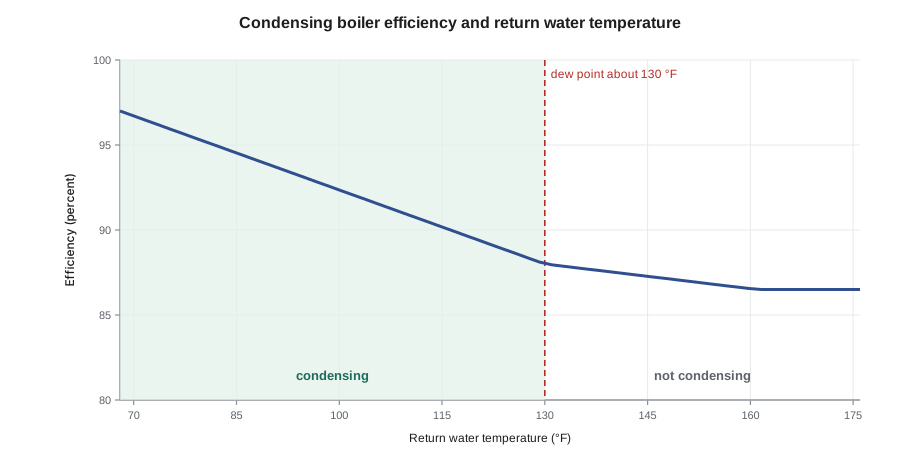
This is why system design matters so much. A condensing boiler connected to undersized baseboard that needs very hot water will rarely condense. The same boiler serving a radiant floor, oversized radiators or fan coils at low water temperatures will condense almost all season. Lesson 10 shows how outdoor reset control lowers the water temperature in mild weather, which keeps the return water cool for most of the season even with baseboard.
The condensate is mildly acidic, roughly as acidic as vinegar or a soft drink. Boilers produce a few liters of it per hour at full fire. It must be drained to a suitable drain, often through a neutralizer cartridge filled with limestone or similar media, as the local plumbing code and the manufacturer require. In cold climates the condensate line must not freeze, so it is kept inside the heated space. A frozen condensate line backs up into the boiler and shuts it down, a classic winter service call.
# Seasonal fuel use for the bungalow's delivered heat at different efficiencies
delivered_btu = 60_200_000    # heat the house used last winter (from the fuel-use check)
btu_per_therm = 100_000
for name, eff in [("old cast iron", 0.70), ("84 percent non-condensing", 0.84),
                  ("condensing, hot returns", 0.88), ("condensing, cool returns", 0.95)]:
    therms = delivered_btu / eff / btu_per_therm
print(f"{name:26s} {eff:.0%} {therms:6,.0f} therms")old cast iron 70% 860 therms 84 percent non-condensing 84% 717 therms condensing, hot returns 88% 684 therms condensing, cool returns 95% 634 therms
The output shows the gap between a condensing boiler that is allowed to condense and one that is not. Replacing the old boiler saves a lot either way, but the last few percent, worth about 50 therms a year in this house, depend entirely on the water temperatures the system is designed for.
Modulation and minimum flow
A modulating boiler adjusts its firing rate to match the load. Its turndown ratio is the ratio of maximum to minimum input: a boiler with a 10:1 turndown and a maximum of 100,000 Btu/h can fire as low as 10,000 Btu/h. Higher turndown means less cycling on mild days. Grace chose a small residential mod-con whose minimum output is below the bungalow's mild-weather load, as Lesson 2 recommended.
Low-mass condensing boilers hold very little water, so they depend on steady flow through the heat exchanger. If flow is too low, the water can overheat and the boiler trips on its high limit or flow switch. Many manufacturers therefore require the boiler to be piped with its own circulator and closely spaced tees, or a hydraulic separator, so that the boiler's flow is independent of zone valves opening and closing. Lesson 6 explains these piping arrangements. The manufacturer's minimum flow and its required piping diagram are not suggestions; a boiler piped differently may fail early and lose its warranty.
Controls and safety devices
Every boiler has operating controls that run it and safety controls that shut it down if something goes wrong. The operating control fires the burner to keep the water at its target temperature. The high limit shuts the burner off if the water gets too hot, and a manual-reset high limit requires a person to reset it after a trip. A low-water cutoff or flow switch prevents firing without enough water. The flame safeguard proves the flame and shuts off the gas if it fails to light or goes out.
Every hot-water boiler also has a pressure relief valve, sized and rated for the boiler's output and set at or below the boiler's maximum allowable working pressure, commonly 30 psi on residential boilers. Its discharge is piped full size to within about 6 in of the floor or to a safe location, where hot water and steam cannot scald anyone, and it must never be capped, plugged or reduced. A combination temperature and pressure gauge lets the service technician read both at a glance.
Large boilers carry more controls. The Kingsway boilers each have well over a million Btu per hour of input. Ohio's boiler law requires boilers of this size to be inspected and to hold a certificate of operation, and their controls follow ASME CSD-1, the standard for controls and safety devices on automatically fired boilers. They have dual high limits, low-water cutoffs and a proven-flow interlock with the boiler circulators.
Venting and combustion air
PLB-230 covered venting in detail; here is how it applies to boilers. Non-condensing natural-draft boilers are Category I appliances and vent into a lined chimney or a listed Category I vent. Most condensing boilers are Category IV: their flue gases are cool and wet and under positive pressure from the combustion fan, so they vent through sealed plastic or stainless steel vent systems listed for that use, such as CPVC, polypropylene or the materials the manufacturer names, sloped back toward the boiler so condensate drains.
Most mod-cons are direct vent, drawing combustion air from outdoors through a second pipe or a concentric vent. Direct venting keeps the boiler independent of house pressure and protects it from contaminated indoor air; laundry products, paint strippers and pool chemicals in a basement release chlorine and fluorine compounds that the burner turns into acids, which eat heat exchangers. Termination clearances from windows, doors, grade, snow lines and air intakes follow the gas code and the manufacturer's instructions.
When a condensing boiler replaces an old Category I boiler, the old chimney is often left serving only a water heater. A chimney sized for two appliances may now be too large for one, causing condensation and poor draft. Grace's plan included checking the water heater's venting or replacing it at the same time, which is a common outcome of a boiler replacement.
Placing and mounting a wall-hung boiler
Grace walked Maya through the decisions for the bungalow's new boiler before anything was ordered. The location had to allow the vent and air pipes to reach an outside wall with the required clearances from the neighbor's window, the gas meter and the basement window wells. It had to leave the service clearances the manufacturer lists around the cabinet, because a boiler that cannot be opened cannot be serviced. It needed a nearby drain for condensate and the relief valve, a dedicated electrical circuit with a service switch, and a wall strong enough to carry the boiler full of water.
Wall-hung mod-cons usually mount on a bracket fastened to studs or to a plywood backer board, never to drywall alone. The piping is supported so that its weight does not hang on the boiler's connections, and isolation valves on the supply and return let the boiler be serviced without draining the system. Many installers use a boiler service valve kit that combines isolation valves with ports for flushing the heat exchanger, because scale and debris build up in narrow condensing exchangers and periodic flushing is part of normal maintenance.
Before removing the old boiler, Grace flushed the existing radiator piping with a cleaning chemical and then plain water to carry out decades of sludge. Old cast iron systems are full of magnetite, a black iron oxide sludge that settles in a new low-mass heat exchanger and blocks it. She also planned a dirt separator with a magnet on the return, which catches the sludge that will keep coming loose from the old radiators for months after the new boiler starts.
Common mistakes
MistakeExpecting a condensing boiler to condense with very hot return water.
InsteadDesign emitters and controls for low return temperatures, below the dew point most of the season.
MistakePiping a low-mass boiler like an old cast iron one.
InsteadFollow the manufacturer's piping, with a boiler circulator and closely spaced tees or a separator where required.
MistakeDraining condensate where it can freeze or into a material it corrodes.
InsteadRoute it inside, through a neutralizer if required, to an approved drain.
MistakeCapping or reducing a relief valve discharge.
InsteadPipe it full size to a safe point near the floor; never block it.
MistakeLeaving an oversized chimney serving only the water heater.
InsteadCheck the remaining appliance's venting after removing a boiler from the chimney.
Summary and key terms
- Boilers range from heavy cast iron to low-mass condensing mod-cons and combis.
- Input is the fuel burned; output is the heat delivered; AFUE rates residential seasonal efficiency.
- The US federal minimum for gas hot-water boilers is 84 percent AFUE; a 95 percent proposal was withdrawn in 2025.
- Condensing recovers latent heat only when the return water is below the flue gas dew point, about 130 °F for natural gas.
- Modulation with a high turndown reduces cycling; low-mass boilers need their required minimum flow.
- Safety devices include high limits, low-water cutoffs or flow switches, flame safeguards and a relief valve piped to a safe point.
- Condensing boilers are usually Category IV direct vent appliances with condensate drainage.
- AFUE
- Annual fuel utilization efficiency: a seasonal efficiency rating for residential boilers and furnaces.
- Condensing boiler
- A boiler that cools its flue gases below their dew point to recover latent heat.
- Dew point
- The temperature at which water vapor in a gas begins to condense.
- Turndown ratio
- The ratio of a burner's maximum input to its minimum input.
- Combi boiler
- A boiler that provides both space heating and on-demand domestic hot water.
- Low-water cutoff
- A device that shuts off the burner when the water level or flow is too low.
- Neutralizer
- A cartridge of alkaline media that raises the pH of condensate before it is drained.
Practice problems
Work each problem on paper first, then reveal the answer to check.
What must the return water temperature be for a natural gas boiler to condense?
Show answer
Below about 130 °F.
A boiler has a 100,000 Btu/h maximum and a 10:1 turndown. What is its minimum input?
Show answer
10,000 Btu/h.
What is the US federal minimum AFUE for residential gas hot-water boilers?
Show answer
84 percent.
Why can a cast iron boiler not be allowed to condense?
Show answer
The acidic condensate attacks the iron.
Where is a relief valve discharge piped?
Show answer
Full size, to within about 6 in of the floor or another safe location.
Why do many mod-cons require closely spaced tees or a hydraulic separator?
Show answer
Low-mass heat exchangers need a steady minimum flow independent of the zones.
Lesson quiz · 5 questions
Score 60% or more to complete this lesson.
Create a free account to save your progress, take quizzes and earn a certificate.