
PLB-220 · Lesson 8 of 12 · 21 min
Tankless and heat pump water heaters
The management office at Kingsway Tower was designed with a small wall-hung gas tankless water heater, and the gym laundry room got a heat pump water heater as a pilot for the owner, who was considering heat pumps for future buildings. Maya had seen tankless heaters on service calls in her first year, but never installed one. "They're both good machines," Luis said, "and they both get a bad name when they're put in the wrong place or set up wrong. A tankless that can't keep up and a heat pump stuck in a closet with no air are the two callbacks I see most."
This lesson covers the two main alternatives to a conventional storage tank. Tankless, or instantaneous, water heaters heat water only as it flows. Heat pump water heaters move heat from the surrounding air into a storage tank. Each has strengths and limits, and each has installation requirements that differ from a conventional tank.
How a tankless water heater works
A tankless water heater has no storage, or only a very small buffer. When a hot tap opens and water flows through the heater, a flow sensor detects it and the heater fires: a gas burner, or electric elements, heat the water as it passes through a heat exchanger. A controller measures the incoming and outgoing water temperatures and adjusts the burner or elements to hold the set outlet temperature. When the tap closes, the heater shuts off. Because there is no tank of hot water cooling between uses, there are no standby losses, and the supply of hot water never runs out as long as the flow is within the heater's capacity.
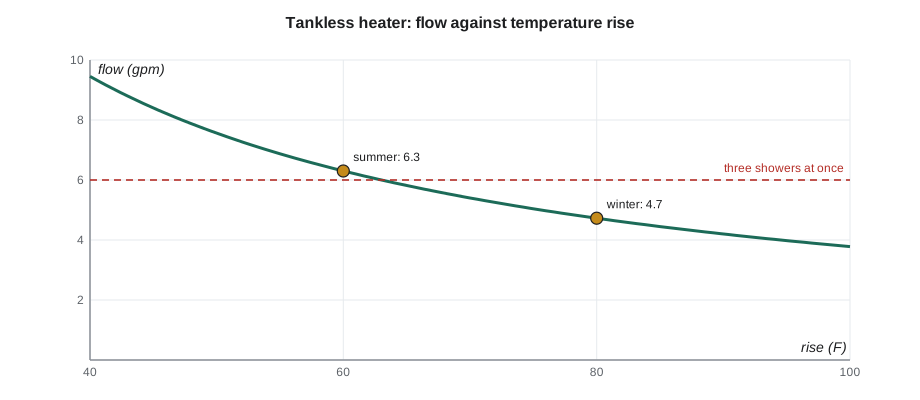
That last condition is the key to sizing a tankless heater. Its output is limited by its input: a heater can only raise so much water per minute by a given number of degrees. When the incoming water is cold, as it is in a Canadian or northern US winter, the heater has to raise the water temperature further, and the flow it can deliver at the set temperature drops. A heater that delivers two showers at once in July may deliver only one in February.
In US units, the flow in gallons per minute is the input in Btu per hour times the efficiency, divided by 500 times the temperature rise in degrees Fahrenheit. The 500 comes from 8.33 pounds per gallon times 60 minutes per hour. This is the same relationship as the recovery rate of a storage heater, worked per minute instead of per hour, because a tankless heater's recovery is its delivery.
# Flow a gas tankless heater can deliver at the set outlet temperature
def flow_gpm(btuh, eff, rise_f):
    return btuh * eff / (500 * rise_f)

btuh, eff, outlet = 199000, 0.95, 120.0   # condensing
shower = 2.0                              # gpm per shower head
for season, inlet in (("summer", 60.0), ("winter", 40.0)):
    f = flow_gpm(btuh, eff, outlet - inlet)
    print(f"{season}: rise {outlet - inlet:.0f} F, {f:.1f} gpm, "
f"{int(f // shower)} shower(s) at once")summer: rise 60 F, 6.3 gpm, 3 shower(s) at once winter: rise 80 F, 4.7 gpm, 2 shower(s) at once
The results show why winter sizing matters. The same heater delivers noticeably less in winter, and the number of fixtures it can serve at once drops. A designer sizes for the coldest expected inlet temperature and the realistic number of fixtures used together, not for the best case printed on a brochure.
Gas and electric tankless heaters
Most whole-house gas tankless heaters have inputs up to about 199,000 Btu/h, and condensing models reach efficiencies above 90 percent. That input is much higher than a storage heater's burner, so the gas piping, the gas meter and the regulator must be able to supply it. A tankless heater that replaces a tank on the old gas line is often starved of gas and cannot reach its rated output. The gas supply is designed and installed by a licensed gas fitter, who checks the pipe size, length and pressure against the gas code.
Electric tankless heaters have the same flow limit with a different constraint: electrical capacity. A whole-house electric tankless heater may draw well over 100 A at 240 V, more than many homes' electrical services can spare. Smaller point-of-use electric tankless heaters, mounted under a single sink, are common for hand sinks far from the main heater, and they need only a modest circuit.
Tankless heaters need a minimum flow to fire, often around 2 L/min or 0.5 gpm. A faucet opened only a little may not start the heater, and a low-flow fixture may sit just below the threshold. They also produce a cold-water sandwich: when a tap is turned off and then on again shortly after, water that was sitting in the cold heat exchanger comes through before the burner heats it, giving a brief burst of cooler water. Some models have a small buffer tank or a recirculation feature to reduce it.
Installing a tankless heater
A tankless heater is lighter and smaller than a tank, but it still needs a careful installation.
- Mounting: on a wall that can carry its weight, with the clearances the manufacturer requires, indoors or outdoors as the model allows, and protected from freezing.
- Gas supply: sized by a licensed gas fitter for the full input, with a shut-off and sediment trap.
- Venting and combustion air: usually a sealed direct-vent system of the listed material, as Lesson 10 explains, with condensate drainage for condensing models.
- Water connections: isolation valves on both the hot and cold connections, with service ports, so the heat exchanger can be flushed.
- Relief valve: a pressure relief valve, or temperature and pressure relief valve if the manufacturer requires one, with its discharge piped like any other relief valve.
- Recirculation: if the building has a recirculation loop, the heater must be rated for it, or a small buffer tank must be added, because constant firing on a small loop flow can shorten its life.
The service valves are important because scale is the enemy of a tankless heat exchanger. In hard water, minerals deposit on the hot surfaces of the narrow passages, cutting flow and efficiency and eventually causing overheating faults. Manufacturers call for periodic descaling, which means closing the isolation valves, connecting a small pump and hoses to the service ports, and circulating a descaling solution through the heat exchanger. A water softener or scale inhibitor upstream may be recommended or required by the warranty.
Worked problem
Will the office tankless keep up?
The management office has a staff washroom with a lavatory, a staff kitchen sink and a small shower. The engineer selected a gas tankless heater of 150,000 Btu/h input at 95 percent efficiency, set to 120 °F. In winter the cold water arrives at 40 °F. Can it serve the shower at 2.0 gpm and the kitchen sink at 1.5 gpm at the same time?
Show solution
- The temperature rise is 120 - 40 = 80 °F.
- Flow = 150,000 x 0.95 / (500 x 80) = 3.6 gpm.
- The two fixtures together need 2.0 + 1.5 = 3.5 gpm, but only part of the shower and sink flow is hot water, so the actual hot demand is less.
- The heater can serve both, with a small margin; it would struggle if the lavatory were used at the same time at full hot.
Answer: Work the winter case. Remember that fixtures draw a mix, so hot demand is less than fixture flow, but leave a margin.
How a heat pump water heater works
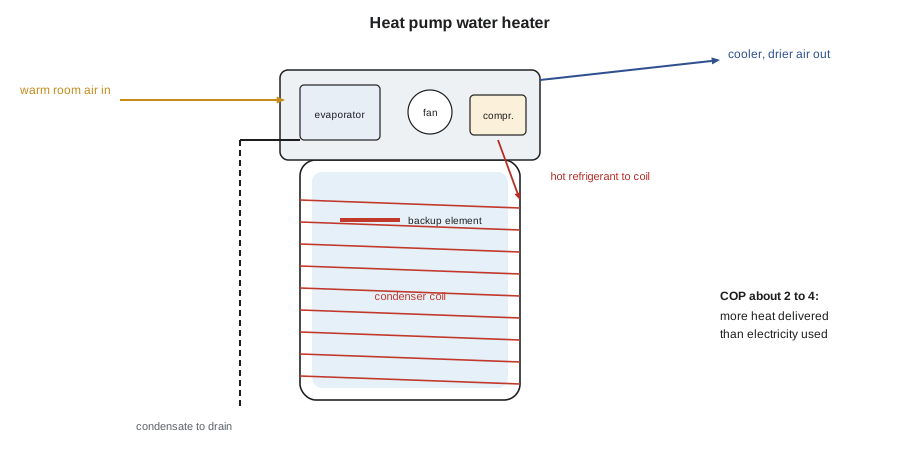
A heat pump water heater, often abbreviated HPWH, uses the same refrigeration cycle as a refrigerator or air conditioner, run in the other direction. A fan draws room air across an evaporator coil, where a refrigerant absorbs heat from the air and evaporates. A compressor raises the refrigerant's pressure and temperature, and the hot refrigerant gives up its heat to the water in the tank through a condenser coil wrapped around the tank or immersed in it. The refrigerant then passes through an expansion valve, cools, and returns to the evaporator. Most residential heat pump water heaters also have electric elements as a backup for times of high demand.
The advantage is efficiency. Moving heat takes much less energy than making it, so a heat pump water heater typically delivers two to four units of heat to the water for each unit of electricity it uses. That ratio is the coefficient of performance, or COP. A heat pump water heater can cut the energy used for water heating by half or more compared with an electric tank, which is why efficiency rules in both countries are moving toward heat pump technology for electric water heating.
Installing a heat pump water heater
The refrigeration cycle gives heat pump water heaters installation needs that a plain electric tank does not have.
Air: the unit takes heat from the surrounding air, so it needs enough room air around it, often a space of at least about 700 to 1,000 cubic feet or a ducted or louvred supply, as the manufacturer specifies. A heat pump water heater in a small closed closet cools the closet, runs less efficiently and falls back on its electric elements.
Temperature: the space should stay within the manufacturer's operating range. In a cold unheated space, the heat pump may not run, and the backup elements do the work.
Cooling effect: the unit blows out cooler, drier air. In a warm basement or laundry room that can be a benefit; in a space that is already cool in winter, it adds to the heating load of the building.
Condensate: water condenses on the evaporator and must drain to a suitable drain or condensate pump, through an indirect connection where the code requires.
Noise and service: the fan and compressor make some noise, and the air filter must be cleaned. The unit needs clearance above it for the air flow and for service.
Electrical: most full-size units need a 240 V circuit like an electric tank; some newer models plug into a 120 V receptacle, which makes replacing a gas or electric tank simpler in some homes.
The gym laundry at Kingsway was a good location for the pilot unit: the dryers keep the room warm, and the heat pump uses that waste heat and cools the room. Maya ran the condensate line to the floor drain with an air gap, and set the unit to its heat pump mode so that the backup elements would run only when demand was high.
| Type | Strengths | Limits | Key installation needs |
|---|---|---|---|
| Gas storage tank | Fast recovery, simple, works without power on some models | Standby losses, venting required | Gas, vent, combustion air, relief, expansion |
| Electric storage tank | Simple, no vent, any location | Slow recovery, high energy cost | Dedicated circuit, relief, expansion |
| Gas tankless | Endless hot water within its flow, no standby loss | Flow limited in winter, large gas demand, scale | Gas sizing, direct vent, service valves, descaling |
| Electric tankless | Compact, point-of-use options | Very large electrical demand for whole-house use | Electrical capacity, relief |
| Heat pump water heater | Two to four times as efficient as electric resistance | Needs air volume and warm space, slower recovery, noise | Air space, condensate drain, circuit, clearance |
Common mistakes
MistakeSizing a tankless heater with summer inlet temperatures.
InsteadSize for the coldest expected inlet water and the fixtures used together.
MistakeConnecting a gas tankless heater to the old tank's gas line.
InsteadHave the gas piping sized by a licensed gas fitter for the full input.
MistakeOmitting service valves on a tankless heater.
InsteadInstall isolation valves with service ports for descaling.
MistakePutting a heat pump water heater in a small closed closet.
InsteadProvide the air volume or ducting the manufacturer requires.
MistakeForgetting the condensate drain on a heat pump or condensing heater.
InsteadPipe condensate to a suitable drain or pump with an air gap where required.
Summary and key terms
- Tankless heaters heat water as it flows; their flow at a set temperature falls as the temperature rise grows.
- Flow in gpm is input in Btu/h times efficiency, divided by 500 times the rise.
- Gas tankless heaters need large gas supplies, direct venting, minimum activation flow and periodic descaling.
- Electric tankless heaters need very large electrical capacity for whole-house use.
- Heat pump water heaters move heat from room air into the tank with a COP of about two to four.
- Heat pump water heaters need adequate air volume, a suitable temperature range, a condensate drain, clearance and the right circuit.
- Tankless water heater
- A heater that heats water only as it flows, with little or no storage.
- Temperature rise
- The difference between the incoming and outgoing water temperature.
- Minimum activation flow
- The smallest flow at which a tankless heater will fire.
- Cold-water sandwich
- A brief burst of cooler water when a tankless heater restarts.
- Heat pump water heater
- A water heater that uses a refrigeration cycle to move heat from air into stored water.
- Coefficient of performance
- The ratio of heat delivered to electrical energy used by a heat pump.
Practice problems
Work each problem on paper first, then reveal the answer to check.
Why does a tankless heater deliver less hot water in winter?
Show answer
The incoming water is colder, so the temperature rise is larger for the same input.
What is the cold-water sandwich?
Show answer
A brief burst of cooler water when a tankless heater restarts after a short pause.
Why do tankless heaters need service valves?
Show answer
So the heat exchanger can be isolated and flushed to remove scale.
What does a heat pump water heater take heat from?
Show answer
The surrounding air.
What is a typical COP for a heat pump water heater?
Show answer
About two to four.
Name two installation needs of a heat pump water heater.
Show answer
Adequate air volume and a condensate drain.
Lesson quiz · 5 questions
Score 60% or more to complete this lesson.
Create a free account to save your progress, take quizzes and earn a certificate.