
PLB-220 · Lesson 11 of 12 · 22 min
Appliance connections and water treatment equipment
The last plumbing work in each Kingsway suite was the appliance connections: the dishwasher under the kitchen counter, the stacked washer and dryer in the laundry closet, and the water line to the refrigerator's ice maker. In the café, the list was longer: a commercial dishwasher, an ice machine, a coffee machine and a carbonated beverage system. Luis called these the small connections that cause big floods. "A dishwasher hose that pops off," he said, "or an ice maker line nobody tightened, can put water through three floors before anyone notices. And a cross-connection on a coffee machine can put the wrong thing in the drinking water."
This lesson covers how appliances are connected to the water supply and the drainage system, and how water treatment equipment such as softeners and filters is installed. Two themes run through all of it: keeping water where it belongs, and protecting the drinking water from backflow.
Dishwashers
A residential dishwasher needs a hot water supply, usually a 3/8 in or 1/2 in line from a dedicated stop valve under the sink, a drain connection, and an electrical connection by the electrician. The supply connects to the dishwasher's inlet valve with a listed connector, either a braided hose or a copper line, and a fitting that matches the valve. The stop must be accessible so the dishwasher can be isolated for service.
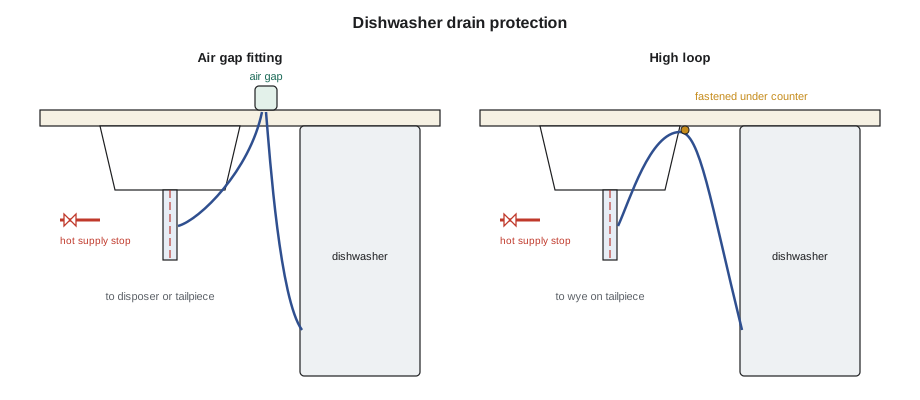
The drain is where the code takes a close interest, because a dishwasher's drain hose connects a machine full of food waste to the sink drain. If the sink backs up, dirty water could flow back into the dishwasher, and the dishwasher's pump pushes water out under pressure. Codes in both countries allow the dishwasher drain to discharge to the kitchen sink's tailpiece through a branch fitting or to the dishwasher inlet on a food waste disposer, provided the drain is protected against backflow. The protection is either an air gap fitting mounted on the sink or counter, which breaks the connection with an open space, or a high loop, where the drain hose is raised and fastened to the underside of the counter before it drops to the connection, as the adopted code and the manufacturer allow. Some jurisdictions require an air gap fitting; others accept the high loop.
The IPC and the Ohio Plumbing Code allow a domestic dishwasher to discharge through an air gap or air break into a standpipe or waste receptor, or into a wye branch on the sink tailpiece or the dishwasher connection of a disposer, provided the drain line rises and is fastened to the underside of the counter before it connects. On the Kingsway suites, the specification called for a high loop secured to the underside of the counter, which the plumbing inspector checked during the final inspection.
Commercial dishwashers are different machines. They use large volumes of very hot water, often boosted to sanitizing temperatures by a built-in or separate booster heater, and they discharge large flows. They usually drain indirectly to a floor sink through an air gap, and the plumbing must be sized for their flow and temperature. In the Kingsway café, the dishwasher drained to a floor sink beside it, and its discharge passed the grease interceptor as PLB-210 described.
Clothes washers
A clothes washer needs hot and cold supplies and a drain. The supplies usually terminate in a recessed washer box in the wall, with two valves or a single lever valve that shuts off both at once, and hose connections. The drain is a standpipe in the same box: a vertical pipe, usually 2 in, that receives the washer's drain hose, with a trap below it. The standpipe must be tall enough that the washer's pump discharge does not overflow it and short enough that the hose cannot be pushed in far enough to siphon the washer. A common requirement is a standpipe height of about 18 to 42 in above its trap weir, with the trap itself above the floor.
The washer's hose must be inserted into the standpipe with an air gap at the top, not sealed into it, so that the standpipe acts as an indirect connection. Washers pump water out fast, and an undersized standpipe or a trap that is too far below the box can overflow and flood the floor. Washer boxes for upper floors often include a drain pan connection, and many specifications call for a pan under the washer with a drain, or a leak detector with an automatic shut-off valve, because a burst washer hose is one of the most common causes of water damage in apartment buildings.
Washers use fast-acting solenoid valves that close in a fraction of a second. Closing a valve that quickly on a flowing pipe causes water hammer, a pressure surge that bangs the pipes and stresses joints. PLB-130 explained water hammer arresters; washer boxes are one of the places where the code or the specification usually requires them, installed close to the valves on both hot and cold.
Worked problem
Checking a laundry closet rough-in
In a Kingsway suite, the washer box is set with its top at 43 in above the floor and the standpipe extends 16 in above the trap weir, which is in the wall at 26 in. The supplies have no arresters. What should Maya change?
Show solution
- The standpipe is shorter than the common minimum of about 18 in above the trap weir; extend it so the washer's discharge cannot overflow.
- Check that the standpipe will still end below the maximum height above the weir, and that the box allows the hose to be inserted with an air gap.
- Add water hammer arresters on the hot and cold supplies close to the valves, as the specification requires.
- Confirm the drain pan or leak detection the specification calls for on upper floors.
Answer: Check standpipe height above the trap weir, the air gap at the hose, water hammer arresters and leak protection.
Ice makers, refrigerators and beverage equipment
A refrigerator with an ice maker or water dispenser needs a small cold water line, usually 1/4 in tubing, from a dedicated stop valve in a recessed box behind the refrigerator. Saddle valves, which clamp onto a pipe and pierce it, were common in the past but are prohibited or discouraged by many codes and manufacturers because they leak and clog. Copper or listed plastic tubing is used, with enough slack coiled behind the refrigerator so it can be pulled out for cleaning without kinking the line. Many specifications now call for braided connectors with a leak detector at the box.
Commercial ice machines need a water supply, often through a filter, and a drain that discharges indirectly through an air gap to a floor sink or other receptor, because ice is food. The drain must slope continuously and be insulated where condensation would be a problem. Some ice machines also have a water-cooled condenser, which uses a separate supply and drain and is restricted or prohibited by some codes and water utilities because it wastes water.
Coffee machines and beverage dispensers connect directly to the water supply, and the code requires backflow protection on them suited to the hazard. Carbonated beverage dispensers need special care. Carbon dioxide dissolved in water forms carbonic acid, and if carbonated water backs up into copper supply piping it can dissolve copper and make people sick. For that reason, the codes require a backflow preventer designed for carbonated beverage dispensers and prohibit copper in the water piping downstream of it. In the café, Maya installed the dispenser's dedicated backflow preventer and ran the line beyond it in stainless steel and listed plastic, as PLB-210 had described in the code.
Food waste disposers
A food waste disposer mounts under the kitchen sink's outlet and grinds food waste so it can pass through the drain. It replaces the sink's basket strainer with a mounting flange, and its outlet connects to the sink's trap. Disposers need an electrical connection and a switch, which the electrician provides. The trap below a disposer is usually 1-1/2 in, and the drain line must have enough slope and flow to carry the ground waste; running cold water while the disposer operates helps.
Commercial food waste grinders are restricted in many places, because ground food adds solids and grease to the sewer. Many municipalities prohibit them in food service establishments or require them to discharge through a solids interceptor, and most do not allow them to discharge through a grease interceptor, because the solids fill it. PLB-210 covered the sewer-use rules; the café at Kingsway had no grinder for exactly that reason.
Water treatment equipment
Water treatment equipment improves water quality for a building or a single fixture. The common types in buildings are water softeners, sediment and carbon filters, reverse osmosis units and ultraviolet disinfection units. Each has its own installation needs, but they share some rules: they must be certified for drinking water contact, installed where they can be serviced, protected with bypass valves so that water service can continue during maintenance, and connected to the drain without creating a cross-connection.
A water softener removes hardness minerals by ion exchange. Hard water flows through a resin bed that swaps its calcium and magnesium for sodium or potassium. When the resin is spent, the softener regenerates: it backwashes the bed, draws brine from a salt tank, rinses and returns to service, discharging the waste water to a drain. The softener's drain line must discharge through an air gap to a floor drain, laundry tub, standpipe or other approved receptor, because the softener is connected to the drinking water. A softener is usually installed on the cold supply after the meter and before the water heater, with a bypass valve so it can be serviced. Some supplies, such as kitchen cold taps, are sometimes left on hard water by owner preference.
Softening helps water heaters and fixtures, because scale reduces water heater efficiency, clogs tankless heat exchangers and spots fixtures. That is why some tankless heater warranties call for softening or a scale inhibitor in hard water areas. But softened water is not right for everything: some people on low-sodium diets avoid it for drinking, and very soft water can be more corrosive to some metals.
Reverse osmosis units, usually mounted under a kitchen sink, push water through a membrane that removes many dissolved contaminants, store the treated water in a small tank and deliver it through a separate faucet. They send part of the water to drain continuously while making treated water. The drain connection must include an air gap, either built into the faucet on the counter or as a listed drain saddle with an air gap, as the code and the manufacturer require. Ultraviolet units disinfect water with UV light; they need power, a pre-filter and a lamp that is replaced on schedule.
# Estimate how often a water softener regenerates
hardness_gpg = 17.5             # grains per gallon, typical hard water
use_gal_per_day = 240           # household water use treated
capacity_grains = 15000         # softener capacity in grains
removed_per_day = hardness_gpg * use_gal_per_day
days = capacity_grains / removed_per_day
print(f"hardness removed: {removed_per_day:,.0f} grains/day")
print(f"regenerates about every {days:.1f} days")hardness removed: 4,200 grains/day regenerates about every 3.6 days
A softener that regenerates every few days, as this one would, is normal. One that regenerates far more often wastes salt and water, and one that regenerates too rarely lets hard water through. Modern softeners measure the water used and regenerate on demand, but the hardness setting still has to be entered correctly at start-up.
Hose bibbs and outdoor connections
Hose bibbs, or outdoor faucets, are among the most common cross-connection risks, because a hose can be left in a pool, a bucket of chemicals or a garden sprayer. Every hose connection must have a vacuum breaker, either built into the hose bibb or screwed onto its outlet as a non-removable hose connection vacuum breaker. In climates like Columbus's, outdoor faucets must also be frost-proof, with a long stem that shuts the water off inside the heated wall, and installed with a slight slope so the stem drains when the faucet is closed.
The Kingsway Tower had hose bibbs on the roof, at the garbage room and at the loading area, each with an integral vacuum breaker and a key-operated handle so that only maintenance staff could use them. On the roof, they were frost-proof and fed from a heated area, with an isolation valve inside so they could be shut off for winter.
Common mistakes
MistakePushing a dishwasher drain hose straight to the tailpiece with no protection.
InsteadUse an air gap fitting or a high loop fastened under the counter, as the code allows.
MistakeSealing a washer hose into the standpipe.
InsteadLeave an air gap at the top of the standpipe.
MistakeUsing a saddle valve for an ice maker line.
InsteadUse a dedicated stop valve in a recessed box.
MistakeRunning copper downstream of a carbonated beverage backflow preventer.
InsteadUse stainless steel or listed plastic beyond the preventer.
MistakeConnecting a softener or RO drain directly to the drain pipe.
InsteadDischarge through an air gap to an approved receptor.
Summary and key terms
- Dishwasher drains need protection such as an air gap fitting or a high loop, as the adopted code allows.
- Washer standpipes must be tall enough not to overflow, short enough not to siphon, with the hose inserted with an air gap; arresters protect against water hammer.
- Ice maker lines use dedicated stops, not saddle valves; commercial ice machines drain indirectly through an air gap.
- Carbonated beverage dispensers need a dedicated backflow preventer and no copper downstream.
- Commercial food waste grinders are often restricted and must not discharge through grease interceptors.
- Softeners, filters and RO units need bypass valves, service access and drain connections through an air gap.
- Every hose connection needs a vacuum breaker; outdoor faucets in cold climates must be frost-proof.
- Air gap fitting
- A device on a sink or counter that breaks a dishwasher drain line with an open space.
- High loop
- A drain hose raised and fastened under the counter before it drops to the drain connection.
- Standpipe
- A vertical pipe that receives a clothes washer drain hose, with a trap below.
- Water hammer
- A pressure surge caused by a valve closing quickly on flowing water.
- Ion exchange
- The process a water softener uses to swap hardness minerals for sodium or potassium.
- Hose connection vacuum breaker
- A device on a hose outlet that prevents water being siphoned back from the hose.
Practice problems
Work each problem on paper first, then reveal the answer to check.
What two forms of backflow protection are used on dishwasher drains?
Show answer
An air gap fitting or a high loop fastened under the counter.
Why is the washer hose not sealed into the standpipe?
Show answer
The air gap makes it an indirect connection and prevents siphoning.
Why are copper lines not allowed downstream of a carbonated beverage backflow preventer?
Show answer
Carbonated water can dissolve copper and make people sick.
Where does a softener's regeneration water go?
Show answer
To an approved receptor through an air gap.
What protects a hose bibb against backsiphonage?
Show answer
A vacuum breaker.
Why are commercial grinders kept away from grease interceptors?
Show answer
The ground solids would fill the interceptor.
Lesson quiz · 5 questions
Score 60% or more to complete this lesson.
Create a free account to save your progress, take quizzes and earn a certificate.