
PLB-220 · Lesson 6 of 12 · 23 min
Commercial fixtures, flush valves and sensor controls
The suites at Kingsway Tower have tank toilets and ordinary faucets, but the ground floor is different. The amenity washrooms, the staff washroom in the management office and the café's customer washrooms all have wall-hung fixtures, flushometer valves and sensor faucets. When Maya started on the ground floor, Luis showed her the first flushometer, a chrome valve sitting on the wall above a wall-hung bowl. "No tank, no float, no flapper," he said. "It uses the pressure in the pipe to flush. That makes it quick and tough, but it also means the piping has to be sized for it and the valve has to be set up right."
This lesson covers fixtures and controls used in commercial and public buildings: flushometer valves for water closets and urinals, sensor and metering controls, commercial lavatories and sinks, drinking fountains and bottle fillers, and emergency fixtures. It explains how they work, how they are installed and adjusted, and why their water demand affects the design of the supply system.
How a flushometer valve works
A flushometer valve, often called a flush valve or flushometer, is connected directly to the water supply and delivers a measured volume of water to a water closet or urinal at high flow for a few seconds. It needs no storage tank, recovers instantly for the next user, and stands up to heavy use, which is why it is the standard in public washrooms.
Inside the valve is a main valve held closed by water pressure in an upper chamber. There are two main designs. In a diaphragm valve, a flexible rubber diaphragm separates the inlet from the upper chamber; a small bypass hole lets supply water fill the chamber, and because the chamber side has the larger area, the pressure holds the diaphragm down on its seat. In a piston valve, a piston with a cup seal does the same job. When the handle or a sensor tips a small relief valve, the upper chamber drains, the pressure above the diaphragm or piston drops, and the supply pressure lifts it off its seat. Water rushes through to the fixture. Meanwhile water refills the upper chamber through the bypass, and when it is full enough, the main valve closes again. The size of the bypass and the volume of the chamber set how long the valve stays open and therefore how much water each flush delivers.
Because the volume depends on the internal parts, flushometers are made in models and with inserts for specific volumes, and the valve must match the fixture. A water closet bowl designed for a low flush volume will not clear properly with a valve set for less, and a valve set for more wastes water and can splash. Urinal valves deliver much smaller volumes than water closet valves. Dual-flush flushometers deliver a full flush when the handle is pushed down and a reduced flush when it is pulled up, or the reverse depending on the model.
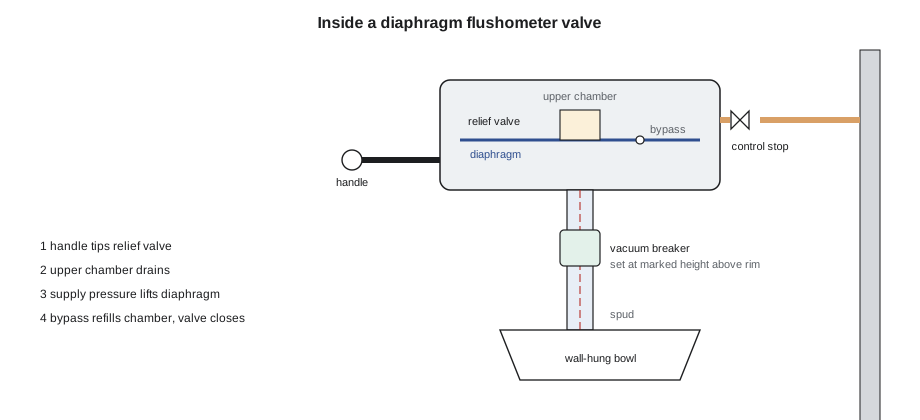
Supply requirements for flushometers
A flushometer needs a large flow at a good pressure for a short time. A typical water closet flush valve needs a supply of 1 in pipe to the valve and a flowing pressure at the valve of at least about 25 psi, with many models performing best between about 35 and 80 psi. Urinal valves usually take a 3/4 in supply. If the pressure is too low, the valve may not open fully or may not close; if the supply pipe is too small, the flush is weak and other fixtures on the branch are starved while it runs.
PLB-130 showed how the water supply is sized using fixture units and demand curves. Flushometer fixtures carry much higher supply fixture unit values than tank fixtures, and the code's sizing method treats them separately, because several flushometers flushing at once can demand far more water than the same number of tank toilets. A building that changes from tank toilets to flushometers during design, or a renovation that adds flushometers to old piping, needs the supply checked, not assumed.
Each flushometer is fitted with a control stop, a small valve at the inlet that serves two purposes. It isolates the flushometer for service, and it is used to throttle the flow so that the valve delivers a clean flush without splashing at the building's pressure. Setting the control stop is part of the installation: Maya opened it fully, flushed, watched the bowl, and closed it gradually until the flush was strong but did not splash out of the bowl. A control stop left fully open on a high-pressure floor makes the fixture splash; one closed too far starves the flush.
Backflow protection on flushometers
A flushometer connects the water supply directly to the bowl, so there is a direct path for contaminated water to be drawn back into the supply if the supply pressure drops while the valve is open or leaking. To prevent this, every flushometer valve must include a vacuum breaker, a device in the outlet tube that lets air into the line if a vacuum forms, so that water cannot be siphoned back. The vacuum breaker must be installed at a minimum height above the flood level rim of the fixture, as marked on the valve, which is why the valve's outlet tube length and the bowl's spud height are matched.
This is the reason Maya never cut a flushometer outlet tube shorter than the manufacturer allowed to make a valve fit a low bowl. A vacuum breaker below its critical level does not work. If a bowl and valve do not match, the right fix is a different valve or tube, not a shorter cut.
Worked problem
Setting up a new flushometer
Maya installs a flushometer on a wall-hung water closet in the amenity washroom. The bowl is rated for a 1.28 gal flush and the valve has a matching insert. The static pressure on the ground floor is about 75 psi. What steps does she take to set it up?
Show solution
- Flush the supply line before connecting, so debris does not lodge in the bypass or relief valve.
- Install the valve with the vacuum breaker at the height marked on the valve above the bowl rim, and the outlet tube cut only within the allowed range.
- Open the control stop fully, flush and watch; at this pressure the flush will likely splash.
- Close the control stop gradually and flush again until the flush clears the bowl cleanly without splashing.
- Check that the valve closes fully and the bowl refills to a proper trap seal, then record the setting.
Answer: Match valve and bowl, protect the vacuum breaker height, then throttle with the control stop until the flush is clean without splash.
Sensor and metering controls
Sensor flush valves use an infrared sensor to detect a user and flush automatically after the user leaves. Sensor faucets run while hands are in front of the sensor. Both reduce the spread of germs, because users do not touch handles, and both can save water when they are adjusted properly. They are powered by batteries, which last a few years depending on use, or by a low-voltage transformer wired by the electrician. Some have a small generator in the water flow that recharges the battery.
Sensors have their own adjustment and their own problems. The range must be set so that the sensor sees a user at the fixture but not someone walking past or the stall door. A sensor flush valve that fires while a person is still seated, or a sensor faucet that runs when someone walks by the counter, is a sign of a range or aiming problem. Many sensor valves have a manual override button so the fixture can be flushed if the sensor fails, and a sentinel flush that runs the valve at set intervals to keep the trap seal full in a seldom-used washroom.
Metering faucets are mechanical: pushing the button opens the valve, and it closes by itself after a set time, controlled by a small internal piston or a timing cartridge. The time is adjustable on most models. The code and the accessibility rules set minimum run times, and the specification often sets the flow per cycle. Metering faucets suit places with heavy use and limited maintenance, such as transit stations and schools.
Commercial lavatories also commonly need tempered water rather than separate hot and cold. A lavatory in a public washroom is often supplied from a thermostatic mixing valve under the counter that delivers water at a set maximum temperature, so that users cannot scald their hands and so that a sensor faucet with a single supply can deliver comfortable water. The mixing valve is set and recorded like the ones in Lesson 4, and it must be accessible for service.
Commercial lavatories, sinks and carriers
Commercial lavatories are often wall-hung on carriers so that the floor beneath can be cleaned, or set in long counters with several basins. Wall-hung lavatories need a carrier or a concealed arm support strong enough for a person to lean on the basin, because people do. Lavatory carriers have arms that fit into the back of the basin and are bolted to the floor and to the wall framing. Counter-mounted basins depend on the counter's support, which is the millwork installer's work, but the plumber should check it before setting the basins.
Hand sinks in food premises are required by public health rules, which in both countries set requirements for their location, their supply of hot and cold or tempered water, and their use for hand washing only. The café hand sink at Kingsway had to be within easy reach of the food preparation area, with a hands-free faucet, and supplied with water at a comfortable temperature. The public health inspector checked it during the café's pre-opening inspection, separately from the building inspector.
Commercial kitchen sinks, three-compartment sinks and prep sinks are often supplied by the food service contractor and connected by the plumber. Some of them must drain indirectly through an air gap to a floor sink, so that a backed-up drain cannot contaminate food or utensils. PLB-210 covered the code rules; in the field, the plumber sets the indirect waste pipe so that it ends above the floor sink's rim by at least the required air gap, and secures it so that it cannot be pushed down into the sink.
Drinking fountains, bottle fillers and emergency fixtures
Drinking fountains and bottle filling stations are fixtures in the code's sense, with a waste connection and a water supply. Many codes require drinking fountains in buildings such as offices, schools and assembly occupancies, and allow bottle fillers to substitute for some of them. A refrigerated fountain contains a small chiller and needs an electrical connection. The supply to a drinking fountain is drinking water, so all its parts must meet the drinking water standards, and the waste must be trapped and vented like any other fixture.
Emergency eyewash stations and safety showers are required where people work with chemicals that can harm the eyes or skin, such as in labs, battery charging areas and some maintenance rooms. Their performance is set by ANSI/ISEA Z358.1, which both Canadian and US safety regulators commonly reference. They must deliver a large flow for at least 15 minutes and be supplied with tepid water, generally between about 60 °F and 100 °F, so that people can stand under them long enough. That usually means a dedicated thermostatic mixing valve designed for emergency fixtures, with a cold-water bypass in case the mixing valve fails. The plumber also needs to plan a drain or a floor drain nearby, because a 15-minute flush puts a lot of water on the floor.
| Fixture or control | Typical supply | Key setup item |
|---|---|---|
| Water closet flushometer | 1 in, about 25 psi minimum flowing | Control stop throttled to stop splash |
| Urinal flushometer | 3/4 in | Volume matched to the urinal |
| Sensor faucet | Tempered water through a mixing valve | Sensor range set, mixing valve set and recorded |
| Metering faucet | 1/2 in hot and cold or tempered | Run time set to the minimum required |
| Emergency eyewash or shower | Tepid water through an emergency mixing valve | 15-minute flow, drain provided |
# Compare the water a public washroom uses with old and new urinal valves
users_per_day = 400
uses_per_user = 1.5
wc_old_gal, wc_new_gal = 1.6, 1.28
urinal_old_gal, urinal_new_gal = 1.0, 0.5
share_urinal = 0.4                       # share of uses at urinals
uses = users_per_day * uses_per_user
old = uses * (1 - share_urinal) * wc_old_gal + uses * share_urinal * urinal_old_gal
new = uses * (1 - share_urinal) * wc_new_gal + uses * share_urinal * urinal_new_gal
print(f"old: {old:.0f} gal/day   new: {new:.0f} gal/day   saved: {old - new:.0f} gal/day")
print(f"saved per year (300 days): {(old - new) * 300:.0f} gallons")old: 816 gal/day new: 581 gal/day saved: 235 gal/day saved per year (300 days): 70560 gallons
Calculations like this are how building owners justify replacing old valves and urinals, and they show why the flush volume of each valve matters. A valve that has drifted to a higher volume because of a worn diaphragm wastes water every time it is used, hundreds of times a day.
Common mistakes
MistakeCutting a flushometer outlet tube to fit a low bowl.
InsteadKeep the vacuum breaker at the marked height; use the correct valve or tube.
MistakeLeaving the control stop fully open.
InsteadThrottle it until the flush is clean without splashing.
MistakeInstalling a flushometer valve with a volume that does not match the bowl.
InsteadMatch the valve or insert to the fixture's rated volume.
MistakeConnecting flushometers to piping sized for tank toilets.
InsteadCheck the supply sizing for flushometer demand.
MistakeSupplying an emergency eyewash with cold water only.
InsteadUse an emergency mixing valve to deliver tepid water for the full 15 minutes.
Summary and key terms
- A flushometer uses supply pressure to open a diaphragm or piston main valve; the bypass refills the upper chamber to close it.
- Water closet flushometers need a 1 in supply and good flowing pressure; urinal valves usually take 3/4 in.
- The control stop isolates the valve and is throttled to give a clean flush without splash.
- Every flushometer has a vacuum breaker that must stay at its marked height above the bowl rim.
- Sensor controls need correct range and aim; metering faucets need correct run time.
- Public lavatories often need tempered water from an accessible, recorded mixing valve.
- Emergency eyewashes and showers need tepid water for 15 minutes and a place for the water to drain.
- Flushometer valve
- A valve connected directly to the supply that delivers a measured flush to a water closet or urinal without a tank.
- Control stop
- The inlet valve of a flushometer, used to isolate it and to throttle the flow.
- Bypass
- The small passage that refills the upper chamber of a flushometer and sets how long it stays open.
- Vacuum breaker
- A device that admits air to a line to stop water being siphoned back into the supply.
- Metering faucet
- A faucet that runs for a set time after being pressed and then closes by itself.
- Tempered water
- Water mixed to a moderate temperature for safe use at a fixture.
Practice problems
Work each problem on paper first, then reveal the answer to check.
What lifts the diaphragm in a flushometer?
Show answer
Supply pressure, once the upper chamber is drained by the relief valve.
What sets how much water a flushometer delivers?
Show answer
The bypass size and upper chamber volume, chosen by model or insert.
What is the control stop used for?
Show answer
Isolating the valve and throttling the flow to stop splashing.
Why must the vacuum breaker stay at its marked height?
Show answer
Below its critical level it cannot stop backsiphonage.
What water temperature range is used for emergency eyewashes?
Show answer
Tepid water, about 60 °F to 100 °F.
Why does adding flushometers to an old building need a supply check?
Show answer
Flushometers demand much more flow than tank toilets.
Lesson quiz · 5 questions
Score 60% or more to complete this lesson.
Create a free account to save your progress, take quizzes and earn a certificate.