
PLB-220 · Lesson 4 of 12 · 24 min
Bathtubs, showers and scald-protection valves
On the fourth floor of Kingsway Tower, the bathtubs went in before the tile. Maya and Luis set acrylic tubs in the standard suites and one-piece fiberglass shower units in the smaller studios, and they roughed in the shower valves at the height the tile setter had marked on the wall. Luis spent longer on the valves than on anything else that week. "A tub that leaks is a repair," he said. "A shower valve that scalds somebody is an injury. That valve is a safety device, and we set it like one."
This lesson covers bathtubs and showers: how they are supported and drained, how the valves that supply them are roughed in and trimmed, and why the code requires valves that protect users from scalding and sudden temperature swings. It ends with the tub filler and mixing valve rules that keep bath water at a safe temperature.
Bathtubs
Most bathtubs in residential buildings are alcove tubs, about 60 in long, enclosed on three sides by walls, with a tiling flange on the three wall sides and an apron on the open side. Corner tubs, drop-in tubs set into a deck, and freestanding tubs are also common. Tubs are made of acrylic, fiberglass, enameled steel or enameled cast iron. Acrylic and fiberglass tubs are light but must be supported underneath, usually on a mortar bed or the foam or leveling base the manufacturer specifies, so that the floor of the tub does not flex. Steel and cast iron tubs are rigid but heavy, and cast iron tubs may need a check of the floor structure.
The tub drain is a waste and overflow assembly: a drain shoe at the outlet in the bottom of the tub, an overflow elbow at the overflow hole in the end wall, a tee that joins them, and a tailpiece to the trap below the floor. The stopper may be a lift-and-turn, toe-touch, trip lever or cable-operated type. The trap for a tub sits below the floor, so the joint between the waste and overflow and the trap must stay accessible. That is why the code or the building's practice usually requires an access panel or another way to reach the tub trap connection, unless the connections are made with joints that the code allows to be concealed.
Setting a tub follows a predictable sequence. The rough-in is checked: drain location, valve and spout positions, and the framing that supports the tiling flange. The waste and overflow is fitted to the tub on the floor, before it is set, because it is much easier to reach. The tub is set in its base, leveled across its length and width, and fastened through the flange to the studs as the manufacturer directs. The tailpiece is connected to the trap, and the drain is tested by filling the tub to the overflow and draining it while someone watches below. Finally the tub is covered to protect it from the other trades.
Luis was strict about the flood test. A tub filled to the overflow holds a lot of water, and a leak at the overflow gasket only shows when the water reaches that height. On a high-rise, a leak on the fourth floor shows up as a stain on the third-floor ceiling, often weeks later. He had Maya fill every tub to the overflow, let it stand, then drain it, and check the ceiling below with a light if it was open.
Showers
A shower may be a prefabricated base with separate wall panels, a one-piece molded unit, or a site-built shower with a waterproofed floor and tiled walls. Prefabricated bases and units are set like tubs: leveled, supported and fastened through their flanges. Site-built showers need a waterproofing membrane, which may be a traditional shower pan liner under a mortar bed or a surface-applied membrane under the tile, sloped to a drain with a clamping ring or bonding flange that ties the membrane into the drain body.
The shower drain receives the water through a strainer and carries it to a trap below the floor. In a site-built shower, the drain body has weep holes in the clamping ring so that water that gets through the grout and reaches the membrane can still find its way to the drain. Blocked weep holes, often filled with mortar or adhesive during tiling, are a common cause of shower floors that stay wet and smell. The plumber's job is to set the drain at the right height for the finished floor, protect the weep holes, and leave clear instructions for the tile setter.
Linear drains run along one wall or across the entrance of a curbless shower and let the floor slope in one direction. They are popular in accessible bathrooms because they make a curbless entry possible. They still need a trap and a code-compliant connection to the drainage system, usually a 2 in outlet, and the membrane must tie into the drain channel as the manufacturer specifies.
The code sets a minimum size for shower stalls so that a person can wash without hitting the walls or the controls, commonly a floor area that will contain a circle of about 30 in in diameter and a minimum finished floor area, and a minimum shower drain size, commonly 2 in. Shower doors and enclosures must be safety glazing. Accessible showers have their own larger dimensions, seats and grab bars, covered in Lesson 5.
Why showers need special valves
Water hot enough to scald is ordinary in a building. Water heaters are often stored at 140 °F or more to control the growth of Legionella bacteria, which grow best in lukewarm water. At that temperature, a full-thickness burn can happen in roughly five seconds for an adult and in much less for a young child. At 120 °F, the same injury takes roughly ten minutes. The difference between a safe shower and a dangerous one can be a few degrees.
The danger in a shower is not just water that is too hot from the start. It is a sudden change in temperature while someone stands under the water. If a toilet is flushed elsewhere in the building, the cold water pressure at the shower drops, the mix swings toward hot, and the person in the shower is hit by a burst of hot water. They may jump back and fall. Older people, young children and people with disabilities, who may not be able to move away quickly, are hurt most often.
For these reasons, the code requires every shower to be supplied through an individual control valve of a type that protects against scalding and thermal shock. The IPC, and with it the Ohio Plumbing Code, requires shower and tub-shower valves to be pressure-balance, thermostatic mixing or combination types conforming to ASSE 1016/ASME A112.1016/CSA B125.16, and requires the valve's high-limit stop to be set to a maximum of 49 °C (120 °F). The limit is set by an adjustable stop in the valve, not by turning down the water heater.
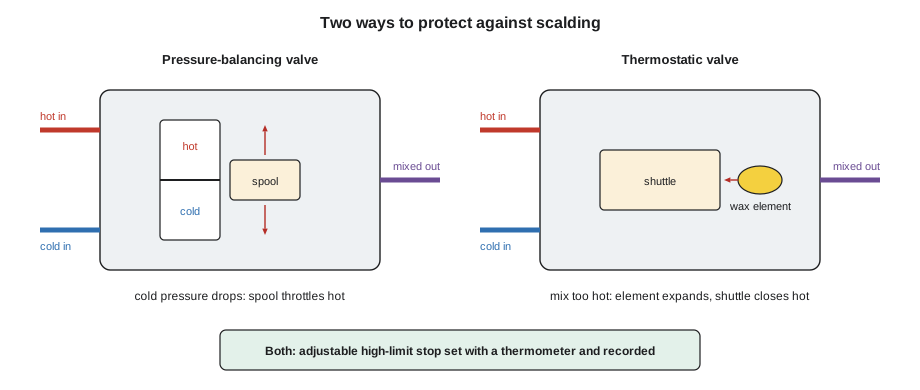
Pressure-balancing, thermostatic and combination valves
A pressure-balancing valve keeps the ratio of hot to cold water steady when the pressure on one side changes. Inside the valve, a spool or diaphragm sits between the hot and cold chambers. If the cold pressure drops because someone flushed a toilet, the spool moves and throttles the hot side to match, so the mix stays close to the same temperature. If the cold supply fails completely, a good pressure-balancing valve shuts off the hot as well, leaving the user with a trickle instead of a blast of hot water. Pressure-balancing valves are simple, reliable and the most common type in residential showers. They do not respond to changes in the temperature of the supply, only to changes in pressure.
A thermostatic mixing valve responds to the temperature of the mixed water itself. A temperature-sensing element, usually wax that expands as it warms, moves a shuttle that adjusts the hot and cold openings to hold the temperature the user set. Thermostatic valves handle both pressure and temperature changes, often hold the temperature more closely, and usually allow the volume and temperature to be set separately. They cost more and their elements and check valves need occasional cleaning or replacement, especially in hard water.
Combination valves include both a pressure-balancing and a thermostatic function. Whichever type is used, the valve has a high-limit stop: an adjustable stop that keeps the handle from being turned past the point that gives the maximum allowed temperature. The stop must be set at installation, after the water heater is at its normal temperature, by running the shower at full hot and measuring the water with a thermometer.
Setting the high-limit stop is a step that is often skipped, and an unset stop leaves the valve able to deliver whatever the water heater supplies. On the Kingsway job, setting and recording the stop was a line on the fixture checklist for every shower and tub, signed by the plumber who set it.
Worked problem
Setting a shower valve high-limit stop
A Kingsway suite has a pressure-balancing tub-shower valve. The building's water heaters store water at 140 °F and supply the risers through a central mixing valve at 131 °F. Maya runs the shower at full hot for two minutes and measures 126 °F at the shower head. What does she do?
Show solution
- The code limit for this valve is 120 °F, so 126 °F is too hot.
- Remove the handle and trim, find the high-limit stop on the valve stem, and rotate it to limit the handle travel toward hot, following the manufacturer's instructions.
- Reinstall the handle, run the shower at full hot again for long enough for the temperature to settle, and remeasure.
- Repeat until the reading is at or just below 120 °F, then record the setting and the reading on the checklist.
Answer: The high-limit stop must hold the maximum at 120 °F or less. Measure, adjust, remeasure and record.
Roughing in and trimming shower and tub valves
The shower valve body is roughed in before the walls are closed, with its face set at the right depth for the finished wall. Most valves come with a plaster guard or depth gauge that shows the correct range. A valve set too deep leaves the trim unable to reach the stem; a valve set too shallow leaves the trim standing off the wall. Common heights are about 48 in above the tub bottom or shower floor for the valve, about 80 in for the shower head in an adult shower, and about 4 to 6 in above the tub rim for the tub spout, but the drawings and the manufacturer's instructions govern.
The valve must be installed with hot on the left. Many valves can be reversed if the supplies are reversed, by rotating a cartridge; this must be done before trim, and checked by running water. The supply pipes to the valve are secured so that the valve cannot move when the handle is turned, and the shower arm drop ear elbow and tub spout outlet are fastened to blocking. The valve is pressure-tested with the rough-in, usually using the plaster guard or a test cap that came with it, so that the cartridge is not exposed to debris.
Many shower valves include integral stops or check valves on the hot and cold inlets. Check valves prevent crossflow, which is hot water flowing into the cold piping or cold into the hot when a valve allows both to be open at the same time. Crossflow can cause odd temperature problems far from the valve, such as warm water at a cold tap in another suite. Single-handle valves without checks are a common cause, and a plumber who finds crossflow often traces it to one such valve.
Trim is installed after the tile. The plaster guard is removed, the cartridge is flushed, the escutcheon is sealed to the wall as the manufacturer directs so that water cannot get behind it, and the handle and spout are fitted. The tub spout may include a diverter that sends water up to the shower head. The shower head is fitted with its flow restrictor in place, because removing it raises the flow above the code limit.
Bathtubs and the temperature limit
Bathtubs filled from a separate tub filler, such as a deck-mounted faucet on a drop-in or freestanding tub, are a scald risk because a bath can be filled with water that is too hot and a child or older person can get in without testing it. The IPC, and the Ohio Plumbing Code, require the hot water supplied to bathtubs and whirlpool tubs to be limited to 49 °C (120 °F) by a water temperature limiting device conforming to ASSE 1070/ASME A112.1070/CSA B125.70, unless the tub is supplied through a shower valve that already limits it. In buildings such as care homes, lower limits often apply under health rules.
Point-of-use mixing valves are small thermostatic valves installed under a lavatory or near a tub. They take hot and cold water and deliver tempered water at a set maximum temperature. The plumber sets them with a thermometer, like a shower valve stop, and records the setting. Mixing valves contain checks and screens that can clog, so they are installed where they can be reached.
# Estimate the hot-water fraction a mixing valve needs for a target temperature
def hot_fraction(t_hot, t_cold, t_mix):
    return (t_mix - t_cold) / (t_hot - t_cold)

t_hot, t_cold = 140.0, 50.0      # deg F supply temperatures at the valve
for target in (100.0, 110.0, 120.0):
    f = hot_fraction(t_hot, t_cold, target)
    print(f"target {target:.0f} F: {f*100:.0f}% hot, {100 - f*100:.0f}% cold")
winter_cold = 40.0               # colder winter supply
print(f"120 F in winter needs {hot_fraction(t_hot, winter_cold, 120.0)*100:.0f}% hot")target 100 F: 56% hot, 44% cold target 110 F: 67% hot, 33% cold target 120 F: 78% hot, 22% cold 120 F in winter needs 80% hot
The fractions show why a valve's limit stop must be checked against real supply temperatures. When the cold supply is colder in winter, the valve needs a larger share of hot water to reach the same mix, so a stop set in summer may feel too cool in January, and a stop set too loosely to make up for it may allow water that is too hot in summer. A thermostatic valve adjusts for this automatically; a pressure-balancing valve does not, which is one reason the stop is set at the maximum allowed temperature rather than at a comfortable one.
Common mistakes
MistakeLeaving a shower valve's high-limit stop at the factory setting.
InsteadMeasure at full hot after the heater is at normal temperature, set the stop to the code maximum and record it.
MistakeLowering the water heater temperature to stop scalding.
InsteadKeep storage hot enough to control bacteria and limit delivery temperature at the valve or with a mixing valve.
MistakeRemoving the shower head flow restrictor.
InsteadLeave it in; removing it raises the flow above the code limit.
MistakeFilling the weep holes of a shower drain with mortar.
InsteadProtect the weep holes so water above the membrane can drain.
MistakeSkipping the tub flood test.
InsteadFill to the overflow, let it stand and drain while watching below.
Summary and key terms
- Acrylic and fiberglass tubs and bases must be supported underneath as the manufacturer specifies.
- Tub waste and overflow connections must be tested by filling to the overflow, and kept accessible where required.
- Site-built showers need a membrane tied into a drain with protected weep holes.
- Showers need pressure-balance, thermostatic or combination valves to ASSE 1016, with the high-limit stop set at 49 °C (120 °F) or less.
- Pressure-balancing valves respond to pressure changes; thermostatic valves respond to mixed water temperature.
- Tub fillers are limited to 120 °F by a temperature-limiting device unless supplied through a limiting shower valve.
- Stops and mixing valves are set with a thermometer after the heater is at normal temperature, and recorded.
- Pressure-balancing valve
- A shower valve that keeps the hot-to-cold ratio steady when supply pressure changes.
- Thermostatic mixing valve
- A valve that senses mixed water temperature and adjusts hot and cold flow to hold it.
- High-limit stop
- An adjustable stop that limits how far a valve handle can turn toward hot.
- Thermal shock
- A sudden temperature change at a fixture that can cause a fall or a burn.
- Crossflow
- Hot water flowing into cold piping, or cold into hot, through a fixture or valve.
- Waste and overflow
- The drain assembly that joins a tub outlet and overflow and carries them to the trap.
Practice problems
Work each problem on paper first, then reveal the answer to check.
What maximum temperature is the shower valve high-limit stop set to?
Show answer
49 °C (120 °F).
What does a pressure-balance valve respond to?
Show answer
Changes in the hot or cold supply pressure.
How is the high-limit stop set?
Show answer
By measuring at full hot with a thermometer and adjusting the stop to the maximum allowed, then recording it.
Why are weep holes in a shower drain important?
Show answer
They let water that reaches the membrane drain away.
How do you test a tub drain?
Show answer
Fill to the overflow, let it stand, then drain while watching below.
Which standard covers the temperature limiting device on a tub filler?
Show answer
ASSE 1070/ASME A112.1070/CSA B125.70.
Lesson quiz · 5 questions
Score 60% or more to complete this lesson.
Create a free account to save your progress, take quizzes and earn a certificate.