
PLB-220 · Lesson 10 of 12 · 22 min
Gas water heater venting, combustion air and license limits
When the gas water heaters went into the Kingsway mechanical room, Maya expected to connect them. Instead, Luis introduced her to Dana, a licensed fitter with Northbridge's mechanical division who handles the gas work. "We set the heaters, pipe the water and the relief valves," Luis said. "Dana does the gas line, the venting, the lighting and the combustion test, under her license and the city's gas permit. But you still need to understand all of it, because if the venting is wrong, the water heater you piped can kill someone."
This lesson is an awareness lesson. It explains how gas water heaters get the air they need to burn their fuel and how they get rid of the combustion gases, the main types of venting, the hazards of carbon monoxide, and the licensing boundaries that decide who may do what. Plumbers who install and service water heaters need this knowledge to recognize a dangerous installation, to coordinate with the gas fitter, and to know when to stop and call someone else.
Combustion, air and carbon monoxide
A gas burner mixes fuel with air and burns it. Natural gas is mostly methane, and when it burns completely, each part of methane combines with oxygen to make carbon dioxide and water vapor, releasing heat. Complete combustion needs enough air, mixed properly with the gas, at the right temperature. When there is not enough air, or the flame is cooled or disturbed, combustion is incomplete and the burner produces carbon monoxide, a colorless, odorless gas that is poisonous at low concentrations. Carbon monoxide binds to the blood in place of oxygen. Early symptoms resemble the flu: headache, dizziness, nausea and tiredness. High exposure causes unconsciousness and death.
A gas appliance therefore needs two things: a supply of air for combustion, and a vent that carries all the combustion products out of the building. If either fails, carbon monoxide can build up indoors. Common causes are a blocked or disconnected vent, a vent that is too small or poorly sloped, a room sealed so tightly that the appliance cannot get air, an exhaust fan that pulls air down the vent, and a burner that is dirty or badly adjusted.
Carbon monoxide alarms are a backup, not a substitute for correct installation. Most US states, including Ohio, and the model building codes require carbon monoxide alarms in new dwellings that have fuel-burning appliances or attached garages, and many require them in existing homes when they are sold or altered. The rules differ by state and city, so the local fire and building departments are the authority.
Venting categories
Gas appliance vents are grouped by two properties of the flue gases. The first is whether the gases are under negative or positive pressure in the vent: negative-pressure vents rely on the buoyancy of hot gases to draw them up, while positive-pressure vents are pushed by a fan and must be sealed so that gases cannot leak out. The second is whether the gases are hot enough to stay above their dew point all the way out, or cool enough that water vapor condenses in the vent. These two properties define four categories, numbered I to IV, and each appliance is listed for a category with its required vent materials.
Category I appliances have negative vent pressure and non-condensing gases. A conventional atmospheric gas water heater with a draft hood is Category I. Its hot gases rise up a metal vent by natural draft, and the vent may be shared with a furnace in a common vent system if the gas code's sizing tables allow it. Category III appliances have positive pressure and non-condensing gases, such as some power-vented heaters, and need sealed vents. Category IV appliances have positive pressure and condensing gases, which describes high-efficiency condensing water heaters like Kingsway's. Their vents are sealed, made of listed plastic or stainless steel, and sloped back toward the appliance so that condensate drains to the condensate trap.
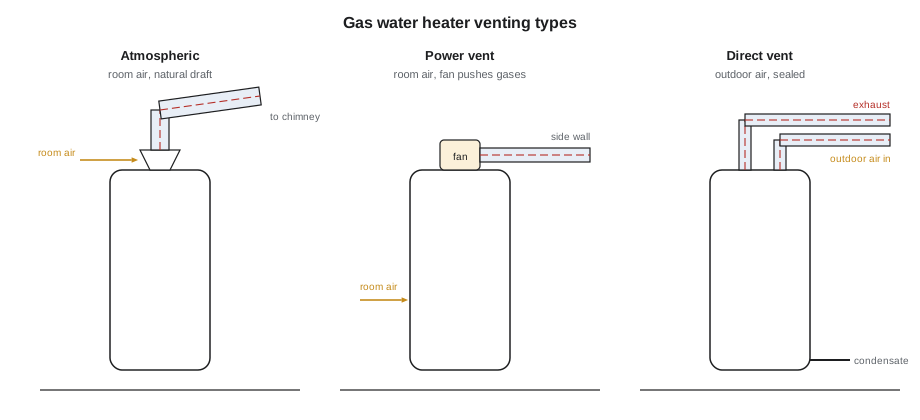
Atmospheric, power and direct venting
An atmospheric water heater draws combustion air from the room around it and vents by natural draft through a draft hood. The draft hood breaks the direct connection between the burner and the vent, so that a downdraft or a blocked vent does not blow out the flame, and it lets room air dilute the flue gases. The vent connector from the draft hood to the chimney or vent must be the right size, must rise continuously toward the vent with a minimum upward slope, must be as short as practical, must have the required clearance from combustible materials, and must be securely fastened at every joint. Atmospheric venting is the most sensitive to problems: if the room is depressurized by exhaust fans or the chimney is cold or blocked, the gases can spill out of the draft hood into the room.
A power-vented water heater has a fan that pushes the flue gases through a sealed vent, often plastic, usually out through a side wall. It still draws combustion air from the room. Power venting allows a water heater to be installed where there is no chimney, but it needs electricity, and its vent termination must meet the clearances for side-wall vents.
A direct-vent, or sealed-combustion, water heater draws its combustion air directly from outdoors through a pipe and exhausts through another, or through a concentric pipe with one inside the other. The combustion is sealed off from the indoor air entirely, so the appliance does not use room air and is not affected by exhaust fans or tight construction. Condensing tankless heaters and condensing storage heaters are almost always direct vent. Direct venting is the safest arrangement in modern, airtight buildings.
Every vent system must be installed with the materials, lengths, number of elbows and termination details listed in the manufacturer's instructions and permitted by the gas code. A plastic vent pipe on a condensing heater looks like plumbing drain pipe, but it is not interchangeable: many manufacturers specify a particular plastic, wall thickness and cement, or a listed polypropylene system, and some do not allow ordinary drainage pipe at all. Mixing materials or substituting fittings voids the listing.
Combustion air for appliances that use room air
Appliances that take combustion air from the room, like atmospheric and power-vented heaters, need enough air to burn properly and to dilute and carry the flue gases. In the United States, the rules come from the fuel gas code adopted locally, usually based on the International Fuel Gas Code or NFPA 54, the National Fuel Gas Code. A common rule is that a space with at least 50 cubic feet of volume per 1,000 Btu per hour of appliance input, in a building that is not unusually tight, can supply the air from indoors; otherwise, openings or ducts to the outdoors, sized for the total input, are required.
Combustion air openings must never be blocked. A common failure is a water heater closet with louvered doors that a homeowner replaced with solid ones, or a combustion air duct stuffed with insulation to stop a draft. The water heater still runs, but it starves for air, and carbon monoxide rises. On service calls, Maya learned to look at the room as well as the heater: is there a source of combustion air, and is it open?
# Rough check: does a small room have enough volume for indoor combustion air?
# Rule used in NFPA 54 / IFGC for standard construction: 50 cubic feet per 1,000 Btu/h
room_l, room_w, room_h = 8, 6, 8               # feet
inputs_btuh = {"water heater": 40000, "furnace": 80000}
volume = room_l * room_w * room_h
needed = 50 * sum(inputs_btuh.values()) / 1000
print(f"room volume {volume} cu ft, required {needed:.0f} cu ft")
print("enough indoor air" if volume >= needed else "not enough: openings to outdoors or adjacent space required")room volume 384 cu ft, required 6000 cu ft not enough: openings to outdoors or adjacent space required
In this example a small mechanical closet holding a water heater and a furnace falls far short. The appliances in it need combustion air openings sized by the gas code, or the space must open to a larger area of the building. This is the situation in which carbon monoxide problems start, and it is why a gas fitter calculates combustion air on every installation rather than guessing.
Spillage, testing and the plumber's role
After a gas water heater is installed or serviced, the gas fitter checks that it is venting properly. For an atmospheric heater, that includes a spillage test: with the heater running and the building's exhaust fans and dryer on and doors closed, a smoke source or mirror is held at the draft hood to see whether flue gases spill into the room instead of being drawn up the vent. Combustion is often checked with an analyzer that measures carbon monoxide in the flue gases. A heater that spills or produces excessive carbon monoxide is shut off and tagged until it is fixed.
A plumber who is not licensed for gas work does not perform these tests, but can recognize warning signs. Soot or scorch marks around the draft hood, rust or water on top of the heater, a disconnected or sagging vent connector, a flame that is yellow and lazy instead of blue, a strong smell when the burner runs, or occupants with headaches that improve when they leave the building are all reasons to stop work and call the gas fitter or the gas utility. In an emergency, the gas supply can be shut off at the appliance valve and the occupants moved outdoors.
Who may do the work
In Ohio, contractors who do plumbing and HVAC work for others are licensed by the Ohio Construction Industry Licensing Board, and cities such as Columbus require permits and inspections for gas piping and appliance installations and set who may do the work under their own rules. Gas piping, appliance connections and venting are usually done by a licensed plumbing or HVAC contractor with the training and permits the local authority requires. Other states have separate gas fitter licenses. A plumber should not assume that a plumbing license or an apprentice card covers gas work; the local building department decides.
Wherever the job is, the same boundaries apply. The plumber who installs the water heater is responsible for the water side: the cold and hot connections, the relief valve and its discharge, the expansion control, the drain pan and the mixing valves. The gas fitter is responsible for the gas piping, the appliance connection, the vent, the combustion air, lighting and testing. The electrician is responsible for any power. On the Kingsway job, the start-up of each heater was a joint event: Maya filled and bled the heater and checked the water side, Dana lit it and tested the combustion, and they both signed the start-up sheet.
Worked problem
A warning sign on a service call
On a service call to a house near Kingsway to replace a leaking faucet, Maya passes the basement water heater and notices black soot above the draft hood and water stains on the top of the tank. The vent connector is loose at the chimney. What should she do?
Show solution
- Recognize the signs: soot at the draft hood and a loose connector suggest spillage of combustion gases.
- Tell the homeowner right away, explain that it can produce carbon monoxide, and check that a working carbon monoxide alarm is present.
- If anyone feels unwell or the alarm sounds, get everyone outside and call the emergency number and the gas utility.
- Recommend that the heater be shut off at its gas valve until a licensed gas fitter inspects and repairs it, and report it to her supervisor.
- Do not reconnect or adjust the vent herself unless she holds the license for gas work.
Answer: Recognize, warn, protect the occupants and call the right person. Venting repairs belong to a licensed gas fitter.
Common mistakes
MistakeAssuming a plumbing license covers gas piping and venting.
InsteadCheck the local rules; gas work usually needs a separate certificate or license.
MistakeUsing ordinary drain pipe for a condensing heater vent.
InsteadUse only the vent materials listed in the heater's instructions.
MistakeIgnoring soot, rust or a loose vent connector on a service call.
InsteadWarn the occupants and call a licensed gas fitter.
MistakeBlocking combustion air openings to stop drafts.
InsteadKeep combustion air openings and ducts clear.
MistakeRelying on a CO alarm instead of correct venting.
InsteadInstall and maintain venting correctly; the alarm is only a backup.
Summary and key terms
- Incomplete combustion produces carbon monoxide, a colorless, odorless poison.
- Gas appliances need combustion air and a vent that removes all combustion products.
- Vent categories I to IV depend on vent pressure and whether the gases condense.
- Atmospheric heaters use room air and natural draft; power-vent heaters use a fan; direct-vent heaters draw outdoor air through a sealed system.
- Fuel gas rules come from the locally adopted code, usually based on the IFGC or NFPA 54.
- Spillage and combustion tests confirm safe venting; warning signs call for the gas fitter.
- Gas work needs the license and permits the local authority requires; a plumbing license may not cover it.
- Carbon monoxide
- A colorless, odorless poisonous gas produced by incomplete combustion.
- Draft hood
- A fitting on an atmospheric appliance that separates the burner from the vent and admits dilution air.
- Direct vent
- A sealed system that brings combustion air from outdoors and exhausts outdoors.
- Vent connector
- The pipe connecting an appliance to a chimney or vent.
- Spillage
- Flue gases escaping into the room instead of going up the vent.
- Combustion air
- The air an appliance needs to burn its fuel completely.
Practice problems
Work each problem on paper first, then reveal the answer to check.
What does incomplete combustion produce?
Show answer
Carbon monoxide.
Which vent category describes a condensing water heater?
Show answer
Category IV: positive pressure, condensing.
Where does a direct-vent heater get combustion air?
Show answer
Directly from outdoors through a sealed pipe.
Name two warning signs of venting problems.
Show answer
Soot at the draft hood and a loose or disconnected vent connector.
What is the common indoor air rule for combustion air in standard construction?
Show answer
At least 50 cubic feet per 1,000 Btu/h of appliance input.
Who decides who may do gas work on a job in Columbus?
Show answer
The local building department, under state and city rules.
Lesson quiz · 5 questions
Score 60% or more to complete this lesson.
Create a free account to save your progress, take quizzes and earn a certificate.