
PLB-130 · Lesson 9 of 12 · 26 min
Water hammer, arresters and thermal expansion
Grace Lin's phone rang late one evening. A tenant in a new townhouse complex complained that every time the dishwasher filled, a loud bang came from the wall, and the pipes shuddered. The next morning Grace found that the dishwasher's solenoid valve, which slams shut in a fraction of a second, was connected to a long run of small copper with no water hammer arrester. A week later, another complaint from the same complex: the water heater's relief valve dripped every afternoon. That one turned out to be thermal expansion in a closed system with no expansion tank. Both problems are about pressure spikes, and both are entirely preventable.
This lesson covers two kinds of pressure surge in water systems. Water hammer is a sudden spike caused by stopping moving water quickly. Thermal expansion is a slower rise caused by heating water in a system that has no room for it to expand. Each has its own causes, effects and cures, and each is something an apprentice will meet on service calls for the rest of their career.
What water hammer is
Water is heavy and almost incompressible. When it flows along a pipe, it carries momentum. If a valve at the end of the pipe closes slowly, the water slows down gently and nothing much happens. If the valve closes suddenly, the moving water slams into it and stops. Its momentum turns into a sharp rise in pressure that travels back up the pipe as a pressure wave at the speed of sound in water, close to a kilometer and a half a second in a rigid pipe and somewhat slower in copper or plastic. The wave reflects back and forth until friction damps it out. The bang people hear is the pressure wave hitting the pipe, and the shudder is the pipe moving on its supports.
Quick-closing valves cause most water hammer: solenoid valves on dishwashers, washing machines, ice makers and irrigation systems; single-lever faucets that can be snapped shut; flush valves; and quarter-turn ball valves closed quickly. Slow-closing valves such as globe valves and older compression faucets rarely cause it, because they take long enough to close that the water slows gradually.
Water hammer is more than a noise. The spike can be many times the normal working pressure. Over time it loosens pipe supports, fatigues soldered and crimped joints, damages valve seats, appliance valves, meters and gauges, and can split weak spots. Repeated hammer is a common cause of leaks at fittings near appliances.
How big the spike is
If a valve closes faster than the time it takes the pressure wave to travel to the far end of the pipe and back, the spike reaches its full size. That full spike depends only on the water's density, the speed of the wave and how fast the water was moving. This relationship is called the Joukowsky equation:
Here \(\rho\) is the water's density, \(a\) is the wave speed, roughly 4000 to 4500 ft/s in copper tube, and \(\Delta v\) is the change in velocity. A useful rule of thumb follows from it: suddenly stopping water raises the pressure by roughly 60 psi for every foot per second of velocity stopped. Stopping water moving at 5 ft/s gives a spike of nearly 300 psi, several times the normal pressure in the pipe.
If the valve closes more slowly than the wave's round-trip time, the spike is smaller. A rough estimate for slower closures divides the momentum of the water in the pipe by the closing time. Either way, the lessons are the same: the spike grows with velocity, with the length of the pipe feeding the valve and with how fast the valve closes. That is why velocity limits help control water hammer, and why long runs of small pipe to appliances with solenoid valves are the classic trouble spot.
Worked problem
Water hammer at a dishwasher solenoid
Water flows at 5 ft/s in a 66-foot run of copper to a dishwasher. The solenoid valve closes in 0.1 s. Take the wave speed as 4300 ft/s. Is the closure fast enough to produce the full spike, and how large is the spike?
Show solution
- Round-trip time for the wave: \(2L/a = 2 \times 66 / 4300 \approx 0.031\) s.
- The valve closes in 0.1 s, longer than 0.031 s, so the spike is less than the full Joukowsky value.
- Slow-closure estimate: \(\Delta p \approx 0.0269\, L v / t = 0.0269 \times 66 \times 5 / 0.1 \approx 89\) psi.
- That is about 89 psi on top of the working pressure.
Answer: About 89 psi of extra pressure, more than doubling the pressure in the pipe each time the dishwasher fills. A water hammer arrester near the valve is the cure.
# Water hammer spike for different closing times (US units)
A = 4300            # ft/s, wave speed in copper tube
L = 66.0            # ft of pipe feeding the valve
V = 5.0             # ft/s

t_crit = 2 * L / A
full = 0.01346 * A * V                        # psi, Joukowsky
print(f"wave round trip {t_crit:.3f} s; full spike {full:.0f} psi")
for t in (0.02, 0.05, 0.1, 0.5, 2.0):
    if t <= t_crit:
        dp = full
    else:
        dp = 0.0269 * L * V / t
print(f"close in {t:4.2f} s: spike about {dp:5.0f} psi")wave round trip 0.031 s; full spike 289 psi close in 0.02 s: spike about 289 psi close in 0.05 s: spike about 178 psi close in 0.10 s: spike about 89 psi close in 0.50 s: spike about 18 psi close in 2.00 s: spike about 4 psi
The output shows why fast valves are the problem. Close the same valve over two seconds and the spike is small; snap it shut in a few hundredths of a second and the full spike arrives.
Water hammer arresters
A water hammer arrester is a small device with a sealed chamber of air or gas separated from the water by a piston or bellows. When a pressure spike arrives, the water pushes the piston and compresses the gas, absorbing the shock like a spring. Because the gas is sealed away from the water, it cannot dissolve into the water and disappear, so the arrester keeps working for years.
Older buildings often have air chambers: capped vertical stubs of pipe above fixture connections, which trap a pocket of air. They work at first, but the air slowly dissolves into the water and the chamber fills with water, at which point it does nothing. Most current codes require engineered water hammer arresters tested to a recognized standard rather than plain air chambers, and require them where quick-closing valves are installed.
Arresters are sized by the load on the branch they protect. The plumbing industry's standard sizing method assigns letter sizes, from the smallest for a single fixture to the largest for long branches with many fixtures, based on the fixture units on the branch. The tables assume a moderate working pressure; above that, the next size up is chosen. Manufacturers publish the tables, and the engineer marks the size on the drawings.
Placement matters as much as size. An arrester works best close to the valve that causes the shock, because that is where the wave starts. On a branch with several fixtures, the arrester usually goes near the end of the branch, between the last two fixtures; long branches may need more than one. For a single appliance with a solenoid valve, the arrester goes as close to the valve as possible, often in the appliance's supply box. Arresters must be accessible if the manufacturer requires it, and they must be installed in the orientation the manufacturer approves.
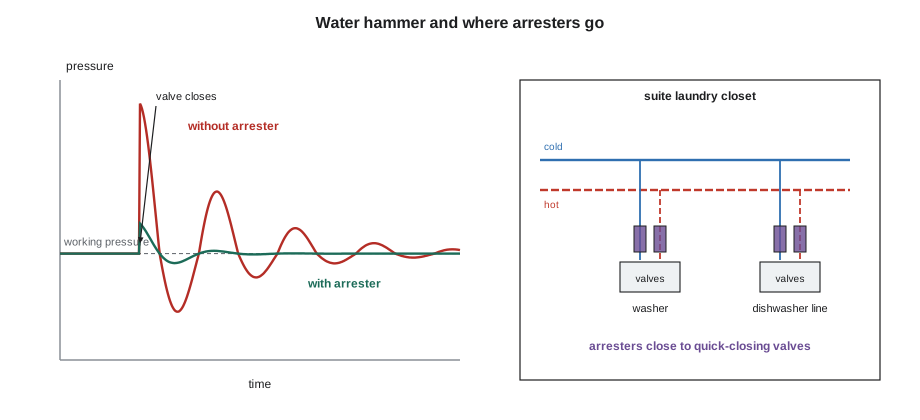
At Kingsway, each suite's laundry closet manifold has arresters on the hot and cold lines serving the washing machine, and the dishwasher supply has its own arrester at the kitchen. The booster pump package has a different solution for its own surges: the variable-speed drives ramp the pumps up and down slowly, and the check valves are a non-slam type that close before the water reverses.
Thermal expansion
When water is heated, it expands. Cold water heated from about 50 °F to 140 °F grows by close to 2 percent of its volume. In an open system, where the cold water supply connects back to the city main with nothing in between, that extra volume simply pushes back into the main and nobody notices. But most modern buildings are closed systems. A backflow preventer, check valve or pressure-reducing valve on the water service stops water from flowing backward into the main. When the water heater fires, the expanding water has nowhere to go, and pressure in the whole building climbs.
The pressure rise is fast and large, because water is so stiff. In a closed system with no air anywhere, heating a tank of water can raise the pressure by hundreds of kilopascals or tens of psi in minutes. The symptoms are familiar to service plumbers: a water heater relief valve that drips during or after each heating cycle; toilet fill valves that hiss or run after the heater fires; faucets that spurt when opened; and, eventually, burst appliance hoses or leaking water heater tanks.
The Ohio Plumbing Code, following the IPC, requires a means of controlling increased pressure from thermal expansion wherever a backflow preventer, check valve or pressure-reducing valve makes the system closed. In practice that is almost always a properly sized expansion tank. The water heater's relief valve is a safety device for emergencies, not a way to control everyday expansion.
Expansion tanks
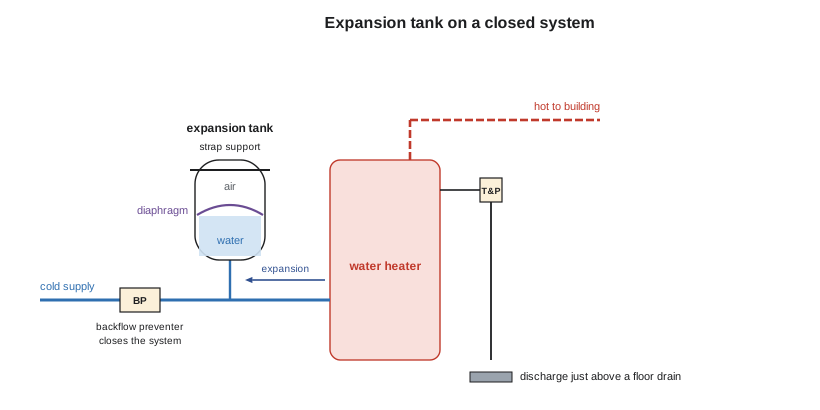
A thermal expansion tank is a small steel tank divided inside by a rubber diaphragm or bladder. The water side connects to the system; the other side holds air or nitrogen at a set precharge pressure. When the water heats and expands, the extra water pushes into the tank and compresses the gas, and the system pressure rises only a little. When the water cools or is used, the gas pushes the water back out.
- Location: on the cold water supply to the water heater, between the heater and the backflow preventer, check valve or PRV that closes the system. Mounting it close to the heater on the cold side is common.
- Precharge: set the gas pressure to match the system's static water pressure at the tank, with the tank isolated and drained on its water side. A tank precharged too low fills with water before the heater fires and has no room left to absorb expansion.
- Support: an expansion tank full of water is heavy. Support it with a bracket or strap; do not hang it on a small copper tee.
- Material: tanks for potable water must be approved for it, with a liner that keeps water away from the steel shell.
Expansion tanks are sized from the volume of water being heated, the temperature rise, the system's static pressure and the maximum pressure the designer allows. The gas in the tank behaves according to absolute pressure, so the sizing formula uses absolute pressures. For a single house, manufacturers publish simple tables. For a building like Kingsway, the engineer calculates it.
Here \(V_s\) is the volume of water heated, the density ratio gives the fraction it expands, \(P_1\) is the system pressure when cold and \(P_2\) is the highest pressure allowed, which must stay safely below the relief valve setting.
Worked problem
Sizing Kingsway's expansion tanks
Kingsway's three heaters hold 360 gallons, and the connected piping between the heaters and the check valves in the booster holds about 40 gallons. Water is heated from 50 °F to 140 °F, which makes it expand by about 1.68 percent. The cold system pressure at the heaters is 100 psig and the designer allows a maximum of 125 psig, well below the 150 psi relief setting. What total tank volume is needed?
Show solution
- Water heated: \(V_s = 360 + 40 = 400\) gallons.
- Expansion: \(400 \times 0.0168 \approx 6.7\) gallons must be absorbed.
- Absolute pressures: \(P_1 = 100 + 14.7 = 114.7\) psia, \(P_2 = 125 + 14.7 = 139.7\) psia.
- \(1 - P_1/P_2 = 1 - 114.7/139.7 \approx 0.179\).
- Tank volume: \(V_t = 6.7 / 0.179 \approx 37.5\) gallons.
Answer: About 37.5 gallons of total tank volume. Kingsway has two 20-gallon tanks on the heater cold supply header, with their precharge set to 100 psi.
The answer surprises most apprentices: the tank is much bigger than the 25 liters or 7 gallons of expansion, because the gas can only be squeezed so far before the pressure reaches the allowed maximum. A higher system pressure makes the tank larger, which is one more reason to keep system pressures moderate.
# Thermal expansion tank size (US units, absolute pressures)
def density(t_f):
    t_c = (t_f - 32) / 1.8
    # approximate density of water relative to 1000 kg/m^3, good from about 40 to 175 F
    return 1 - (t_c + 288.9414) / (508929.2 * (t_c + 68.12963)) * (t_c - 3.9863) ** 2

def tank_gal(v_sys, t_cold, t_hot, p1_gauge, p2_gauge, atm=14.7):
    grow = density(t_cold) / density(t_hot) - 1
    p1, p2 = p1_gauge + atm, p2_gauge + atm
    return v_sys * grow / (1 - p1 / p2), grow

for p1 in (50, 80, 100):
    v, g = tank_gal(400, 50, 140, p1, p1 + 25)
print(f"cold {p1} psi, max {p1 + 25} psi: expansion {g:.4f}, tank {v:5.1f} gal")cold 50 psi, max 75 psi: expansion 0.0168, tank 24.1 gal cold 80 psi, max 105 psi: expansion 0.0168, tank 32.2 gal cold 100 psi, max 125 psi: expansion 0.0168, tank 37.6 gal
Each line of output keeps the same allowed rise above the cold pressure, and the tank grows as the system pressure rises.
Checking and servicing expansion tanks
Expansion tanks fail quietly. The diaphragm can rupture or the precharge can leak away, and the tank fills with water. A failed tank feels heavy and solid when tapped and sounds dull rather than hollow. To check the precharge, isolate the tank, drain its water side and measure the gas pressure at the valve on top with a tire gauge. If it reads low, top it up with a bicycle pump or nitrogen to match the system's static pressure. If water comes out of the gas valve, the diaphragm has failed and the tank must be replaced.
When Grace returned to the townhouse complex with the dripping relief valve, she found that an expansion tank had been installed, but its precharge had been left at the factory setting, far below the building's static pressure. The tank had filled with water the day the system was turned on and had never absorbed any expansion. Setting the precharge correctly stopped the dripping. A thirty-second check at installation would have saved a service call.
Common mistakes
MistakeInstalling plain capped air chambers to stop water hammer.
InsteadUse tested water hammer arresters sized and placed as the manufacturer and the engineer specify.
MistakePutting the arrester far from the quick-closing valve.
InsteadMount it as close as possible to the valve, or near the end of the branch between the last two fixtures.
MistakeTreating a dripping relief valve as a faulty valve and replacing it.
InsteadCheck for thermal expansion in a closed system and for a failed or wrongly charged expansion tank.
MistakeLeaving an expansion tank's precharge at the factory setting.
InsteadSet the precharge to the system's static pressure with the water side drained.
MistakeHanging a large expansion tank on the pipe.
InsteadSupport it independently with a bracket or strap.
Summary and key terms
- Water hammer is a pressure spike caused by stopping moving water suddenly, usually by a quick-closing valve.
- The full spike equals density times wave speed times the velocity stopped; it is smaller if the valve closes slowly.
- Water hammer arresters absorb the spike with a sealed gas chamber and are sized by fixture units and placed near the valve.
- Heating water from 50 °F to 140 °F expands it by close to 2 percent; in a closed system the pressure climbs quickly.
- Backflow preventers, check valves and PRVs make systems closed, and codes then require thermal expansion control.
- Expansion tanks go on the heater's cold supply, are sized with absolute pressures and must be precharged to the static pressure.
- Water hammer
- A pressure surge caused by suddenly stopping the flow of water.
- Water hammer arrester
- A device with a sealed gas chamber that absorbs water hammer pressure spikes.
- Air chamber
- A capped pipe stub that traps air to cushion water hammer; it waterlogs over time.
- Closed system
- A water system in which a check valve, backflow preventer or PRV stops water flowing back to the main.
- Expansion tank
- A tank with a gas cushion behind a diaphragm that absorbs the expansion of heated water.
- Precharge
- The gas pressure set in an expansion tank before it is filled with water.
Practice problems
Work each problem on paper first, then reveal the answer to check.
Why do solenoid valves cause water hammer?
Show answer
They close in a fraction of a second, stopping the water suddenly.
Using the rule of thumb, roughly what spike results from suddenly stopping water moving at 4 ft/s?
Show answer
About 60 times 4, roughly 240 psi.
Where should a water hammer arrester go on a branch serving several fixtures?
Show answer
Near the end of the branch, between the last two fixtures.
Why do air chambers stop working?
Show answer
The air dissolves into the water and the chamber fills with water.
What makes a water system closed?
Show answer
A backflow preventer, check valve or pressure-reducing valve on the supply.
An expansion tank sounds dull and feels heavy. What is likely wrong?
Show answer
It is waterlogged: its precharge has leaked away or its diaphragm has failed.
Lesson quiz · 5 questions
Score 60% or more to complete this lesson.
Create a free account to save your progress, take quizzes and earn a certificate.