
PLB-130 · Lesson 11 of 12 · 20 min
Protecting water quality
The water that arrives at Kingsway's meter room has been treated, tested and monitored by the city. Whether it is still safe when it comes out of a twelfth-floor faucet depends on the building: the materials it touches, how long it sits, how warm it gets and whether anything dirty can find its way back into it. Luis told Maya that keeping water safe is the plumber's most important job and the easiest one to forget, because a mistake usually cannot be seen, smelled or tasted until someone gets sick.
This lesson covers the main ways water quality is protected inside a building: choosing safe materials and keeping lead out, limiting how long water sits in the pipes, controlling the temperatures that let bacteria grow, keeping construction debris out of new systems, and preventing cross-connections and backflow. Backflow prevention is covered in depth in PLB-310; here it is introduced so that you can recognize the hazards and understand why devices are where they are.
Safe materials and lead
Every pipe, fitting, valve, solder, flux, sealant and device that touches drinking water must be approved for potable water. In the United States and Canada, products are tested and certified to health effects standards, the most widely used being NSF/ANSI/CAN 61 for drinking water components and NSF/ANSI/CAN 372 for lead content. The Ohio Plumbing Code requires materials in potable water systems to meet these kinds of standards, and the product's marking or certification shows that it does.
Lead is the biggest historic concern. Lead service lines, lead solder and leaded brass were once common, and lead leaches into water, especially soft or corrosive water that sits in the pipes. There is no known safe level of lead exposure, and young children are the most vulnerable. Modern codes limit lead in solder and flux and in the wetted surfaces of pipes, fittings and fixtures to very low levels, as PLB-110 described.
In the United States, the Environmental Protection Agency's Lead and Copper Rule Improvements, finalized in 2024, require water systems to inventory and replace lead service lines over the following years and lower the lead action level to 0.010 mg/L. Water systems must comply by November 2027 and replace most lead service lines by 2037. Columbus, like other utilities, has a lead service line inventory and replacement program. When a plumber working on an older house finds a dull gray, soft service pipe that scratches shiny with a key, it is likely lead, and the homeowner should be told about the city's program.
Even in new buildings, follow the material rules exactly. Use only lead-free solder and flux on potable lines, use only thread sealants approved for potable water, and never use materials meant for heating systems, such as some brass fittings or boiler sealants, on drinking water piping.
Water age and stagnation
Water that sits in pipes changes. The disinfectant the city added, usually chlorine or chloramine, slowly breaks down. The water warms toward room temperature. Metals dissolve from pipes and fittings, and bacteria can grow on pipe walls in a thin slimy layer called biofilm. The longer water sits, the more these changes add up. The time water spends in the building's pipes is called water age.
Water age is high wherever water moves slowly or not at all: oversized pipes, long branches to fixtures that are rarely used, dead legs, and whole buildings with low occupancy. A dead leg is a section of pipe that carries no flow, such as a capped branch left from a removed fixture or a branch to a future fit-out. Dead legs hold stagnant water that can seed the rest of the system with bacteria.
- Size pipes for realistic demand, not generously. Oversized pipes hold more water and move it more slowly.
- Avoid dead legs. Cut back removed branches to the main, and keep future connections short.
- Keep hot and cold pipes separated or insulated so cold water does not warm up and hot water does not cool down into the danger range.
- Flush a new building before people move in, and flush low-use areas regularly.
Low occupancy is a real problem in new buildings. A tower that opens with only a few residents uses a small fraction of the water the system was designed for, and water may sit in the pipes for days. Building operators flush the system on a schedule until occupancy rises. The program below estimates water age in Kingsway's high zone from the volume of the piping and the daily use at different occupancies.
# Rough water age in a pressure zone at different occupancies (US units)
PIPE_VOLUME_GAL = 630       # cold piping in the high zone, gallons (estimate)
USE_PER_SUITE = 100         # gallons of cold water per occupied suite per day
SUITES = 70

for occupied in (0.05, 0.2, 0.5, 1.0):
    daily = SUITES * occupied * USE_PER_SUITE
    days = PIPE_VOLUME_GAL / daily
    print(f"{occupied:4.0%} occupied: {daily:7.0f} gal/day  average water age {days * 24:5.1f} h")
# The average hides the worst cases: water in a branch to an empty suite
# does not move at all until someone opens a tap.5% occupied: 350 gal/day average water age 43.2 h 20% occupied: 1400 gal/day average water age 10.8 h 50% occupied: 3500 gal/day average water age 4.3 h 100% occupied: 7000 gal/day average water age 2.2 h
At full occupancy, the water in the zone's mains turns over in about two hours on average. At five percent occupancy, it sits for more than a day and a half, and the water in branches to empty suites does not move at all. That is why Kingsway's operator flushed every suite weekly through the first months after opening.
Legionella and temperature
Legionella bacteria live naturally in fresh water. They multiply in warm water, roughly 77 °F to 113 °F, especially where water is stagnant and biofilm, sediment and scale give them shelter. People become ill by breathing in fine droplets of contaminated water, from showers, faucets with aerators, decorative fountains, hot tubs and cooling towers. Legionnaires' disease is a serious pneumonia, most dangerous for older people, smokers and those with weakened immune systems.
Plumbing systems control Legionella mainly with temperature and flow:
Keep hot water hot. Store it at 140 °F or more, keep the recirculating loop hot enough that water returns well above the growth range, often about 122 °F or more, and avoid long uncirculated hot branches.
Keep cold water cold. Ideally below about 68 °F. Insulate cold pipes that run near hot pipes or through warm ceiling spaces and shafts.
- Keep water moving. Avoid dead legs and flush low-use outlets.
- Keep systems clean. Drain and clean water heaters and storage tanks as the manufacturer recommends, and remove sediment.
Large buildings, health care facilities and buildings with vulnerable occupants increasingly have a water management program, a written plan that identifies where Legionella could grow, sets control limits such as minimum temperatures, and requires regular monitoring and corrective action. An industry standard from ASHRAE sets out how to build such a program, and some health authorities and building owners require one. For an apprentice, the practical message is that the temperature settings and balancing valves set during commissioning are part of that safety plan, not just comfort settings.
Keeping new systems clean
Construction is hard on water quality. Pipe sits on site in the rain and dust; mice, insects and debris get into open ends; flux, cutting oil and shavings collect inside; and partly finished systems sit full of stagnant water for months. Good practice keeps problems out from the start:
- Store pipe off the ground with the ends capped, and keep fittings in their bags or boxes.
- Cap or plug every open end at the end of the shift, not just at the end of the job.
- Ream and clean every cut, and use only as much flux as the joint needs; excess flux runs inside and can cause pitting.
- Flush each section after installation to clear debris before connecting it to fixtures and valves with fine strainers or cartridges.
Lesson 12 covers the final flushing and disinfection of the completed system.
Cross-connections and backflow
A cross-connection is any actual or possible connection between the potable water system and anything that could contaminate it: a non-potable pipe, a tank, a boiler, a chemical, a drain or simply a hose left in a bucket. Backflow is water flowing the wrong way, from the cross-connection back into the potable system. It happens in two ways.
- Backsiphonage occurs when the supply pressure drops below atmospheric, for example during a water main break, a fire-fighting flow or a booster failure. The negative pressure sucks water backward, like drinking through a straw.
- Backpressure occurs when the pressure on the contaminated side rises above the supply pressure, for example from a boiler, a pump or an elevated tank, and pushes water backward into the potable system.
Real incidents show why this matters. Chemicals from lawn sprayers, boiler treatment, car washes and even mortuary equipment have been drawn into public water through unprotected cross-connections. A hose submerged in a laundry tub or a pail of floor cleaner is the most common cross-connection in any building, and a vacuum at the wrong moment is all it takes.
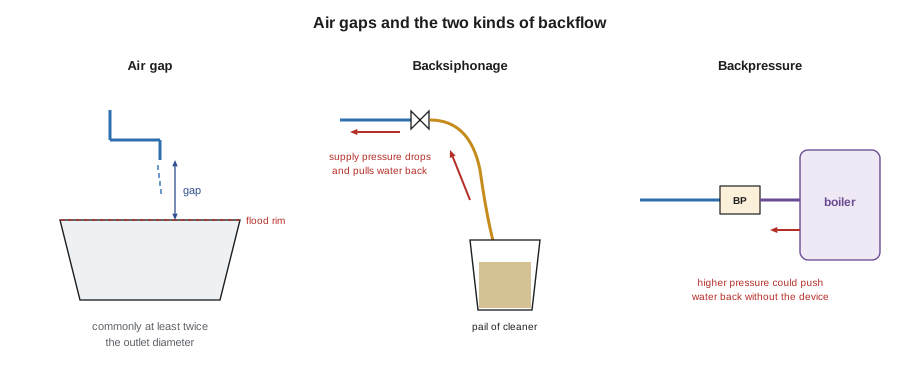
Backflow is prevented in two ways. The most reliable is an air gap: a physical open space between the water outlet and the flood level of whatever it fills. A faucet spout above a sink rim is an air gap. Codes set the minimum gap, commonly twice the diameter of the outlet. Where an air gap is impractical, a mechanical backflow preventer is used. The main types, in rough order of the protection they give, are atmospheric vacuum breakers, pressure vacuum breakers, double check valve assemblies and reduced pressure principle assemblies. Each is suited to certain hazards and certain conditions, and the more hazardous the connection, the higher the level of protection required.
In Ohio, the Plumbing Code requires backflow protection for connections to the potable system, and Ohio EPA rules require public water systems to run cross-connection control programs, which in cities such as Columbus include premise isolation and annual testing by certified testers. PLB-310 covers device selection, installation and testing.
At Kingsway, protection is layered. A double check valve assembly in the meter room isolates the whole building from the city. Inside, the fire sprinkler service has its own backflow preventer, the boiler make-up water has a reduced pressure assembly because boiler chemicals are a high hazard, the garage hose bibbs have vacuum breakers, and every faucet has an air gap at its spout.
Treatment equipment
Some buildings add treatment equipment: water softeners in hard water areas, filters for taste or sediment, ultraviolet units, or chemical feeders. Treatment equipment can improve water, but it can also make it worse if neglected. Filters that are never changed grow bacteria; softeners that are not regenerated or disinfected can harbor them; and any equipment that adds chemicals is a potential cross-connection. Treatment devices must be approved for potable water, installed with bypass and isolation valves, protected against backflow where required, and handed over with clear maintenance instructions.
Reading the signs on a service call
Residents usually notice water quality problems before anyone tests for them, and the complaint often points to the cause. Brown or rusty water after a shutdown usually means sediment or iron stirred up from old piping or the city main, and it clears with flushing. Blue-green stains on fixtures suggest copper being dissolved by aggressive water. A rotten-egg smell from the hot water only, but not the cold, often comes from bacteria reacting with the water heater's anode rod. A chlorine smell is usually just the city's disinfectant and is harmless. Cloudy water that clears from the bottom of the glass up is tiny air bubbles, common after work on the system. Grace Lin's advice to Maya: note exactly which taps, hot or cold, and when, because those three facts usually tell you where to look.
Common mistakes
MistakeUsing a sealant or fitting meant for heating systems on potable piping.
InsteadUse only materials certified for potable water and meeting lead-free limits.
MistakeLeaving a capped branch for a future fixture several meters long.
InsteadAvoid dead legs; keep future connections as short as possible or remove them.
MistakeLeaving pipe ends open on site overnight.
InsteadCap or plug every open end at the end of each shift.
MistakeTreating hose bibbs as harmless.
InsteadProvide vacuum breakers; a submerged hose is the most common cross-connection.
MistakeTurning down hot water temperatures to save energy without thinking about bacteria.
InsteadKeep storage and recirculating temperatures high enough to control Legionella and limit delivery temperature at the fixture.
Summary and key terms
- Every material that touches drinking water must be certified for potable use and meet lead-free limits.
- Lead service lines and leaded materials remain a hazard in older buildings, and cities have replacement programs.
- Water age rises in oversized pipes, dead legs and low-occupancy buildings; flushing and good sizing keep water moving.
- Legionella grows in warm, stagnant water and is controlled by keeping hot water hot, cold water cold and water moving.
- Construction debris is kept out by capping pipe, cleaning joints and flushing.
- Cross-connections can let contaminated water back in by backsiphonage or backpressure; air gaps and backflow preventers stop it.
- Water age
- The time water spends in a building's piping between entering and being used.
- Dead leg
- A section of piping where water does not flow, such as a capped branch.
- Biofilm
- A thin layer of bacteria and other microorganisms that grows on the inside of pipes.
- Cross-connection
- An actual or possible connection between potable water and a source of contamination.
- Backsiphonage
- Backflow caused by negative pressure in the supply.
- Air gap
- An open vertical space between a water outlet and the flood level of the receptor it fills.
Practice problems
Work each problem on paper first, then reveal the answer to check.
Why is lead in drinking water a particular concern for young children?
Show answer
There is no known safe level, and children are the most vulnerable to its effects.
Name three causes of high water age.
Show answer
Oversized pipes, dead legs and low occupancy; also rarely used fixtures.
In what temperature range does Legionella grow best?
Show answer
Roughly 77 °F to 113 °F.
What is the difference between backsiphonage and backpressure?
Show answer
Backsiphonage is caused by negative supply pressure; backpressure by higher pressure on the contaminated side.
What is the most reliable form of backflow prevention?
Show answer
An air gap.
Why does a boiler make-up line need a high level of backflow protection?
Show answer
Boiler water contains treatment chemicals and is under pressure, a high hazard.
Lesson quiz · 5 questions
Score 60% or more to complete this lesson.
Create a free account to save your progress, take quizzes and earn a certificate.