
PLB-130 · Lesson 7 of 12 · 24 min
Hot water supply and recirculation
Two years after a building opens, the complaint that service plumbers hear most is not about leaks or pressure. It is about hot water: it takes forever to arrive, it runs lukewarm on the top floors, or it scalds someone in the shower. Grace Lin told Maya that almost every one of those calls traces back to how the hot water system was designed, balanced or maintained. Hot water is where pressure, flow, temperature and water quality all meet, and it deserves a lesson of its own.
This lesson covers the hot water side of Kingsway Tower: how the water is heated and stored, why it is stored hot and delivered cooler, how mixing valves protect people from scalds, why large buildings recirculate hot water, how recirculation is sized and balanced, and how insulation and controls keep the system efficient. Water heater installation and venting are covered in later courses; the focus here is on the water piping.
Heating and storing hot water
Buildings heat water in one of three ways. A storage water heater heats water in a tank and keeps it hot until it is used. A tankless or instantaneous heater heats water only as it flows, with a large burner or element that can raise the temperature quickly. A central plant, common in large buildings, uses boilers or large heaters to heat water through a heat exchanger into storage tanks. Each approach has trade-offs between first cost, space, energy use and how well it handles a short, heavy peak.
Storage is valuable in apartment buildings because demand comes in sharp peaks. In the morning, dozens of showers run at once for half an hour; the rest of the day, demand is low. A system with storage can meet the morning peak from hot water in the tanks and reheat slowly afterward. A system without storage must have enough heating capacity to meet the peak flow instantly, which takes much larger burners and gas piping.
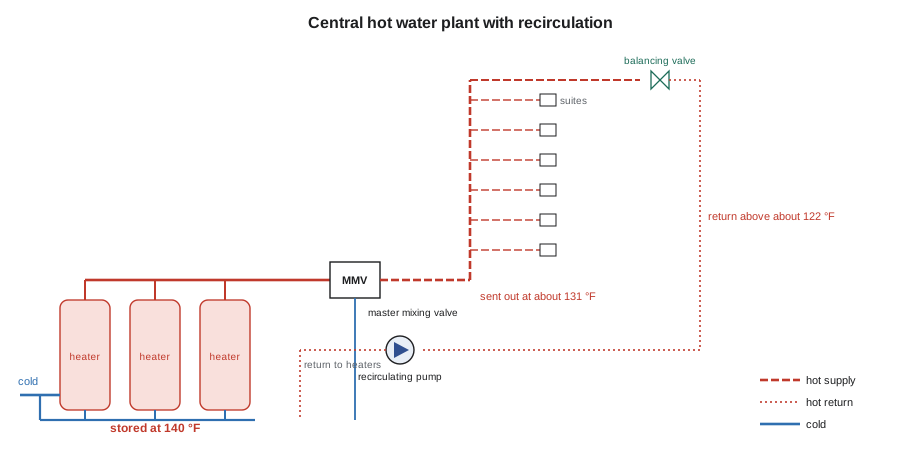
Kingsway's hot water plant, in the lower parking level mechanical room beside the booster pumps, has three gas-fired condensing storage water heaters piped in parallel, each holding about 120 gallons. Cold water reaches them from the booster discharge header. The high zone's hot water leaves the plant directly; the low zone's hot water passes through its own pressure-reducing valve station, just as the cold does.
Parallel heaters must be piped so that each one carries an equal share of the flow. The usual method is reverse return piping, in which the first heater to receive cold water is the last to deliver hot water, so every path through the plant is the same length. If one heater carries more than its share, it works harder and wears out sooner while the others sit idle.
Stored hot, delivered safe
Two hazards pull the hot water temperature in opposite directions. Legionella bacteria, which cause a serious pneumonia called Legionnaires' disease, grow best in warm water, roughly between 77 °F and 113 °F, and are controlled when water is kept hot. Scalding, on the other hand, happens quickly at high temperatures: water at 140 °F can cause a serious burn in a few seconds, while water at 120 °F takes several minutes. Young children and older adults burn fastest.
The answer is to store water hot and deliver it cooler. Water heaters are often set to 140 °F, which helps control bacteria in the tank. The Ohio Plumbing Code, following the IPC, requires shower and bathtub valves to limit the outlet temperature to 120 °F, and public hand-washing fixtures to deliver tempered water at a lower temperature. The water between those two points, in the distribution piping, is kept hot enough to discourage bacteria and cooled at or near the fixture.
Mixing valves
Mixing valves blend hot and cold water to a set outlet temperature. There are several kinds, each tested to its own standard, and they are used at different points in a system.
- Master or central thermostatic mixing valves sit at the water heater plant and set the temperature of the water sent out to the building. They handle large flows and are usually set somewhat above the delivery temperature so that the water reaching the fixtures, after losing some heat in the pipes, is still hot enough.
- Point-of-use or point-of-distribution mixing valves sit near a fixture or group of fixtures, under a sink or in a wall, and limit the temperature delivered to them.
- Pressure-balancing shower valves keep the mix steady when the pressure in the hot or cold supply changes, for example when someone flushes a toilet. They have a limit stop that sets the maximum hot position.
- Thermostatic shower valves sense the outlet temperature directly and adjust the mix to hold it steady, even if the supply temperatures change.
Mixing valves need maintenance. Their elements and check valves can scale up or stick, especially in hard water areas, and a valve that fails can send water that is too hot or too cold. They need isolation valves and strainers, and the limit stops on shower valves must be set and checked when the building is commissioned. A shower valve's limit stop is set by measuring the hottest water it delivers with a thermometer and adjusting the stop until it reads at or below the limit.
At Kingsway, a master thermostatic mixing valve at the plant sends hot water to the building at about 131 °F. Each suite's tub and shower has a pressure-balancing valve with its limit stop set to 120 °F. The kitchen sinks, dishwashers and washers receive the 131 °F water directly, as the code allows for those fixtures.
Why large buildings recirculate
In a house, when you open a hot tap, the cold water sitting in the pipe has to run out before hot water arrives. With a short run, that takes a few seconds. In a large building, the hot water pipe from the plant to a twelfth-floor suite holds a lot of water. Without recirculation, the water in the pipe would cool between uses, and a resident might run the tap for minutes before it turned hot, wasting water and energy and annoying everyone.
A recirculation system keeps hot water moving through a loop: out from the plant in supply pipes, up the risers and back to the plant in return pipes. A small pump drives the flow. Because water keeps moving, it stays hot all the way to each riser, and the wait at the tap is only for the water in the short branch from the riser to the fixture. Recirculation also keeps water from sitting lukewarm, which helps control bacteria.
The Ohio Plumbing Code, following the IPC, requires a circulation system or heat tracing where the developed length of hot water piping from the source to the farthest fixture exceeds 50 feet, and energy codes add requirements for controls and insulation. For Kingsway, with every suite well over 50 feet of pipe from the plant, recirculation is plainly required.
How much water must recirculate
The recirculation flow is not sized for the fixtures; they draw from the supply piping. It is sized to replace the heat the loop loses while no one is using hot water. Every meter of insulated pipe still loses some heat. If the water flows too slowly, it cools too much before it returns. The designer picks the temperature drop allowed around the loop, often a few degrees, adds up the heat loss of all the supply piping, and calculates the flow needed to carry that heat.
The 500 comes from the weight and heat capacity of water: one gallon per minute flowing for an hour carries about 500 Btu for every degree Fahrenheit of temperature change.
Worked problem
Recirculation flow for Kingsway's high zone
The high zone's hot water supply piping has an estimated heat loss of 14,300 Btu/h with insulation. The engineer allows the water to drop 9 °F around the loop. What recirculation flow is needed?
Show solution
- \(\text{gpm} = 14\,300 / (500 \times 9)\).
- \(500 \times 9 = 4\,500\).
- \(\text{gpm} = 14\,300 / 4\,500 \approx 3.2\) gpm.
Answer: About 3.2 gpm, a small flow compared with the fixture demand. The recirculation pump and return piping are small.
Because the recirculation flow is small, the return pipes are much smaller than the supply pipes. Many designers size the return for a low velocity to keep noise and erosion down, since it runs all day.
Balancing the loop
Kingsway has several hot water risers, each with its own return. Water follows the easiest path, so without help, most of the recirculation flow would go through the riser closest to the pump and very little through the farthest. The far risers would cool, and residents at the end of the building would wait for hot water. Balancing makes each riser get its share.
Balancing valves at the top or bottom of each return riser set the flow through that riser. Manual balancing valves have a calibrated opening and test ports; a technician measures the flow and sets each valve during commissioning. Thermostatic balancing valves adjust themselves automatically: they open when the returning water is cool and throttle when it is hot, so each riser takes only the flow it needs. Many modern buildings use thermostatic valves because they keep the loop balanced as conditions change.
Poor balancing is one of the most common causes of hot water complaints in apartment buildings. When Grace gets a call about slow hot water on one side of a building, she checks the return temperature at each riser. A riser whose return is much cooler than the others is not getting enough flow, usually because a balancing valve is closed, stuck or set wrong, or because a check valve has failed.
The recirculation pump and controls
The recirculation pump is a small circulator, usually bronze or stainless steel because it pumps fresh, oxygenated water that would corrode cast iron. A check valve after the pump stops water flowing backward through the return when a fixture draws hot water. Isolation valves on each side let the pump be replaced.
Controls decide when the pump runs. A pump that runs all the time keeps water hottest and best controls bacteria, but uses electricity and loses more heat. Energy codes often require controls such as timers or temperature sensors that stop the pump when it is not needed. In residential buildings, where people use hot water at any hour, many designers run the pump continuously with an efficient motor, accepting the energy cost for the comfort and the bacterial control. Kingsway's pump runs continuously, with an alarm that warns the building operator if the return temperature falls too low.
The return water must re-enter the plant at the right point. If it enters the cold supply to the heaters, it raises the heater inlet temperature. If it enters the hot outlet after the master mixing valve, it can upset the mixing valve's control. The engineer's drawings show the exact connection, and the mixing valve manufacturer's instructions often specify it, because a wrong connection can make the valve deliver water that is too hot or too cold.
Insulation and heat loss
Insulating hot water pipes saves energy, keeps the water hotter and reduces the recirculation flow. Energy codes require insulation on hot water supply and return piping, with thicker insulation for larger pipes. The insulation must be continuous through hangers, which is why insulation shields or inserts are used at supports, and its vapor retarder must be sealed on cold pipes nearby so that condensation does not soak it. Uninsulated valves and fittings in a mechanical room can lose a surprising amount of heat.
Heat loss sets how fast the water in a branch cools between uses. That cooling, together with the volume of water in the branch, decides how long a resident waits for hot water. Keeping branches short and small is the best way to keep waits short. The program below estimates the wait at a few fixtures from the volume of water in the branch and the fixture's flow.
# Waiting time for hot water at the fixture (US units)
import math

def gal_per_ft(id_in):
    return math.pi * id_in ** 2 / 4 * 12 / 231

branches = [("kitchen sink, 1/2 in PEX", 0.475, 20, 1.5),
            ("ensuite shower, 1/2 in PEX", 0.475, 46, 2.0),
            ("ensuite lavatory, 1/2 in PEX", 0.475, 43, 1.2),
            ("same lavatory, 3/4 in line", 0.785, 43, 1.2)]
for name, d, length, gpm in branches:
    vol = gal_per_ft(d) * length
    wait = vol / gpm * 60
print(f"{name:28s} {vol:4.2f} gal in the line {wait:4.0f} s wait at {gpm} gpm")kitchen sink, 1/2 in PEX 0.18 gal in the line 7 s wait at 1.5 gpm ensuite shower, 1/2 in PEX 0.42 gal in the line 13 s wait at 2.0 gpm ensuite lavatory, 1/2 in PEX 0.40 gal in the line 20 s wait at 1.2 gpm same lavatory, 3/4 in line 1.08 gal in the line 54 s wait at 1.2 gpm
The last two lines make the point: upsizing a long branch to a low-flow lavatory more than doubles the wait, because the faucet has to push out much more cold water before hot arrives. Bigger is not always better in hot water piping.
Relief valves and safety
Every water heater has a temperature and pressure relief valve, usually called a T&P valve, that opens if the water gets too hot or the pressure too high. Its discharge pipe must be the full size of the valve outlet, run downward without traps or valves, and end where hot water can discharge safely and visibly, such as just above a floor drain. A T&P valve that drips is usually telling you that pressure rises when the heater fires, which points to missing or failed thermal expansion control (Lesson 9). Never cap or plug a relief valve discharge.
Common mistakes
MistakeSetting the water heater low to prevent scalds.
InsteadStore water hot to control bacteria and limit delivery temperature with approved mixing or limiting valves.
MistakeLeaving shower valve limit stops at the factory setting.
InsteadSet and check each limit stop with a thermometer during commissioning.
MistakeConnecting the recirculation return anywhere convenient in the plant.
InsteadFollow the drawings and the mixing valve instructions for the return connection.
MistakeSkipping balancing because the pump is running.
InsteadBalance each riser so the far risers get their share of recirculation flow.
MistakeUpsizing every hot water branch for good measure.
InsteadKeep branches short and appropriately sized; oversized branches hold more cold water and lengthen the wait.
Summary and key terms
- Hot water may be heated by storage heaters, instantaneous heaters or a central plant; storage helps meet sharp peaks.
- Water is often stored at 140 °F to help control Legionella, and shower and tub valves limit delivery to 120 °F to prevent scalds.
- Master, point-of-use, pressure-balancing and thermostatic valves blend hot and cold at different points and need maintenance.
- Recirculation keeps hot water moving so it stays hot and arrives quickly; codes require it for long or tall systems.
- Recirculation flow is sized from the loop's heat loss and the allowed temperature drop, and each riser must be balanced.
- Insulation, short branches and correct relief valve piping keep the system efficient and safe.
- Storage water heater
- A water heater that heats and holds a volume of hot water in a tank.
- Master mixing valve
- A thermostatic mixing valve at the hot water plant that sets the temperature sent to the building.
- Limit stop
- An adjustable stop on a shower valve that limits how far it can turn toward hot.
- Recirculation system
- A loop of supply and return piping with a pump that keeps hot water moving and hot.
- Balancing valve
- A valve that sets or controls the flow through one part of a recirculation system.
- T&P valve
- A temperature and pressure relief valve that protects a water heater from overheating and overpressure.
Practice problems
Work each problem on paper first, then reveal the answer to check.
Why is hot water stored hotter than it is delivered?
Show answer
To control Legionella in storage while preventing scalds at the fixture.
What temperature limit applies to shower and tub valves under the Ohio Plumbing Code?
Show answer
120 °F.
A loop loses 10,000 Btu/h and may drop 8 °F. What recirculation flow is needed?
Show answer
10,000 divided by 500 times 8, 2.5 gpm.
Why are recirculation pumps bronze or stainless steel?
Show answer
They pump fresh, oxygenated water that would corrode cast iron.
What does a thermostatic balancing valve do?
Show answer
It opens when the return water is cool and throttles when it is hot, keeping each riser balanced.
A water heater's T&P valve drips each time the burner fires. What is the likely cause?
Show answer
Pressure rising from thermal expansion in a closed system without working expansion control.
Lesson quiz · 5 questions
Score 60% or more to complete this lesson.
Create a free account to save your progress, take quizzes and earn a certificate.