
PLB-130 · Lesson 2 of 12 · 23 min
Water service, curb stop and meters
Before any water could reach Kingsway Tower's risers, it had to get from the city main into the building. The water service was installed early in the job, before the parking garage walls were backfilled, and Maya had only seen the end of it sticking through the north foundation wall with a temporary cap. Luis took her outside with the civil drawings and the city's service connection permit to walk the route from the street to the meter room.
The water service is short compared with the piping inside the building, but it has some of the hardest conditions in the whole system. It is buried, so it must resist soil loads, frost and corrosion. It crosses the property line, so the utility and the building owner both have rules about it. It is the only path for water into the building, so a failure shuts everyone off. And it ends at the meter, where the utility measures every liter the building uses.
The service connection at the main
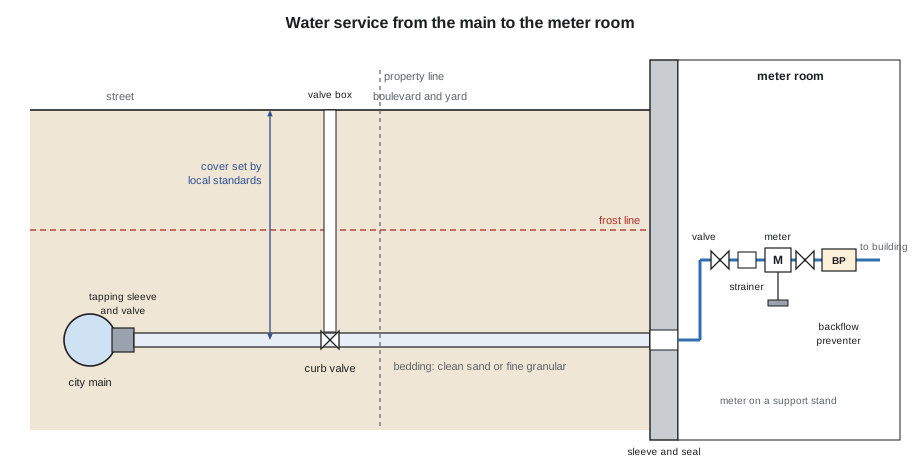
The water utility makes the connection to its own main, or closely supervises a licensed contractor who does. On small services, typically up to about 2 inches, the main is drilled and tapped under pressure and a corporation stop, a small bronze valve, is screwed into it. A gooseneck or flexible bend in the service pipe right after the corporation stop allows for settlement of the main or the soil.
On larger services like Kingsway's, a tapping sleeve is clamped around the live main and a tapping valve is bolted to it. A tapping machine drills through the valve and cuts a disc out of the main without shutting off the water to the rest of the street. The valve is then closed, the machine removed and the new service pipe connected. The tapping valve becomes the main valve for the building's service.
In Columbus, the Division of Water's standards set out who may make connections to city mains, the materials allowed for services of each size, and the depth and location of valves. Northbridge's site superintendent applied for the service connection permit months before the work began, because the city schedules its crews and inspections well ahead.
The curb stop and valve box
Between the main and the building, usually at or near the property line, sits the curb stop, also called the curb valve or property line valve. On small services it is a quarter-turn bronze valve operated with a long key that reaches down through a valve box from the surface. On large services it is a gate valve in a cast iron valve box. Either way, its job is to let the utility or the owner shut off the water to the building without digging.
The curb stop also usually marks the boundary of ownership. The utility typically owns and maintains the pipe from the main to the curb stop; the property owner owns the pipe from the curb stop to the building. Rules vary from city to city, and some utilities own the service all the way to the meter. Knowing where the boundary is matters when a service leaks, because it decides who pays for the repair.
The valve box must stay accessible and level with the finished surface. Landscapers and paving crews often bury or damage valve boxes, and a curb stop that cannot be found in an emergency is useless. On Kingsway, Luis showed Maya the two valve boxes in the city boulevard, one for the domestic service and one for the fire service, and the tie-in dimensions on the as-built drawing that locate each box from fixed points such as the building corner and a hydrant.
The water service pipe
The water service pipe runs from the curb stop to the building. Because it is buried, the code and the utility control its material, depth, bedding and separation from other utilities.
- Material. Service pipe must be approved for potable water and for burial. Common choices are type K soft copper for small services, polyethylene for small and medium services, and PVC or ductile iron pressure pipe for large services. The utility often restricts the choice.
Depth. The pipe must be buried below the depth of frost penetration so that the water in it never freezes. In Columbus, the city's standards call for a cover depth that keeps the pipe safely below frost; services under driveways and parking areas need the same protection even though snow is cleared.
- Bedding. The pipe sits on and is surrounded by clean sand or fine granular material, free of rocks that could dent or puncture it. Large services may need thrust blocks or restrained joints where they change direction.
Separation from sewers. A water service must be kept away from the building sewer so that a leaking sewer cannot contaminate the water. The Ohio Plumbing Code, following the IPC, generally requires a horizontal separation of 5 feet between the water service and the building sewer, unless the water pipe is placed on a solid shelf at least 12 inches above the sewer or the sewer is made of pipe approved for use inside a building.
- Entry into the building. Where the pipe passes through the foundation wall it goes through a sleeve with room for settlement and a seal against groundwater. Inside, it must be protected from freezing until it reaches a heated space.
At Kingsway, the 4-inch domestic service is PVC pressure pipe from the curb valve to the foundation wall, with restrained joints at the two bends. It enters through a sleeve with a link-seal and turns up into the meter room, which is heated.
Thrust and why big services need restraint
Water under pressure pushes outward on every bend, tee, reducer and dead end. In a small copper or PEX service the force is small and the joints hold it easily. In a large service, the force at a bend can be thousands of newtons. Push-on gasketed joints, which are common on PVC and ductile iron pipe, have no strength in tension: if nothing holds the bend in place, the force can pull the joint apart.
Two methods keep large buried pipe in place. A concrete thrust block is cast against undisturbed soil behind the bend, so the soil takes the force. Restrained joints use mechanical glands or locking gaskets that grip the pipe so the joints themselves carry the force along the pipe. The engineer or the utility's standard drawings specify which method to use and how big the block must be.
Worked problem
Thrust on a 90-degree bend
A 4-inch service runs at a test pressure of 150 psi. What is the resultant thrust on a 90-degree bend? Use the pipe's inside diameter of about 4.1 inches.
Show solution
- Area of the bore: \(A = \pi d^2 / 4 = \pi (4.1)^2 / 4 \approx 13.2\) in\(^2\).
- Force along each leg: \(F = pA = 150 \times 13.2 \approx 1\,980\) lb.
- For a bend of angle \(\theta\), the resultant thrust is \(T = 2pA\sin(\theta/2)\).
- For 90 degrees: \(T = 2 \times 1\,980 \times \sin 45^\circ \approx 2\,800\) lb.
Answer: About 2,800 lb, roughly the weight of a small car, pushing the bend outward. That is why the bends are restrained.
# Resultant thrust at bends in a pressurized pipe (US units)
import math

def thrust_lb(p_psi, d_in, angle_deg):
    area = math.pi * d_in ** 2 / 4
    return 2 * p_psi * area * math.sin(math.radians(angle_deg) / 2)

for angle in (11.25, 22.5, 45, 90):
    t = thrust_lb(150, 4.1, angle)
    print(f"{angle:6.2f} degree bend: {t:6.0f} lb")
print(f"dead end or cap: {150 * math.pi * 4.1 ** 2 / 4:6.0f} lb")11.25 degree bend: 388 lb 22.50 degree bend: 773 lb 45.00 degree bend: 1516 lb 90.00 degree bend: 2801 lb dead end or cap: 1980 lb
The program shows that even a shallow bend carries a real force, and that a cap on the end of a pipe carries the full pressure times the area. When a service is tested with a temporary cap, the cap must be restrained too.
The water meter
The meter measures the volume of water that flows into the building so the utility can bill for it. The utility usually owns the meter and chooses its type and size. Plumbers install the meter setting: the valves, fittings, supports and bypass arrangement that hold the meter and let it be removed for testing.
- Positive displacement meters measure water by filling and emptying a chamber of known volume, often with a nutating disc. They are accurate at low flows and are used for houses and small buildings.
- Turbine meters measure the speed of water turning a rotor. They handle large flows with little pressure loss but are less accurate at very low flows.
- Compound meters combine a small positive displacement meter for low flows with a turbine meter for high flows, switching automatically. Apartment buildings, whose flow ranges from a single faucet at night to hundreds of fixtures in the morning, often use them.
- Electromagnetic and ultrasonic meters have no moving parts and measure flow electronically. Many utilities now use them, along with remote reading systems that report usage automatically.
A meter setting typically has an isolating valve on each side of the meter so it can be removed without draining the building, a strainer ahead of the meter to catch debris, supports so the meter does not hang on the pipe, and a test outlet. Large meters may have a bypass with a valve that the utility seals or locks shut, so water can still reach the building while the meter is out for testing. Some utilities do not allow bypasses at all. Meters must be installed horizontally or in whatever orientation the manufacturer approves, with the flow arrow pointing the right way and the required lengths of straight pipe before and after.
Every meter causes some pressure loss, which must be counted when the system is sized. The meter manufacturer publishes a chart of pressure loss against flow. A meter that is too small for the building's peak demand can steal a large share of the available pressure, and the top floors feel it first. Lesson 6 includes the meter loss in the pressure budget.
At Kingsway, the city supplied a 4-inch compound meter with a remote reading register. Northbridge installed the setting: a gate valve on the inlet, a strainer, the meter on a support stand, a gate valve on the outlet and, downstream, the double check valve assembly required by the city's backflow program. The meter room has a floor drain and a hose bibb for flushing.
Suite meters and submetering
Many apartment and condominium buildings also have smaller meters on each suite so the owner or condominium corporation can bill each household for its own water. These submeters are owned by the building, not the utility. They are usually installed at the suite's water entry, near the manifold, where they can be read remotely. Kingsway's suites each have a small submeter on the cold supply to the laundry-closet manifold, and the hot water is metered with a second submeter so the building can share the cost of heating water fairly.
Submeters add pressure loss at every suite. They are small, so the engineer must check that the loss at peak suite flow is acceptable, especially in the high zone where pressure is already tight.
Backflow protection at the service
Right after the meter, most utilities require a backflow preventer that isolates the entire building from the public water system. This is called premise isolation. It protects the city's water from anything that might go wrong inside the building, such as a cross-connection to a boiler, a chemical feeder or a contaminated hose. Inside the building, individual fixtures and equipment get their own protection as well, called fixture or zone isolation.
Backflow preventers come in several types, from simple dual check valves to reduced pressure principle assemblies, and the utility chooses the type based on the hazard the building presents. They must be tested when installed and usually once a year after that by a certified tester. PLB-310 covers backflow prevention in depth. For now, remember three things: the device belongs in the meter room right after the meter, it creates a closed system that affects thermal expansion (Lesson 9), and it causes a pressure loss that must be included in sizing (Lesson 6).
Winter, flushing and the first water
Until the building is heated, the water service and meter room are exposed to frost. On Kingsway, the service was installed in the fall, so Northbridge kept the curb valve closed and the line drained until the meter room was enclosed and heated, then filled it slowly to push the air out. Filling a large pipe too fast traps air and can cause surges that damage valves and meters.
Before the meter goes in, the service is flushed at full flow through a temporary spool piece to clear out sand, gravel and debris from installation. Debris that reaches the meter can jam it, and debris that reaches the distribution system can lodge in valve seats and aerators for years. The service is then pressure tested and, in most cities, disinfected and sampled by or for the utility before the building is allowed to use it. Lesson 12 covers testing and disinfection in detail.
Common mistakes
MistakeBurying a water service above the frost line because the surface will be paved.
InsteadBury the service below frost depth everywhere; paving and snow clearing make frost go deeper, not shallower.
MistakeLaying the water service in the same trench as the building sewer without the required shelf or separation.
InsteadFollow the code's separation rules so a leaking sewer cannot contaminate the water.
MistakeRelying on push-on joints alone at bends in a large buried service.
InsteadRestrain bends with thrust blocks or restrained joints as the engineer or utility specifies.
MistakeInstalling a meter without isolation valves, supports or the required straight pipe lengths.
InsteadBuild the meter setting to the utility's standard and the manufacturer's instructions.
MistakeForgetting the pressure loss through the meter and backflow preventer.
InsteadInclude both losses in the pressure budget when sizing the system.
Summary and key terms
- Small services connect to the main with a corporation stop; large services use a tapping sleeve and valve.
- The curb stop or property line valve lets the utility shut off the building and often marks the boundary of ownership.
- Water service pipe must be approved for burial and potable water, laid below frost depth, bedded properly and kept away from sewers.
- Large pressurized pipes need thrust blocks or restrained joints at bends, tees, reducers and caps.
- Meters may be positive displacement, turbine, compound or electronic; the setting includes valves, a strainer, supports and sometimes a bypass.
- A premise isolation backflow preventer usually follows the meter, and both cause pressure losses that must be counted.
- Corporation stop
- A small valve screwed into a tapped water main that starts a small water service.
- Tapping sleeve and valve
- A split fitting clamped around a live main with a valve, used to connect large services without shutting down the main.
- Valve box
- A vertical casing from a buried valve to the surface that lets a key reach the valve.
- Thrust block
- A concrete block cast between a pipe fitting and undisturbed soil to resist the force of water pressure.
- Compound meter
- A water meter that combines a low-flow and a high-flow measuring element.
- Premise isolation
- Backflow protection at the service that isolates a whole building from the public water system.
Practice problems
Work each problem on paper first, then reveal the answer to check.
Who usually owns the pipe between the main and the curb valve?
Show answer
The water utility, although rules vary between cities.
Why must the water service be buried below frost depth?
Show answer
So the water in it never freezes and splits the pipe.
What horizontal separation does the IPC generally require between a water service and a building sewer?
Show answer
5 feet, unless the water pipe is on a solid shelf at least 12 inches above the sewer or the sewer pipe is approved for use inside a building.
What does a compound meter do?
Show answer
It switches between a small meter for low flows and a turbine meter for high flows.
Why is a strainer installed ahead of the meter?
Show answer
To catch debris that could jam or damage the meter.
Where does the premise isolation backflow preventer usually go?
Show answer
In the meter room, right after the meter.
Lesson quiz · 5 questions
Score 60% or more to complete this lesson.
Create a free account to save your progress, take quizzes and earn a certificate.